AI summary
A ranking-focused blog starts with a real reader task and a useful, supported answer. Keywords help identify the subject; they cannot replace the argument, evidence, or practical detail the reader came to find.
- Decide before drafting: Research intent and existing results, check your own library, and prepare a brief connecting the reader, recommendation, evidence, and next step. Choose an original contribution you can substantiate.
- Make each section earn its place: Deliver the heading's promise with a direct answer, reasoning, application, and necessary conditions. Use completed examples and inspectable resources rather than padding the word count.
- Review and verify: Check argument, evidence, and language separately. Align metadata and media with the approved draft, verify the actual page, and assess relevant readership and enquiries. No writing process can guarantee a search position or deadline.
To write a blog with a credible chance of ranking, choose a relevant search intent, identify what your reader needs to accomplish, and build a supported answer that adds useful information. Research before drafting, organize the argument, write clearly, and verify the published page. Good writing supports visibility; it cannot guarantee a position or timeline.
A common writing problem is not a missing keyword. It is a draft that never makes a clear decision about what it owes the reader.
A page can mention every related term and still leave someone unable to choose an approach, complete a task, or assess a claim. Search optimization cannot substitute for that missing usefulness.
This guide focuses on the editorial process: brief, research, outline, draft, and revision. For the wider system of technical eligibility, authority, and diagnosis, use the companion guide to ranking a blog in 2026.
We will use one hypothetical assignment throughout: an article helping a lean marketing team brief a B2B content writer. It is an illustrative brief, not a report of keyword volumes, client research, or measured rankings.
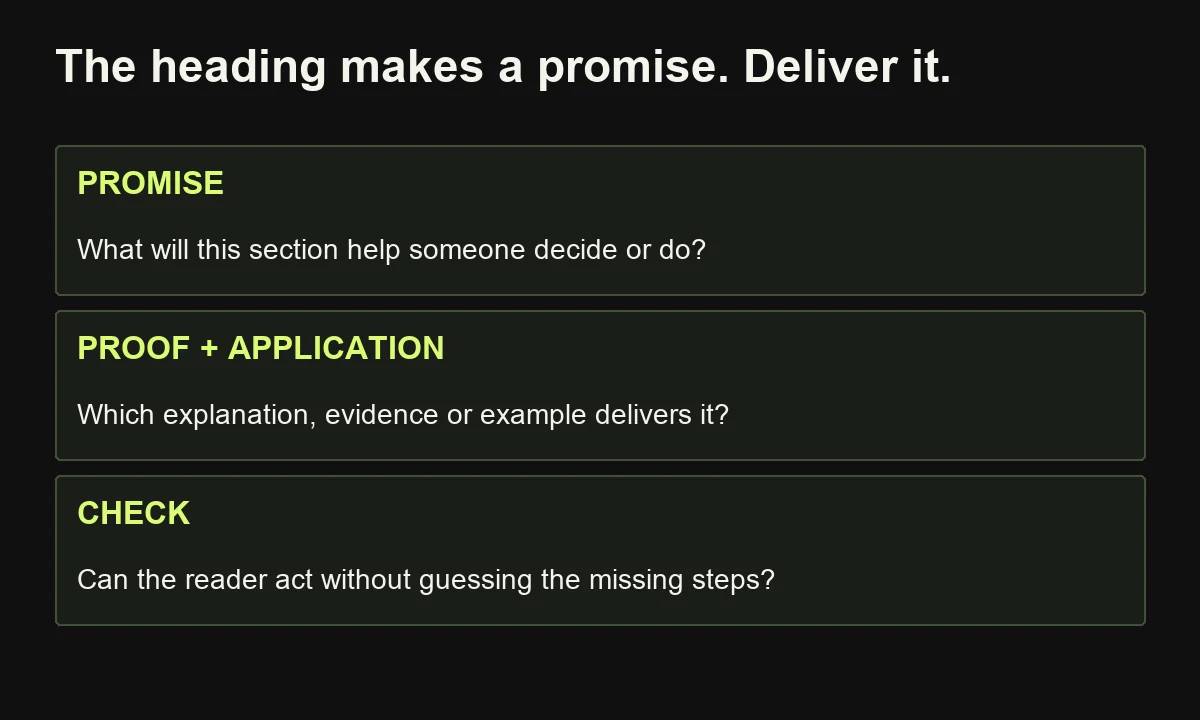
The working standard is a promise-to-proof check. Each important section should deliver its heading's promise with an explanation, usable detail, and appropriate evidence. This is an editorial review method, not a ranking formula.
Start there, and the article becomes easier to research, write, edit, and evaluate.
How do you choose the right reader and search intent?
Choose a topic where a real audience need overlaps with expertise and an offer your business can responsibly explain. Establish what the searcher is trying to do, not merely the phrase they enter. Your article should satisfy that task while giving an appropriate reader a useful route toward your services or further information.
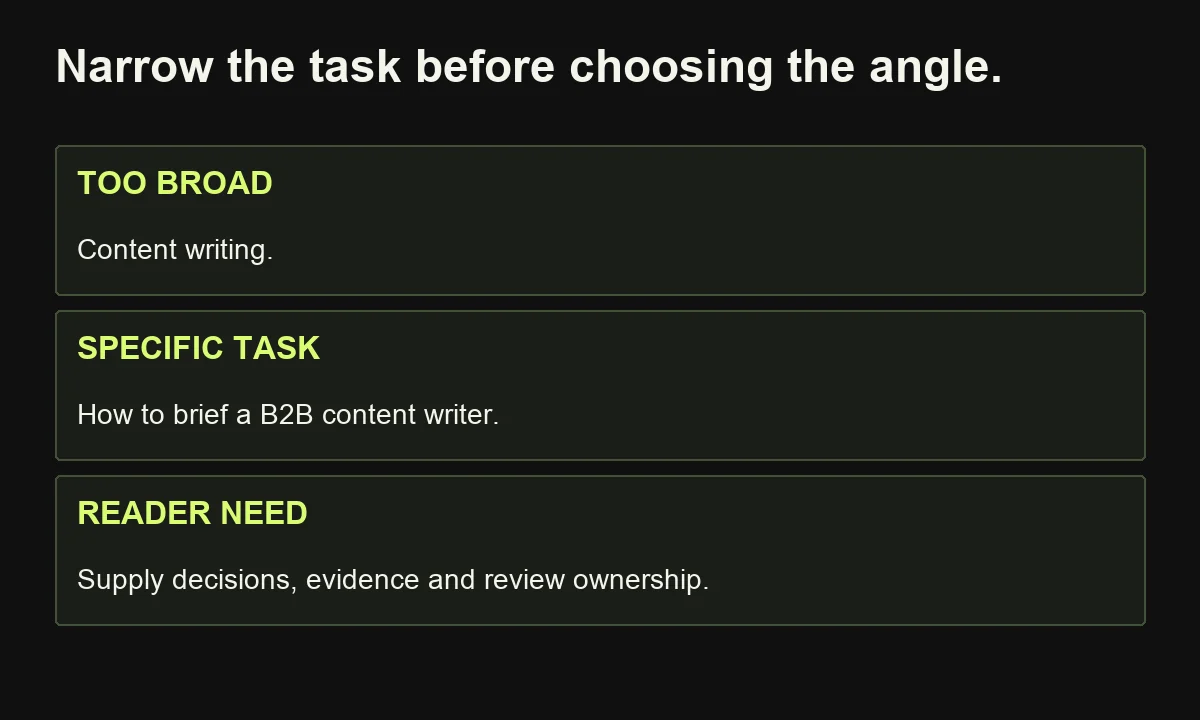
For our hypothetical assignment, “content writing” is too broad. “How to brief a B2B content writer” suggests a particular task: prepare information that helps a writer make good decisions without repeated clarification.
Define four things:
- Reader: A marketing lead commissioning specialist content.
- Situation: They have an offer and a writer, but inconsistent briefs.
- Task: Produce an actionable brief with evidence and review ownership.
- Useful next step: Apply a template or assess help with research and direction.
That is a working audience hypothesis. Verify it through relevant customer conversations, sales questions, or other evidence rather than treating an imagined persona as research.
A primary keyword helps label the main topic. Secondary keywords should represent genuine subquestions, concepts, or terminology the explanation needs. Do not add unrelated sections simply because a tool suggests them.
Check your existing library before commissioning a new page. If another article already answers the same task, an update or narrower complementary angle may serve the reader better than two competing versions of the same guide.
What should you learn from the search results?
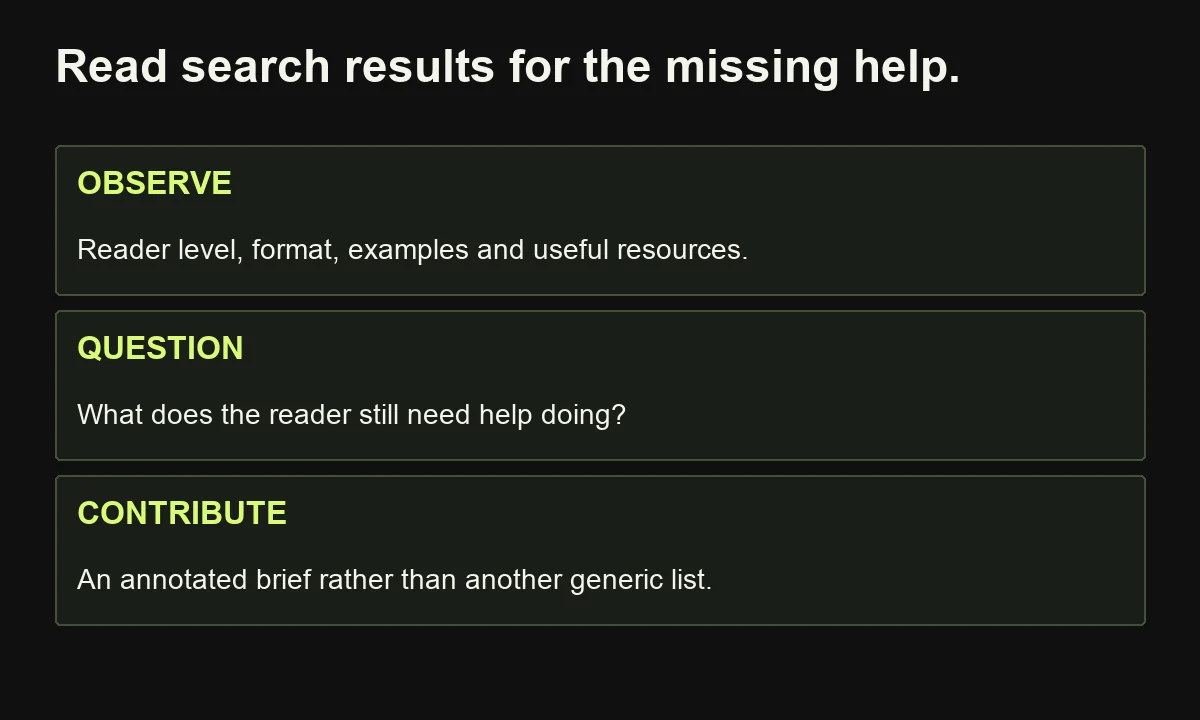
Study relevant results to understand the expected content type, depth, reader level, and unresolved questions. Look for what a searcher can actually accomplish after reading them. Their headings and formats are useful observations; they do not reveal which factors caused the pages to rank or how easily your site could compete.
For this guide, I read the writing processes published by Ahrefs, Semrush, and HubSpot. They combine topic selection, outlines, drafting, editing, optimization, and promotion, with examples or templates.
Those features plausibly help satisfy a beginner's task. They are not a verified causal ranking explanation. Search results vary, and a research snapshot does not establish a durable Google position.
Use a compact comparison table in your notes:
| Inspect | Ask |
|---|---|
| Reader and task | Is this for beginners, specialists, or buyers? |
| Useful substance | Which examples, evidence, or procedures do they provide? |
| Missing decision | What does the reader still need help choosing or doing? |
| Opportunity | What can we contribute that we can substantiate? |
For our brief article, a useful contribution could be an annotated brief showing how each field changes the writer's decisions. Copying the most common outline and adding adjectives would not close that gap.
Use related terminology for research inspiration, not a requirement to repeat every competitor's vocabulary.
What should an SEO content brief include?
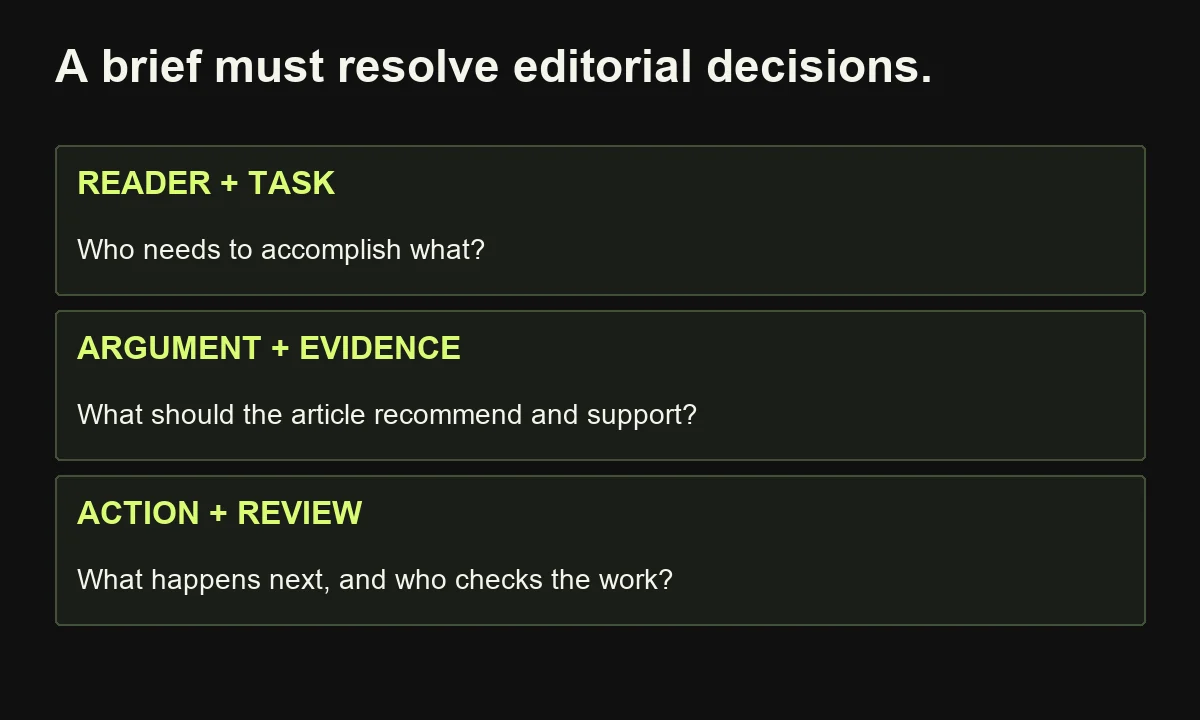
A useful brief connects the reader's task, the article's argument, the evidence available, and the intended next step. It should give the writer enough direction to exercise judgment. A keyword, word count, and list of competitor links describe an assignment, but they leave its most consequential editorial decisions unresolved.
Use this working template:
| Brief field | Illustrative instruction |
|---|---|
| Reader and situation | Marketing lead commissioning B2B content |
| Main question | What information should we give the writer? |
| Central recommendation | Specify decisions, evidence, and review ownership |
| Scope | Article briefing, not an entire content strategy |
| Original contribution | An annotated brief with weak and strong examples |
| Evidence | Approved offer facts and relevant source material |
| Reader action | Complete the template or identify missing research |
| Review | Named factual and final editorial owners |
Add terminology, voice, constraints, internal destinations, and acceptance criteria where they affect the work. Mark unknown facts rather than asking the writer to make them sound plausible.
A good brief can also be challenged. If the assignment demands an article that no available evidence can support, clarify the claim or commission additional research before drafting.
Treat the outline as a proposal, not a prison. Research may reveal a better sequence or a missing objection. Preserve the purpose while allowing the writer to improve the route to it. Record significant changes so reviewers understand the reasoning behind the draft.
How do you research enough to write something valuable?
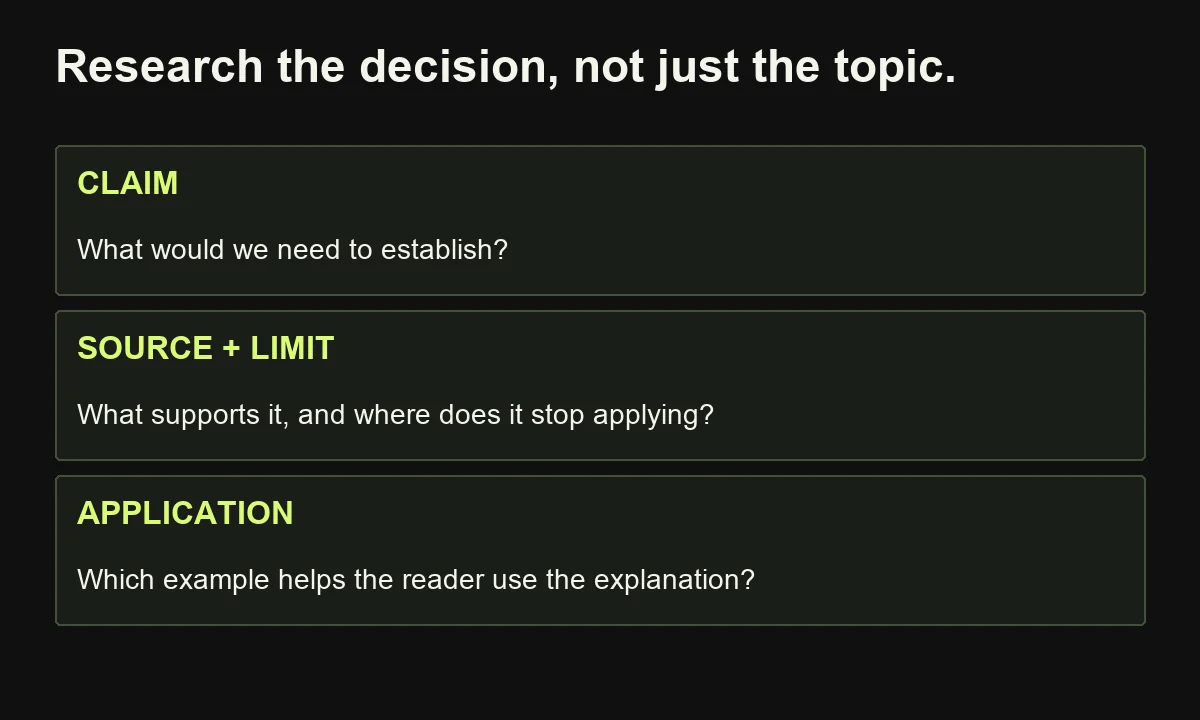
Research until you can explain the recommendation, demonstrate how to apply it, and identify its important limits. Gather primary sources for external claims and legitimate first-hand material for the business's own experience. More tabs do not automatically create more insight. Organize the evidence around the decisions the article needs to support.
Create a research note for each consequential claim: source, date, relevant passage or observation, scope, and how you intend to use it. Record disagreements and missing evidence separately.
For product behavior, prefer current official documentation. For a research statistic, inspect the population, method, and period. For your own work, identify the actual contribution and the records that support it.
Interview subject-matter experts for decisions and examples:
- What do beginners usually misunderstand?
- What information changes your recommendation?
- Can you show a specific implementation or artifact?
- When would you choose a different approach?
- Which claim would need more evidence?
Do not turn the expert's recollection into a measured result without checking it. Distinguish their experience, opinion, and documented findings.
Google's people-first guidance asks whether content provides substantial value and demonstrates relevant knowledge. An original contribution can be a well-explained example or method, not necessarily a new survey.
For our assignment, the research should reveal why brief fields matter and how they affect the writer's choices. That is more useful than collecting another definition of a content brief.
How do you build an outline that earns its length?
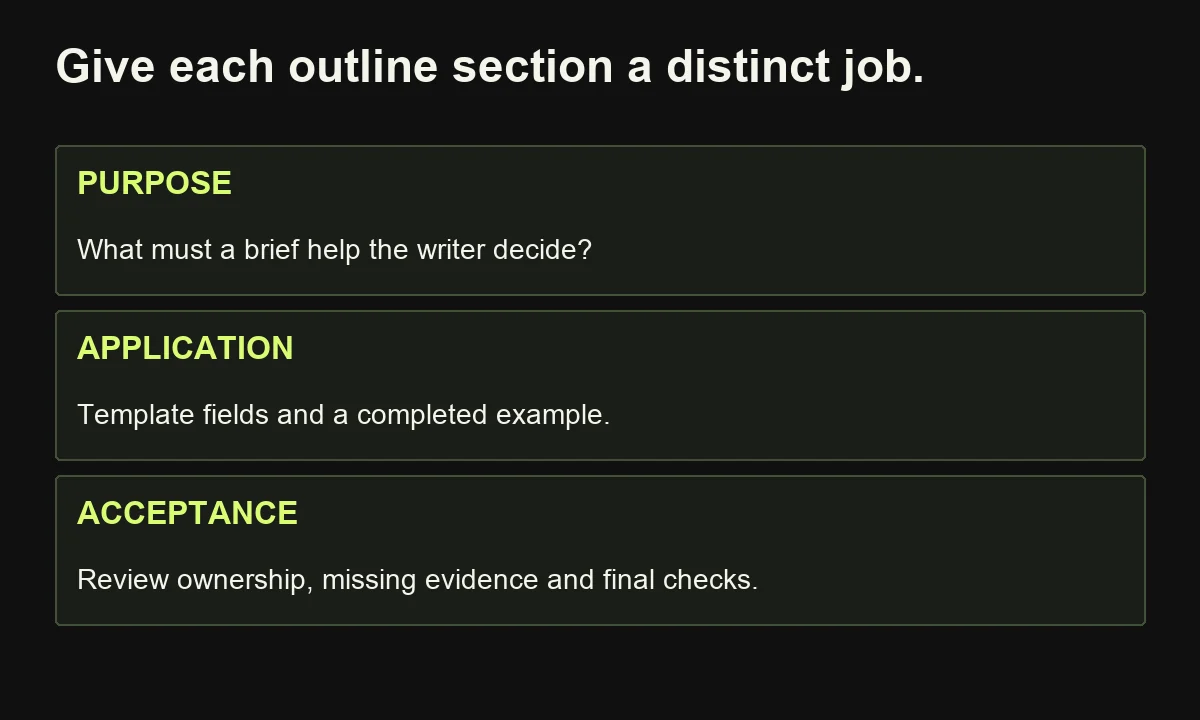
Build the outline around the questions a reader must resolve to complete the task. Each section should have a distinct job, a clear takeaway, and enough supporting material to deliver it. Remove sections that merely repeat the introduction or add a keyword without advancing understanding. Depth comes from useful explanation, not heading count.
For the hypothetical briefing article, an outline could be:
- What a brief must help the writer decide.
- Information to collect before briefing.
- The template, with an explanation of each field.
- A completed example and why it works.
- Review responsibilities and handling missing evidence.
- A final check before commissioning.
Under each heading, add a one-sentence answer, evidence or example, and an open research question. This reveals weak sections before you spend time drafting them.
Use the promise-to-proof check: if the heading says “a completed example,” have you actually prepared one? A list of tips is not the promised artifact.
Sequence matters. Readers need to understand the purpose of the brief before interpreting its fields. They need a usable example before evaluating whether their own version is complete.
Allow alternative paths when appropriate. A reader with an existing brief may jump to the review checklist. Descriptive headings and a contents list help without forcing a linear journey.
If the necessary material cannot sustain a long guide, narrow the scope instead of filling space with obvious definitions or repeated advice.
How do you write an introduction that gets to the point?
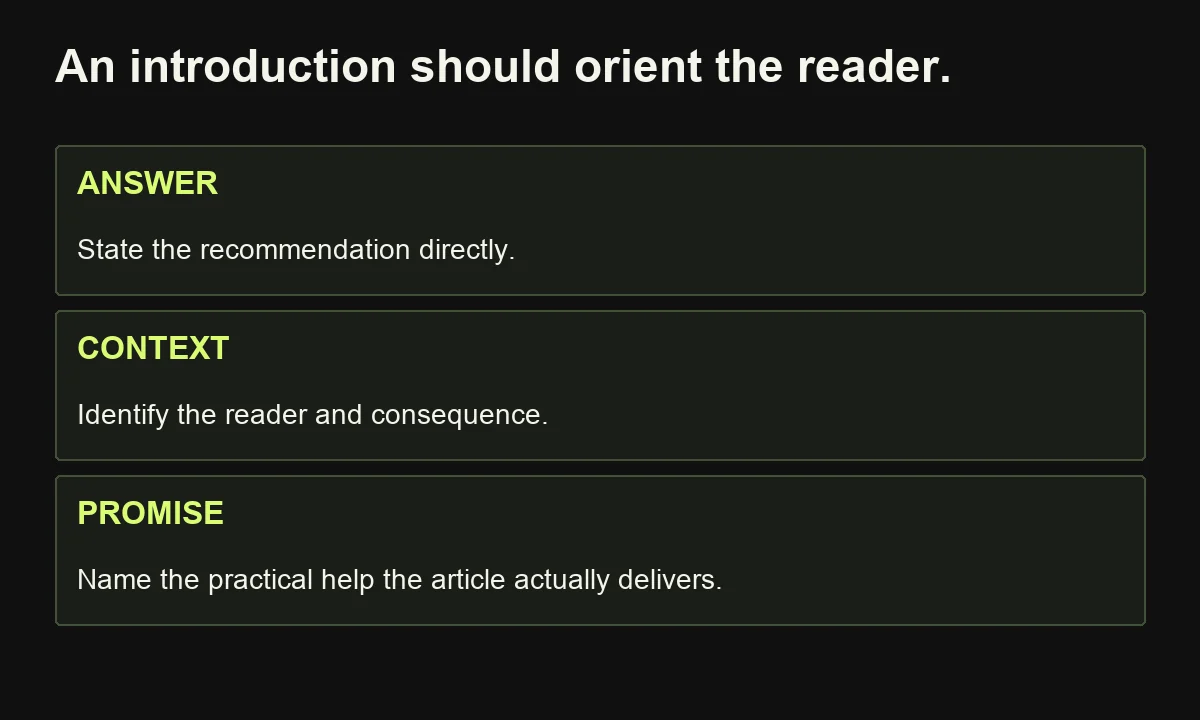
Open with the answer or central recommendation, establish who the article is for, and explain what practical help follows. Use context where it sharpens the problem rather than postponing the answer. An introduction should orient the reader and set an honest promise that the body can fulfill.
Compare two illustrative openings.
Weak: “In today's digital world, content is more important than ever. Businesses need quality content to stand out in a competitive marketplace.”
Stronger: “A B2B content brief should tell the writer whose decision the article supports, what argument to make, and which evidence is available. Include approved offer facts and review ownership. Without those inputs, even a polished draft can answer the wrong question.”
The second opening identifies the subject and its consequence without inventing urgency or statistics. The next paragraph can explain that the guide includes a template and completed example.
Avoid a long autobiography unless your experience directly changes the reader's assessment. Establish authorship through relevant evidence and sound explanation throughout the piece.
Also avoid promising “everything” when the article covers one bounded task. State what is included and link to genuinely relevant wider material.
After drafting the body, revisit the introduction. Has the recommendation changed? Does the promised resource exist? Can a busy reader identify the point without scrolling through several generic paragraphs? Edit the opening to match the article you actually wrote, not the one you initially imagined.
How should you write the body of the article?
Write each section as a complete response to its question: state the answer, explain the reasoning, demonstrate the application, and preserve important conditions. Use the amount of detail the task requires. A reader should leave with a clearer decision or usable action, not merely a list of instructions that need another guide to interpret.
Here is an illustrative section from the briefing assignment:
What evidence should a writer receive?
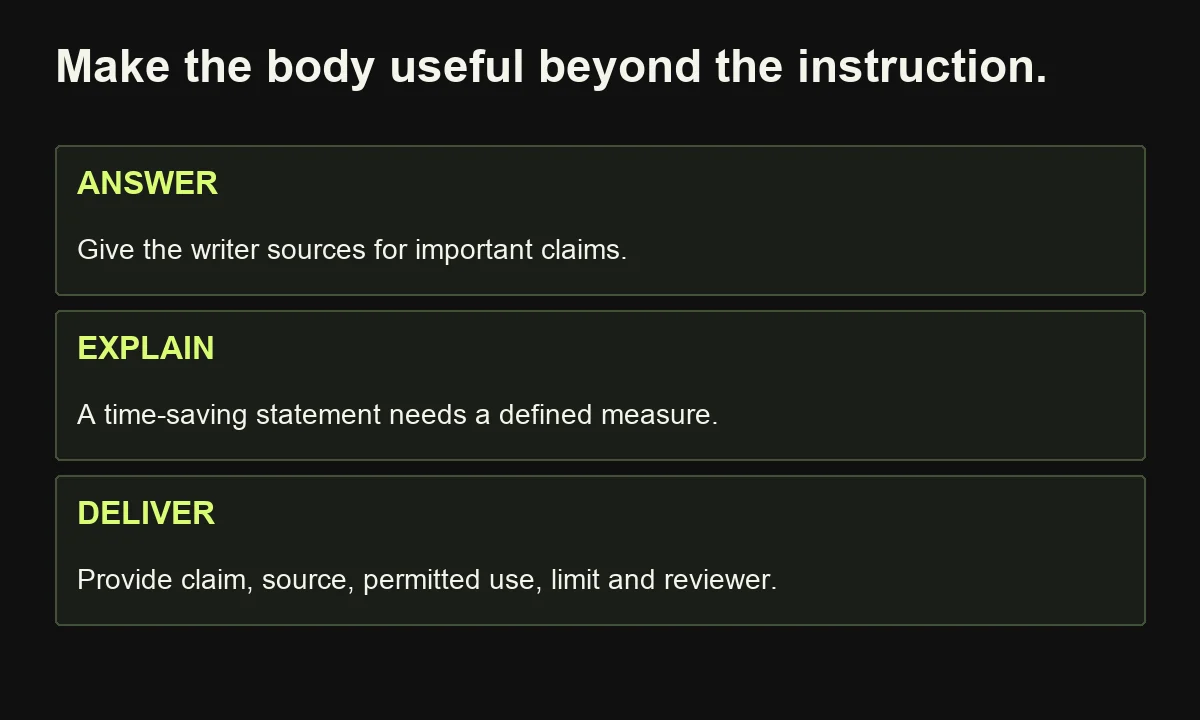
Give the writer the sources needed to support the article's main claims, alongside the limits on using them. Include approved product or service facts, relevant customer material, and primary references for external claims. Mark missing information explicitly so the writer can investigate or narrow the argument.
For example, “our software saves teams time” is insufficient direction. Supply the documented task, measurement period, comparison, and relevant conditions if you want to discuss a time-saving result. If no such evidence exists, explain the capability without inventing a figure.
A customer quotation also needs its source and approved meaning. Do not ask the writer to make an unsupported testimonial sound more persuasive.
The practical handoff is a short evidence list: claim, source, permitted use, limitation, and verification owner. The writer can then distinguish a supported assertion from an open question.
That sample moves from answer to reasoning and a concrete deliverable. Keep this standard throughout the guide. Delete a paragraph if it adds neither explanation, evidence, application, nor a necessary qualification.
How do you write the title and meta description?
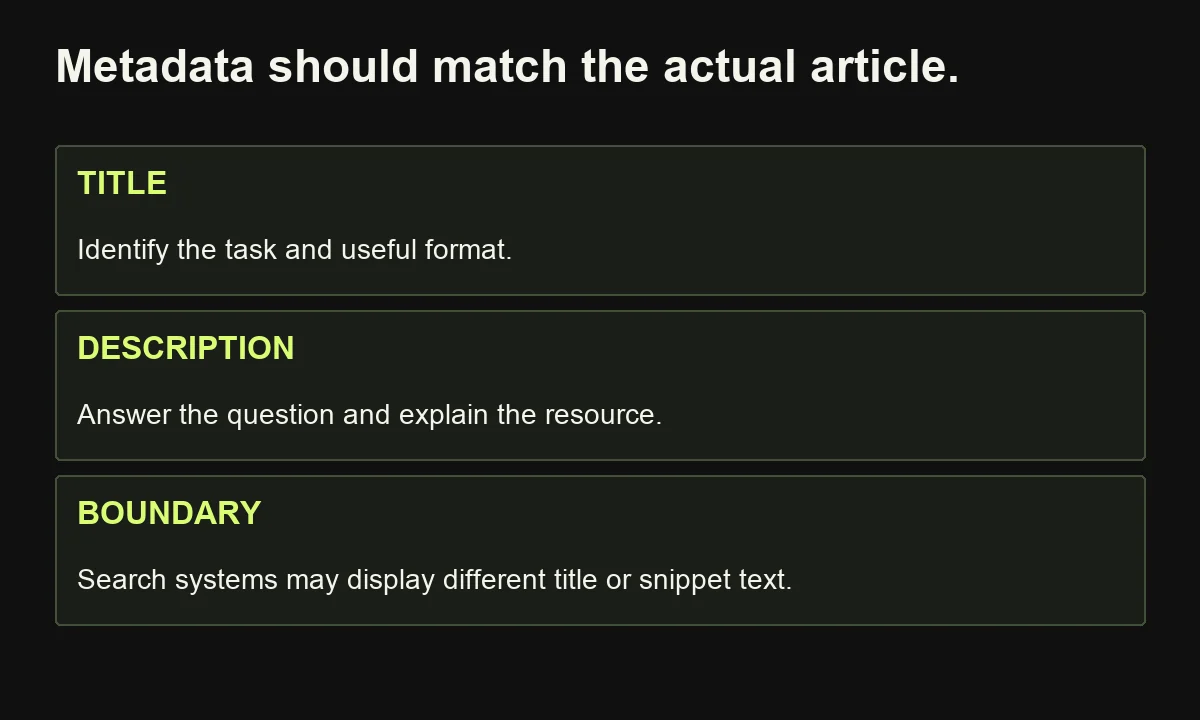
Write a title that identifies the main topic and gives a credible reason to read. Make the description a concise, accurate explanation of the answer or value inside. Align both with the visible article. Neither a clever headline nor a keyword-filled description can compensate for a page that fails to deliver its promise.
For our hypothetical article:
Title: How to Brief a B2B Content Writer: A Practical Template
Description: Brief a B2B writer with the reader's decision, central argument, approved evidence, and review responsibilities. Use the template and completed example.
The title indicates task and format. The description answers the question and identifies the resource, without promising rankings or a guaranteed reduction in revisions.
Google's title guidance recommends descriptive, concise titles and warns against repetitive or stuffed wording. Google may generate a different title link from available signals.
Its snippet guidance also explains that snippets are primarily generated from page content; a meta description may be used when it better describes the page. The exact text you write is not guaranteed to appear.
Character targets are editorial constraints, not a promise about display across devices. Keep the meaningful phrase early and remove unnecessary branding or inflated claims.
Choose the final headline after checking the evidence and draft. If the strongest useful contribution is a template, say that instead of implying you discovered a universal formula.
How do SEO, AEO, and GEO affect the writing?
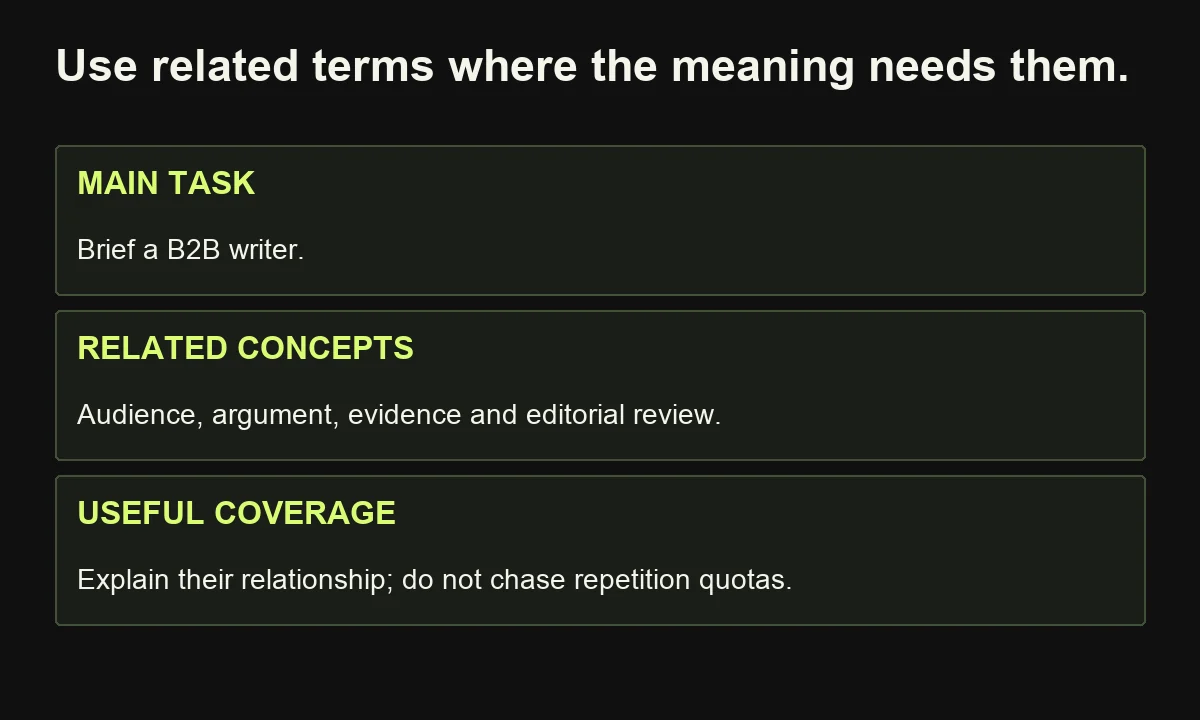
They should encourage clear topics, useful answers, accurate claims, and sound publishing practices. Use the main term where it naturally identifies the subject, and explain related concepts where readers need them. Do not turn the article into a repeated search phrase. Write for understanding first, then inspect whether the page communicates that understanding clearly.
For the briefing example, related terms might include content brief template, SEO content brief, subject-matter expert, search intent, and editorial review. Each belongs where the explanation requires it, not because the draft must achieve a density score.
Google's AI search guidance says existing SEO foundations remain relevant and special AI markup is unnecessary. It does not prescribe an ideal paragraph length or require every query variation to appear verbatim.
A direct answer under a descriptive heading helps readers find information. A table can make comparisons easier. Neither grants a right to a featured answer or AI citation.
Make important statements understandable when quoted, while keeping conditions close enough to preserve their meaning. Cite external evidence beside the claim it supports, and label hypothetical examples.
For deeper platform and measurement context, see the AEO guide and GEO guide.
Do not add hidden instructions for agents or fabricate experience to appear authoritative. Demonstrate expertise through the quality of the explanation and evidence someone can inspect.
How do visuals, links, and examples improve the article?
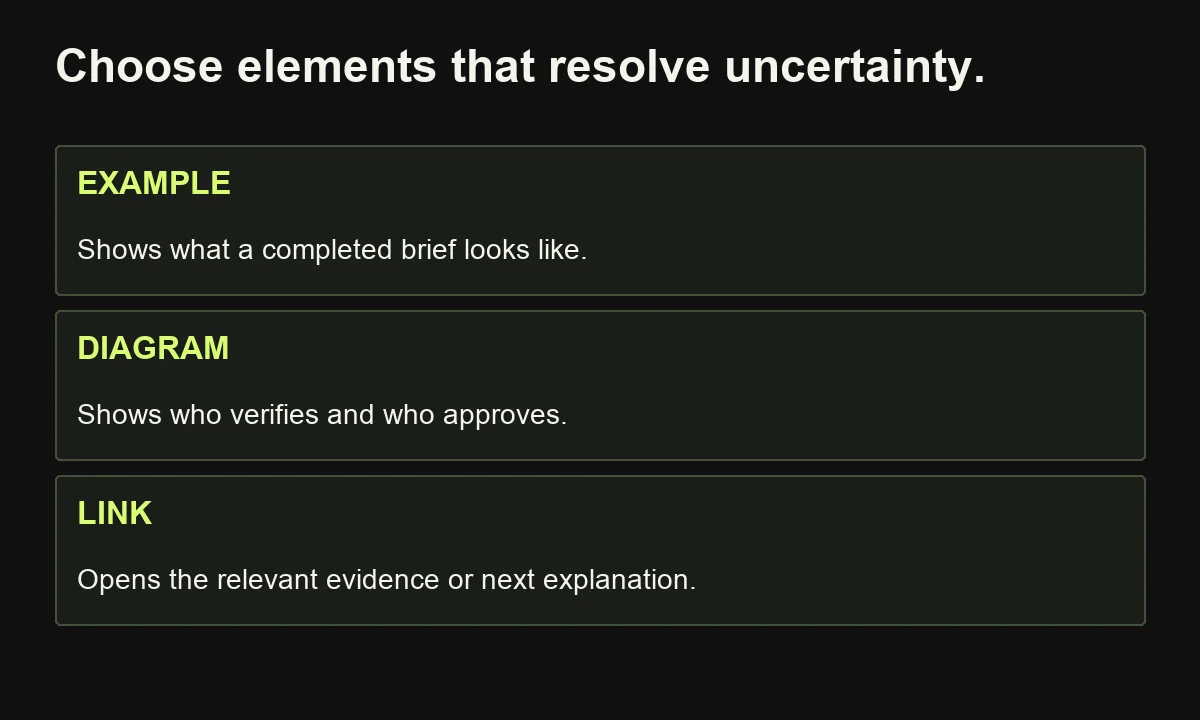
Use each element to resolve a specific uncertainty. An example demonstrates application, a diagram explains a relationship, and a link gives access to relevant detail or evidence. If an element does not help the reader understand or act, it may add weight without adding value. Choose usefulness before decoration.
For the briefing article, an annotated template shows what to supply; a role diagram clarifies who checks facts and who approves the final draft. A stock photo of a keyboard does neither.
Keep essential meaning in text. The W3C's complex-image guidance recommends adequate text equivalents for detailed graphics. Compress image files, use meaningful alt text, specify dimensions, and check legibility on mobile.
Choose links for their destination's actual usefulness. Google recommends descriptive, contextual link text. “See our article” tells the reader less than a clear description of the question the destination answers.
Connect explanations to relevant evidence or service information through buyer-focused internal links. Do not send a reader to a loosely related case study as proof of a different claim.
For material intended to attract references, make the resource inspectable: definitions, assumptions, editable inputs, and clear attribution where required. A useful worksheet gives another writer something specific to reference. It creates a reason to link, not a guarantee that anyone will.
How do you edit the draft before publication?
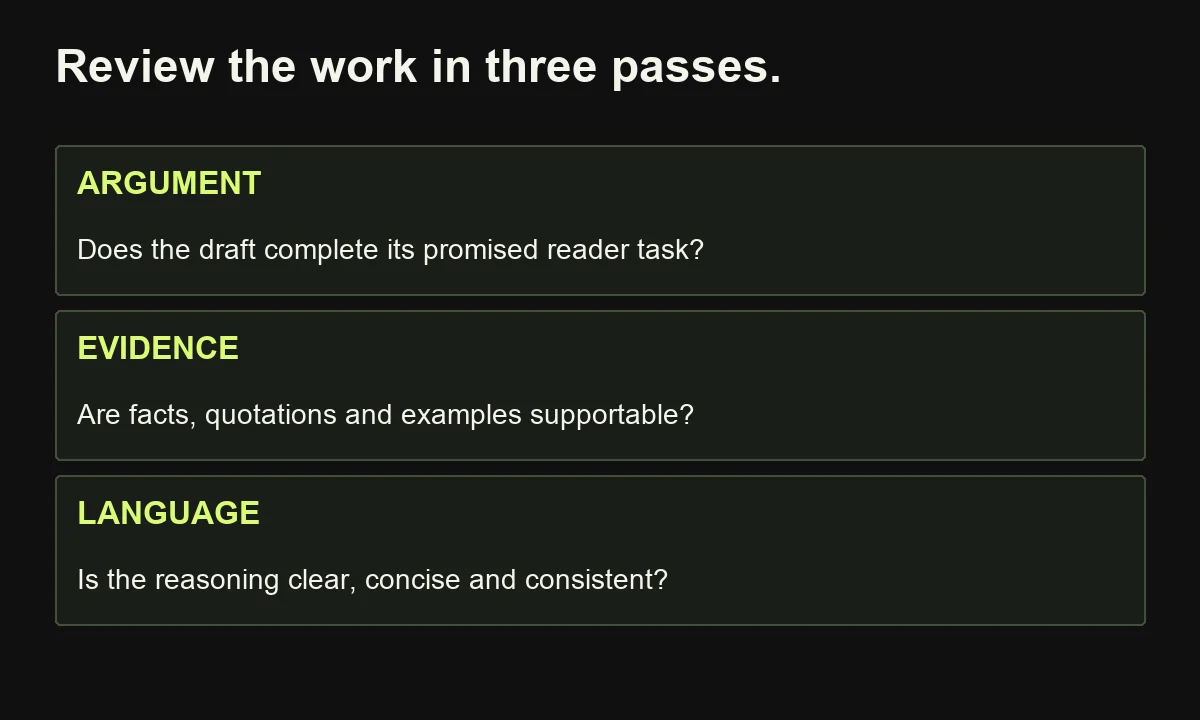
Edit the argument, evidence, and language in separate passes. First check whether the article resolves its promised task. Then verify factual support and examples. Finally improve clarity, consistency, and flow. A grammar checker can catch surface mistakes, but it cannot decide whether the central recommendation is justified or useful to the intended reader.
Ask a reviewer to complete the task using the draft. For our example, can they prepare a usable brief without asking what each field means? Their confusion identifies missing implementation detail more effectively than a request for general feedback.
Use these acceptance questions:
- Does every major heading deliver a distinct answer?
- Can the recommendation be explained without jargon?
- Are examples clearly real, attributed, or hypothetical?
- Does each number have the necessary source and context?
- Are quotations accurate and permitted?
- Does the CTA follow naturally from the reader's situation?
- Are the title, summary, and body consistent?
AI can help reorganize notes, suggest alternatives, or identify repetition. Keep responsibility for source verification, original judgment, and final approval with a person. Do not accept generated citations without opening the actual source.
For production, hand over the approved text, metadata, image files and alt text, link destinations, and review date together. Keep unresolved questions visible. The publisher should not have to invent missing decisions while formatting the page.
A clean handoff preserves the reasoning as well as the copy.
What should you check after writing, and what comes next?
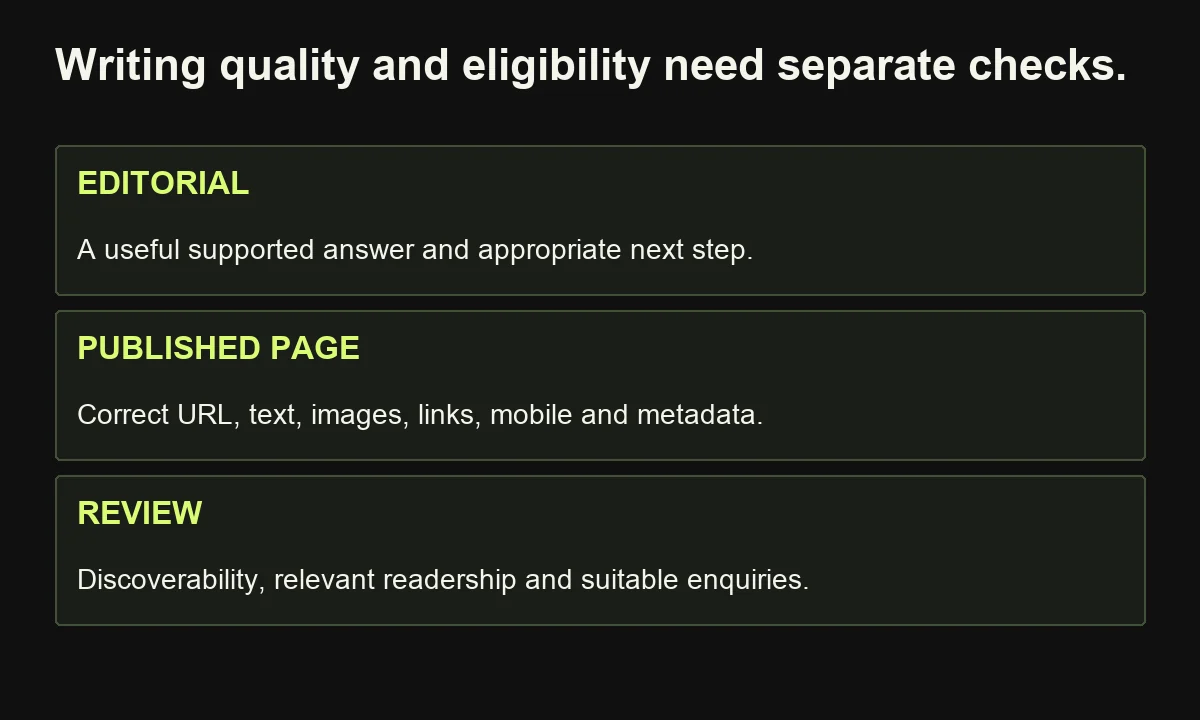
Use the blog brief and editorial review worksheet to retain the task, evidence, section purpose, review decisions, and publication checks. Verify the actual page: intended URL, accessible text, working links, correct images, mobile layout, metadata, and indexing settings. Writing quality and technical eligibility need separate checks.
How long should a ranking-focused blog be?
Long enough to complete the reader's task without padding. Google says it has no preferred word count. Choose depth through the questions, examples, and evidence the topic requires.
Can a new post rank quickly?
Sometimes, but no responsible writer can guarantee a position or deadline. Competition, site foundations, discovery, evidence, and the usefulness of the page all matter.
What should I measure?
Track whether the page is discoverable, attracts relevant searches, helps readers, and supports suitable enquiries. These are related but different outcomes. A rising traffic total alone does not establish commercial value.
When should I update the article?
When the offer, evidence, reader questions, or source information changes, or when observed problems justify investigation. Diagnose before rewriting. A date change without a substantive review is not an improvement.
If you need someone to connect buyer research, content direction, and the finished article, share your offer and the question your next blog must answer. I can help assess the work needed to make the article useful before it is optimized or promoted.