AI summary
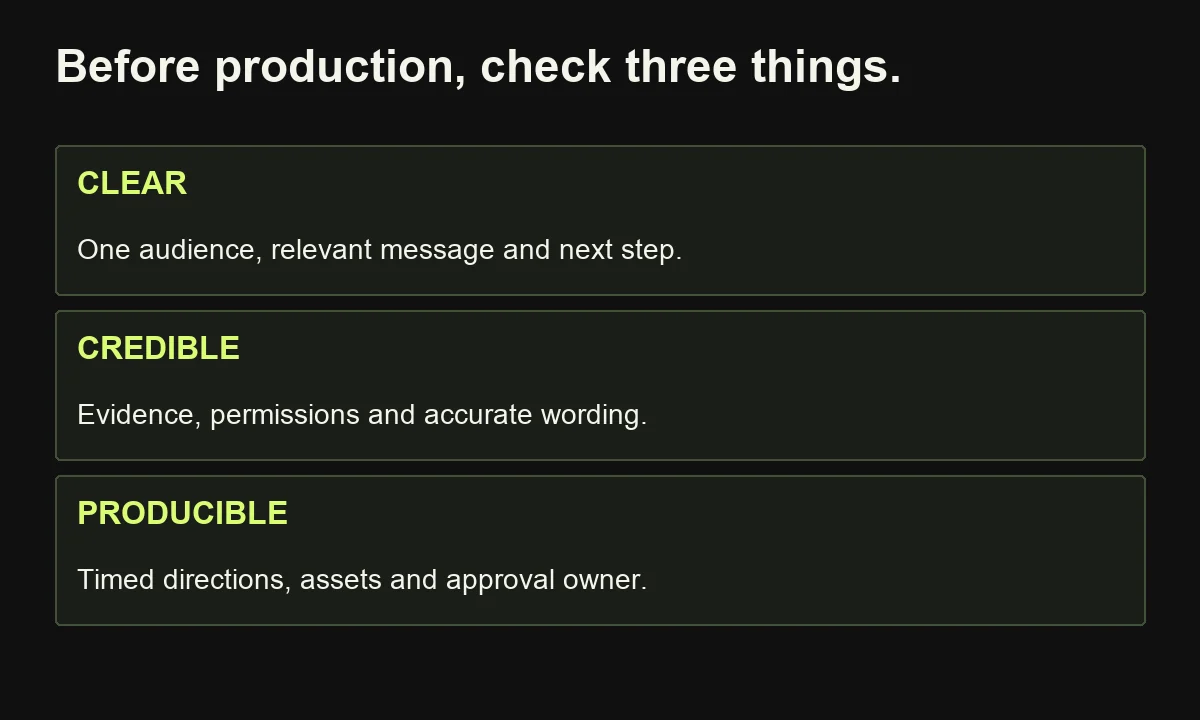
An effective ad script connects a relevant message with believable evidence and a suitable next step. Write the audience experience alongside the copy, whether you are selling a consumer product or explaining a business service.
- Resolve the strategy first: Choose the audience, purchase situation, objective and offer before drafting hooks. Match the strength of every promise to evidence you can actually show or verify.
- Make it producible: Specify visuals, spoken lines, essential text and timing. Adapt to the placement, rehearse the edit, and check captions, readability, rights and the destination page.
- Learn from the response: Test a clear hypothesis and evaluate meaningful outcomes, including purchase economics or enquiry quality. Attention and clicks help diagnose performance; they do not independently prove commercial success. Keep a human accountable for claims and final approval.
To write an ad script, choose one audience, one message and one intended response. Build a relevant opening, explain the offer, supply credible evidence, and make the next step clear. Then specify what people will see and hear, rehearse the timing, and check that the destination delivers what the ad promises.
That process applies to a skincare demonstration, a software explainer, a local restaurant spot and a podcast sponsorship. The creative treatment changes. The need for a believable reason to pay attention does not.
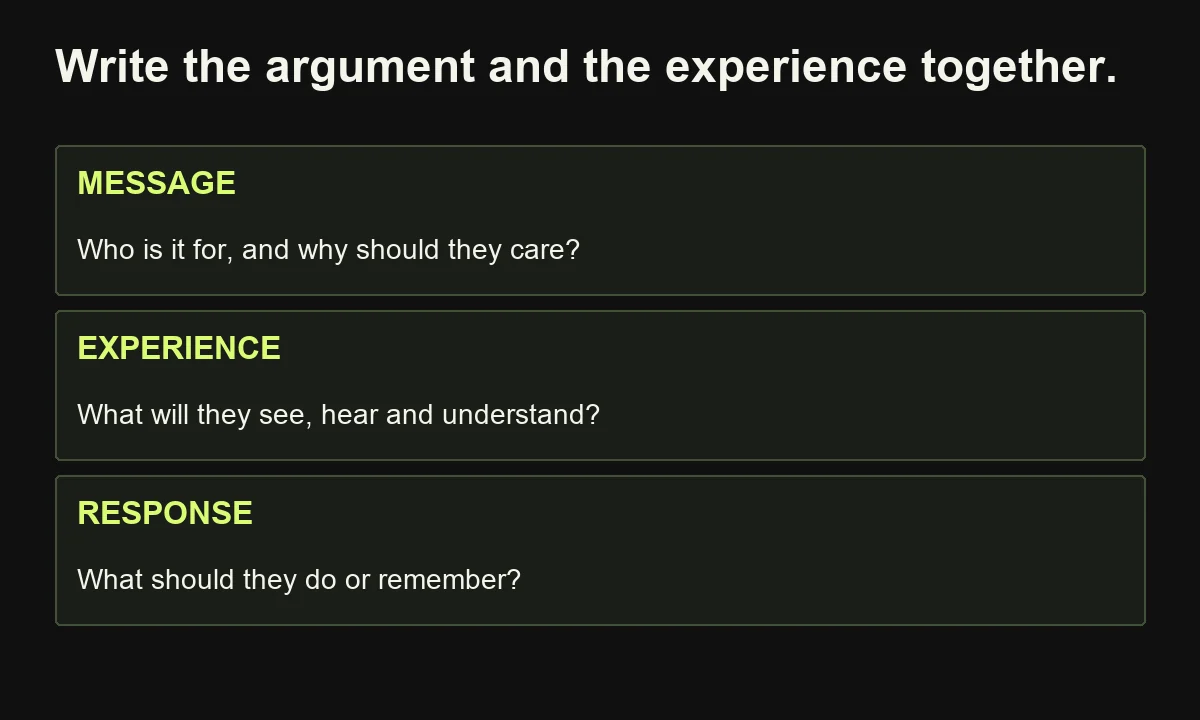
The distinction I recommend is simple: write the argument and the experience together. Persuasive words are only part of a script. A product demonstration, a pause, a recognisable sound or an expression can do work that another sentence cannot.
This guide covers B2C and B2B advertising across video, television, radio, podcasts and social platforms. It includes two original worked examples, a downloadable planning worksheet and a practical review process. The examples are fictional teaching material, not client campaigns or tested winners.
What is an ad script?
An ad script is a production plan for a promotional message. It records spoken copy, visual action, on-screen text, audio cues and timing as appropriate to the medium. It should make the message reproducible by a presenter, producer or editor without requiring them to invent the strategy.
Static advertisements also need persuasive copy, but usually do not need a timed audiovisual script.
1. Decide what this advertisement must accomplish
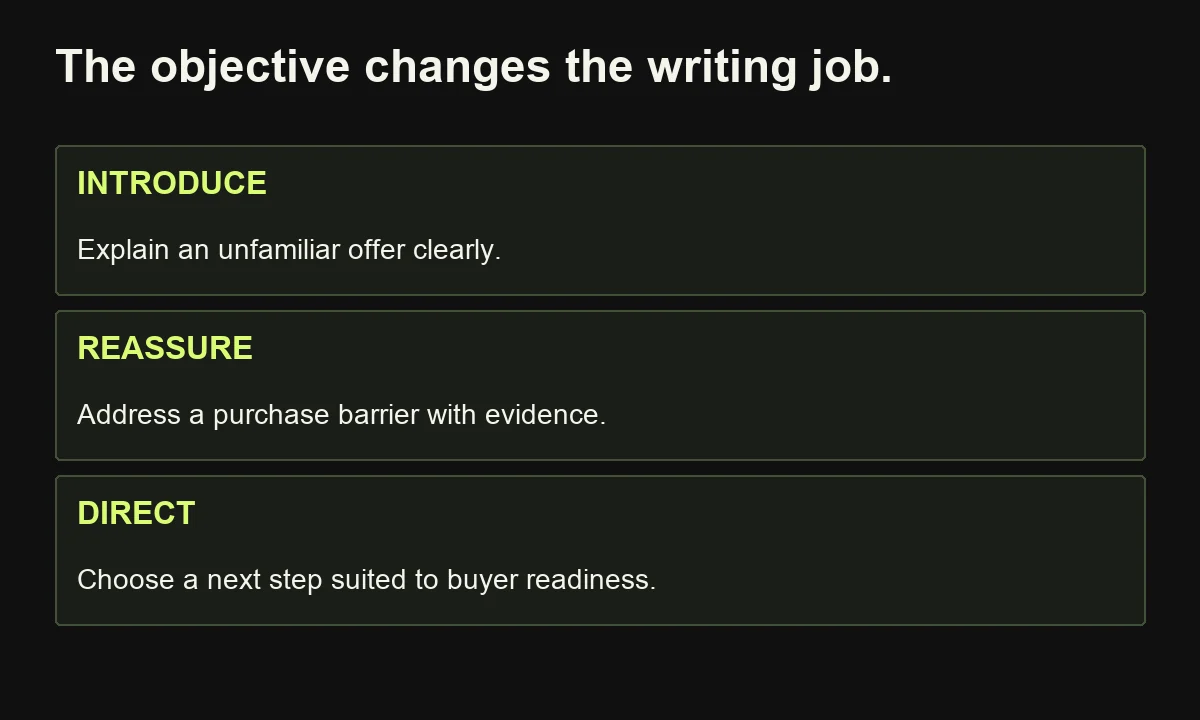
Start with the response you need from a particular audience in a particular situation. An unfamiliar consumer product might need recognition and understanding. A service aimed at an active buyer might need a qualified enquiry. These are different writing jobs, even when the production budget is identical.
Write a brief before writing dialogue:
| Decision | What to specify |
|---|---|
| Audience | Who is this for, and what do they already know? |
| Situation | What triggers their interest or frustration? |
| Message | What single idea should remain afterwards? |
| Evidence | What can we truthfully show or substantiate? |
| Response | What should the person do or remember? |
| Placement | Where, how and for how long will it run? |
| Constraints | Budget, rights, claims, approvals and deliverables |
For B2C, the situation could be carrying lunch on a crowded commute. For B2B, it could be preparing a board report from inconsistent spreadsheets. “Busy people” describes both so vaguely that it helps neither.
Choose an objective you can evaluate. “Make something engaging” cannot settle a disagreement about the script. “Explain the lunch container's closure and send shoppers to its product page” gives the team a decision standard.
An awareness ad does not need to force an immediate purchase. Decide what progress means before demanding a conversion from every impression. Use the TOFU, MOFU and BOFU guide to match the request to the buyer's readiness.
2. Research the language and the purchase barrier
Research should identify what the audience needs to understand or believe, not merely supply colourful phrases. Review customer interviews, support questions, product reviews, sales conversations and actual usage. Separate recurring evidence from an interesting comment that may represent only one person.
Record four things: the situation, the customer's wording, the obstacle and the evidence available to address it. Remove personal information before sharing research with creative tools or outside collaborators.
Consider two illustrative findings:
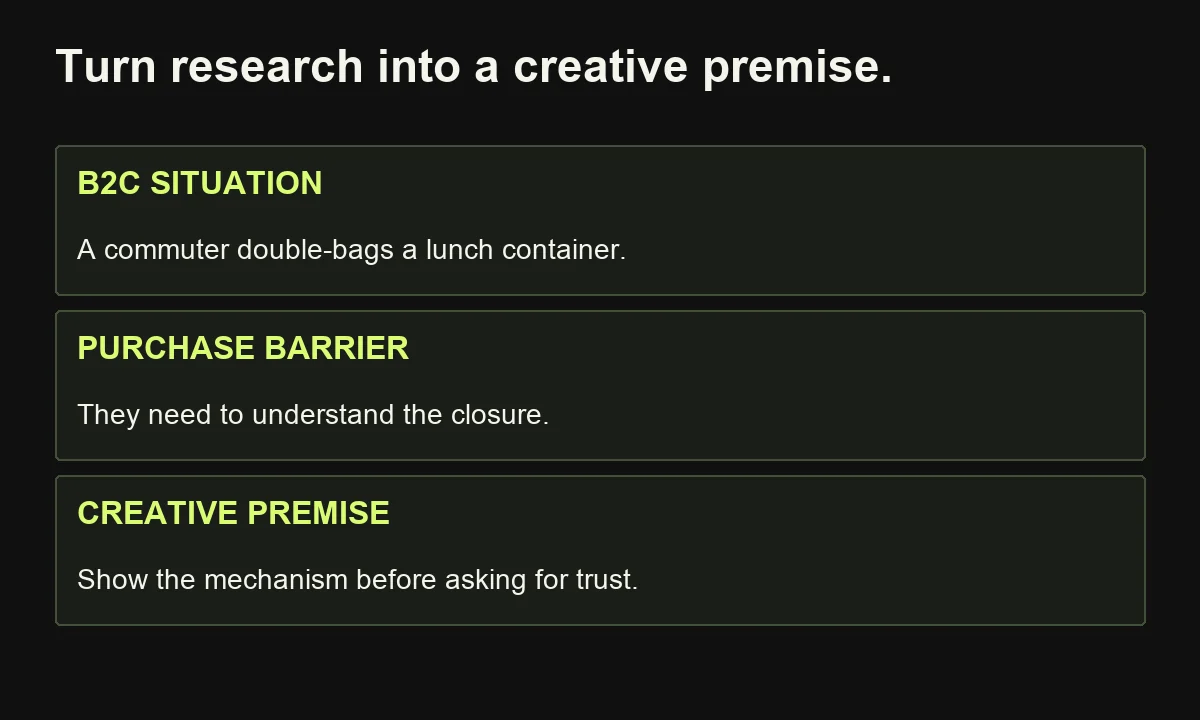
- Consumer product: “I wrap my lunch box in another bag.” The barrier may be trust in the closure. A relevant demonstration could matter more than another lifestyle montage.
- Business service: “Everyone edits the report, but nobody owns the final number.” The barrier may be accountability. Show the review process rather than promising effortless growth.
These are invented examples of research questions, not findings from a real study. Verify the underlying behaviour with your own customers.
Look at competing advertisements to understand category conventions and repeated promises. Do not copy their wording or assume visibility proves effectiveness. You cannot see their full economics, targeting or unsuccessful variants.
The useful output is a specific creative premise: “Show how the closure works before asking someone to trust it.” That is more actionable than “Make the brand relatable.” For complex purchases, distinguish the company you want from the person evaluating the offer using the ICP versus buyer persona guide.
3. Choose a structure that serves the message
A structure is a planning aid, not a conversion guarantee. Choose the order that makes the offer understandable and credible. A visible product action may deserve the opening; a complicated service may need a recognisable situation before its method makes sense.
Common approaches include:
| Structure | Useful starting point | Main risk |
|---|---|---|
| Demonstration first | A feature is easy to show | An attractive action with no meaning |
| Problem, agitate, solution | The problem is already recognised | Exaggerating distress |
| Attention, interest, desire, action | The offer needs explanation | Spending too long explaining |
| Customer account | A genuine experience supplies evidence | Turning an account into a fake testimonial |
| Story or humour | A memorable situation carries the brand | Remembering the joke but forgetting the offer |
Google's YouTube ABCDs emphasise attention, branding, connection and direction. TikTok's Creative Codes recommend hook, body and close within platform-native creative. Treat these as platform guidance, not a reason to make every advertisement identical.
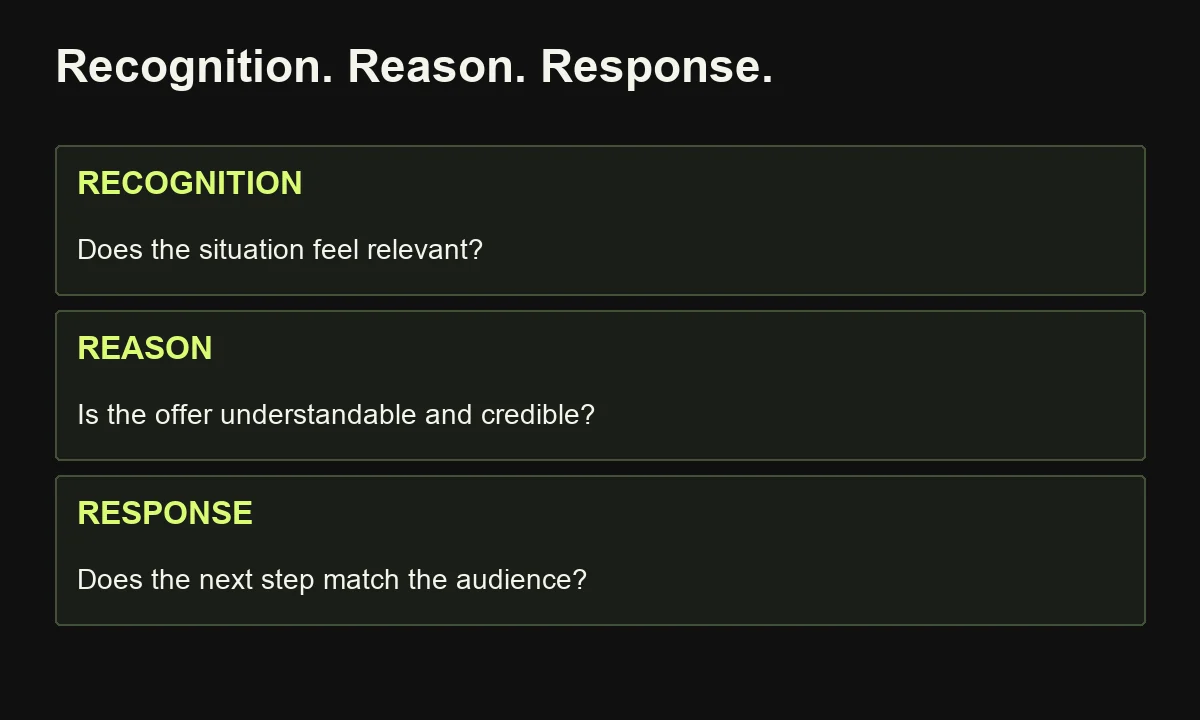
My practical check is whether the script connects recognition, reason and response: the audience recognises relevance, receives a credible reason to care, and understands what follows. This is a review lens proposed here, not a validated scientific model.
Do not give each component equal time automatically. Allocate time according to what this audience needs to understand and what the production can communicate clearly.
4. Write a hook that attracts the right attention
A useful ad hook introduces a relevant situation, question, desire or demonstration. Its job is to earn the next moment without making a promise the rest of the advertisement cannot honour. Write the first frame or sound alongside the first sentence; they must support each other.
For the lunch container, try three distinct openings:
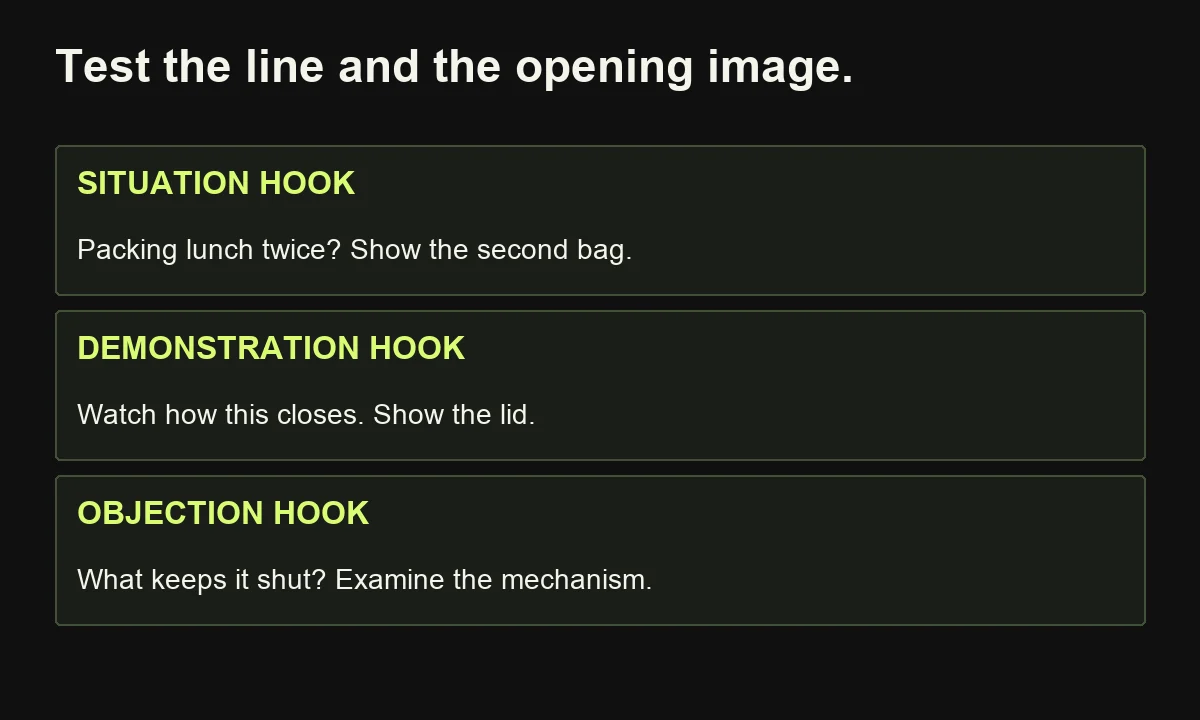
- Situation: A commuter wraps a container in a spare bag. “Packing lunch twice?”
- Demonstration: Close-up of the lid mechanism. “Watch how this closes.”
- Objection: A shopper examines the lid. “What actually keeps it shut?”
For the reporting service:
- Situation: Several versions of a report appear. “Which number goes into the board pack?”
- Method: A reviewer opens a source register. “Start with the source, not another slide.”
- Objection: “What would changing your reporting process involve?”
These are creative directions to develop and test, not predictions of which will win. Avoid interchangeable hooks such as “This changes everything” unless the following content earns that claim.
Branding should belong in the experience. Show the product, packaging, presenter or distinctive brand assets where they help understanding. A long logo animation can delay relevance; hiding the advertiser until the end can leave attention disconnected from the brand.
There is no universal opening duration that guarantees success. Placement, objective and audience change the available attention. Make the opening clear, then examine how people actually respond.
5. Turn benefits into believable evidence
A benefit describes why something matters. Evidence gives the audience a reason to believe the claim. Match the strength of the wording to what the demonstration, documentation or customer account actually supports. Specific language is useful only when its specificity is truthful.
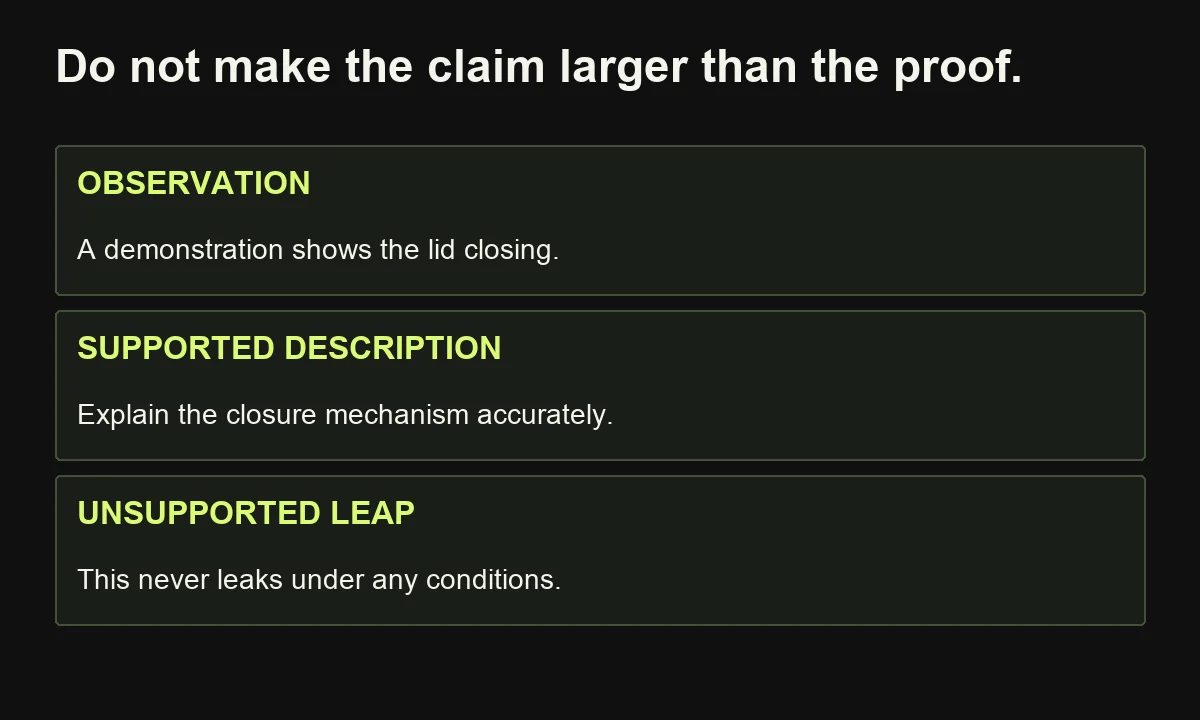
For example, showing a lid locking demonstrates the mechanism. It does not prove that a container never leaks under every condition. Showing a reporting checklist demonstrates a process. It does not prove that a consultancy increases revenue.
Build a small claim register:
| Proposed claim | Evidence needed before use |
|---|---|
| “Fits this bag” | Actual dimensions and representative demonstration |
| “Dishwasher safe” | Verified product instructions and relevant limitations |
| “Saves five hours weekly” | Defined task, baseline, sample and measurement period |
| Customer quotation | Accurate wording, permission and appropriate context |
A creator-style ad is a presentation format, not permission to invent a customer's experience. A hired presenter can demonstrate a product without pretending to have bought or used it for months.
For US-facing campaigns, the FTC's endorsement guidance explains truthful endorsements and disclosure of material relationships. Other markets and regulated categories have their own requirements; have the appropriate reviewer check the final advertisement.
If evidence is missing, narrow the claim or choose a different angle. Do not bury a contradiction in small print. The main message and its qualifications must describe the same offer.
6. Write the audiovisual script, not just voiceover
Use a timed table that separates what the audience sees from what they hear. Include exact dialogue, important on-screen text, meaningful sound cues and the action in each shot. The purpose is production clarity, not elaborate camera terminology or directions that remove every creative choice.
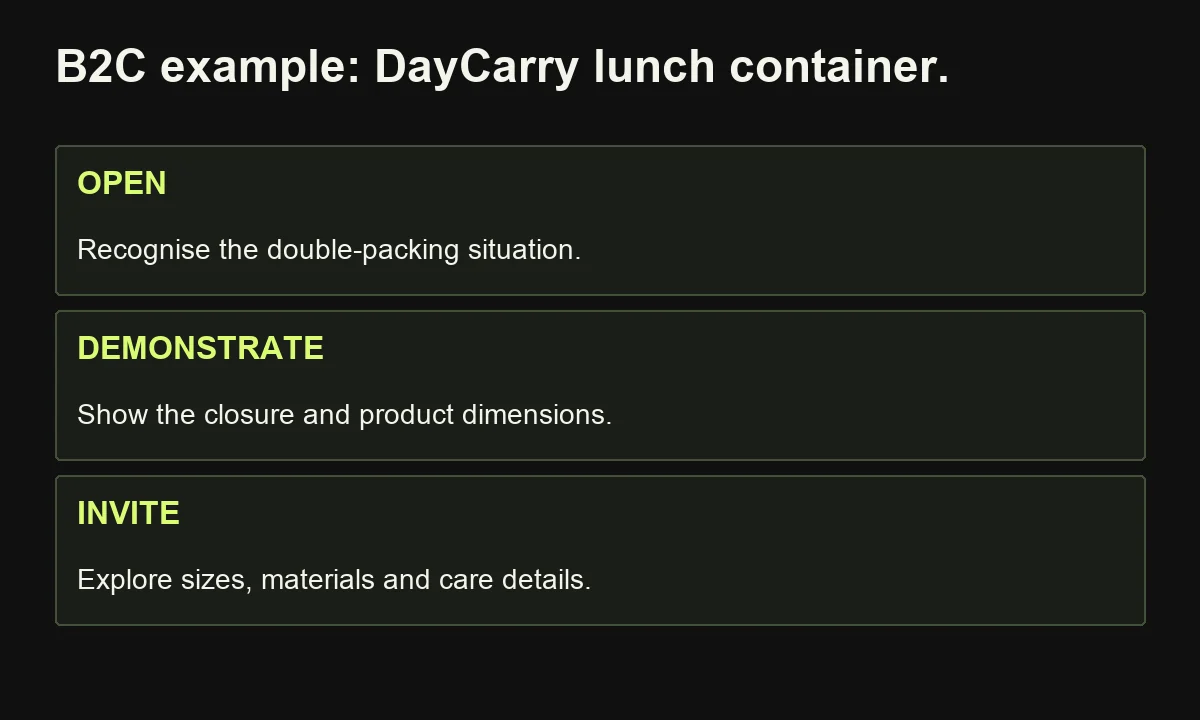
Here is an original 30-second B2C script outline for a fictional lunch container called DayCarry. Product details are assumptions for teaching, not verified specifications. Times are proposed edit allocations that require rehearsal.
| Time | Visual and on-screen text | Audio |
|---|---|---|
| 0–5s | Commuter wraps lunch box in another bag. Text: “Packing twice?” | “Packing lunch twice? Once for the food. Again for the worry.” |
| 5–12s | Show DayCarry branding and the actual lid closing. | “Meet DayCarry. See how the lid closes.” |
| 12–20s | Show compartments and container dimensions beside a bag. Text: “Check the fit.” | “Separate your lunch. Check the dimensions against your everyday bag.” |
| 20–26s | Close-up of product details page. | “See the sizes, materials and care instructions before you choose.” |
| 26–30s | Branded end card. Text: “Explore DayCarry.” | “Explore DayCarry.” |
The script makes a modest, inspectable proposition. It does not invent a leakproof guarantee, a customer review or a discount. If real product testing supports stronger claims, add them with the relevant conditions.
Production needs the genuine container, a bag, food, simple lighting and approved product information. Confirm those requirements before promising a shoot date.
7. Adapt the argument for a business service
B2B ad writing uses the same fundamentals as consumer advertising: relevance, understanding, credibility and an appropriate response. What often changes is the purchase context. A service may involve several evaluators, implementation questions and greater perceived risk, so a concrete explanation can matter more than a dramatic promise.
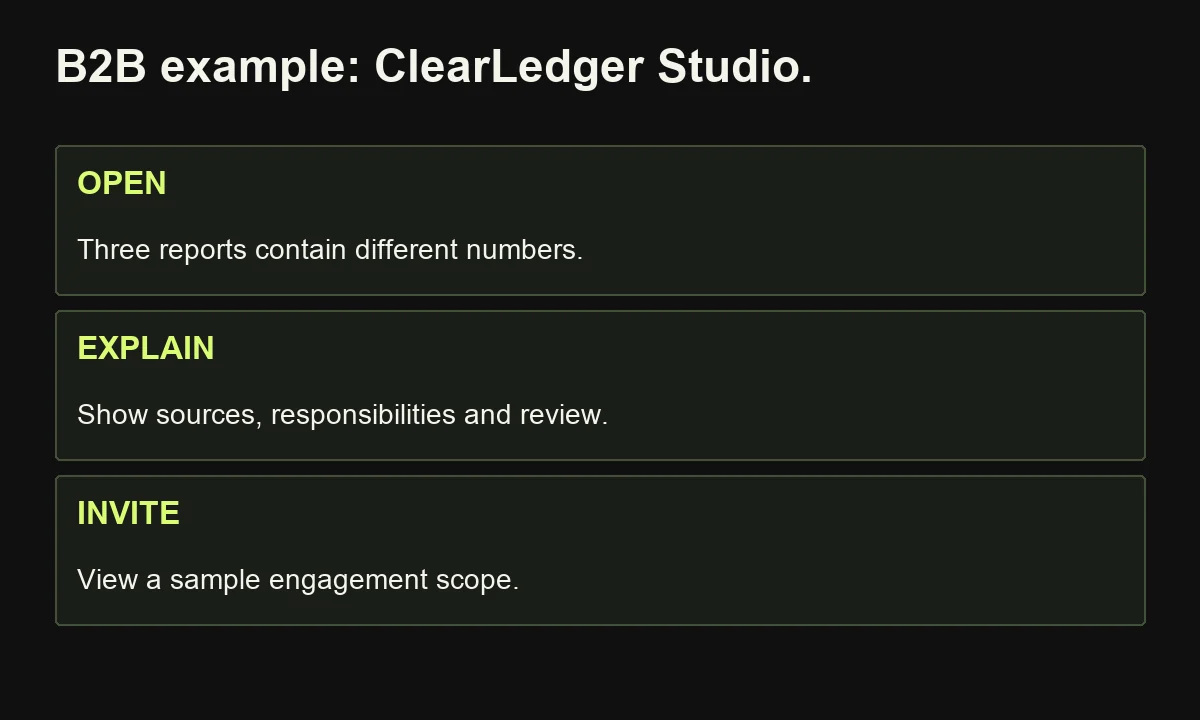
Here is an original 30-second B2B outline for a fictional reporting consultancy, ClearLedger Studio. It is not a real provider, client result or statement about my own service scope.
| Time | Visual and on-screen text | Audio |
|---|---|---|
| 0–5s | Three report versions. Text: “Which number is final?” | “Three reports. Three different numbers. Which one goes to the board?” |
| 5–12s | Branded sample source register. | “ClearLedger Studio helps finance teams map sources and review responsibilities.” |
| 12–20s | Demonstration checklist connects source, owner and approval. Label: “Illustrative process.” | “First, document the sources. Then agree who checks each figure.” |
| 20–26s | Sample project scope; preparation requirements visible. | “See a sample engagement and what your team would need to prepare.” |
| 26–30s | End card: “View the sample scope.” | “View the sample scope.” |
The next step reduces uncertainty without requiring an immediate sales meeting. A buyer already comparing providers might instead need a relevant, permission-cleared project account and a consultation.
Notice the boundary: the process is explained, but financial improvements are not promised. Useful specificity comes from showing the work, not decorating the script with invented results.
8. Fit the script to its medium and placement
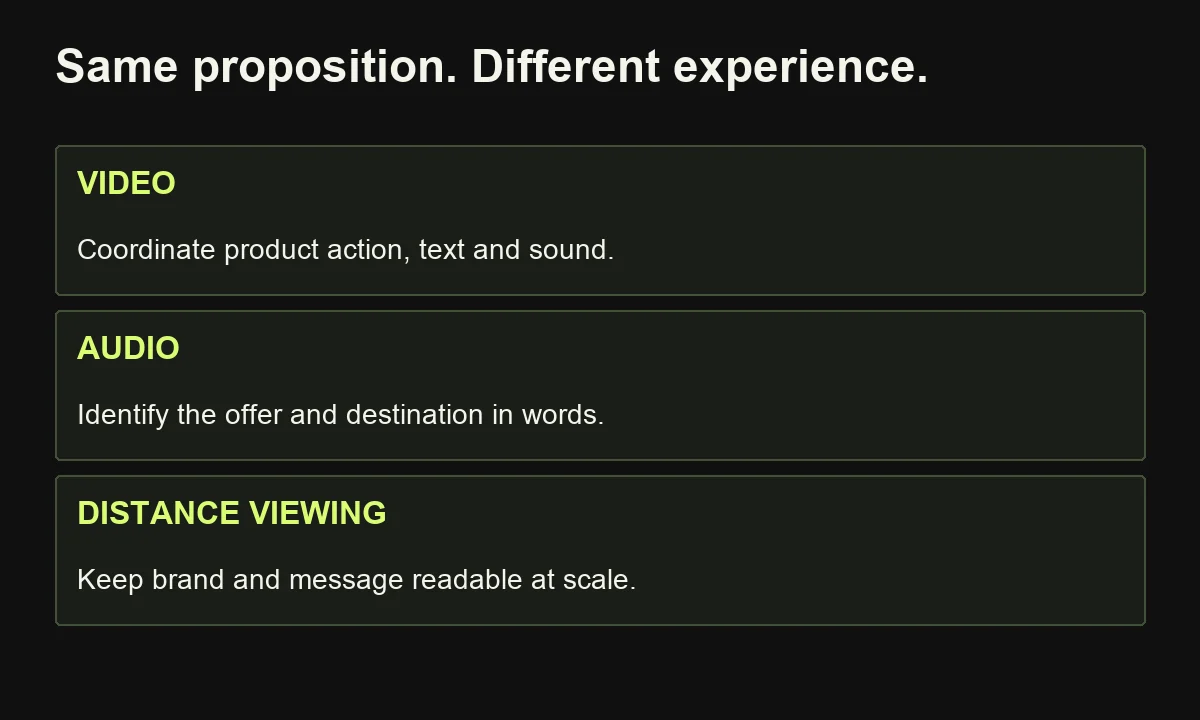
Adapt the viewing or listening experience, not just the file dimensions. A television spot, a vertical feed ad and a podcast sponsorship can communicate the same proposition differently. Check current placement specifications, market availability and acceptance rules before production; do not assume every platform is available in every country.
- Social video: Make the opening understandable in the feed. Plan readable text, mobile framing and interface-safe space. A creator-led demonstration can work without pretending to be an independent review.
- YouTube: Match the creative to the selected format and campaign objective. Introduce relevance and brand meaning without assuming everyone watches to the end.
- Television and connected TV: Make product, brand and response legible at viewing distance. Confirm broadcaster or publisher delivery and clearance requirements.
- Radio and podcasts: Identify the offer through audio. Replace visual-only proof with a clear explanation, meaningful sound or a truthful host account. Give listeners a memorable destination.
- Cinema and out-of-home video: Design for viewing distance and the actual audio environment. Test whether the idea survives without detailed small text.
For a 15-second DayCarry adaptation, keep the double-packing situation, the lid demonstration, branding and one next step. Do not speed up the entire 30-second read.
For audio, rewrite rather than narrating camera directions: “Packing lunch twice? Meet DayCarry. Explore the sizes, materials and lid details on our website.” Use a real, easy-to-remember destination when producing the advertisement.
9. Rehearse timing, readability and accessibility
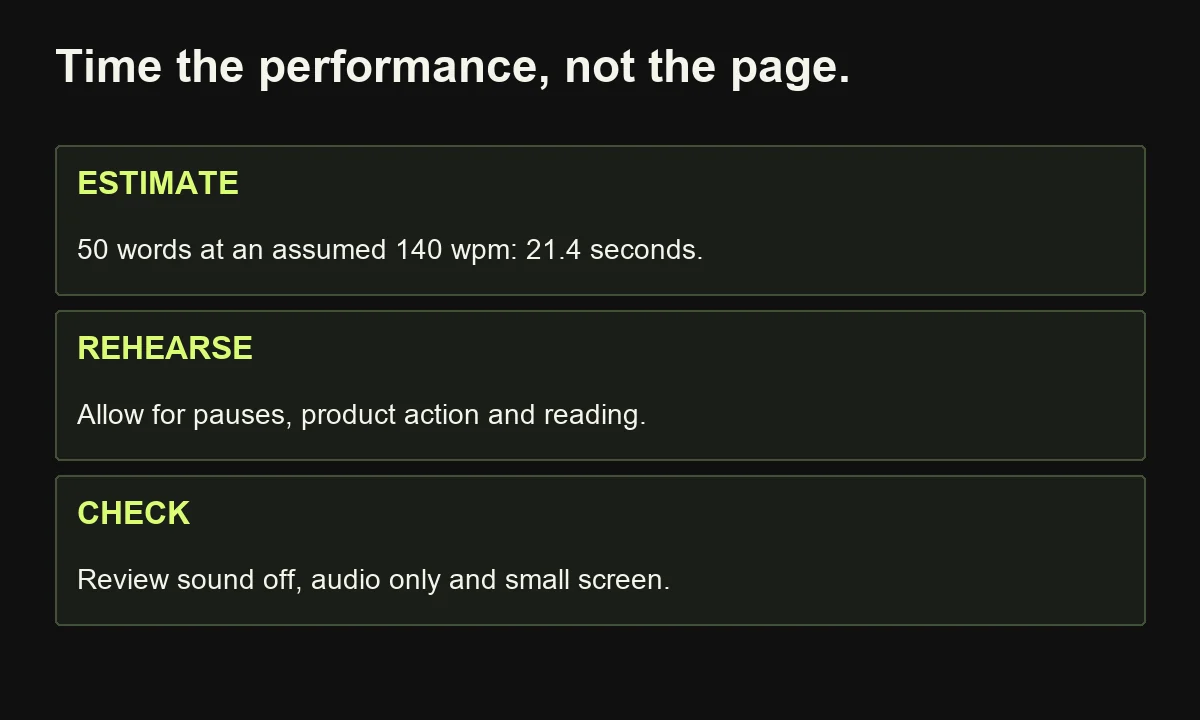
Time the performance, not the document. Read the copy aloud at the intended pace, including names, numbers and pauses. Then rehearse the visual sequence. A script can fit the voiceover allocation while leaving too little time to understand a demonstration or read an essential condition.
A planning calculation can help: spoken words ÷ assumed words per minute × 60 = estimated speaking seconds. At an assumed 140 words per minute, 50 words need about 21.4 seconds. That is arithmetic, not evidence that a particular performer or audience needs that pace.
Record a rough read over placeholder shots. Keep the demonstration and end card on screen long enough to assess them. If it feels rushed, remove material before asking the presenter to accelerate.
Run three separate checks:
- Sound off: Can a viewer understand the visual message and next step?
- Audio only: Does the spoken message identify the offer without unexplained references to “this”?
- Small screen: Are text, product details and necessary disclosures readable in context?
W3C's caption guidance explains that captions include meaningful non-speech audio as well as speech. Automatic captions need accuracy checks. Marketing supers that highlight a benefit are not a substitute for complete captions.
Do not confuse these checks with a full accessibility assessment. They are practical production checks that help identify problems before money is spent on the final edit.
10. Finish the call to action and the handoff
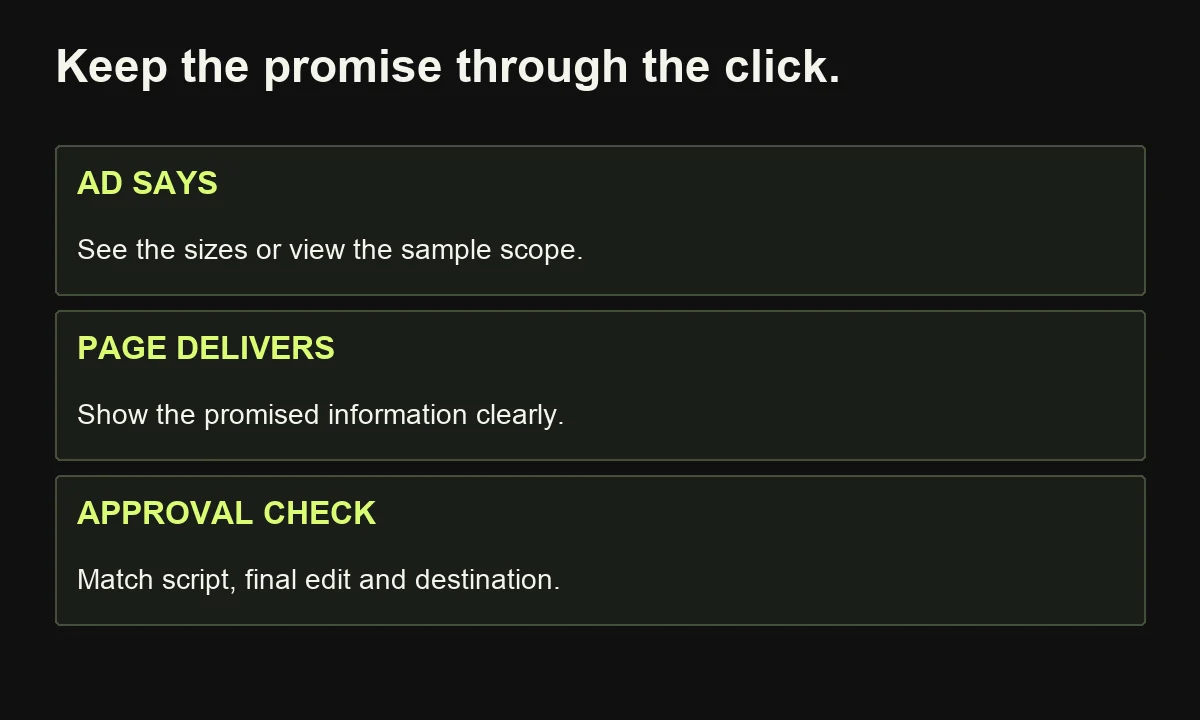
A call to action should explain the next step and match what happens after someone responds. “See the sizes” should open useful product information. “View the sample scope” should reveal that scope. An unexpected form or sales request can break the promise made in the advertisement.
For consumer purchases, answer the relevant hesitation: size, compatibility, delivery, care or returns. For business purchases, it may be scope, implementation effort, pricing approach or evidence. The landing page should continue the argument rather than restart it with generic claims.
Hand production a complete package:
- Approved brief, script version and named decision owner.
- Shot requirements, exact on-screen wording and pronunciation notes.
- Product information, supporting evidence and required qualifications.
- Rights for music, footage, faces, quotations and other assets.
- Placement, aspect ratios, captions, end cards and cutdown requirements.
- Landing-page destination, tracking plan and final approval checklist.
One person should reconcile feedback. Otherwise, a simple script can become a collection of stakeholder preferences with no coherent message.
AI can help generate hook alternatives, shorten dialogue or identify missing production notes. Give it approved facts and explicit boundaries. Review every claim and read every line aloud; a fluent draft does not establish truth or production feasibility. The AI in marketing guide explains how to combine assistance with accountable human review.
Keep the approved script linked to the final exported advertisement so later edits do not silently introduce an unreviewed claim.
11. Test a hypothesis, not a pile of variations
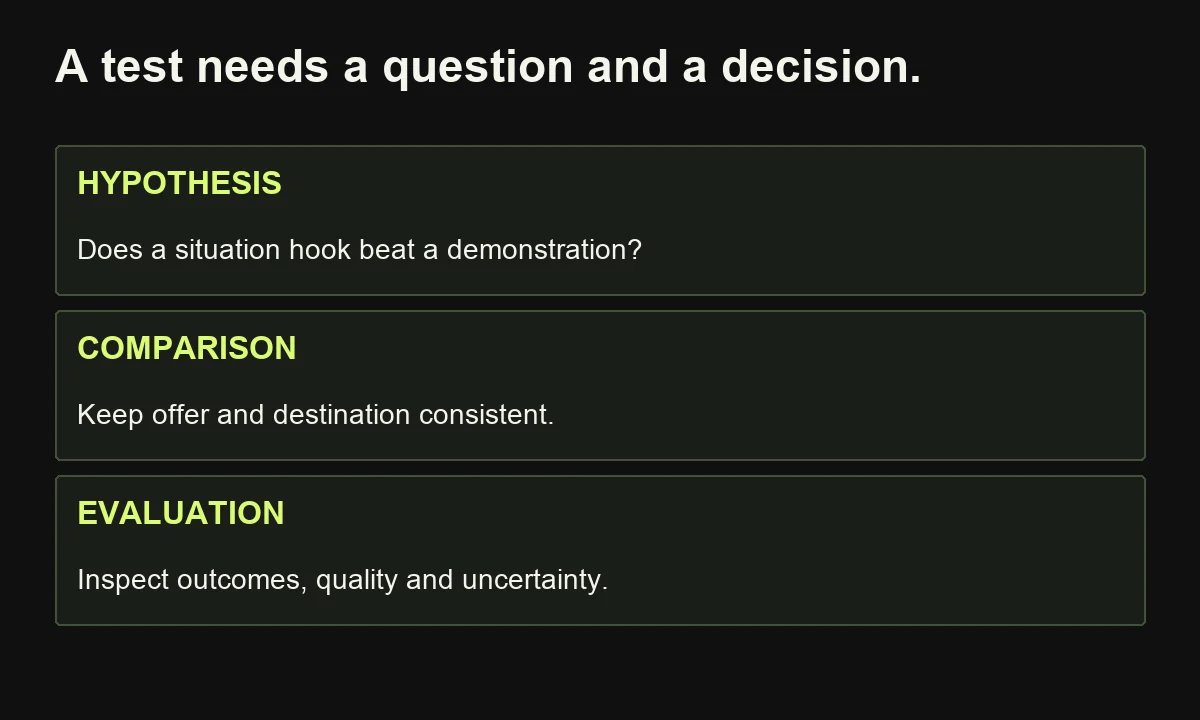
A useful creative test asks a specific question about the audience's response. Compare alternatives designed around that question, record what changed, and judge results against the campaign objective. Three different videos with different offers, audiences and destinations cannot isolate which opening worked better.
For DayCarry, compare a double-packing opening with a lid-demonstration opening while holding the offer and destination consistent. For ClearLedger Studio, compare a conflicting-reports opening with a source-register opening. These are separate tests for separate businesses, not a cross-category contest.
Track the appropriate sequence: delivery and attention, visits, meaningful on-page actions, and purchase or enquiry quality. Video retention and click-through rate are diagnostic signals. Neither independently establishes sales impact or qualified demand.
For lead generation, define qualification before reporting a winner. Ten relevant enquiries may be more valuable than fifty people seeking something you do not provide. For ecommerce, consider purchase value, margin and returns alongside acquisition cost.
Use an appropriate platform experiment where available. Set the evaluation period and decision rules before looking for a favourable result, and account for limited volume, attribution uncertainty and differences in delivery. Small samples may justify another test rather than a confident conclusion.
Record a short learning note: hypothesis, variants, audience, spend, observed response, uncertainty and next decision. Keep failed tests too. An advertisement becomes a useful learning asset when the next writer can understand what happened and what remains unknown.
Frequently asked questions about ad script writing
How long should a 30-second ad script be?
Long enough to communicate clearly within the performed edit. Estimate from the intended delivery pace, then time a real read with pauses, product action and the end card. A fixed word count cannot account for names, demonstrations, music or the information someone must read.
What makes a good advertisement script?
A clear audience, relevant message, believable reason to care and suitable response. The visual and audio directions must make that message producible. Judge clarity, truthfulness, timing and audience response rather than assuming a famous copywriting formula guarantees effectiveness.
Can the same script work for B2B and B2C?
The planning principles transfer, but the actual argument usually needs adapting. Purchase risk, decision participants, product knowledge and the next step differ. Research the situation rather than assuming business buyers want jargon or consumer buyers only respond to emotion.
What should I send an ad script writer?
The audience, offer, objective, placement, available evidence, budget constraints and approval requirements. Include customer questions and the destination page. Download the ad-script planning worksheet to organise the brief, production decisions and test hypothesis.
If the offer is clear but the message is difficult to articulate, tell me what you are advertising. We can discuss the research and writing required to make it understandable, credible and ready for production.