AI summary
A B2B case study should help a prospect evaluate your work in context. Choose a relevant project, document the decisions and contribution, and let the evidence determine how strongly you describe the outcome.
- Research before the headline: Collect the brief, timeline, work, measurement definitions, and known limitations. Interview participants for specific decisions and inspectable examples rather than general praise.
- Preserve the evidence boundary: Verify numbers, quotations, permissions, and review ownership. Distinguish outputs from outcomes, relative changes from percentage points, and observed improvement from demonstrated causation.
- Make the story useful: Explain implementation, customer responsibilities, and lessons. Use relevant visuals and a clear next step, then check the approved publication version. An honest implementation account can be valuable without an impressive but unsupported financial result. Keep context for readers unfamiliar with the project.
To write a case study, choose a real project relevant to your reader, gather its evidence, interview the people involved, and explain the context, decisions, work, and outcome. Verify numbers and quotations, preserve important limitations, and obtain the agreed approvals. The finished story should help someone evaluate your work, not merely admire it.
A case study has a harder job than a testimonial. A testimonial can express satisfaction. A case study must let a prospect examine whether your judgment, process, and experience apply to their situation.
That is why a dramatic headline cannot rescue a missing explanation. “We increased leads” leaves too much unanswered: which leads, over what period, following which changes, and with what contribution from the people telling the story?
This guide focuses on B2B customer stories and professional portfolio case studies. Academic case analysis, clinical reports, and classroom teaching cases have different requirements. Use the appropriate disciplinary guidance for those assignments.
My working rule is simple: every consequential claim should have an inspectable route back to evidence. You can manage that with a small claim register rather than an elaborate production system.
The process below takes you from project selection to a publishable narrative. It includes interview questions, a reusable structure, calculation checks, an illustrative case, and a downloadable worksheet. Treat the example as a teaching aid, not a claim about my client results.
What should a good case study help the buyer decide?
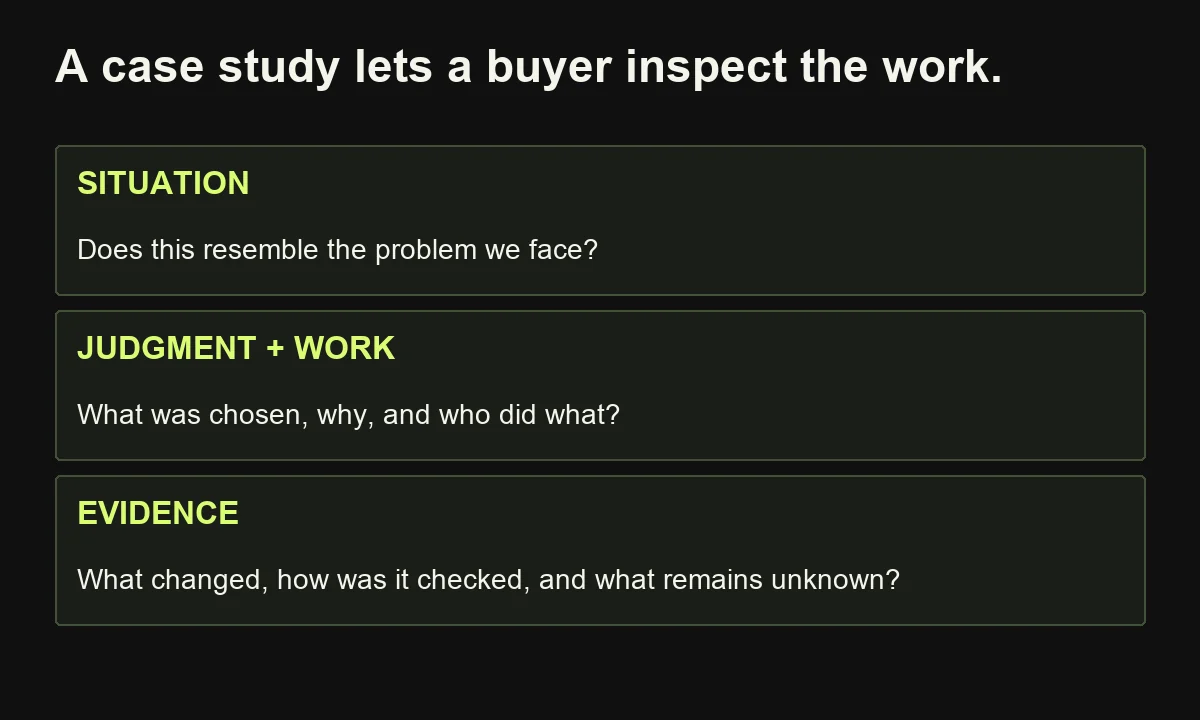
A useful case study helps a buyer assess whether the situation resembles theirs, whether the intervention makes sense, and what evidence supports the outcome. It should reveal the conditions under which the work happened. Its purpose is informed evaluation, not proving that every future customer will receive the same result.
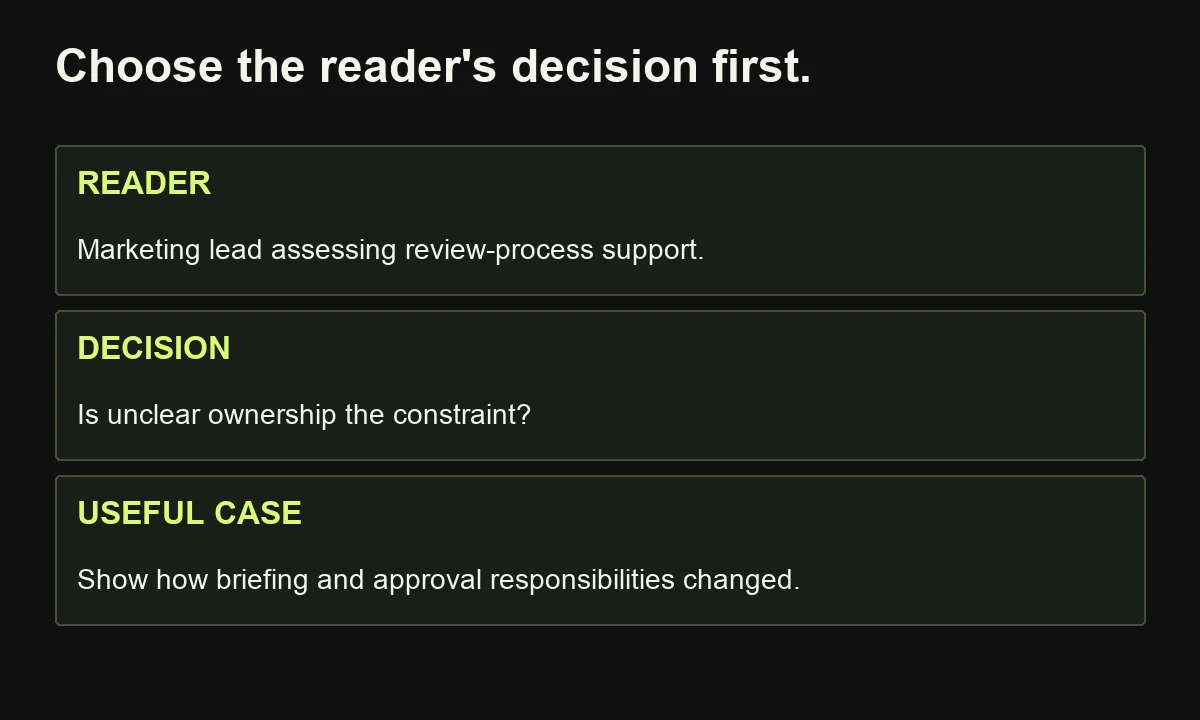
Write one commissioning sentence before gathering material: “This case will help [reader] evaluate [decision] by examining [specific work].”
For example: “This case will help a marketing lead evaluate a content-review redesign by showing how ownership and briefing changed.” That is more useful than “Show that we are a great agency.”
The CDC's descriptive case-study guide starts with goals, audience, background knowledge, and format. Although its context is broader than commercial customer stories, those planning questions are useful here too.
Distinguish the asset from nearby formats:
| Format | Main purpose |
|---|---|
| Testimonial | Communicate someone's experience or opinion |
| Case study | Explain a particular situation, intervention, and evidence |
| Business case | Assess whether a proposed investment is justified |
| Tutorial | Help someone perform a task |
A case study can contain a testimonial or teach a method, but it should not rely on praise as its only evidence. Define the buying question first, then choose the project that can responsibly answer it.
How do you choose a project worth documenting?
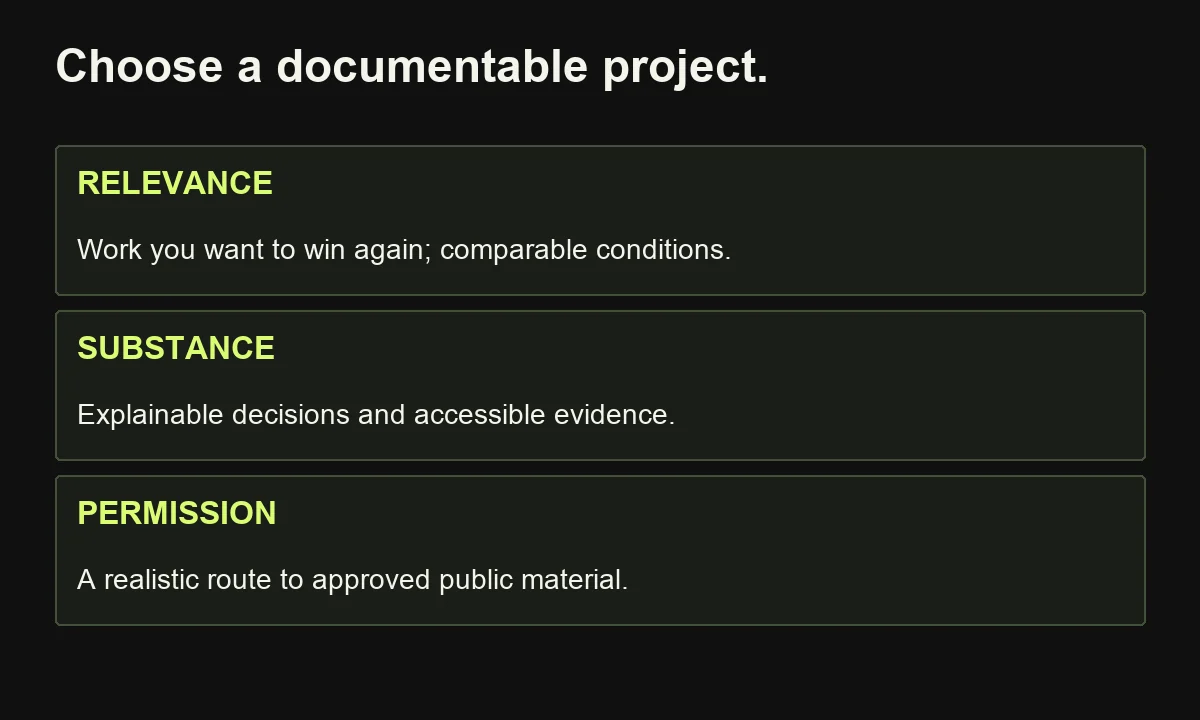
Choose a project with a relevant problem, explainable decisions, accessible evidence, and a realistic approval path. Familiarity to your ideal buyer matters more than the customer's prestige. A smaller project with clear documentation can provide a more useful case than a famous logo attached to an outcome nobody can substantiate.
Review candidate projects against five questions:
- Does this resemble work you want to win again?
- Can you explain the starting condition and constraints?
- Is your contribution distinguishable from other work?
- Is there evidence of an outcome or meaningful implementation?
- Can the necessary material be approved for use?
Do not select only effortless successes. A documented complication, revised decision, or implementation boundary can make the story more informative. The point is to describe it accurately, not manufacture drama.
Ask sales or customer-facing colleagues which uncertainties recur in buying conversations. Perhaps prospects question implementation effort, specialist knowledge, or what their own team must contribute. Select evidence that addresses that uncertainty.
Use ICP and buyer persona research to establish relevance. Similar industry labels alone do not establish comparable conditions.
If results are still developing, consider a clearly labeled implementation account. Explain what was delivered and what remains unmeasured. Do not write a success claim and hope the evidence arrives later. Sometimes the correct editorial decision is to wait or choose a better-documented project.
What evidence should you collect before the interview?
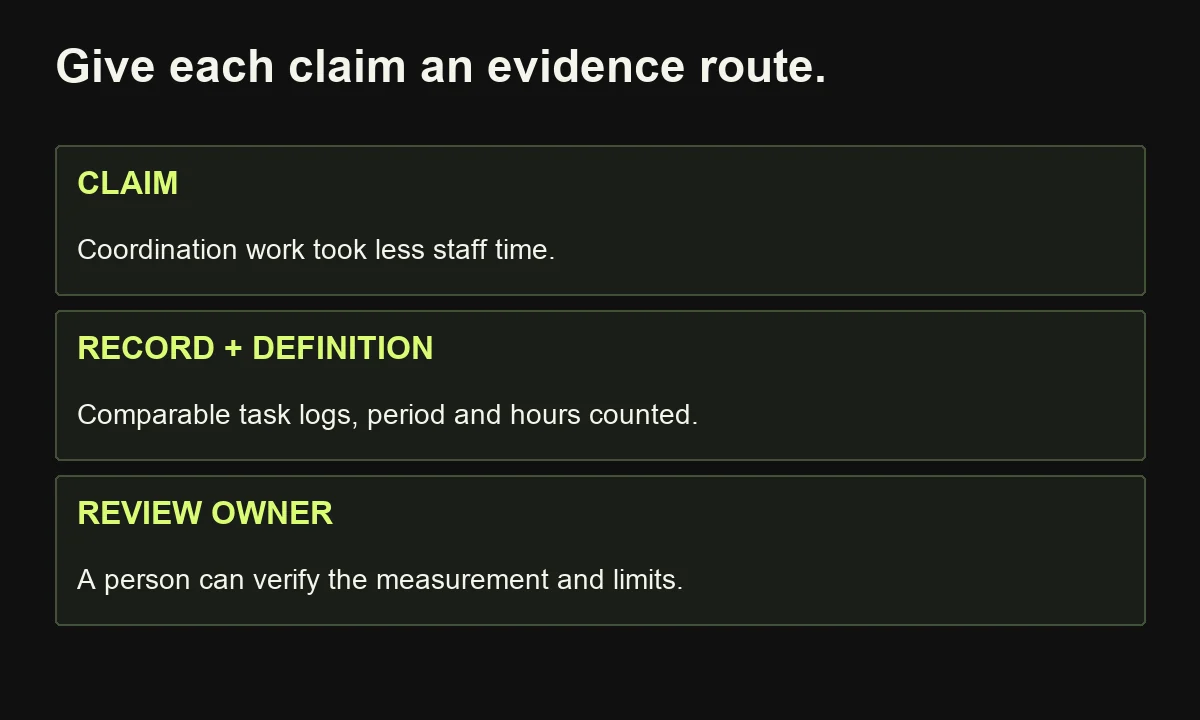
Collect the original brief, timeline, relevant work, decisions, outcome records, and known limitations before interviewing. This lets you ask specific follow-ups and identify gaps early. An interview can explain what happened, but a remembered number should still be checked against its underlying record where that record exists and can be used.
Create a claim register with these columns:
| Proposed claim | Source | Definition or condition | Verification owner |
|---|---|---|---|
| The process took longer before | Workflow records | Same task and comparable period | Operations owner |
| Responsibilities changed | Approved process document | Which roles and effective date | Project lead |
| The customer found handoffs clearer | Interview or feedback | Attributed experience, not a universal measure | Customer reviewer |
Also assemble a simple sequence: before the project, diagnosis, options, intervention, implementation, and measurement. Record other changes that could affect the outcome.
Separate three categories: observed facts, participant interpretations, and your editorial conclusions. A customer saying the launch felt smoother supports their assessment. It does not establish a measured reduction in errors.
Keep confidential raw documents outside public drafts and design files. Use a missing-evidence note when a statement needs confirmation. The register should make it easy for a reviewer to challenge a sentence before it becomes a headline.
A strong evidence packet reduces avoidable rewriting because the narrative is built around what the project can actually support.
How do you arrange permission and customer participation?
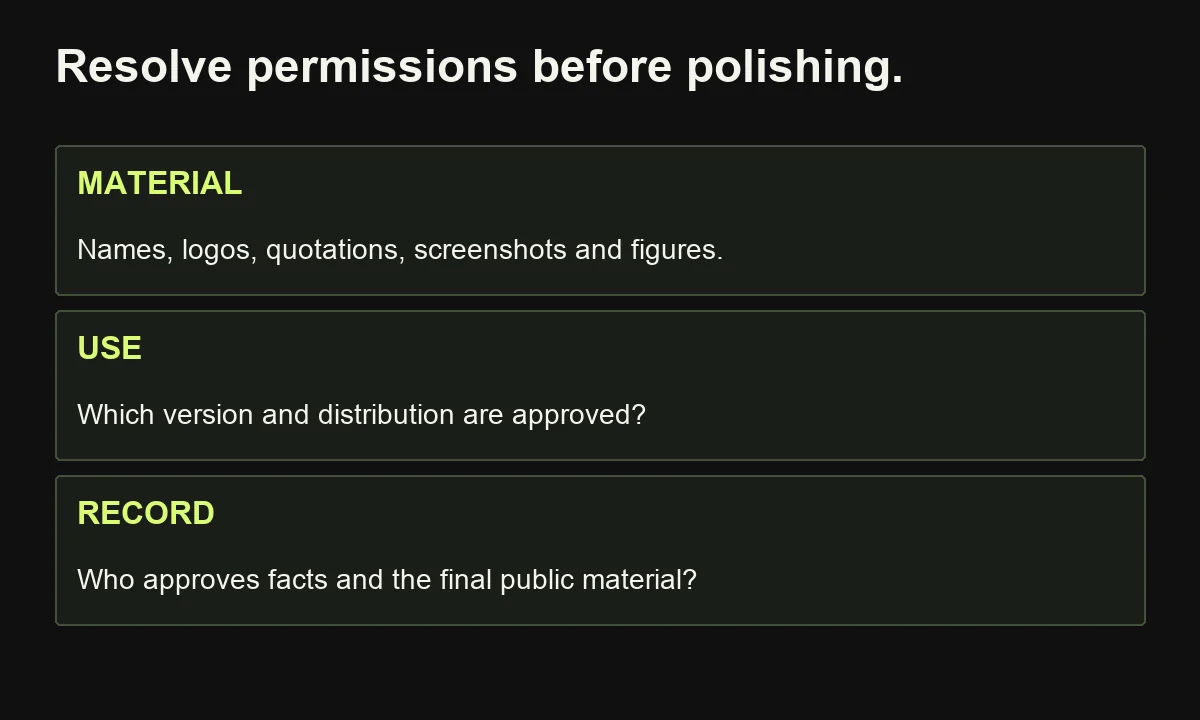
Agree the proposed story, participants, permitted material, review responsibilities, and publication uses early. Confirm what can be named, quoted, shown, or measured. This is production planning as well as responsible information handling: late uncertainty about a logo, screenshot, or metric can force changes to an otherwise finished case study.
A useful request explains why this project is relevant, what participation involves, and how factual review will work. Do not promise a specific review timeline unless the people involved have agreed to it.
Record decisions about company and individual names, titles, logos, recording, quotations, screenshots, financial figures, sensitive implementation details, and intended distribution. Identify who can approve the final material and who can answer factual questions.
For an anonymous case, preserve enough permitted context to assess relevance. “A distributed professional-services team” may be useful; invented company names presented as real are not. Remove indirect identifiers when they could reveal information you agreed to withhold.
Do not manufacture approval by treating silence as agreement. Maintain the approved wording and the version that received sign-off.
Customer stories used as endorsements need particular care. US FTC guidance emphasizes honest experience and substantiated claims. A testimonial cannot make an unsupported claim credible merely because someone approved the quotation.
Keep the practical rule clear: publish only material you can support and are entitled to use in the agreed way.
Which interview questions produce a useful case study?
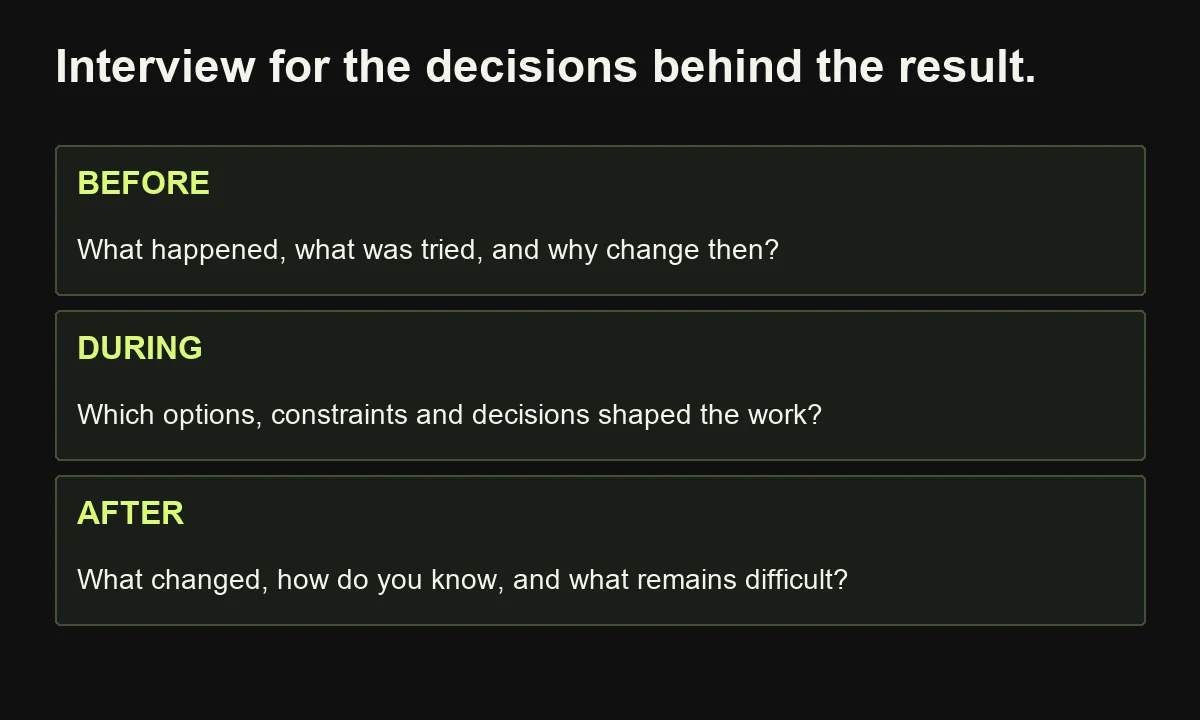
Interview for the sequence of decisions, not a list of compliments. Ask what triggered the project, what people knew at the time, which options they considered, what changed during implementation, and how they assessed the outcome. Follow general statements with specific questions about examples, records, and conditions.
Use these prompts as a flexible guide:
- What was happening before the project began?
- Who experienced the problem, and how did it appear?
- What made it worth addressing then?
- What had you already tried?
- Which alternatives did you consider?
- Which constraints affected the decision?
- What did each team actually do?
- What changed during implementation, and why?
- How did you determine what improved?
- What remains difficult or would you change next time?
Ask for a concrete episode. If someone says approvals were confusing, ask them to describe one approval before and after the intervention. Clarify who owned the decision and which artifact records the change.
Give different participants questions they can answer from their own involvement. A sales contact may not know the measurement method; the operations owner may.
Keep quotations traceable to a transcript, notes, or explicitly approved statement. Edit for clarity only without changing meaning, and obtain the agreed review. If a useful idea needs substantial rewriting, present it as a paraphrase or request confirmation rather than silently turning your prose into the customer's words.
What case study structure should you use?
Use a structure that connects context, challenge, decisions, implementation, evidence, and implications. The familiar challenge–solution–results format is a useful starting point, but “solution” should not conceal the actual work. Buyers need to understand why an approach was chosen, what it required, and how the outcome was established.
A reusable B2B case study template:
| Section | Question it answers |
|---|---|
| Headline and short snapshot | What is this case about, and who is it relevant to? |
| Context and challenge | What was happening and why did it matter? |
| Options and decisions | What did the team consider and choose? |
| Implementation | What changed, who contributed, and what was difficult? |
| Outcomes and evidence | What was observed, how, and over what period? |
| Limitations and lessons | What does this example establish or leave unresolved? |
| Relevant next step | Where can a reader assess comparable help? |
Adjust emphasis to the case. A complex implementation may need more explanation than a straightforward redesign. Do not force every story into the same word budget.
Draft the evidence and implementation sections first when those are the clearest material. Then write the opening and headline to match the supported story.
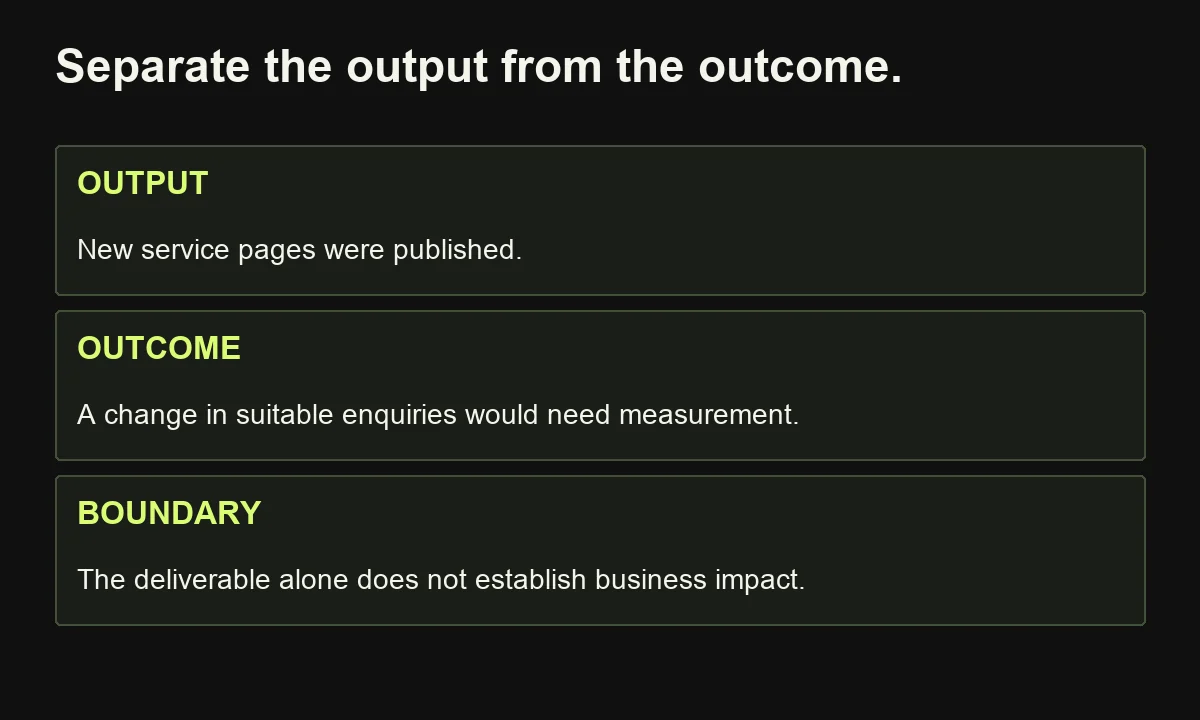
Distinguish an output from an outcome. Publishing new service pages is an output. A measured change in suitable enquiries is an outcome requiring its own evidence. One should not quietly stand in for the other.
How do you report results without overstating them?
Define the metric, comparison, population, period, and source before describing improvement. Show whether the change is absolute or relative, and separate observed movement from causal explanation. A before-and-after case study can document a change without proving that one intervention alone caused it. Include other material changes and measurement limitations.
Consider these hypothetical calculations, not client results:
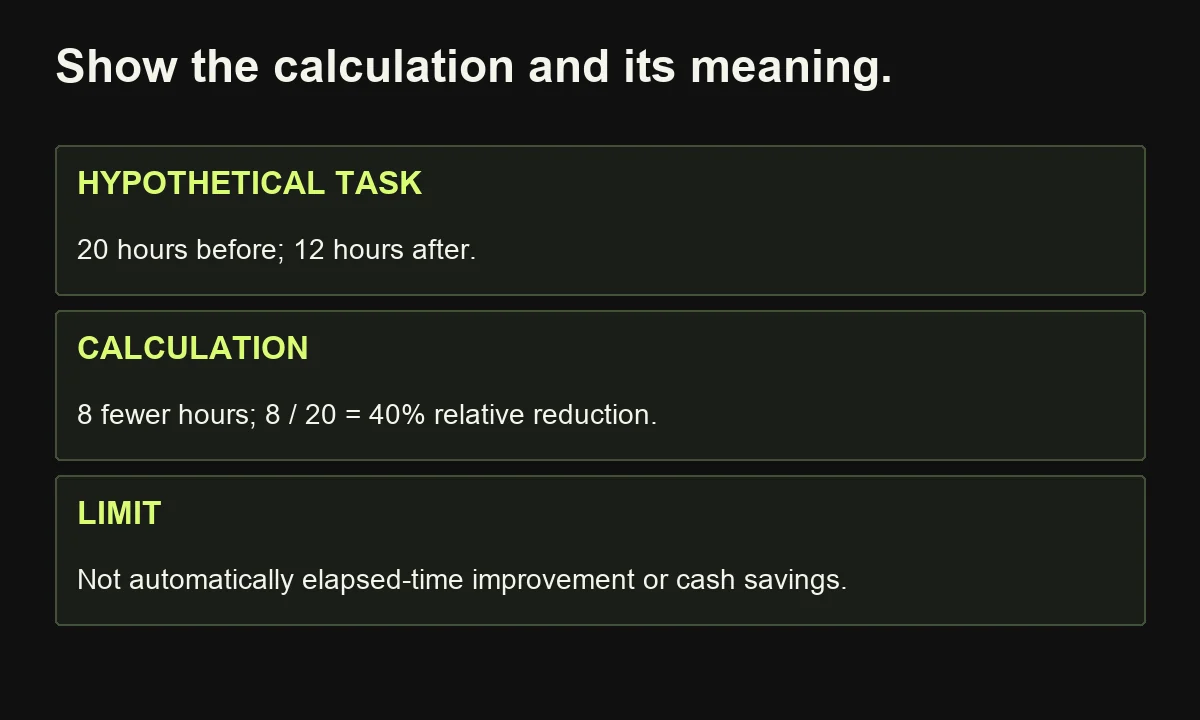
- A recurring task falls from 20 hours to 12 hours. That is eight fewer hours, or a 40% relative reduction: (20 − 12) ÷ 20.
- A conversion rate rises from 2% to 3%. That is one percentage point, or a 50% relative increase. Those descriptions are not interchangeable.
Comparable measurement matters. Were you counting the same task, comparable volumes, and the same event definition? Did staffing, demand, or data collection change?
Write “the measured period showed” when the evidence supports an observation. Use a stronger attribution only when the study design and analysis support it. Explain your role alongside the customer's and other contributors'.
Do not convert time released into financial savings unless an actual financial saving is established. Capacity and avoided expenditure are different claims.
If a figure cannot be published, ask whether an approved range, indexed comparison, or qualitative finding can be used responsibly. Never invent a substitute number. A narrower, verifiable result is more useful than a spectacular claim whose measurement cannot be explained.
What does a clear case study example look like?
The following is a completely hypothetical miniature case, with illustrative records and figures. It demonstrates structure and claim boundaries; it is not an anonymized customer story, testimonial, or report of my own work. A real case would need its actual source records, permissions, and review before publication.
Headline: A clearer approval process for a small marketing team.
A professional-services firm's marketing team sent drafts through several reviewers without a named final approver. Conflicting comments made it difficult to establish which changes were necessary.
The team considered buying a new workflow tool. Instead, it first examined a sample of completed reviews and mapped who supplied subject expertise, brand feedback, and final approval.
A content specialist helped redesign the brief, separate review responsibilities, and document escalation when reviewers disagreed. The customer appointed an approval owner and tested the process on a recurring content format.
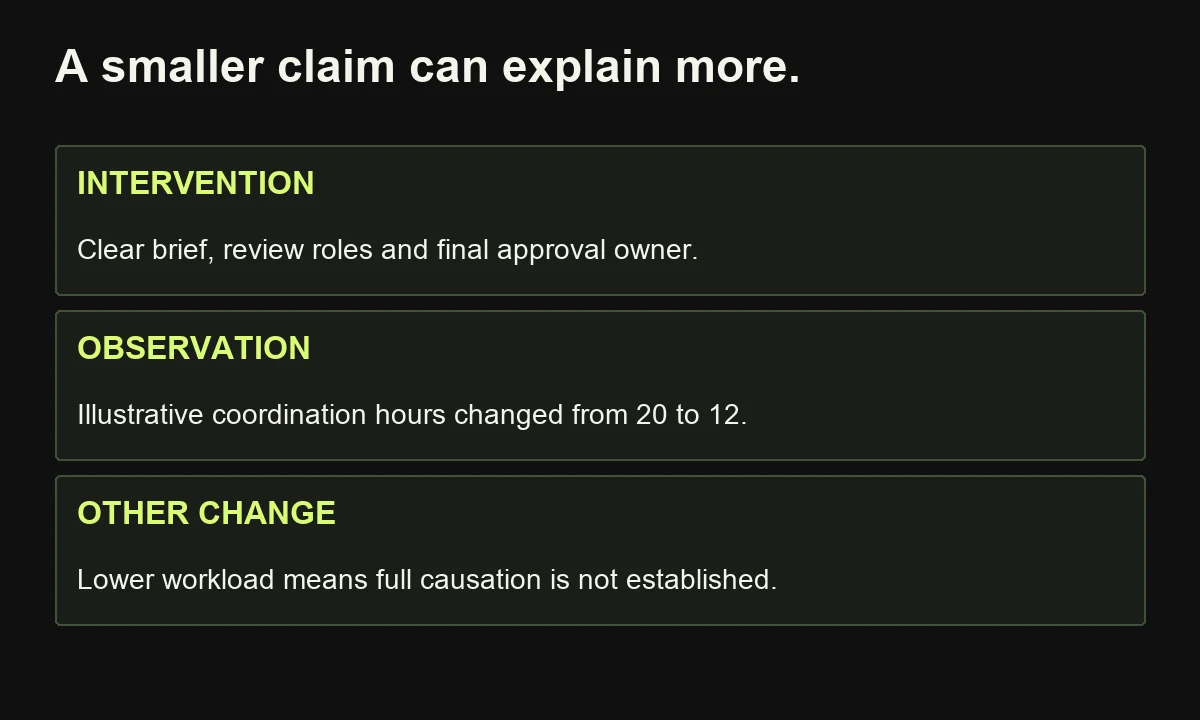
In this illustrative scenario, active coordination time for comparable batches fell from 20 hours to 12 hours. The measure covers staff coordination work, not total elapsed publication time or cash saved. A temporary reduction in project volume also occurred, so the case does not attribute the entire change to the process redesign.
The immediate lesson is that unclear authority can resemble a software problem. The next evaluation would check whether the revised process holds under normal workload.
Notice what the example includes: a decision, the actual intervention, customer responsibility, a defined measure, and an unresolved question.
How do you edit a case study into a convincing narrative?
Edit for a clear explanation before polishing sentences. A reader should be able to follow the relationship between the problem, the decision, the work, and the evidence. Remove claims that outrun the source material. Then tighten language, check consistency, and test whether someone outside the project can understand its significance.
Use three passes:
Reasoning: Does the challenge explain the intervention? Are the options and constraints visible? Have you credited the customer's contribution and other relevant work?
Evidence: Can every number and quotation be traced? Are dates, definitions, and comparison periods clear? Does the headline say more than the results section establishes?
Language: Replace “transformed efficiency” with the task that changed. Prefer named actors and concrete verbs. Define specialist terms, and remove repeated claims of excellence.
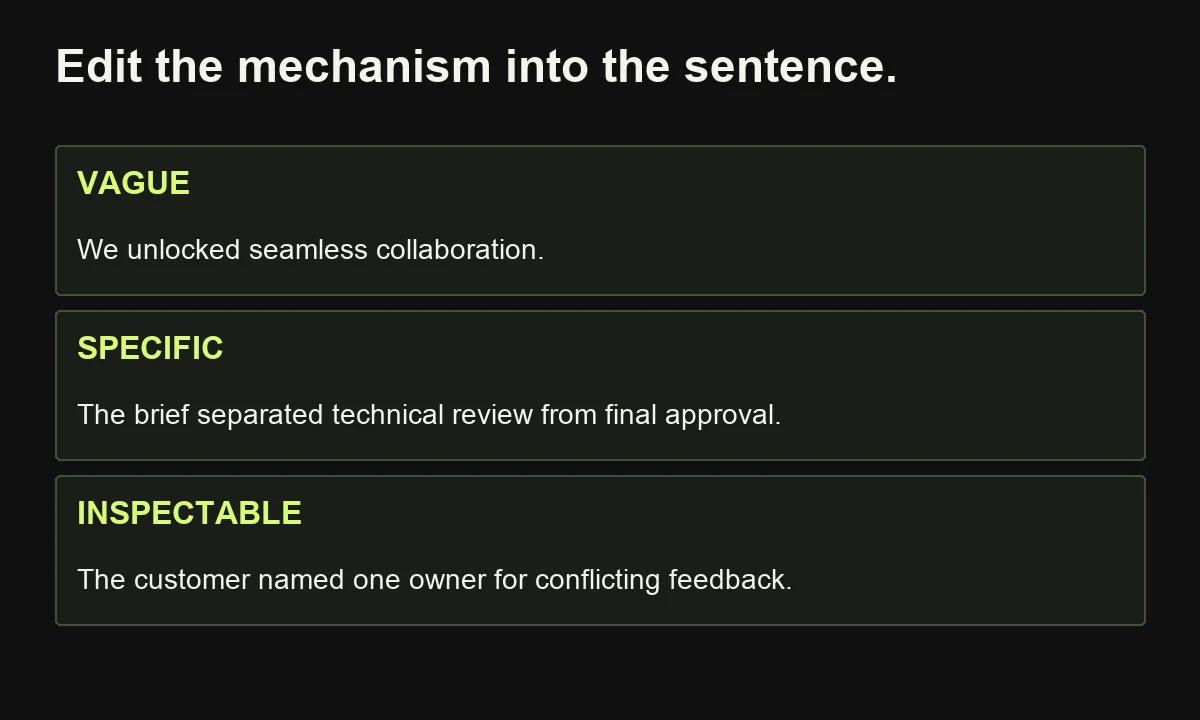
Weak: “Our innovative strategy unlocked seamless collaboration.”
Stronger: “The brief separated technical review from final approval, and the customer named one person to resolve conflicting feedback.”
The second sentence exposes the mechanism without inventing a commercial outcome.
The CDC's case-study guidance recommends review by people unfamiliar with the draft. Ask them what happened, why the approach was chosen, and what remains uncertain.
Finally, compare the edited draft with the claim register. Attractive wording should not introduce a stronger claim than the evidence packet contains. Send factual questions back to their owners rather than smoothing over gaps with confident prose.
How should you design a case study page?
Design the page so readers can inspect the argument and evidence at different levels of attention. Use a descriptive headline, short context, clear sections, relevant visuals, and an accessible next step. Keep essential information in text. A visually impressive page should not make the actual work or measurement harder to understand.
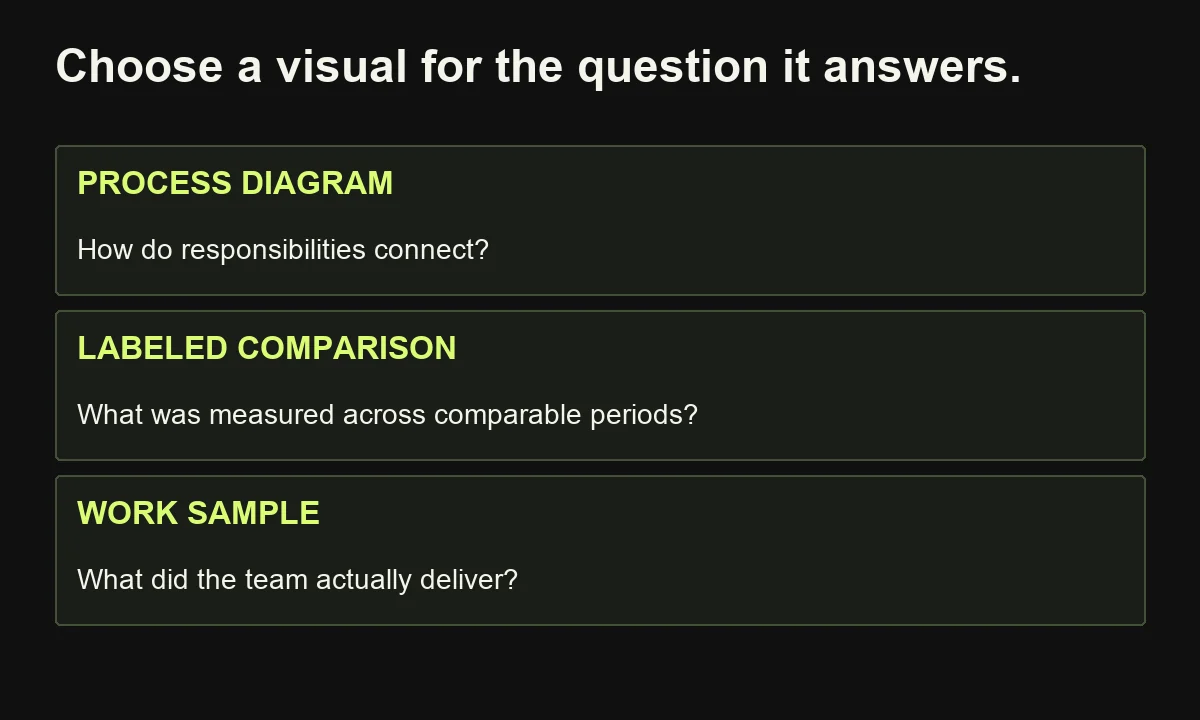
Choose visuals by the question they answer:
- A process diagram explains responsibilities or sequence.
- A redacted work sample shows what was delivered.
- A labeled comparison clarifies a measured change.
- A timeline distinguishes implementation from measurement.
Use actual, permitted artifacts where available. Label recreated diagrams, illustrative data, and hypothetical examples. Do not present a generated interface as the customer's real system.
For quantitative charts, show units, periods, comparable definitions, and the starting values needed to interpret the claim. Avoid a cropped axis or isolated percentage that exaggerates the result.
The W3C's guidance for complex images calls for text equivalents that convey the important information. Alt text alone may be insufficient for a detailed chart; explain the result in nearby text too.
Compress images, preserve readable type, specify dimensions, and test the mobile layout. A downloadable PDF can be useful for sales, but an accessible HTML page gives readers a direct place to inspect and share the evidence. Keep versions consistent when facts or permissions change.
How do you make the case study discoverable and useful in sales?
Connect the case study to the problem and service it actually supports. Give it a clear title, descriptive URL, accurate summary, and contextual internal links. Help readers establish relevance before asking them to enquire. Search and AI visibility are opportunities to investigate; neither follows automatically from publishing a customer story.
Use a headline that identifies the meaningful work or supported outcome. If a number needs extensive qualification, a process-focused headline may be more accurate than a dramatic percentage.
Write a short opening that states the situation, contribution, and evidence boundary. This helps a colleague understand the case when someone forwards the link without an introduction.
Follow Google's people-first content guidance: add useful, reliable information rather than merely restating material already available. Appropriate Article metadata should match the visible author, dates, and content; markup cannot guarantee citations.
Use internal links among blogs, case studies, and services where the case answers the reader's next question. A loosely related success story should not imply proof for a different claim.
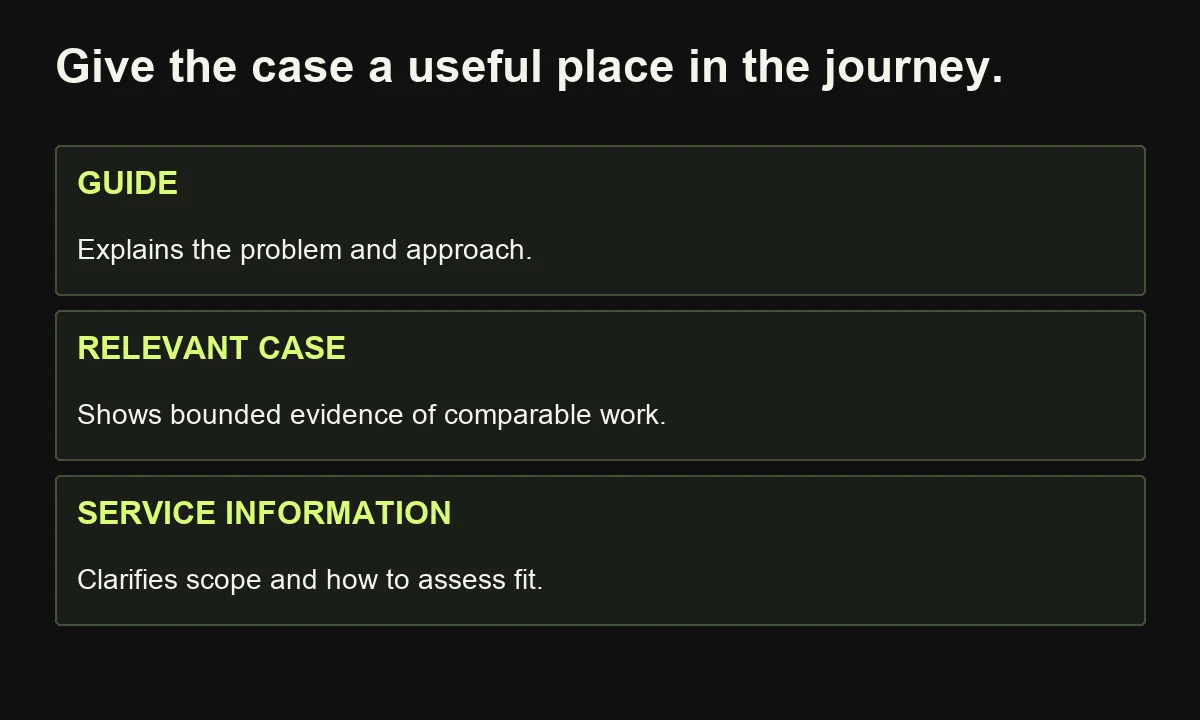
Give sales a short relevance note: who should receive this, which concern it addresses, and what it does not demonstrate. Observe how prospects use it and what questions remain. A case study's value includes helping people evaluate fit, not simply maximizing downloads.
A case study checklist and frequently asked questions
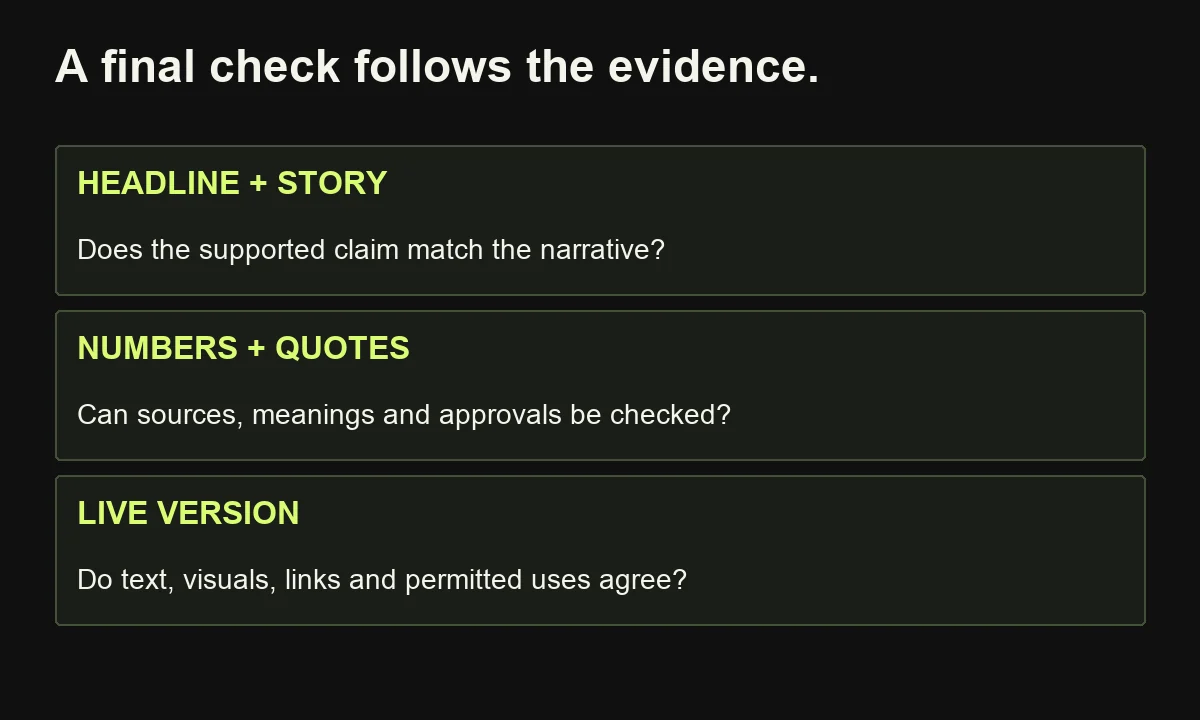
Use the case study evidence and production worksheet to record the buyer decision, sources, interview gaps, measurement definitions, approvals, and final checks. Before release, confirm that the supported headline, complete narrative, published figures, and approved version all agree. Assign someone to review later corrections and changes in permission or relevance.
How long should a case study be?
Long enough to explain the work and evidence clearly. A short sales summary and a detailed implementation account serve different needs. Choose the depth from the buyer's questions rather than treating a word count as proof of quality.
Can I write one without numerical results?
Yes, if it documents meaningful work or an attributed experience accurately. Show the decision, deliverables, implementation, and known limitations. Do not imply an unmeasured business result.
Can the customer stay anonymous?
Yes, when the permitted context remains useful and the underlying account is real. Agree the description and avoid identifying details that undermine the intended anonymity.
Can AI write the case study?
AI can organize permitted notes or suggest questions. A person must verify sources, quotations, calculations, confidentiality, and meaning. Generated praise and invented results are not customer evidence.
If you have worthwhile work but no clear way to explain it, share the project and the buyer question it should answer. I can help shape the research, interviews, content direction, and writing into a case study prospects can assess.