AI summary
An ideal customer profile identifies organizations your offer can serve well. Buyer personas explain the decisions, concerns, and evidence needs of people involved. Connect them to choose better accounts and create more useful content.
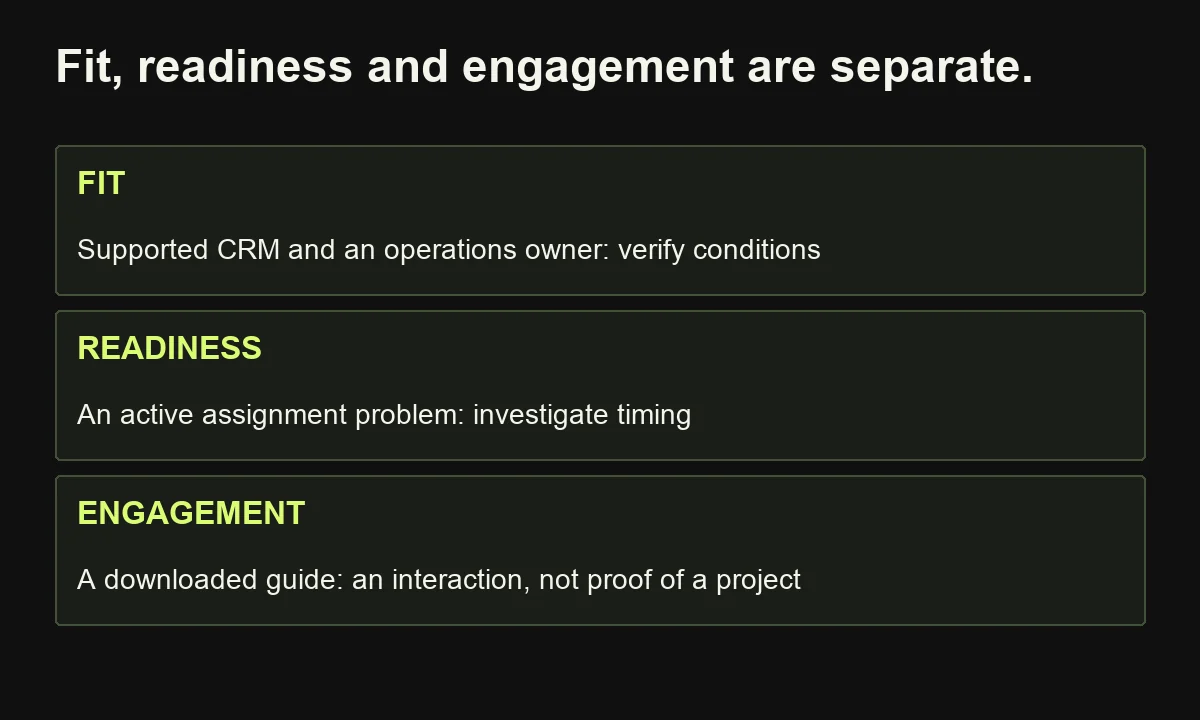
- Keep the judgments separate: Account fit, current readiness, and contact engagement answer different questions. A download or senior title does not establish a suitable company or approved project.
- Research actual buying decisions: Compare customer outcomes and delivery requirements. Interview recent buying participants, including alternatives and no purchase, and distinguish observations from interpretation. Treat untested profiles as hypotheses.
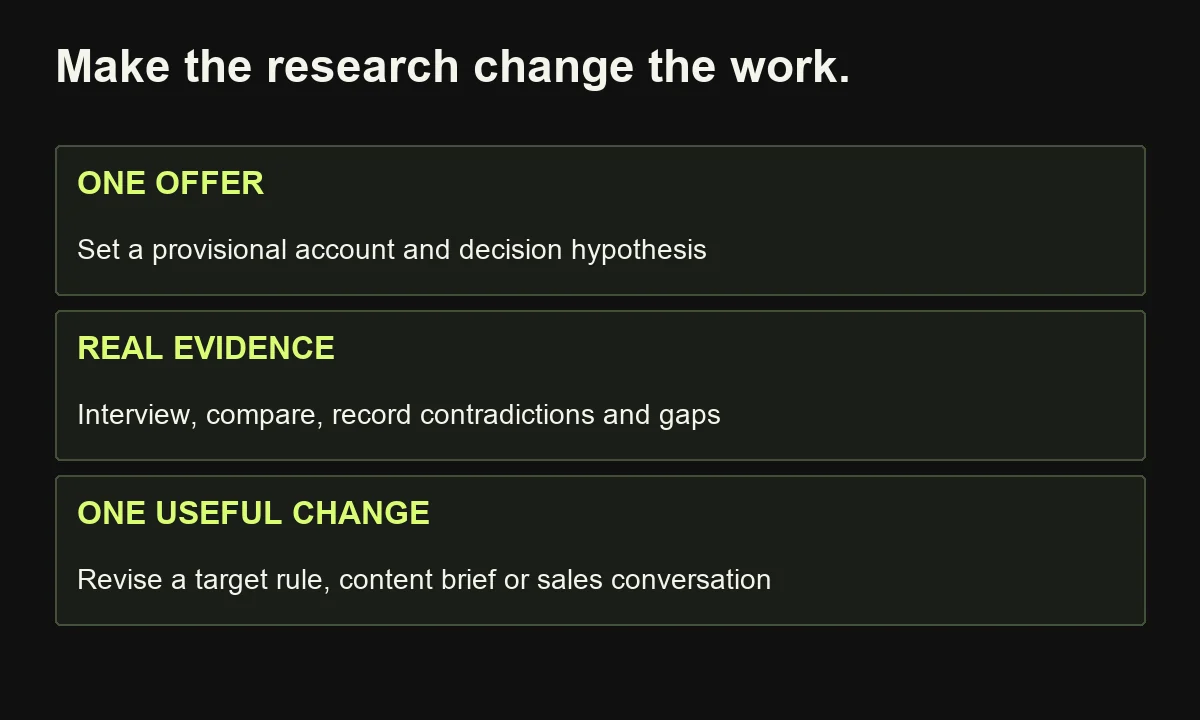
- Activate and maintain the insight: Map account conditions to reader decisions and supporting evidence. Change targeting rules, content briefs, and sales handoffs; then review outcomes, contradictions, and missing perspectives. Create separate models only when they change useful action.
In B2B marketing, an ideal customer profile defines the organizations best suited to your offer. A buyer persona explains the needs, concerns, and decision behavior of people involved in buying it. Use the ICP to prioritize accounts and personas to shape conversations, content, and evidence. You usually need both.
A company can look perfect on paper and still have no reason to buy. A contact can love your article and work for a business you cannot serve profitably. Those are different problems, and merging your ICP and buyer persona makes both harder to diagnose.
The distinction matters beyond terminology. It affects which prospects sales pursues, what marketing publishes, which case studies you develop, and whether your content reaches people who can move a purchase forward.
This guide is for B2B founders, marketing leaders, and lean teams building or repairing their audience strategy. It uses one hypothetical software example throughout, so you can see how the same research becomes targeting rules and useful content.
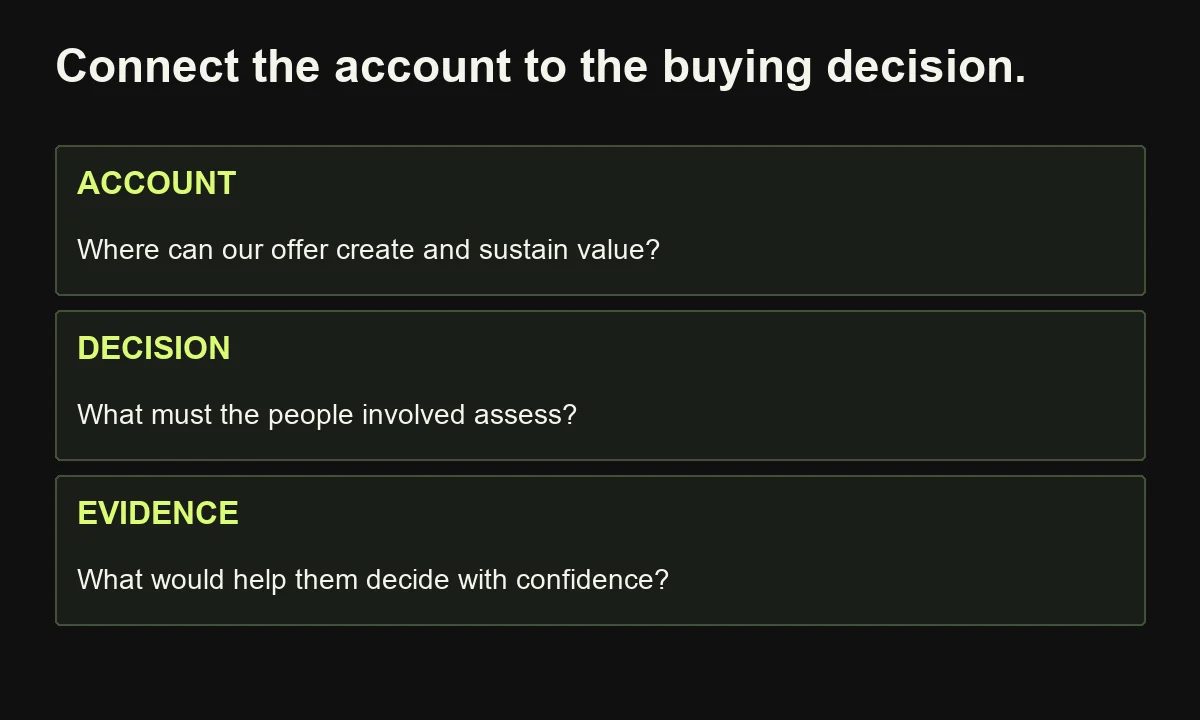
My proposed planning tool is Account–Decision–Evidence: identify the account conditions, the decision someone must make, and the evidence that would help. It is an editorial working method, not a validated prediction model.
The aim is a better commercial decision, supported by research, rather than a prettier description of a customer you hope exists.
What is an ideal customer profile?
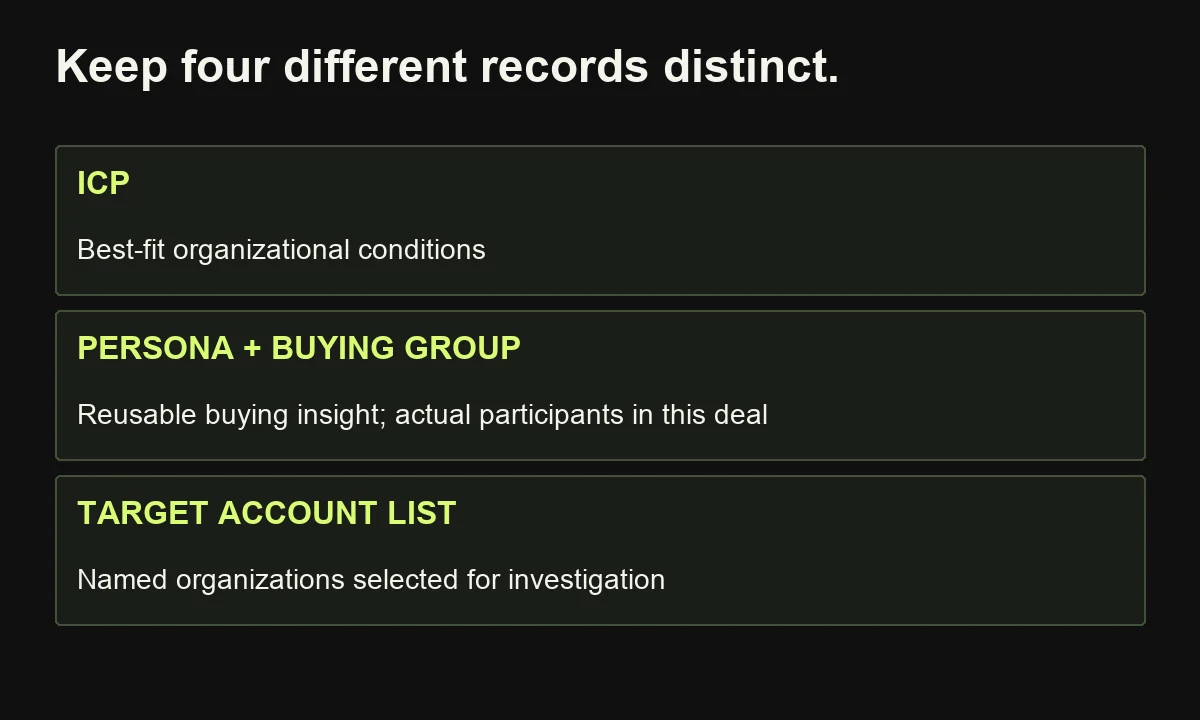
An ideal customer profile, or ICP, describes the organizational conditions under which your offer can create meaningful value and support a viable customer relationship. In B2B, that commonly includes use case, business size, operating environment, relevant technology, buying constraints, and ability to implement. It should also identify situations you cannot serve well.
Salesforce distinguishes an ICP from a buyer persona by company fit versus an individual buyer representation. Terminology varies across businesses, so agree what your documents mean before comparing templates.
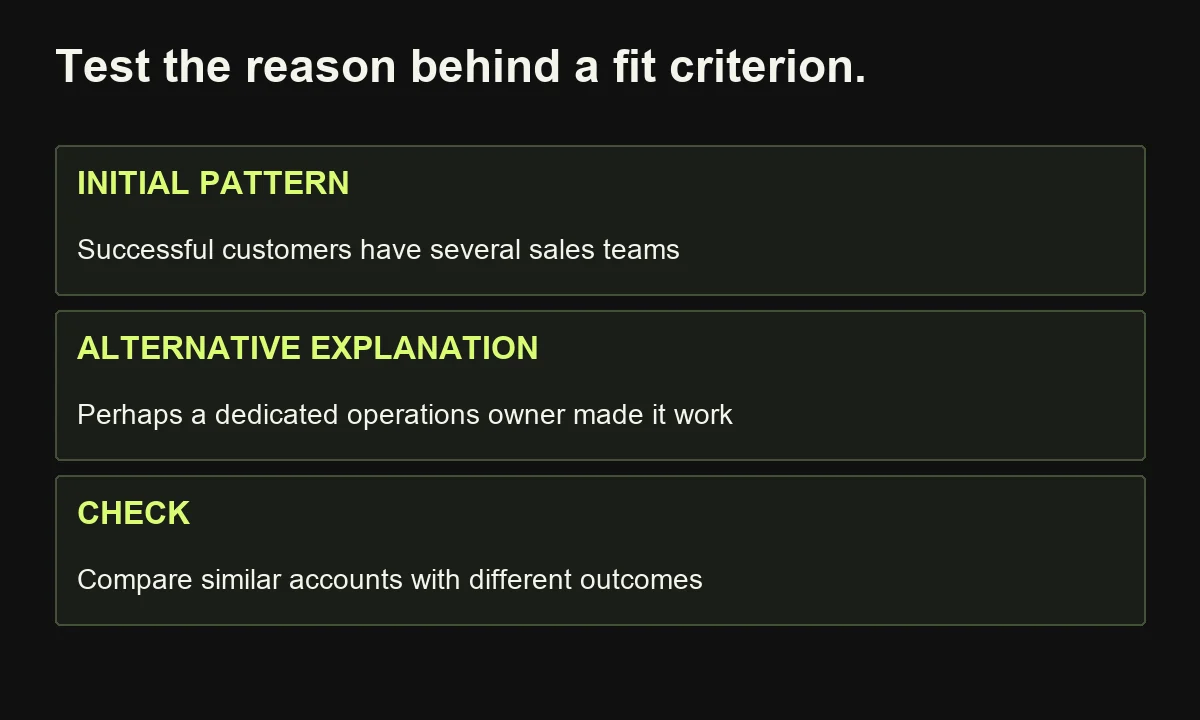
An ICP needs an explanation of fit. “Software companies with 50–200 employees” is a filter. Why does that range matter? Perhaps those organizations have several sales teams but no dedicated operations function. The operating condition is more informative than the number alone.
Useful criteria connect to value or delivery:
- A recurring problem your offer can address.
- A practical environment where it can work.
- Resources and ownership to implement it.
- Commercial terms that can sustain delivery.
- Explicit exclusions where the promise breaks down.
Do not define ideal as merely prestigious, easy to contact, or high revenue. A large contract requiring unsupported customization may be a poor fit.
Separate stable fit from current readiness. A suitable company may have no active project. A company announcing a project may still lack the conditions your solution needs.
What is a buyer persona?
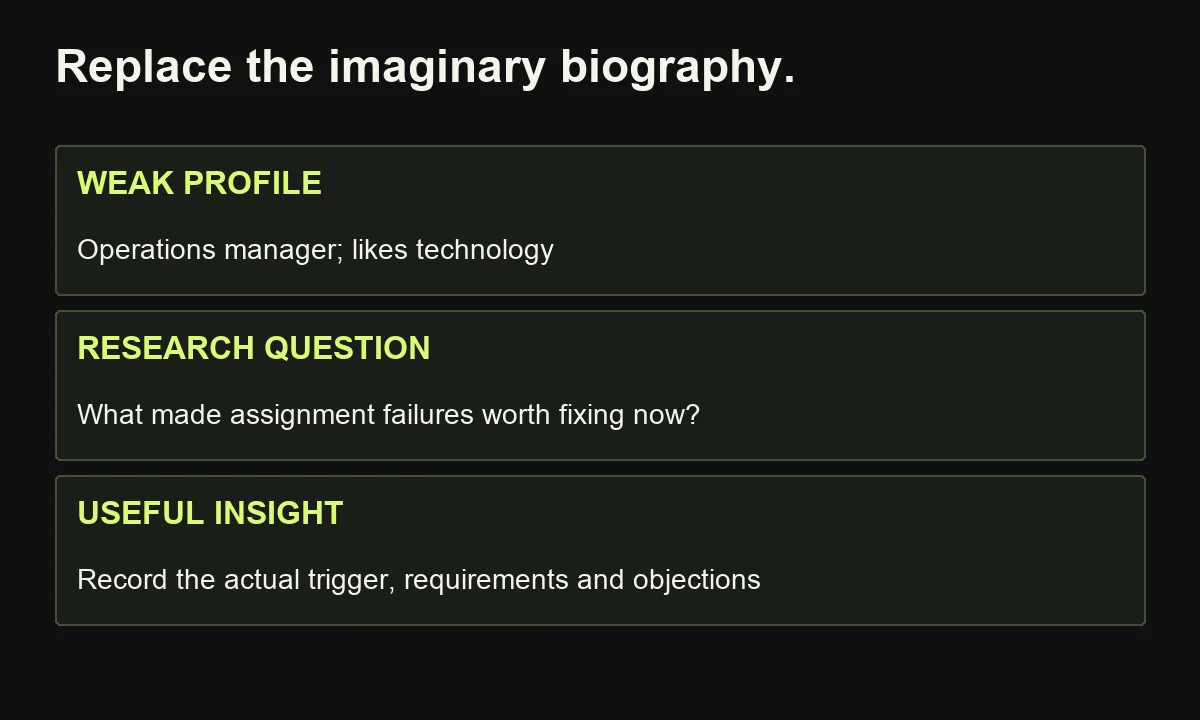
A buyer persona is a research-based synthesis of the goals, constraints, decision criteria, and behaviors of people involved in a particular purchase. It helps explain why they consider change, what worries them, whose agreement they need, and what information builds confidence. It is not a fictional biography of an imagined customer.
HubSpot's persona research guide emphasizes customer research, interviews, and collaboration with sales. The “semi-fictional” label often used in marketing should mean an anonymized composite, not permission to invent motivations.
Start with the purchase. “Revenue operations manager evaluating lead-routing software” gives you a decision to investigate. “Tech-savvy Taylor, 34, loves podcasts” gives you decoration unless those details demonstrably change channel selection or messaging.
A useful B2B buyer persona records:
- The job or outcome the person is responsible for.
- The event that made the problem worth addressing.
- Alternatives considered, including doing nothing.
- Requirements, objections, and acceptable evidence.
- Influence, approval dependencies, and information sources.
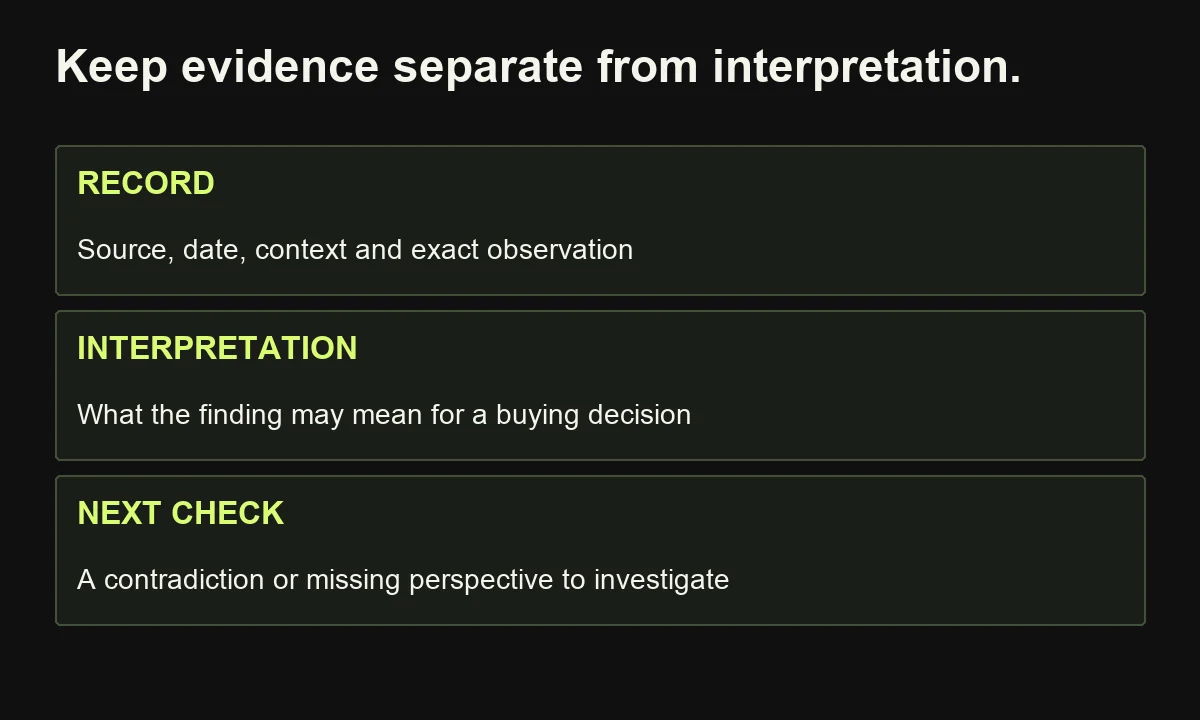
Separate what someone says from your interpretation. An interview comment about unreliable reports supports a reporting concern. It does not automatically establish that the person fears losing their job.
Also distinguish a buyer persona from a user persona. The person operating software may influence its purchase, but their daily usability needs and the budget owner's investment criteria are not interchangeable.
Ideal customer profile vs buyer persona: the practical differences
The ICP defines which organizations deserve attention; buyer personas explain how people within relevant buying situations evaluate change. Both depend on evidence, and they should inform each other. Keep them connected while preserving their separate jobs: account selection, human understanding, and decisions about what to say or investigate next.
| Dimension | Ideal customer profile | Buyer persona |
|---|---|---|
| Main unit | Organization or account segment | People participating in a purchase |
| Central question | Can we serve this account well? | What must these people understand or decide? |
| Useful inputs | Customer outcomes, delivery effort, fit conditions | Buying interviews, objections, evaluation behavior |
| Practical output | Targeting and qualification criteria | Messaging, content, evidence and conversation guidance |
| Common failure | Firmographics without reasons | Invented personality without buying insight |
A target market is the broader market you could serve. Segmentation divides that market using meaningful differences. An ICP prioritizes a best-fit segment for a particular offer. A target account list contains actual organizations selected for investigation or outreach.
A buying group is the actual set of participants in a purchase. Personas are reusable research models; they cannot tell you which named people are involved in a live deal without discovery.
Keep those distinctions visible in your CRM and briefs. A contact's senior title does not prove account fit, decision authority, budget availability, or interest. Each requires its own supporting information.
A worked B2B example: same account, different decisions
Consider a hypothetical company selling lead-routing software to B2B service firms. Its proposed ICP is firms with multiple sales teams, recurring inbound enquiries, a supported CRM, and a named operations owner. The problem is inconsistent assignment and follow-up. These are illustrative conditions, not researched market benchmarks or promises about any product.
An employee range could help find candidates, but it should not override those conditions. A smaller firm with complex routing might fit better than a larger firm with a simple shared inbox.
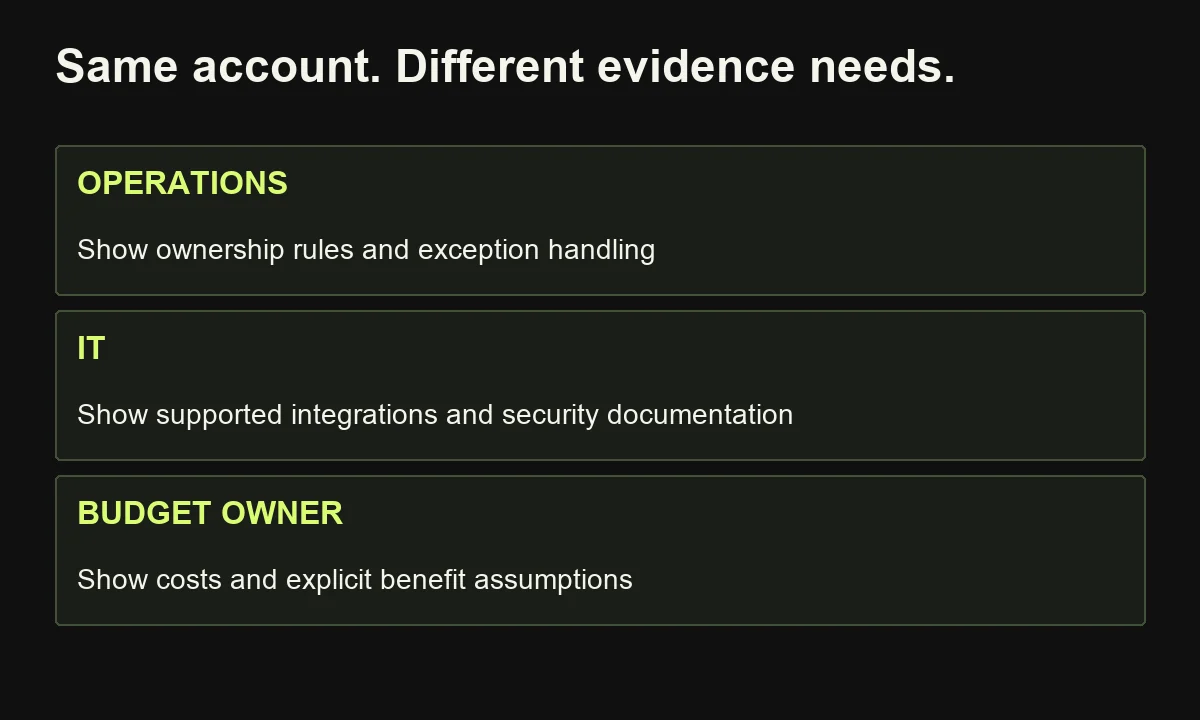
Inside a suitable account, different people need different answers:
| Participant | Decision or concern | Useful evidence |
|---|---|---|
| Operations lead | Can we manage exceptions and ownership? | Routing rules and failure-handling demonstration |
| Sales leader | Will assignment reflect our coverage model? | Territory and escalation walkthrough |
| IT reviewer | Can this meet our technical requirements? | Supported integrations and security documentation |
| Budget approver | Is the investment justified? | Transparent costs and explicit benefit assumptions |
These are role hypotheses to investigate, not four fully validated personas. One person may hold several roles; a particular purchase may involve others.
Notice what changes in the content. The operations lead needs a workflow explanation. The approver needs a business case. Sending both a feature list misses their different evaluation tasks, even though they belong to the same ICP.
How do you build an ICP from customer evidence?
Build an ICP by comparing customer situations and outcomes, identifying conditions that explain value, and checking whether your business can repeatedly serve those conditions. Include successful accounts, difficult implementations, lost opportunities, and poor-fit enquiries. A profile based only on your happiest customers can miss important constraints and alternative explanations.
Begin with one offer. Mixing consulting, software, and training customers can produce an average that describes nobody's buying situation.
Create a research table with one row per account. Record use case, relevant business characteristics, implementation requirements, relationship outcome, delivery effort, and the source behind each entry. Use comparable periods where financial or retention data is available.
Then ask three questions:
- Value: Under what conditions did the customer achieve the intended outcome?
- Delivery: What did successful implementation require from both sides?
- Viability: Could the relationship support the actual cost of serving it?
Look for contradictions. If two similar-sized companies had different results, investigate ownership, workflow, expectations, or adoption before concluding that size predicts fit.
Convert the findings into provisional rules: required conditions, useful indicators, exclusions, and unknowns. Record why each rule exists.
A lost deal does not automatically reveal poor fit. Timing, competitive positioning, procurement, or your own sales process may explain the outcome. Treat the reason as something to verify rather than a convenient label.
How do you research buyer personas without inventing them?
Research personas by reconstructing real buying decisions with people who recently experienced them. Ask about the sequence of events, alternatives, concerns, participants, and evidence. Compare accounts and perspectives before declaring a pattern. Interviews provide explanations and language; records and observed behavior help test whether those explanations match what happened.
The Buyer Persona Institute recommends interviewing recent buyers, including people who chose competitors or chose not to buy. That broadens the view beyond customers who already accepted your offer.
Use questions that invite an actual story:
- What changed before you started looking?
- How was the problem being handled previously?
- Which options did you seriously consider?
- What nearly stopped the purchase?
- Who challenged the proposal, and what did they ask?
- What information changed your view?
- What happened after the decision?
Follow specific incidents rather than asking whether someone would hypothetically appreciate a feature. Strategyzer's interviewing guidance similarly emphasizes concrete past experiences over abstract opinions.
Record account context, participant role, decision date, and your interpretation separately. Obtain appropriate permission for recording and quotation; keep identifying research material private.
There is no universal interview count that makes a persona accurate. Continue until the important differences are understood well enough for the decision at hand. Small qualitative samples can reveal useful explanations without establishing how common each view is across a market.
How many ICPs and personas do you need?
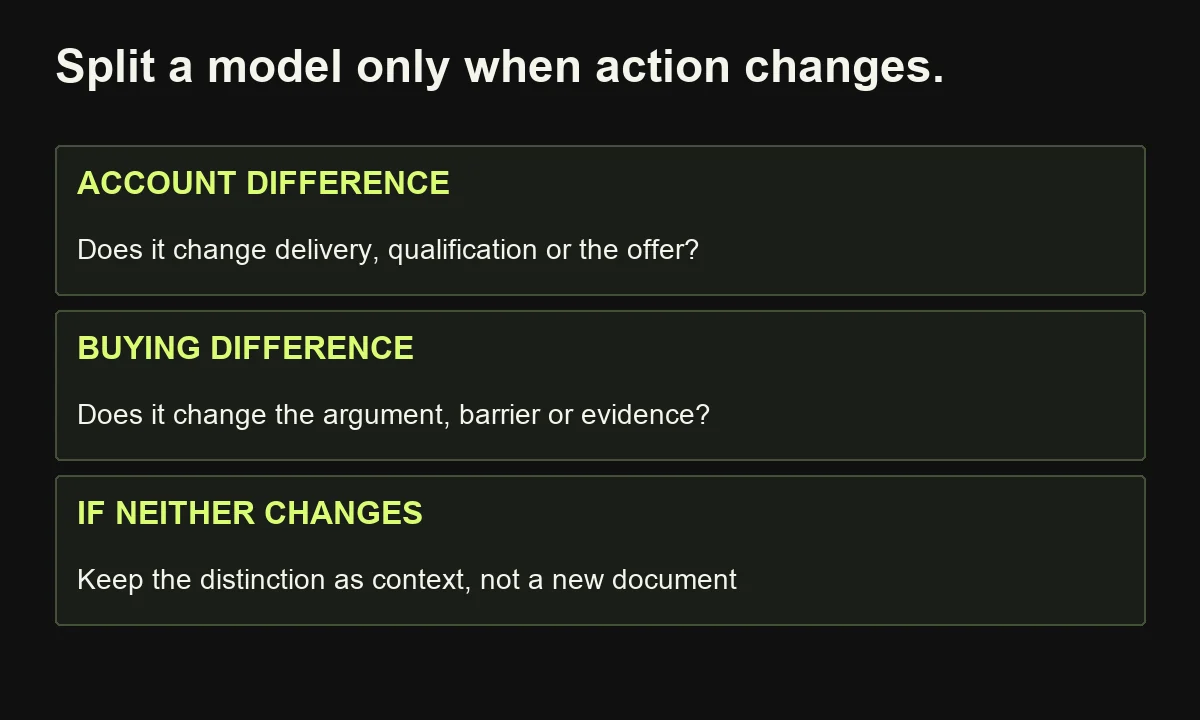
Create separate ICPs when differences in account conditions materially change your offer, delivery model, qualification, or route to market. Separate persona insights when buying goals, barriers, evidence needs, or decision behavior change enough to require different treatment. Do not multiply documents simply because your prospect database contains many industries or job titles.
For the routing example, a small services firm and a regulated enterprise might need distinct account profiles if implementation, procurement, and product requirements differ substantially.
Two operations managers with different titles may still share the same decision problem. Conversely, two people called “marketing director” may face different purchases, constraints, and approval structures.
The Buyer Persona Institute distinguishes decision-focused research from biographical profiles. Its approach can encompass multiple participants around a shared buying decision. Persona conventions differ; explicitly document whether yours represents a role or the broader decision pattern.
Use the smallest set of models that changes useful action. Ask: Would this distinction alter our qualification rule, content argument, evidence, channel, or delivery promise? If not, a separate document may add maintenance without improving decisions.
For an early-stage company without customers, label the ICP and personas as hypotheses. Use relevant prospect interviews, category research, and a clearly scoped pilot to investigate them. Competitor positioning can suggest questions, but it cannot validate your own customer fit or reveal private buyer motivations.
Where does the buying group fit into the model?
The buying group connects your account profile to the people who influence a particular purchase. Map participants, responsibilities, unanswered questions, and approval dependencies for the live opportunity. Use personas as preparation, then verify the actual situation. A model of likely behavior should never replace asking who is involved and what they need.
Forrester identifies distinct buying-group roles, including champions, decision-makers, influencers, users, and ratifiers. These describe participation in a decision, not a fixed organizational chart.
In the routing example, an operations manager might champion the purchase, while IT evaluates technical conditions and finance examines the expenditure. The same individual might also be a user. Confirm responsibilities rather than assuming them from a title.
Record four things for each known participant: their decision, concern, required evidence, and next unresolved dependency. “Finance engaged” tells you less than “finance needs implementation cost and benefit assumptions before approval.”
Include the status quo as a serious alternative. A company may accept manual work because switching effort, perceived risk, or another priority outweighs the expected benefit.
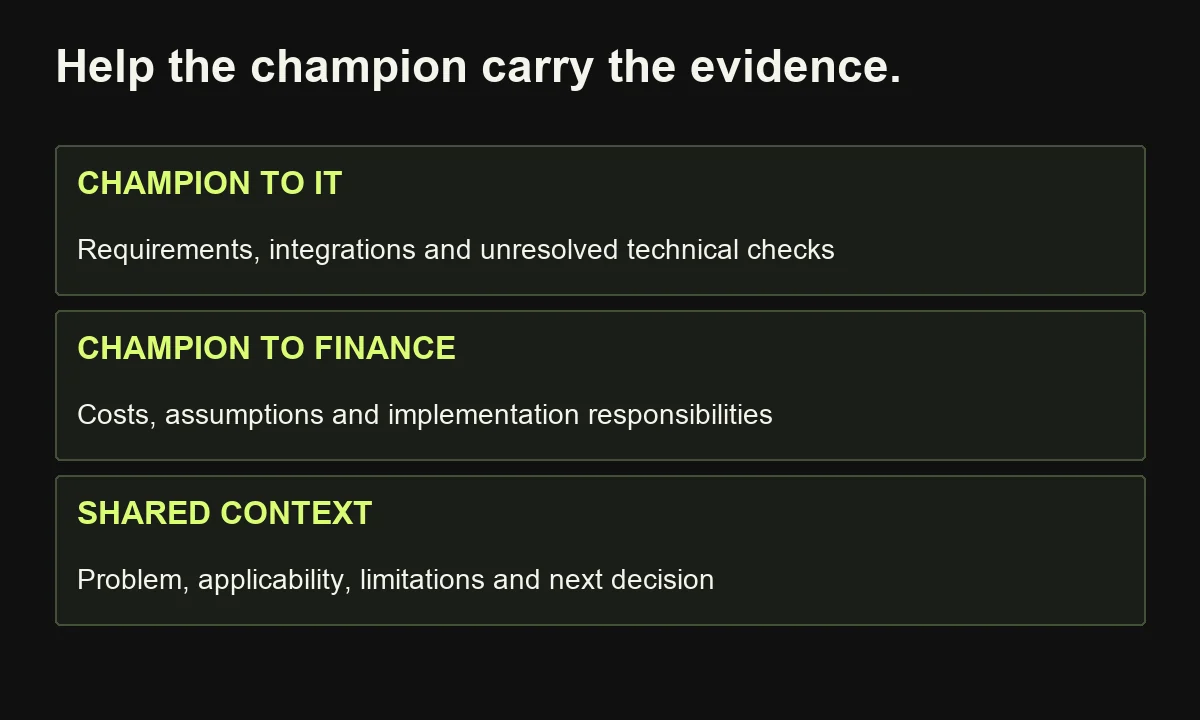
Your content should help the original contact explain the proposal internally. Give forwarded material enough context to stand alone: problem, applicability, evidence, limitations, and next step. A confident champion still needs something credible to share with colleagues who never attended the first conversation.
How do ICPs and personas improve content strategy?
Use the ICP to select the commercial context and personas to define the reader's decision. Then choose the evidence and format that help resolve it. This turns audience research into content choices: which questions to answer, which examples to include, which claims need support, and which next action is proportionate.
Apply Account–Decision–Evidence to the hypothetical routing offer:
| Account condition | Reader's decision | Content and evidence |
|---|---|---|
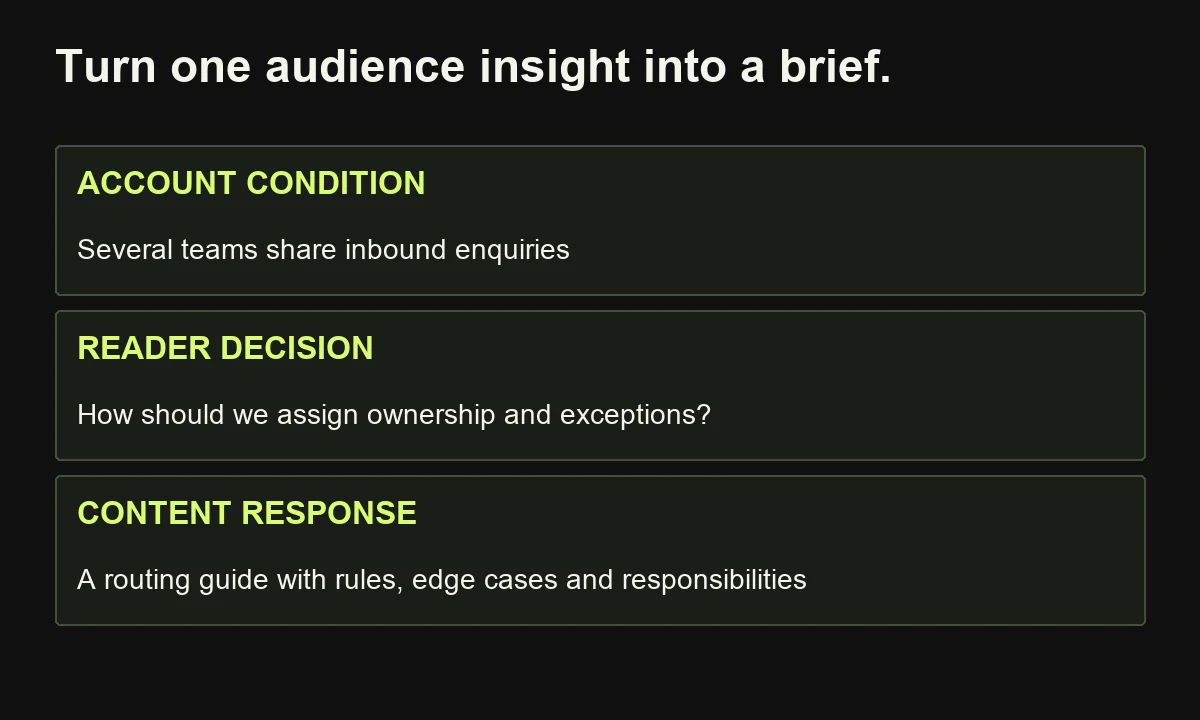
| Several teams share inbound enquiries | How should ownership work? | Assignment guide with exception examples |
| Supported CRM, limited operations capacity | Can we implement this responsibly? | Setup requirements and maintenance responsibilities |
| Active budget review | Does the benefit justify the expense? | Editable business case with labeled assumptions |
Turn one row into a brief: primary reader, specific decision, trigger, approved offer facts, supporting sources, objection, and next step. Ask a reviewer to identify the decision from the finished draft without seeing the brief.
Connect relevant assets using internal links across blogs, case studies, and services. A guide explains the method; a case study supplies bounded project evidence; service information clarifies scope and fit.
For SEO, AEO, and GEO, publish clear answers that remain understandable when quoted. Google's AI search guidance supports strong existing SEO foundations; special AI markup does not guarantee inclusion. Audience specificity improves the argument's usefulness, not a guaranteed ranking position.
How should sales, marketing, and automation use the profiles?
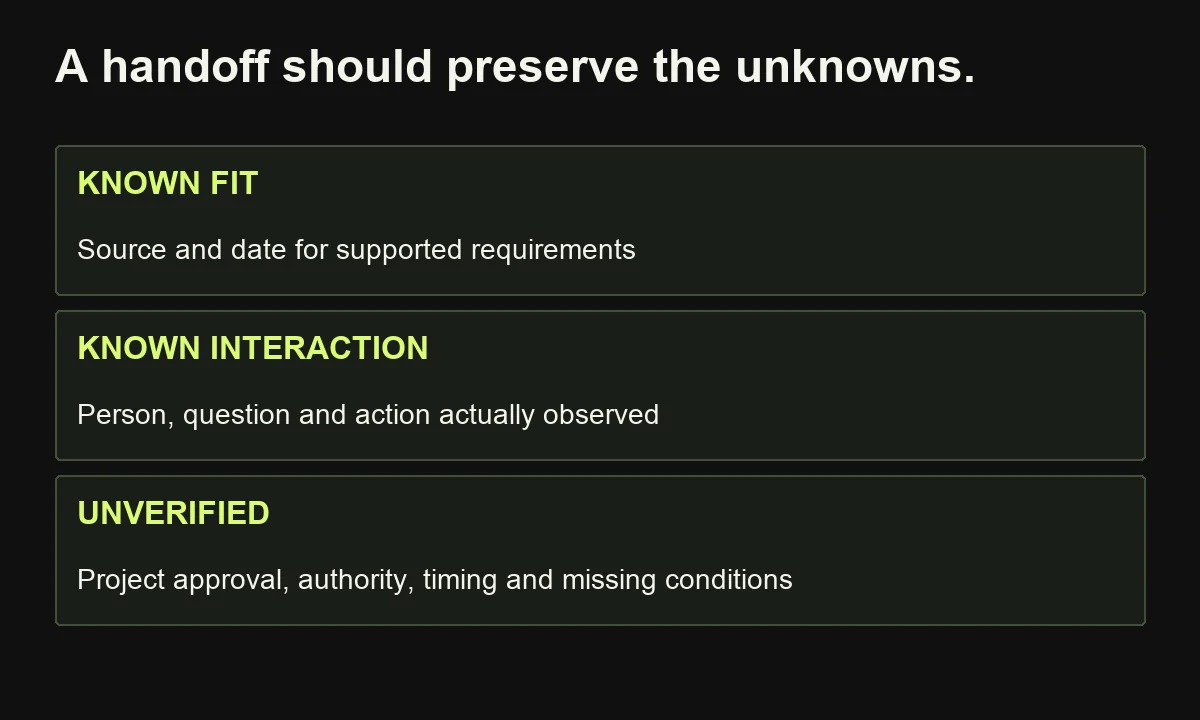
Keep account fit, purchase readiness, and contact engagement as separate judgments. Use ICP criteria to investigate fit, buying signals to investigate timing, and persona insights to choose relevant communication. An article download proves an interaction. It does not establish an approved project, decision authority, or the suitability of the company behind it.
In your CRM, store account-level conditions against the account: use case, relevant systems, implementation owner, exclusion checks, and unresolved gaps. Keep participant role and evaluation concerns against the contact or opportunity, as appropriate to your system.
Write an explicit handoff note: why this organization may fit, what is known about the project, who engaged, what they asked, and what remains unverified. Sales should be able to challenge the assumptions rather than inherit a mysterious score.
Automations can help organize evidence or suggest follow-up. A rules-based workflow might flag a missing CRM requirement; AI might summarize interview notes for human review. Neither should silently turn inferred motivations into confirmed customer facts.
For each important field, retain source, date, and verification status. Avoid collecting personal details that have no legitimate bearing on the buying decision.
See the B2B marketing automation guide for handoff and ownership considerations. The practical priority is consistent definitions across teams, so a promising interaction becomes a useful conversation rather than an automatic assumption of readiness.
How do you know whether the profiles are working?
Evaluate profiles by the decisions they improve and the outcomes of accounts selected using them. Track fit, content usefulness, opportunity progression, and customer outcomes separately. Compare like situations over appropriate periods, and investigate exceptions. A change in conversion after introducing a persona does not by itself prove that the persona caused it.
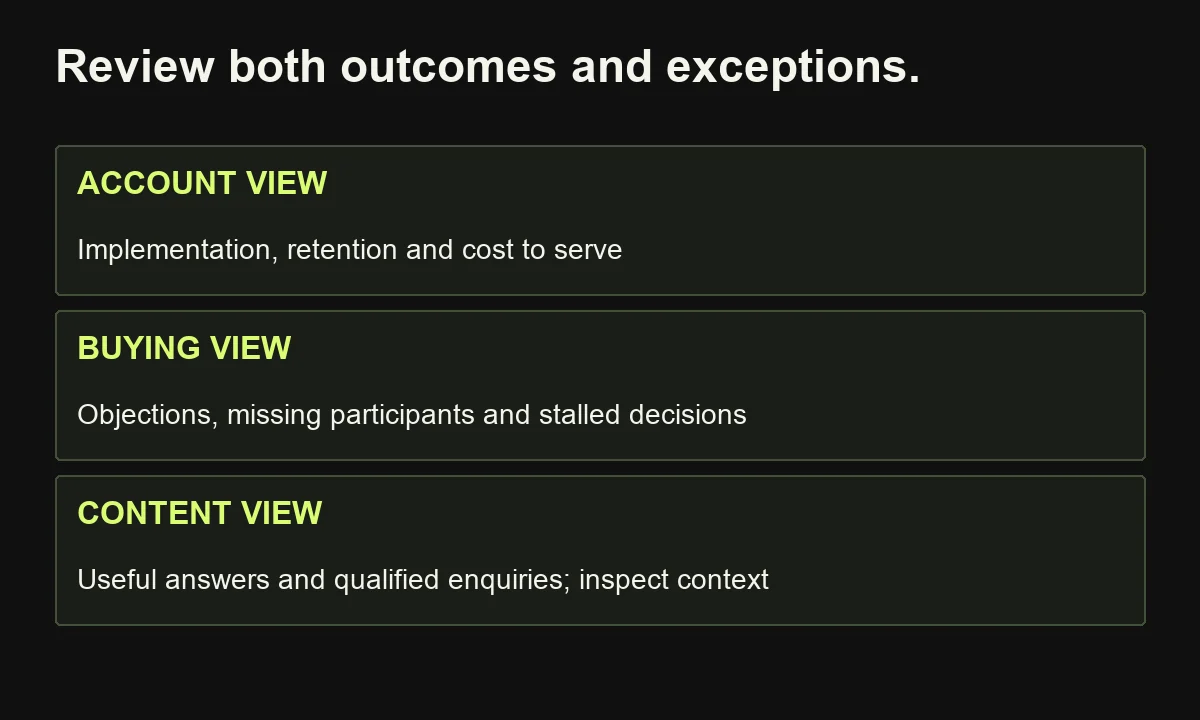
A practical review combines three views:
- Account quality: Are target accounts meeting fit conditions and succeeding after purchase? Inspect implementation effort, retention, and service burden where relevant.
- Buying clarity: Are recurring objections understood? Can sales identify missing participants and explain stalled decisions?
- Content usefulness: Do the intended people find the answers helpful? Review sales feedback, customer questions, and qualified enquiries alongside search data.
Report denominators and context. “Four of ten assessed opportunities met our implementation requirements” is more useful than “fit improved,” but remains a small sample. Avoid treating a convenient percentage as a market-wide finding.
Check for selection bias: targeting only the accounts your model already favors can hide promising adjacent segments. Keep a small, explicitly exploratory list where uncertainty justifies further research.
Assign a research owner and review after meaningful triggers: a new offer, repeated losses, unexpected support effort, changing buyers, or contradictory interviews. Preserve previous versions so you can explain which assumption changed and why. A quarterly checkpoint can help organize the work, but events should drive substantive updates.
A usable template, common mistakes, and frequently asked questions
Download the ICP and buyer decision worksheet. Separate account conditions, buying insights, evidence, confidence, and content decisions. Start with one offer and buying situation. Leave uncertain fields open to guide the next interview.
Avoid three mistakes: copying your largest customer's attributes without explaining fit; inventing personal detail to make a persona feel real; and creating profiles that never alter targeting, briefs, or sales conversations. Research earns its place through better choices.
Which comes first: ICP or buyer persona?
Start with a provisional account hypothesis so research has boundaries. Develop buyer insights alongside it, then revise both when conversations reveal different needs or delivery constraints.
Can one ICP contain several personas?
Yes. One account segment can involve several decision perspectives. Separate them when their needs change the communication, not merely because job titles differ.
Is an ICP the same as a target audience?
No. Target audience is broader language. In B2B, specify whether you mean account fit, content readers, campaign recipients, or actual buying participants.
Can AI create the profiles for me?
AI can organize permitted research and surface patterns. People must verify sources, contradictions, and implications. Generated assumptions are hypotheses, not customer evidence.
If your audience documents are not helping you choose what to publish, tell me about your offer and the buyer question you cannot answer. We can assess the research, content direction, and writing needed to make those choices clearer.