AI summary
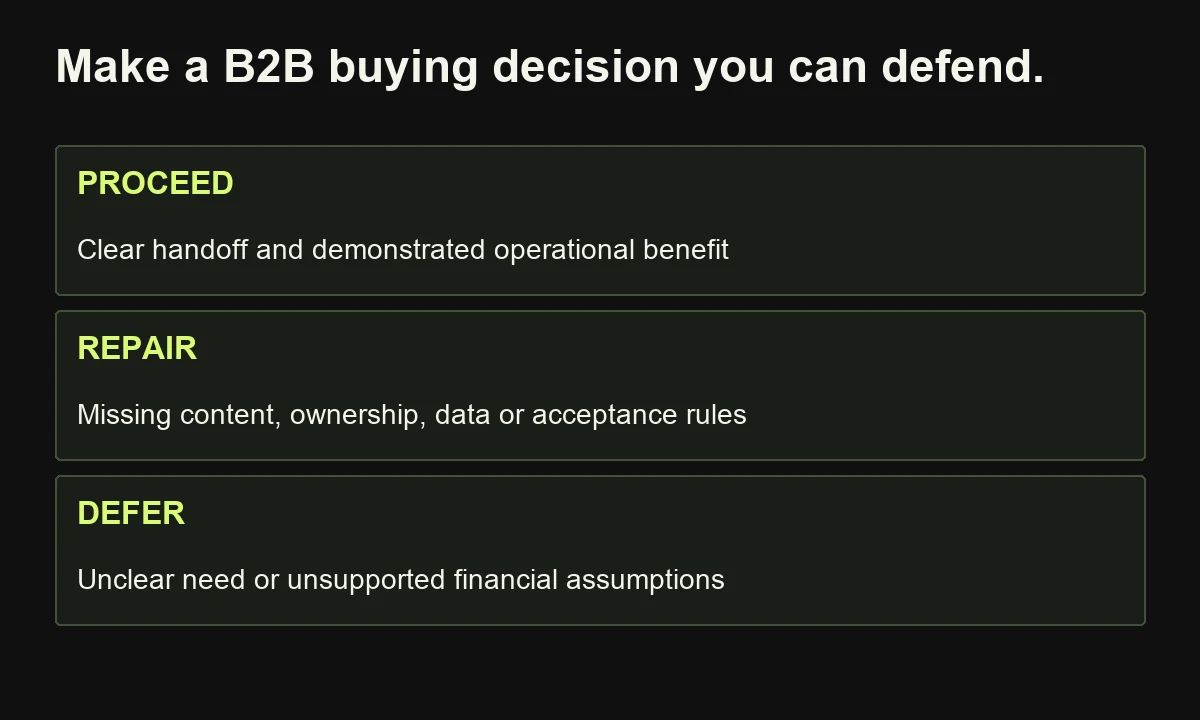
B2B marketing automation is worth funding when it improves a useful buyer decision or sales handoff at a defensible cost. Define the evidence and accountable owner before expanding the workflow.
- Qualify the account context: Keep contact engagement, account fit, buying-group questions, and sales acceptance distinct. A lead score or delivered notification does not establish readiness or commercial progress.
- Make the handoff usable: Agree required information, ownership, response rules, and rejection feedback. Supply content that helps buyers evaluate the offer, with clear journey exits and exceptions.
- Separate capacity from financial return: Include setup and ongoing costs. Count recovered hours separately from actual avoided expense and evidenced incremental contribution; attributed pipeline is not cash.
- Prove the operating model: Pilot representative inputs and failures, compare consistent cohorts, and retain human ownership of strategy, evidence, review, and recovery.
B2B marketing automation is worth the money when it improves a defined buyer journey or sales handoff enough to justify setup, software, content, and operating costs. Measure accepted work, relevant opportunities, and financial value separately. More emails, higher lead scores, or faster drafting do not, by themselves, establish a return.
A marketing team can automate everything between a download and a sales notification while leaving the important question unanswered: does the next person receive something they can use?
That person might be a buyer receiving a comparison guide, a salesperson evaluating an enquiry, or an operations manager reviewing the business case. Each handoff has different requirements. A successful software action is only the beginning.
This guide is for B2B marketing leaders, founders, and service businesses deciding whether to fund a first workflow or expand an existing programme. It addresses buying groups, qualification, lead nurturing, sales alignment, and long measurement windows.
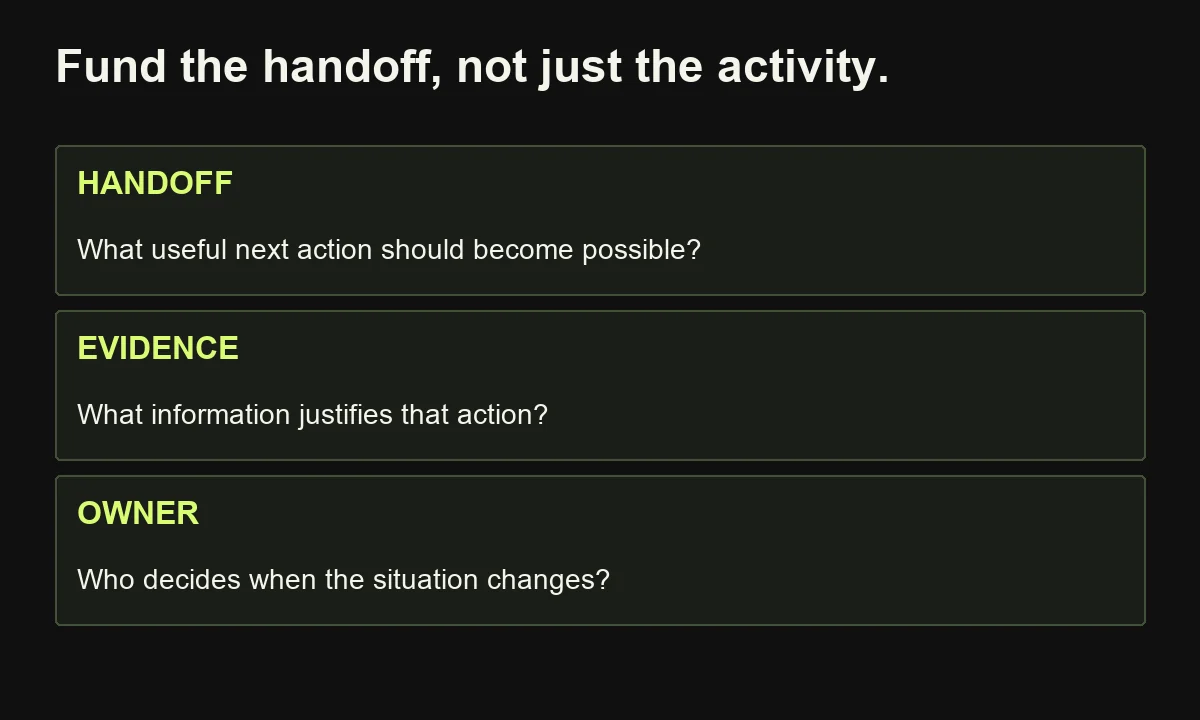
My proposed decision aid is Handoff–Evidence–Owner: identify the useful next action, the evidence needed to justify it, and the person responsible when the process fails or changes. This is an original editorial framework, not a validated performance model.
The financial examples use hypothetical assumptions, not market prices or client outcomes. For the broader distinction between time returned and money saved, see my general marketing automation investment guide. Here, the question is what changes when the sale involves an account, several people, and substantial evaluation.
What makes B2B marketing automation different?
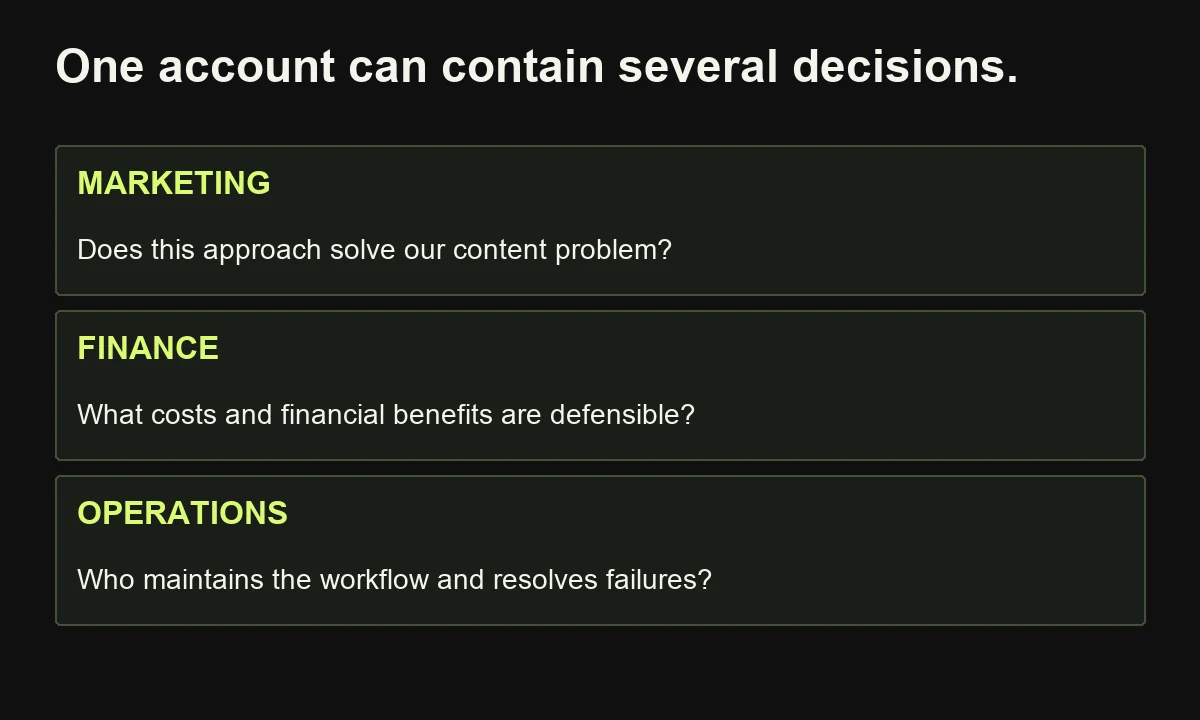
B2B marketing automation coordinates information and actions around prospective or existing business customers. It may support qualification, relevant messages, account activity, and sales follow-up. The distinctive planning problem is that a contact's behavior does not necessarily represent the account's decision, and different participants may need different evidence before the business can proceed.
A marketing manager might investigate a workflow problem. Finance may evaluate recurring cost. Operations may ask who maintains the integration. Sending each person the same promotional sequence can miss those decisions.
Adobe's buying-group documentation distinguishes accounts, solution interests, roles, and group members. That illustrates why an account can contain several relevant people and different buying groups for different offers.
You do not need an enterprise buying-group platform to apply the principle. A small team can record the account, known participants, unresolved questions, and relevant next action in its existing CRM.
The practical unit is a supported decision, not a scheduled touchpoint. Ask what the communication or handoff helps someone evaluate.
Salesforce's B2B automation overview describes lead nurturing and sales-marketing coordination within its customer platform. That is a capability description, not proof that adopting the software will increase your revenue.
Begin by mapping the real buying situation. A straightforward service enquiry and a complex account evaluation should not automatically enter the same workflow or share the same success measure.
When is a B2B team ready to invest?
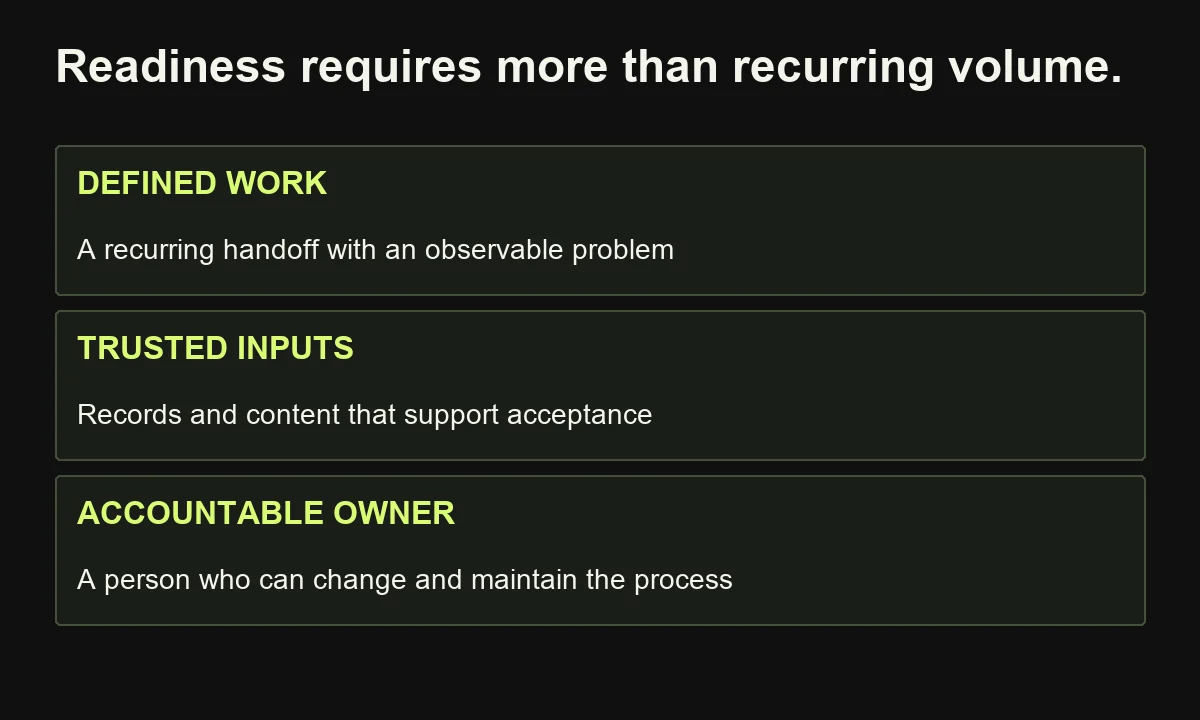
A team is ready when it can identify recurring work, define a useful output, supply trustworthy inputs, and assign an owner. Automation is especially worth investigating when repeated handoffs lose context or consume avoidable effort. If the offer, audience, or approval authority remains unclear, those problems need attention before the workflow can perform reliably.
Look for observable symptoms:
- Suitable enquiries arrive, but responsibility for responding is inconsistent.
- Sales receives names without the problem, request, or relevant history.
- Buyers repeatedly ask questions that existing content does not answer.
- Teams copy approved information between systems and reconcile conflicting records.
Separate process symptoms from demand problems. Automating a follow-up cannot create an attractive offer. A sophisticated lead-scoring model cannot supply evidence that a prospect has a problem you can solve.
Review recent examples of the same task. Record active effort, waiting, missing information, corrections, and the next person's response. Establish the baseline before changing the system.
Then write an investment hypothesis: “We will make consultation enquiries easier to assess by capturing the request and assigning an accountable owner.” Specify what would show improvement.
If volume is low, a clearer form, shared inbox, or reusable response may be sufficient. If work crosses several maintained systems, an integration pilot may be justified.
Choose the smallest intervention that can test the hypothesis. A major platform purchase should follow a demonstrated requirement, rather than become the way the team discovers what its process ought to be.
What customer data must be trustworthy first?
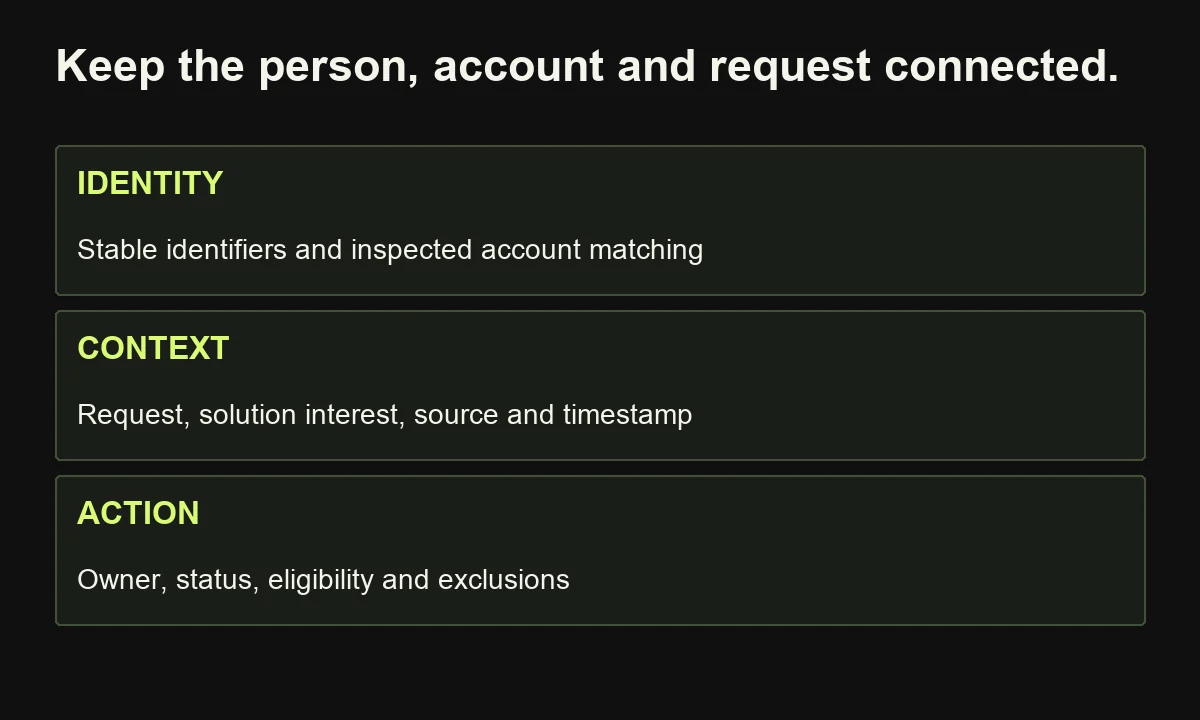
The workflow needs enough reliable information to identify the person, the relevant account, the request, and the permitted next action. Define the source and owner of each essential field. Missing or conflicting data should produce a visible exception, not a guessed customer profile or an automatic claim that the account is qualified.
Create a small data contract:
| Field | Decision it supports |
|---|---|
| Stable person and account identifiers | Recognize the record and relevant organization |
| Request and solution interest | Understand what help is being considered |
| Source and timestamp | Interpret when and how the signal arrived |
| Current owner and status | Avoid conflicting action across teams |
| Communication eligibility and exclusions | Choose an appropriate next message |
Do not infer buying authority from a job title alone. A consultant may represent several organizations; a personal email address may still belong to a genuine buyer. Where matching is uncertain, route the record for inspection.
Specify which system owns the authoritative value. If two integrations update lifecycle status differently, a visually tidy automation can still produce contradictory instructions.
Use synthetic or suitably anonymized records while testing. Grant only the access the workflow needs, and check the organization's requirements for handling customer information.
Finally, test correction: what happens when an account association changes or a contact is no longer eligible? A data contract needs a maintenance path, not just a successful initial import.
Can lead scoring distinguish interest from buying readiness?
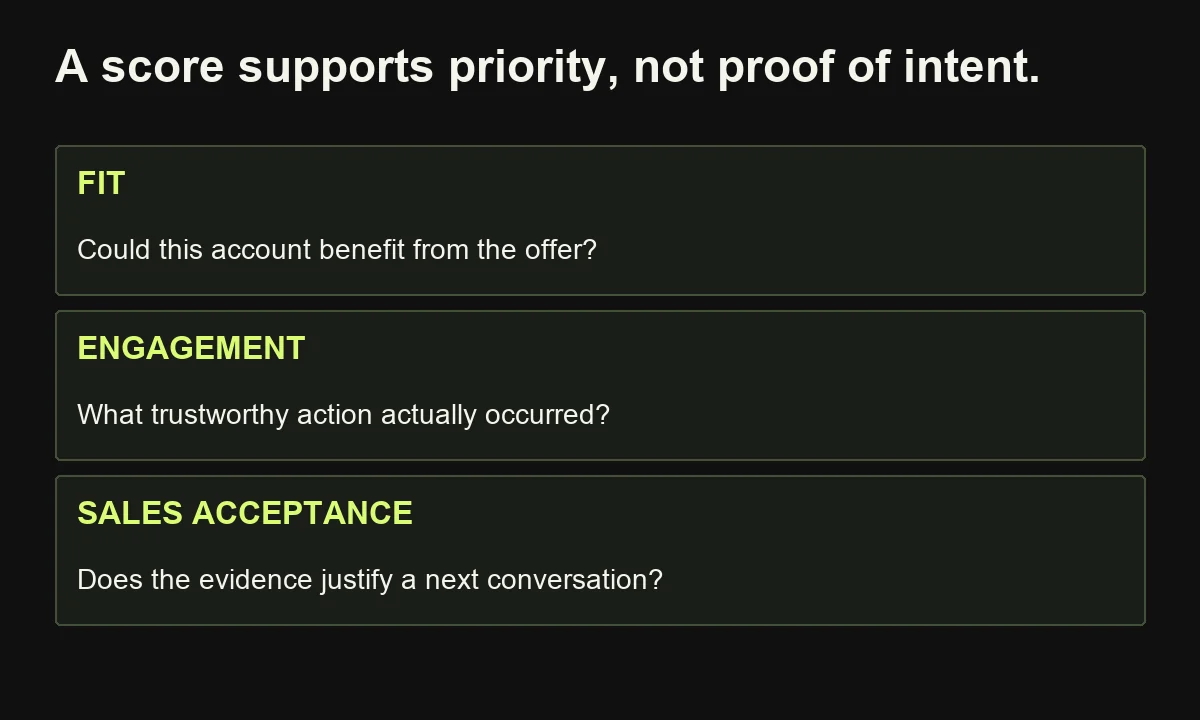
Lead scoring can organize fit and engagement signals, but a score is a prioritization rule rather than proof of intent. Separate who could benefit from your offer from what someone has done. Validate the criteria with sales feedback, and preserve the evidence behind a score so the next person can assess it.
HubSpot's scoring documentation distinguishes fit, engagement, and combined scores for supported records. The implementation lesson is to retain those distinctions instead of treating every interaction as equal commercial progress.
For a hypothetical consultancy, relevant fit might include a content team and an identifiable review problem. Engagement might include a request for audit scope. A generic article visit supplies much less context.
A noisy signal should not become a confident handoff. HubSpot's bot-filtering guidance explains that email activity can include security scanners and privacy-related interactions. Inspect how your platform handles them before using opens or clicks as qualification evidence.
Define a marketing-qualified lead, or MQL, as a record meeting your agreed marketing criteria. Define sales acceptance separately: did the salesperson confirm that the record deserves the next conversation? These are organizational definitions, not universal thresholds.
Review accepted, rejected, and unresolved examples. Record why sales disagreed with the rule. Change the criteria when the evidence warrants it, and retain the version used during each measurement period so later results remain interpretable.
How should B2B lead nurturing support a buying group?
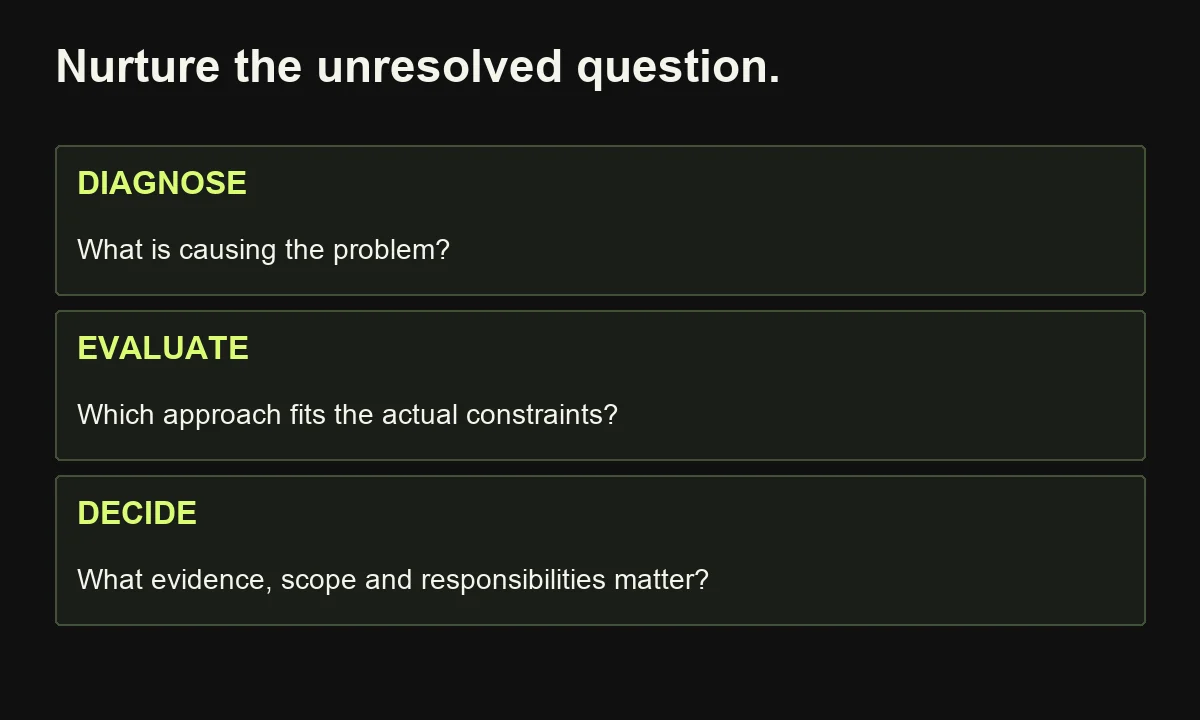
Lead nurturing should provide relevant evidence while a buyer evaluates a problem, approach, or provider. Choose the next message by the unresolved question and known situation, not simply by how many days have elapsed. Coordinate with sales activity and provide clear exit conditions so the automated journey does not contradict an active conversation.
Map the questions before writing the sequence. A hypothetical workflow consultancy might need these assets:
- A diagnostic explaining whether delays come from drafting or approval.
- A comparison of hiring capacity, improving responsibilities, and automating handoffs.
- A relevant project example with its actual conditions and limitations.
- An explanation of engagement scope, access, ownership, and support.
Those assets serve different jobs. My TOFU, MOFU, and BOFU guide explains recognition, evaluation, and decision support without imposing a compulsory route.
Let the known context change the sequence. An existing opportunity may need implementation detail; a new subscriber may need an explanation of the problem. A customer should not automatically receive prospect messaging for a service already purchased.
Keep content understandable when forwarded. Another stakeholder may see the asset without earlier emails or your terminology. Explain the recommendation, evidence, trade-offs, and applicable conditions on the destination page.
Automation can deliver those assets consistently. The strategic work is deciding which uncertainty matters and whether your content genuinely resolves it. Without that work, increasing message frequency can increase activity while leaving evaluation unsupported.
What should a sales handoff actually contain?
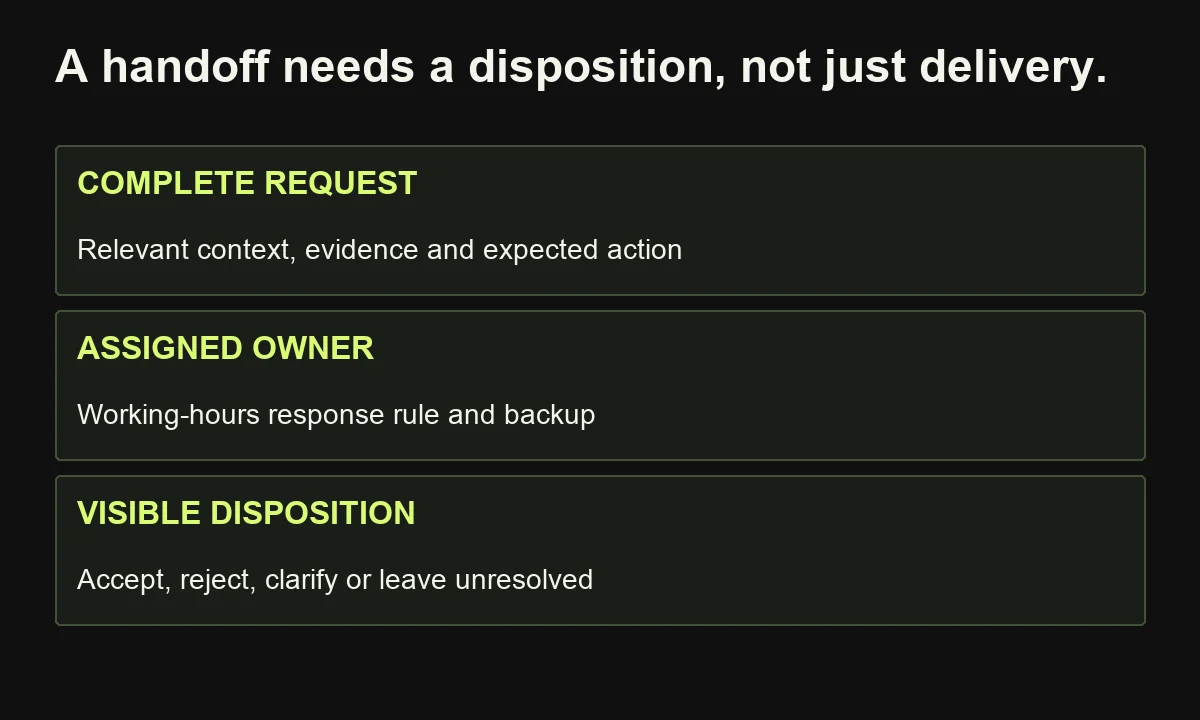
A useful handoff gives sales the request, account context, qualification evidence, relevant activity, and expected next action. Assign an owner and require a visible disposition: accepted, rejected, returned for clarification, or still unresolved. A CRM notification confirms delivery of a record; it does not establish that the salesperson understood or acted on it.
Use a handoff contract agreed by marketing, sales, and operations. Define:
- Which conditions make a record eligible for transfer.
- Which information must accompany it.
- Who receives it, including backup ownership.
- The response window and working-hours interpretation.
- What happens when sales accepts, rejects, or needs clarification.
For the consultancy, an acknowledgement might say: “Request received; assigned to the strategy lead; the prospect is evaluating approval-process redesign.” That contains more useful context than “hot lead.”
Test ownership conflicts. If two contacts from the same account submit requests, should the system assign two independent conversations or attach both to an existing evaluation? Agree the rule rather than letting whichever automation runs first decide.
Measure time from a complete eligible request to an actual disposition, alongside active effort. An automated timestamp should not disguise an unanswered request.
Sales feedback belongs in the system. Rejection reasons such as unsuitable scope or missing context help refine the message, qualification criteria, and offer explanation. A reliable handoff is a learning loop, not a one-way notification that marketing treats as the end of its responsibility.
What belongs in a B2B marketing automation budget?
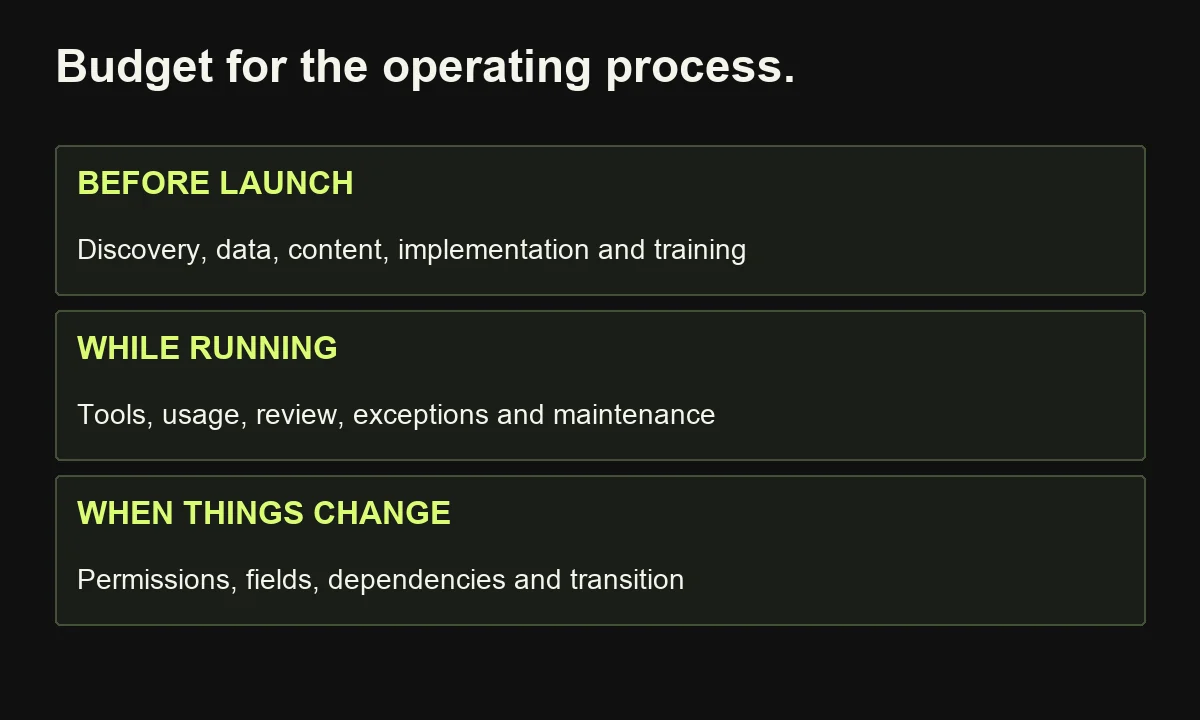
Budget for the whole operating process: discovery, implementation, data preparation, content, subscriptions, usage, review, training, maintenance, and changes. Compare incremental cost against the existing process. Separate one-time work from recurring expenditure, and name the internal effort that remains after automation rather than treating it as invisible or automatically eliminated.
The largest gap may be content readiness. A platform can deliver a service comparison, but someone must research and write the comparison. Existing generic assets may not answer procurement or implementation questions.
Build a cost register with owners and assumptions:
| Cost category | What to inspect |
|---|---|
| Setup | Mapping, integration, testing, data correction, training |
| Recurring tools | Required plan, contacts, profiles, sends, usage |
| Human work | Evidence review, exception handling, content updates |
| Maintenance | Changed fields, access, dependencies, monitoring |
| Transition | Migration, exports, historical records, exit support |
Check the billing unit before estimating volume. As reviewed in my 2026 tools shortlist, contacts, tasks, credits, and executions are different measures. A hundred enquiries may produce several hundred actions, depending on the design.
Do not count an existing CRM twice, but include an upgrade required by the new workflow. Identify who pays for model usage and external integrations.
Request a busy-period estimate and a failure scenario. A proposal that prices only successful runs and initial setup has not yet described the complete cost of operating the system through ordinary changes.
How do you build a defensible B2B automation business case?
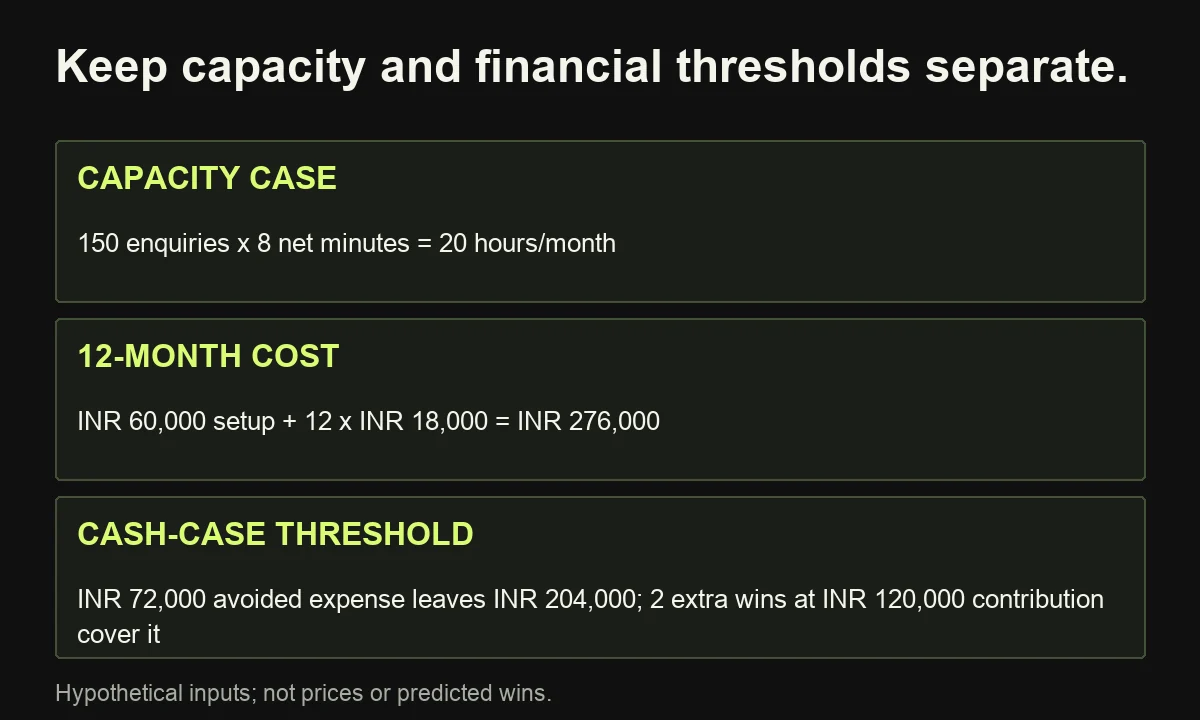
Separate operational improvement from financial return. Recovered staff time creates capacity; actual avoided expenditure and evidence-backed incremental contribution support a financial case. Use the same assessment period for benefit and cost, include setup once, and avoid adding the same labor saving to both ledgers. Pipeline value is not realized financial benefit.
Consider a hypothetical team processing 150 enquiries monthly. The new process saves eight net minutes per enquiry, after review and exceptions. That returns 20 hours. At an assumed internal rate of ₹1,200 per hour, capacity value is ₹24,000 monthly.
Assume incremental operation costs ₹18,000 monthly, with ₹60,000 setup including content preparation and training. Surplus capacity value is ₹6,000 monthly, covering setup in ten months on that basis. Unchanged payroll means this is not ten-month cash payback.
For a separate financial scenario, assume ₹6,000 monthly of genuinely avoided expense. Twelve-month cost is ₹276,000: setup plus twelve months of operation. Avoided expense totals ₹72,000, leaving ₹204,000 to cover.
If an additional won deal supplies ₹120,000 contribution within the period, the threshold is two incremental deals. Contribution means revenue after the variable cost of fulfilling that additional work. Those deals must be genuinely additional and evidenced, not simply touched by the workflow.
These are invented planning inputs, not prices or predicted outcomes. Replace them using the editable B2B business-case worksheet, and leave unsupported benefits out of the financial ledger.
How should you measure a long B2B sales cycle?
Measure immediate workflow performance and later commercial outcomes separately. Use consistent cohorts, qualification definitions, and observation windows. A recent enquiry may not have had time to become an opportunity or sale. Compare records with similar follow-up time, and report unresolved outcomes instead of classifying every unfinished evaluation as success or failure.
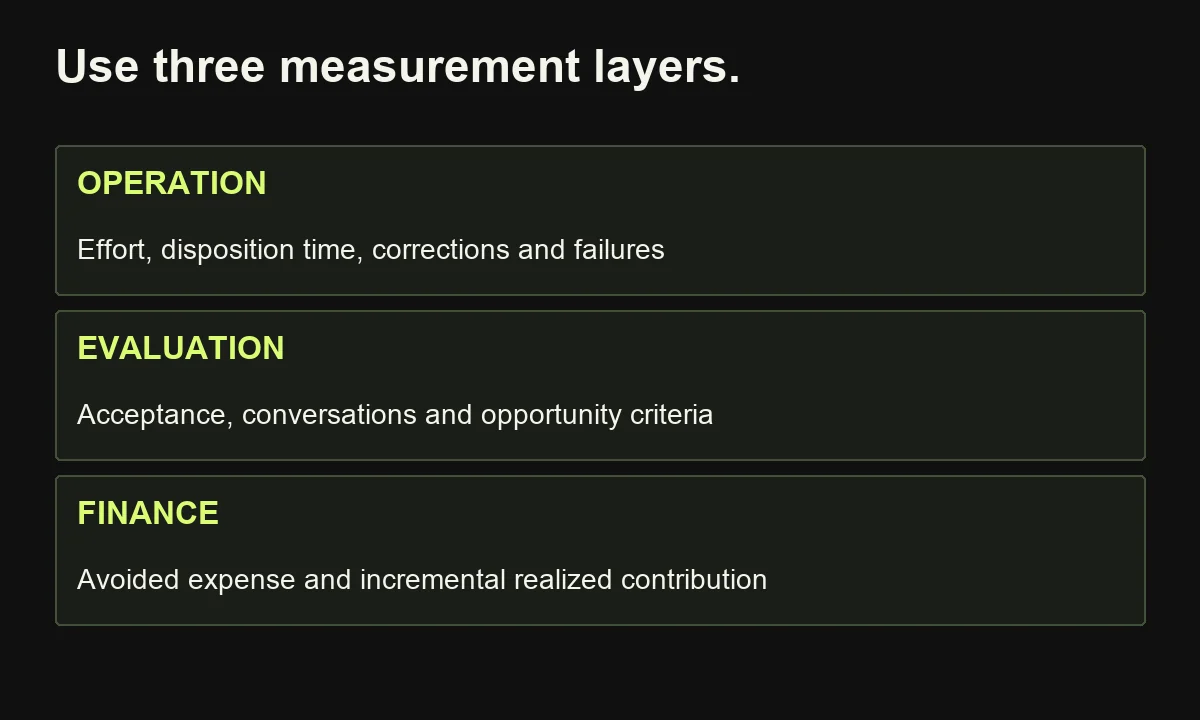
Start with three layers:
- Operation: complete records, time to disposition, corrections, duplicate handling, and failed runs.
- Evaluation: sales acceptance, relevant conversations, agreed next steps, and opportunity criteria met.
- Finance: genuinely avoided expenditure and additional realized contribution supported by evidence.
Report numerators and denominators. “Acceptance improved” is incomplete without the eligible records, accepted records, period, and any changes to the rule.
Google's attribution guidance explains assigning credit to interactions. Credit allocation helps describe a journey; it does not, by itself, establish what would have happened without the automation.
Where practical, design a controlled comparison with a qualified analyst. Consider assigning at account level when contacts share one evaluation, so competing treatments do not mix within the same buying group. Small samples can remain inconclusive.
If a comparison is unavailable, use operational evidence and describe the commercial uncertainty openly. Record other changes: offer revisions, new salespeople, campaigns, seasonality, and pricing.
Avoid using a weighted pipeline estimate as cash available to recover setup. It is a forecast with assumptions, not a bank balance or proof that the workflow caused a sale.
Where should human judgment remain in the loop?
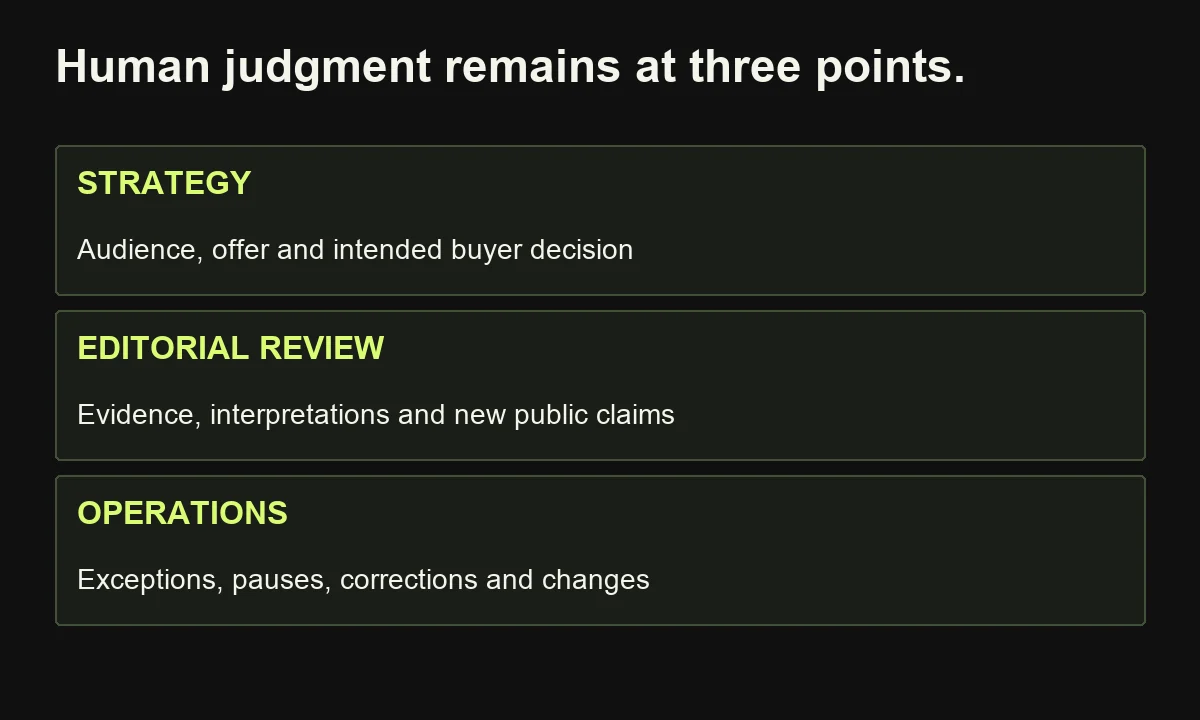
People should own commercial direction, evidence standards, permissions, consequential actions, and responses to exceptions. Routine transfers can follow approved rules without individual review. New claims, unusual customer situations, and material changes need a defined decision owner. A sophisticated AI system changes the execution possibilities; it does not remove responsibility for the business's promises.
Keep three decisions distinct:
Strategy: which audience, offer, question, and next action deserve attention?
Editorial review: are the message, interpretation, and supporting claims accurate and useful?
Operations: should the system proceed, pause, correct a record, or escalate?
n8n's human-review documentation describes approval before selected agent tool calls. The principle is selective control: choose the actions that need judgment, then enforce the trusted decision against the exact version released.
An AI-generated field saying “approved” must not authorize its own publication. Likewise, changing a substantive offer claim after review should return the asset to the appropriate reviewer.
In my Ruh AI case study, I describe connecting positioning and content strategy with automated production that retained human approval. This is a first-party project account, not an independently audited ROI benchmark for your business.
AI can help summarize permitted evidence, explore alternatives, and prepare drafts. Its most useful role is to give people more capacity to make and execute good decisions. Hire for that workflow judgment and maintainability, as well as familiarity with the platform.
How should you run a B2B automation pilot?
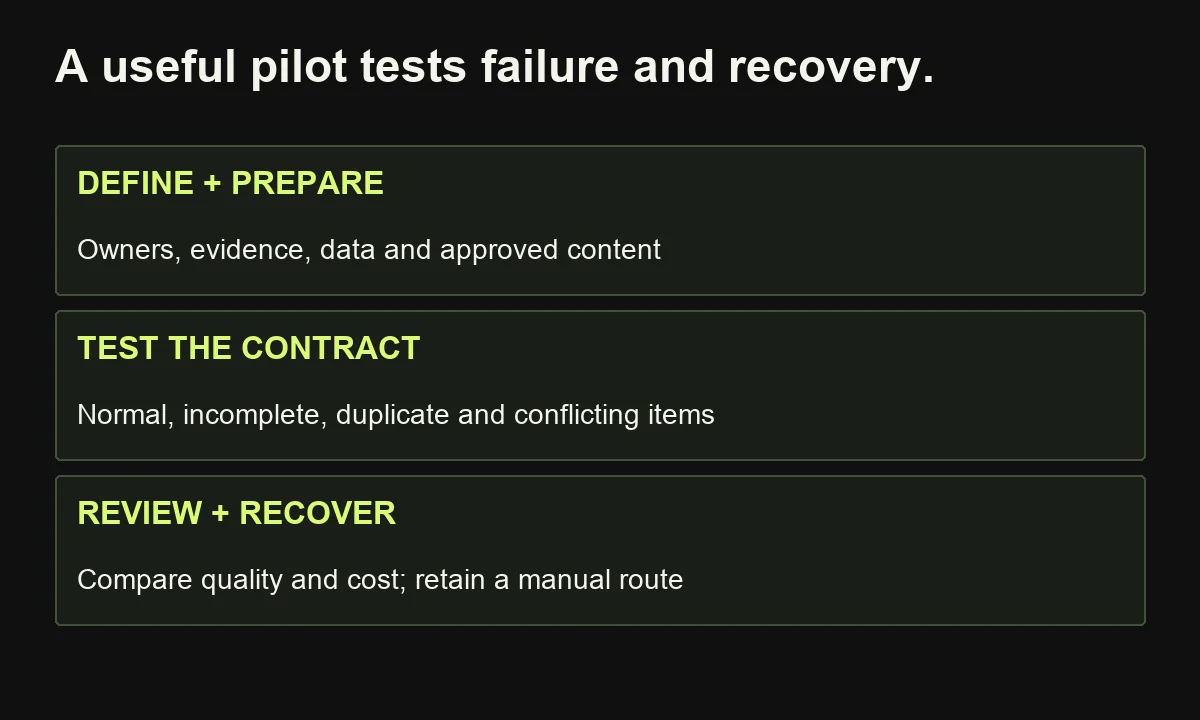
Run one bounded workflow with representative inputs, explicit acceptance criteria, and a documented recovery path. Establish a baseline first. Test normal delivery and exceptions before expanding live use. Decide which operational observations justify continuation, while allowing enough follow-up time for meaningful commercial outcomes; a successful demonstration is not evidence of sustained return.
A practical pilot has four stages:
- Define: select the handoff, owners, inputs, output, and evidence required for acceptance.
- Prepare: check records, approved content, permissions, and integration behavior.
- Test: include incomplete requests, duplicates, conflicting ownership, rejected drafts, and unavailable destinations.
- Review: compare effort, time, quality, operating cost, and unresolved commercial questions.
Use a limited live rollout after the test set passes. Preserve a manual route for outstanding requests. If an external write times out, inspect the destination before retrying; missing acknowledgement does not necessarily mean the record was never created.
Log the input identifier, version, owner, status, and resulting destination. If runs overlap, the system needs a reliable way to prevent two runs from processing the same item concurrently.
Assign maintenance before handover. Ask a colleague to operate and pause the workflow using the documentation. If only its builder can understand it, the pilot has not demonstrated a maintainable process.
A useful consultant should explain these choices and the content they depend on. My automation consultant hiring guide provides scope and handover questions for comparing proposals.
Frequently asked questions: is B2B marketing automation worth it?
Is B2B marketing automation suitable for a small team?
Yes, when recurring work and a clear handoff justify the operating effort. Start with your existing tools and one maintained workflow. If enquiry volume is low or the process is unclear, simpler improvements may be the better investment.
Does lead nurturing automatically generate qualified pipeline?
No. Useful nurturing can support evaluation, but pipeline also depends on audience fit, the offer, evidence, and sales execution. Require defined opportunity criteria and sales feedback. Message delivery or a higher score alone does not establish a qualified opportunity.
How long should I wait before judging ROI?
Check operational behavior immediately and review commercial outcomes against the relevant sales cycle. State the cohort, observation period, and unresolved records. Avoid a universal payback promise; setup costs, volume, contribution, and implementation timing differ across businesses.
Do I need a new marketing automation platform?
Only if a documented requirement warrants it. Test whether better content, ownership, CRM configuration, or a native integration solves the problem first. Compare the complete migration and operating cost against the improvement you can verify.
The buying decision starts with a commercial handoff you can explain. Name its owner, evidence, and useful next action, then build a pilot around that contract. If those pieces are unclear, share where your B2B marketing process loses momentum. I can help connect buyer research, content, and workflow design before your team commits to a larger investment.