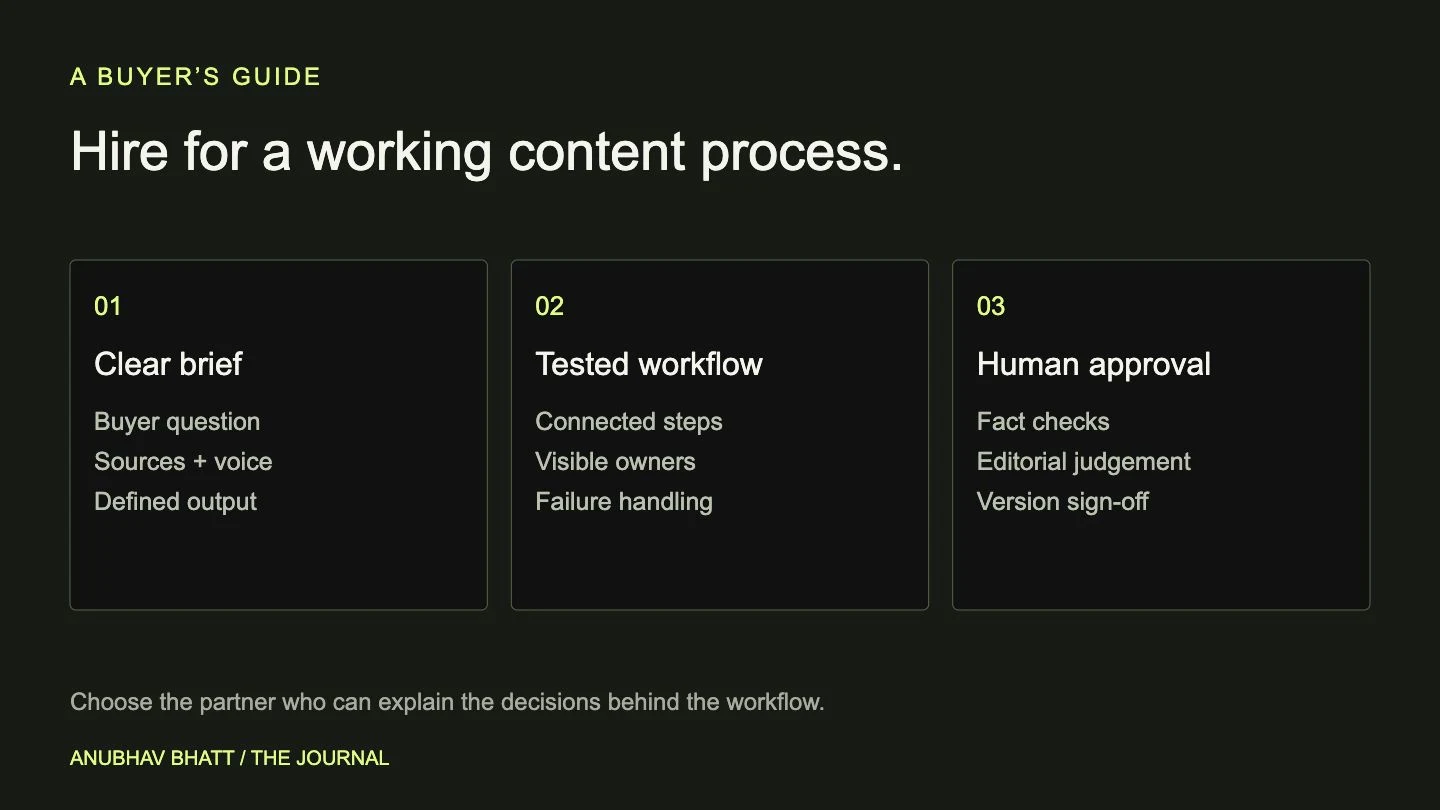
Hire a B2B content automation consultant when your team needs a repeatable way to research, draft, review, and distribute content, and nobody owns the connections between those steps. Look for someone who understands buyer questions and editorial quality, can demonstrate a working process, and provides the documentation and training your team needs to maintain it.
If your writers are producing drafts and experimenting with AI, but articles still sit in review, the bottleneck may be the process. LinkedIn posts need rewriting, and publishing depends on one person remembering what happens next.
Another writing tool may help with a task. On its own, it is unlikely to resolve an unclear brief or a missing approval owner.
This guide explains how to decide what help you need, compare consultants, and agree on a pilot before committing to a larger engagement.
What does a B2B content automation consultant actually do?
A B2B content automation consultant designs and connects the steps that move content from a business question to an approved asset. The work can include research intake, briefs, AI-assisted drafting, review routing, repurposing, and publishing preparation. A useful engagement also defines ownership, failure handling, and the checks that protect accuracy and brand voice.
Content workflow automation means using rules, integrations, and sometimes AI to move information or perform defined tasks in a content process. AI-assisted drafting is one possible task within that process.
For example, a consultant might connect an approved interview transcript to a structured brief, create a draft in the right document, and notify an editor. That editor still decides whether the argument is useful and whether the claims are supported.
Ask which parts the consultant will design, build, document, and maintain. “We automate your content” is too broad to compare proposals.
Do you need a consultant, a writer, or an automation specialist?
Hire a writer when you have clear positioning, approved briefs, and a working review process but need more writing capacity. Hire an automation specialist when the process is already defined and the problem is technical integration. Hire a content automation consultant when content decisions and operational handoffs both need attention before the system can work reliably.
| Your main problem | Start by looking for | What to request |
|---|---|---|
| Drafts lack substance despite detailed briefs | B2B writer or editor | Relevant work samples and an editorial trial |
| Nobody agrees on the audience or message | B2B content strategist | Buyer questions, positioning, and content priorities |
| Approved assets are copied manually between tools | Automation specialist | A mapped integration and failure-handling plan |
| AI drafts, review, and distribution are disconnected | Content automation consultant | A workflow audit and one tested pilot |
A consulting engagement may be unnecessary if you mainly need five more articles from an established brief. Conversely, hiring another writer may leave an approval bottleneck exactly where it was.
You may already have the right person internally. If a team member understands the editorial process and can maintain the integrations, a focused advisory engagement could be sufficient.
What should you prepare before asking for proposals?
Prepare one recent content project, the steps it passed through, the people involved, and where it stalled. Share a representative brief, an approved piece, and an example that needed substantial revision. Describe the buyer, the desired business outcome, and your existing tools. These inputs help a consultant price the actual problem rather than an imagined workflow.
A useful enquiry can be this simple:
We have writers and an editor, but turning an approved webinar into a blog and LinkedIn posts requires repeated copying and rewriting. We need a documented process, an editorial checkpoint, and a pilot using our existing tools. Please explain the scope, dependencies, and ongoing costs.
Avoid sharing confidential customer material in a first enquiry. Describe the situation, then agree how source material and account access will be handled.
Map the delay before buying the fix
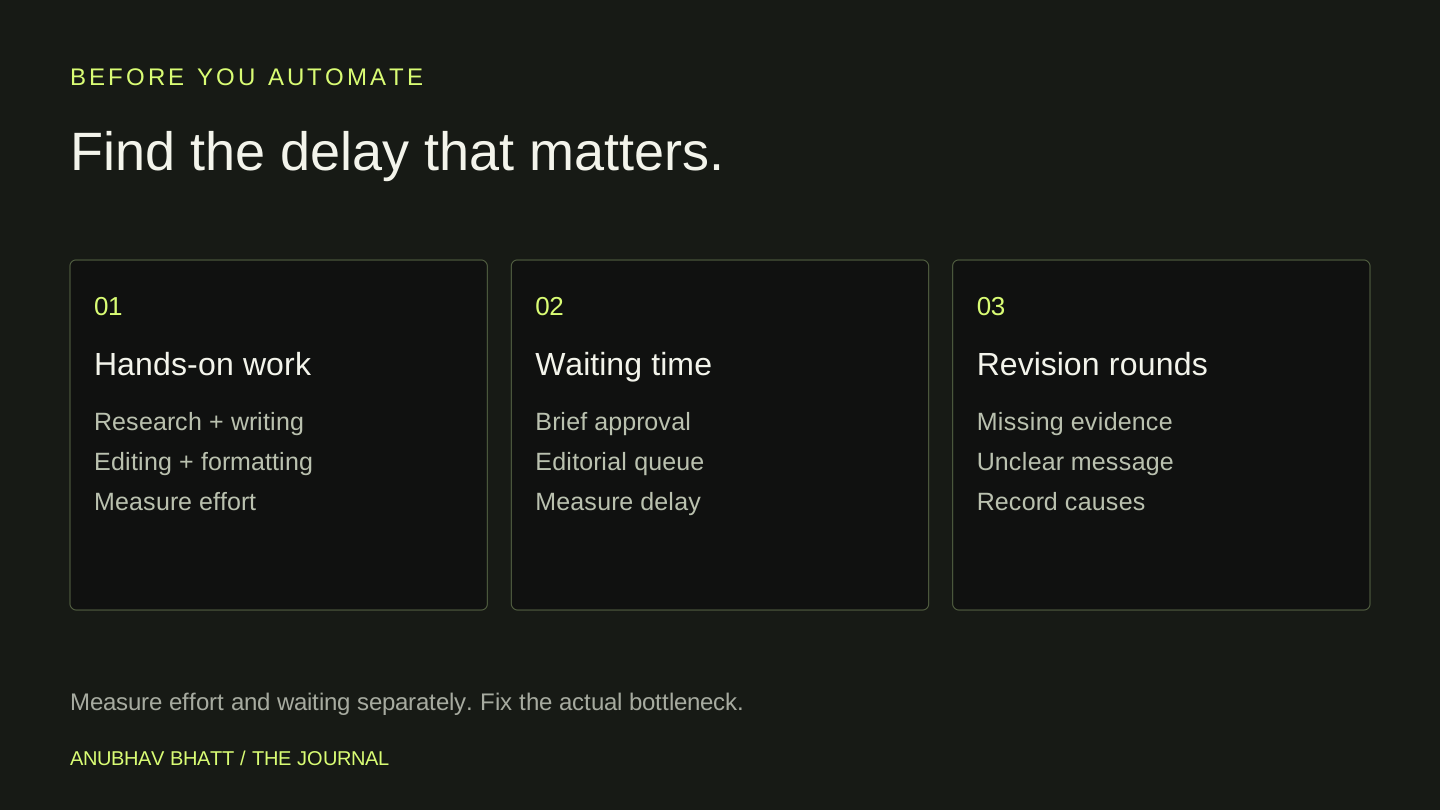
Use a short B2B content workflow audit to separate effort from waiting time. For one recent asset, record:
- When the brief became ready.
- When drafting started and finished.
- When each review was requested and completed.
- How many revision rounds were needed.
- When the approved asset was published or handed over.
If drafting took two hours but the approval queue took six days, reducing drafting time is unlikely to address the main delay. Those numbers are an illustrative example, not a benchmark.
What deliverables should you expect?
Ask for a current-state workflow map, a proposed process, one working pilot, explicit approval rules, and a handover document. The proposal should identify inputs, outputs, owners, dependencies, and acceptance criteria. If implementation is included, require a demonstration with representative content and a failure scenario, rather than judging the work only from a polished example.
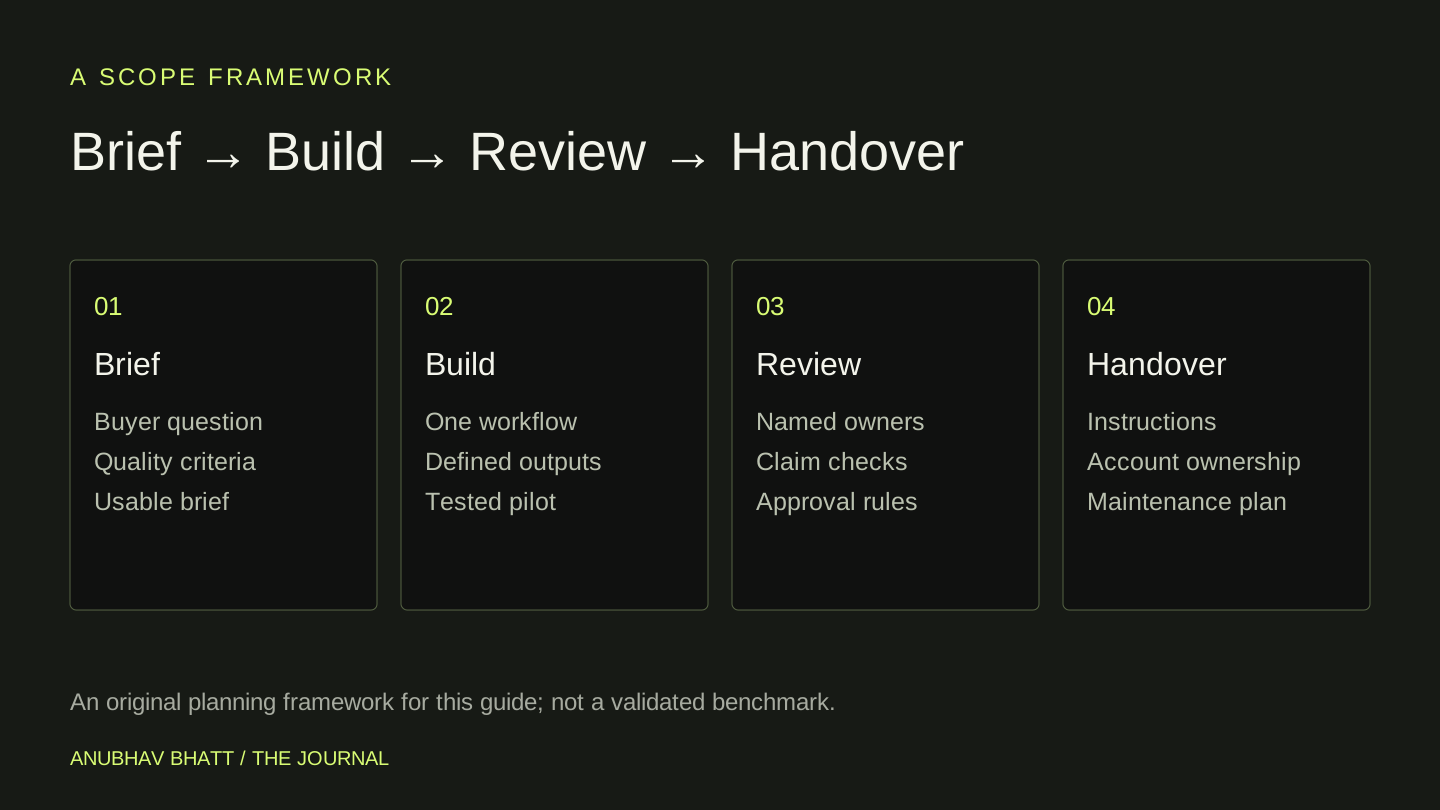
Here is a practical framework for comparing scope. I call it Brief → Build → Review → Handover. It is a planning framework for this guide, not a research-validated model.
1. Brief: establish what good content looks like
Agree on the intended buyer, the question the content answers, acceptable sources, and the next action for the reader. Provide examples of approved writing and explain what makes them good.
The output should be a usable brief and editorial criteria. A folder of prompts does not establish those criteria by itself.
2. Build: connect one useful workflow
Choose one recurring task, such as turning an approved webinar transcript into a blog outline and draft social posts.
Define the exact inputs and outputs. Decide where the team will review them and what the workflow should do when a required input is missing.
3. Review: make approval visible
Name the person who checks facts, the person who checks voice, and the person who approves publication. One person may hold several roles, but each decision needs an owner.
An AI content approval workflow should record approval against the exact version being released. If substantive content changes after approval, it should return to review.
4. Handover: make the workflow maintainable
Request operating instructions, account ownership details, a list of dependencies, and a procedure for changing prompts or switching tools. Agree on what happens when an integration stops working.
Your team should be able to explain the process after the consultant leaves.
How do you judge whether a consultant is good?
Ask the consultant to explain a relevant workflow, the editorial problem it solved, the controls it required, and what failed during implementation. Look for clear decisions and maintainable handoffs. A credible demonstration should show how the process treats weak source material, conflicting instructions, rejected drafts, and unavailable services, alongside the successful path.
Use these five questions when comparing content automation consultants:
- What would you automate first, and why? Look for a link to your bottleneck, not a preferred tool.
- How do you preserve our point of view? Expect a discussion of source material, examples, and editorial judgement.
- What happens when a claim cannot be verified? The workflow should flag it for review rather than fill the gap with a plausible sentence.
- Who owns the accounts, documents, and workflow? Clarify this before implementation.
- How will we know the pilot worked? Ask for agreed measures and evidence you can inspect.
What my Ruh AI work illustrates
In my Ruh AI case study, I describe connecting positioning and a six-month content strategy with an automated production process informed by the strongest writer’s tone and editorial approach. Human approval remained part of publication.
The useful hiring lesson is the sequence: establish the perspective and quality standard, then design the production process around them.
That case study is my first-party account. It is not an independently audited benchmark or a promise that another team will achieve the same result. You can also review my Draup case study for how buyer research and content planning connect to the wider marketing journey.
How much should a content automation project cost?
The cost of a content automation project depends on the scope: how many workflows are included, the complexity of integrations, the amount of editorial design required, and the level of training and support. Compare written proposals using the same pilot brief. Separate setup fees from subscriptions, usage charges, maintenance, and optional ongoing content production.
I do not publish a standard rate for this work here. A useful quote needs a defined workflow and clear boundaries.
Ask each provider to separate:
| Cost component | Question to ask |
|---|---|
| Audit and strategy | What findings and decisions will we receive? |
| Implementation | Which integrations and outputs are included? |
| Tool subscriptions and usage | What accounts are needed, and who pays? |
| Training and documentation | Can our team operate the process independently? |
| Support and changes | What is covered after handover? |
The lowest setup quote may exclude the documentation your team needs. A larger engagement may include services you do not yet need. Compare scope before price.
How should you measure an AI content workflow pilot?
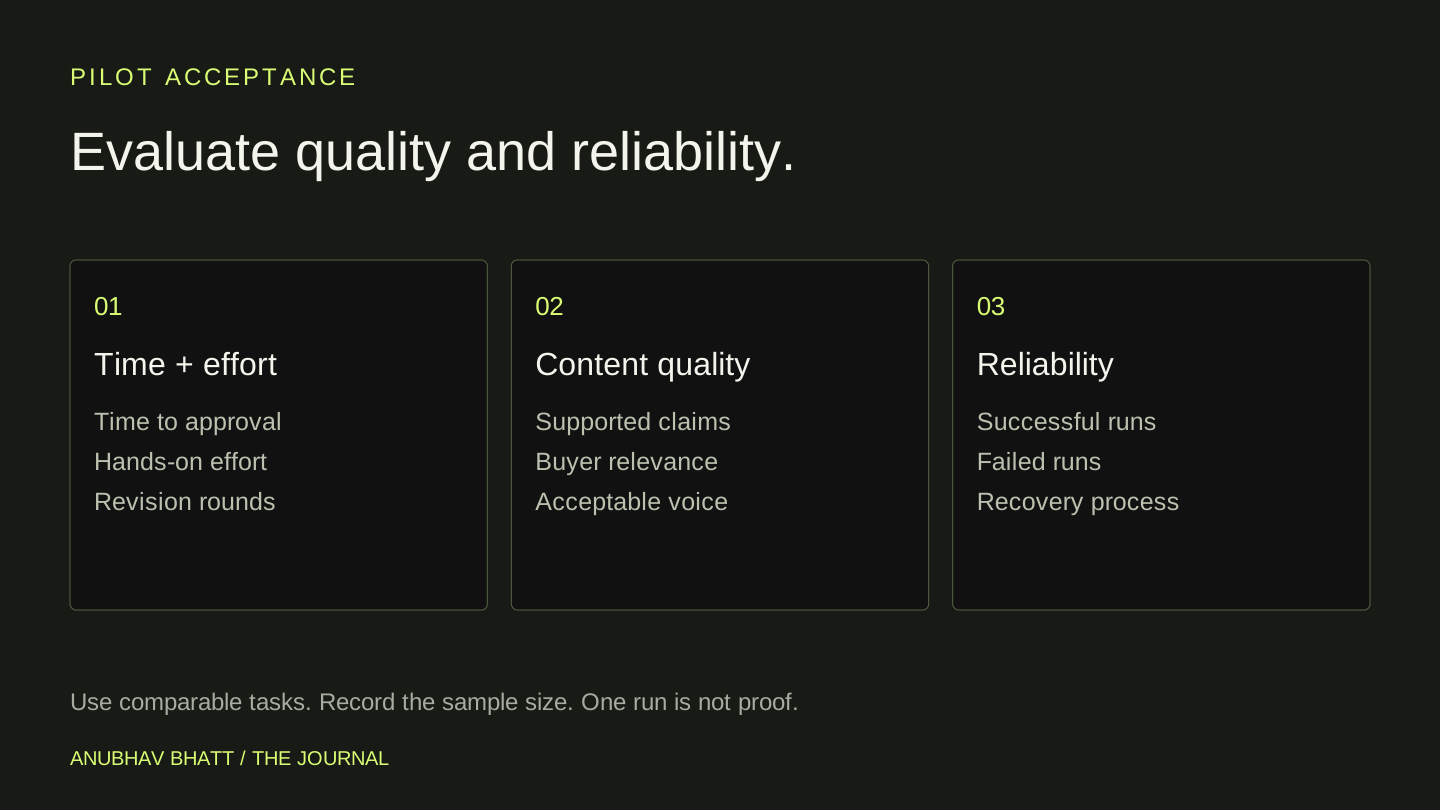
Measure an AI content workflow pilot against the same process before automation: elapsed time to approval, hands-on effort, revision rounds, and factual corrections. Track whether the output meets the agreed brief and whether the team can operate the workflow. Use comparable content tasks, record the sample size, and avoid treating one successful run as proof of sustained performance.
For a first pilot, choose one asset type and one repeatable process. Agree on the test set before reviewing the results.
Record these measures:
- Time to approval: elapsed time from a complete brief to final approval.
- Hands-on effort: time spent drafting, editing, transferring, and fixing output.
- Revision rounds: how often work returns for substantive changes.
- Quality checks: supported claims, useful examples, and acceptable brand voice.
- Reliability: successful runs, failed runs, and the reason for each failure.
Qualified enquiries and influenced opportunities can be tracked after distribution. They depend on the topic, audience, offer, and other marketing activity, so they should not be attributed to automation alone.
For example, test whether an approved webinar transcript can produce a usable outline, three distinct social drafts, and a source checklist. Deliberately test a missing transcript and an unapproved source as well. This is a suggested acceptance test, not a client result.
Can AI-assisted content support SEO, AEO, and GEO?
AI-assisted content can support SEO, AEO, and GEO when it helps produce useful, accurate material that addresses real buyer questions. Start with clear answers, supporting evidence, descriptive headings, and relevant internal links. Automation should help the team meet those standards consistently. It cannot guarantee rankings, answer-engine citations, or a particular time to results.
For this guide, SEO means improving discoverability in search, AEO means making answers easy to understand and retrieve, and GEO means improving suitability for discovery and citation in generative search experiences. These activities overlap; they are not separate promises of placement.
Google says existing SEO practices remain relevant to its AI search features and that no special AI markup is required. See its guidance on AI features and websites.
Google also warns that generating many pages without adding value can violate its scaled content abuse policy. Its guidance on generative AI content is a useful reference when discussing production targets.
Ask a consultant how they will obtain original input, check claims, and preserve a useful argument. “We can publish every day” is a capacity claim. It does not establish that the articles will help your buyers.
Frequently asked questions
Can we keep our existing content tools?
Often, the sensible starting point is to assess the tools you already use. Whether they can support the proposed workflow depends on their integrations, access controls, and limits. Ask the consultant to explain any replacement recommendation and the added operating cost before agreeing to a new stack.
Should AI content be published automatically?
For a workflow producing new public-facing B2B claims, I recommend an explicit human approval checkpoint. Routine formatting or transfer of approved material may be automated. The proposal should distinguish those tasks from new drafting and explain which changes require another review.
How long should implementation take?
There is no reliable standard timeline without a defined scope. Ask for milestones tied to discovery, access, pilot testing, review, and handover. A promised completion date should state what your team must provide and what could delay acceptance.
Can a consultant guarantee leads or AI citations?
No consultant controls all the factors that determine leads, search rankings, or generative search citations. Ask for a plan connecting the workflow to your audience and offer, plus measurable acceptance criteria. Treat guaranteed placement or guaranteed lead counts as a reason to examine the proposal closely.
What should I send Anubhav before discussing a project?
Send your website, the content task that repeatedly stalls, the tools involved, and the outcome you want. A short description is enough to begin. There is no need to send confidential documents or account credentials in the initial enquiry.
Want to work out where your content process is getting stuck?
I work across B2B content strategy, writing, and marketing automation. If you have a team producing content but the process is difficult to repeat, tell me where it breaks down.
Send me a short note with your website, current workflow, and the bottleneck you want to fix. We can discuss whether the next step is clearer strategy, editorial help, or a more connected production process.