
AI summary
Begin with the traffic GA4 already classifies, then investigate verified assistant sources that need a separate reporting view. Keep unknown traffic visible and connect detected visits with useful landing pages and clearly defined business actions.
- Use the right scope: Session acquisition describes recorded visits, while first-user acquisition answers a different question. The AI Assistant channel excludes Google AI Overviews and AI Mode, which belong to Organic Search under Google’s current definitions.
- Validate before expanding: Build custom rules from observed sources, test matching and nonmatching cases, and reconcile total sessions. Collection and classification require separate checks; a tagged test link cannot establish how every assistant passes referral information.
- Report bounded outcomes: Distinguish sessions, key-event occurrences and qualified enquiries. Keep the denominator visible, interpret small samples carefully and never relabel unexplained Direct traffic as confirmed AI discovery.
To track AI referral traffic in GA4, start with the AI Assistant channel, then inspect session source and medium for visits that need further investigation. Separate detected referrals from unknown traffic, and connect those visits with useful landing pages and meaningful key events. A session report cannot count every AI-influenced buying decision.
This sequence prevents a common reporting mistake: building a complicated custom channel before checking what Analytics already classifies. It also avoids relabeling unexplained Direct traffic as AI simply because assistant usage is growing.
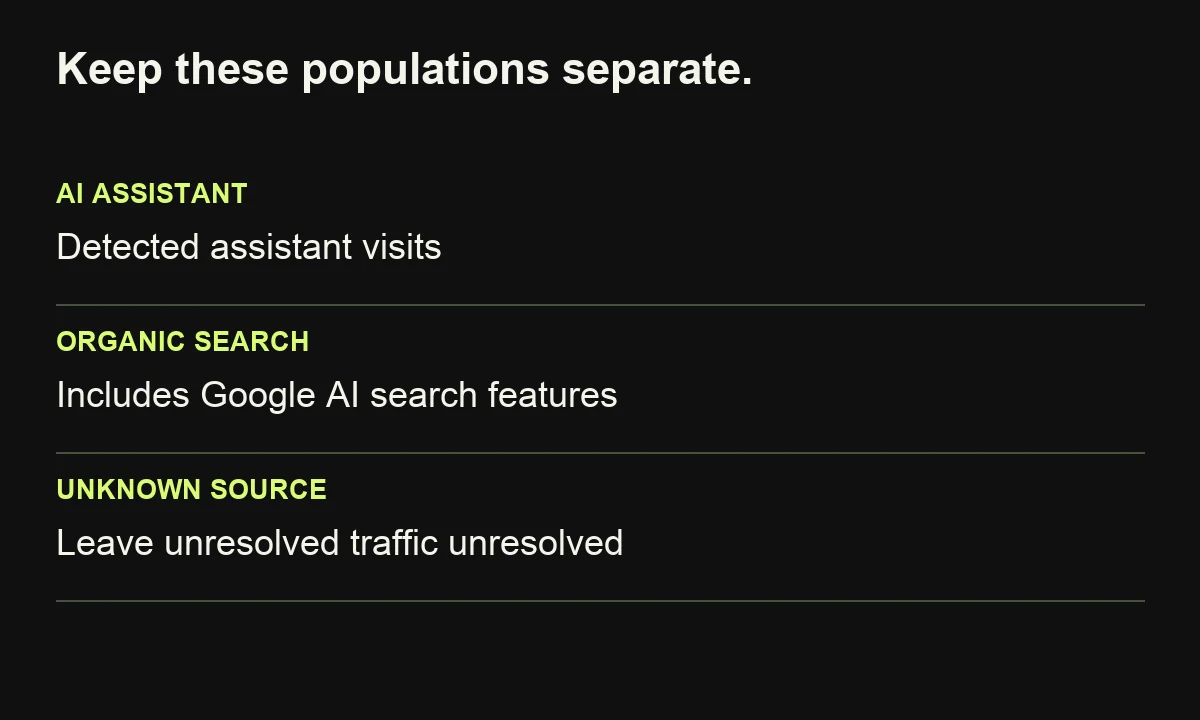
Google's default channel definitions now include AI Assistant. The channel covers visits from sources such as ChatGPT and Gemini, while excluding Google's AI Overviews and AI Mode. Google places its own Search AI features within Organic Search.
That distinction changes the measurement brief. “How many detectable assistant sessions arrived?” is answerable within the available data. “How many buyers encountered our brand anywhere in AI?” requires other evidence and will still have limits.
Before changing reports, record the property, date range, reporting time zone and the business question. Save an unmodified baseline export. Work in one property at a time so an experiment does not quietly become a different report for every stakeholder.
Inspect the existing acquisition report first
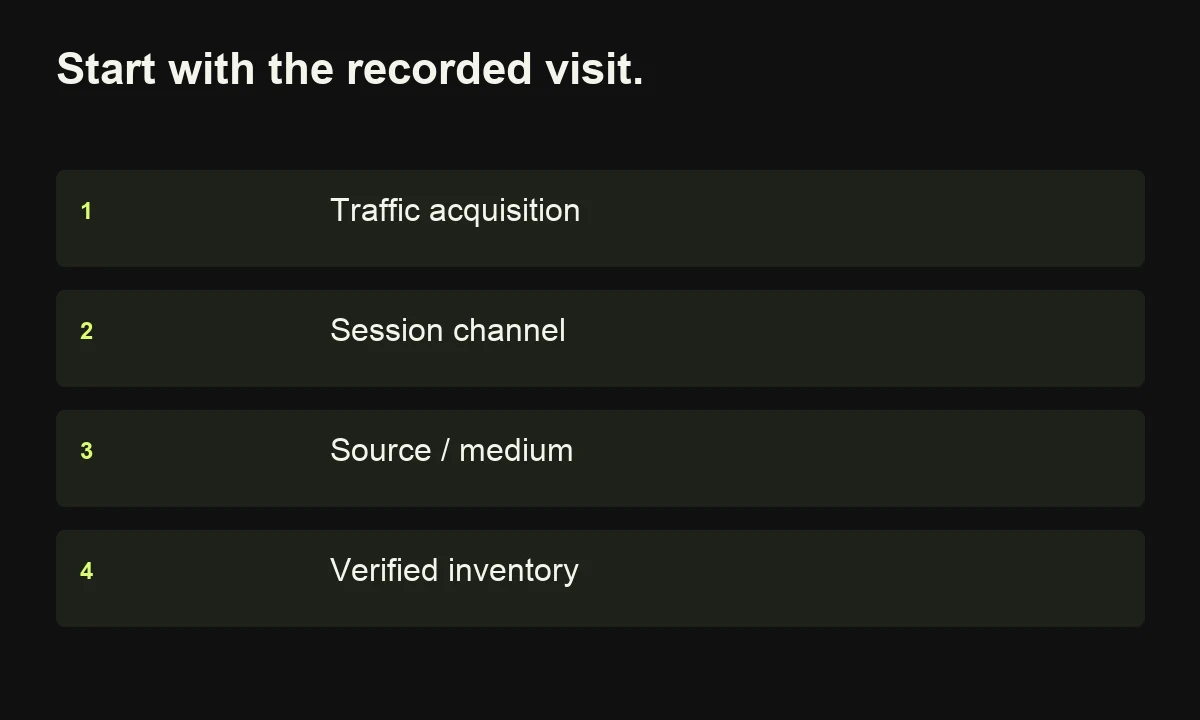
Open the Traffic acquisition report in the correct property. Use Session default channel group to inspect the AI Assistant row, then review Session source / medium. Session dimensions answer where visits began; first-user dimensions answer a different acquisition question.
Choose a period with enough activity to inspect, and compare an equivalent period where that comparison is meaningful. Keep filters consistent. A new reporting classification or changed tracking setup can affect interpretation, so record material measurement changes beside the numbers.
Export the source rows and mark each as recognized assistant, other known source or unresolved. Check actual values before writing matching rules. A familiar word inside a domain is a reason to investigate, not proof that the traffic came from an AI assistant.
For a hypothetical software site, the initial findings might be:
| Observed row | Working interpretation |
|---|---|
| Recognized assistant in AI Assistant | Detected assistant sessions |
| Verified assistant domain in Referral | Review classification and reporting need |
| Google organic | Search traffic; do not reclassify wholesale |
| Direct without identifying evidence | Source remains unknown |
Keep this inventory with the report. It explains the scope to a colleague who did not build the dashboard and prevents an apparently precise total from hiding unresolved classifications.
Add a custom channel only for a clear reason
A custom group is useful when the business needs a maintained view of verified assistant sources beyond the standard classification. It is optional. If the default channel answers the question, another group can create unnecessary reporting differences.
Google's custom-channel documentation explains how to copy an existing group, add conditions and reorder channels. Traffic enters the first channel whose definition matches. Put a custom assistant rule before other rules that could capture the same sessions, and retain the remaining channels.
Build the source list from verified observations. Prefer explicit domain conditions to a broad expression matching “ai” anywhere. Such a broad match can collect unrelated sources and make the assistant total look larger than the evidence supports.
Record the group's name, included source values, campaign exclusions, owner and creation date. If your team uses an assistant's name in its own campaign tags, distinguish that deliberate campaign from a naturally arriving referral.
Test the rule against a small table of examples before saving. Include a known matching source, an unrelated domain, a Google organic session and an unknown Direct session. The last two should remain outside your custom assistant channel. Keep the default group available as a comparison rather than replacing every existing report immediately.
Validate collection and classification separately
A working pageview does not prove that a channel rule is right. An accurate rule does not prove that the page is collecting events correctly. Check both layers and document what each test establishes.
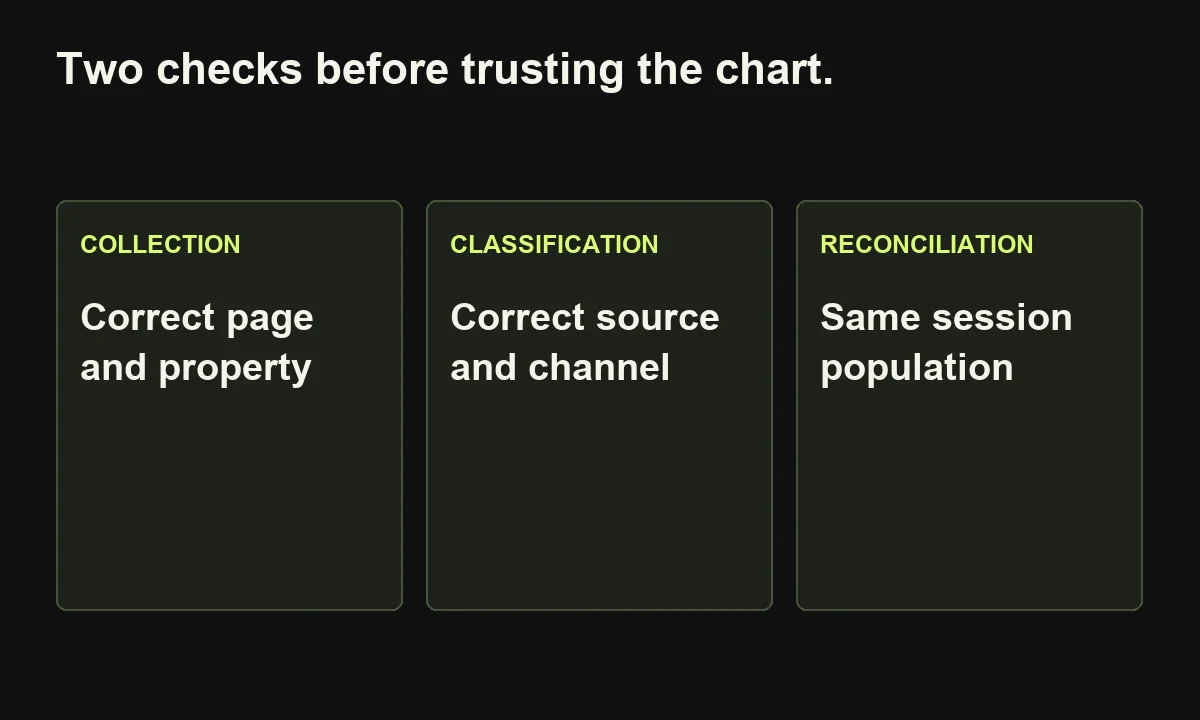
For collection, use a controlled visit to a page with the intended analytics setup. Confirm that applicable consent choices, filters and browser settings are understood. Check that the page and expected event reach the correct property. Do not submit genuine customer information merely to test a marketing report.
For classification, inspect how a visit with a known source appears after processing. Use a clean test session and keep the exact test conditions. A manually tagged link tests the tagging and reporting path; it does not demonstrate how every real assistant will pass referral information.
Compare the custom group's total sessions with the default group's total for identical dates and filters. Reclassification should redistribute sessions rather than create a second population. Investigate unexpected differences before circulating the chart.
Retain failed tests as well as successful ones. A source that disappears inside a particular browser is a measurement finding, not permission to guess its identity. Assign an analyst to review new domains periodically and remove obsolete conditions. This keeps the definition explainable as products and referral behavior change.
Measure useful visits, with the denominator visible
Once the detected segment is stable, ask which pages those sessions reach and what visitors do next. A page that earns a handful of relevant consultations may deserve a different decision from a page attracting many unrelated visits.
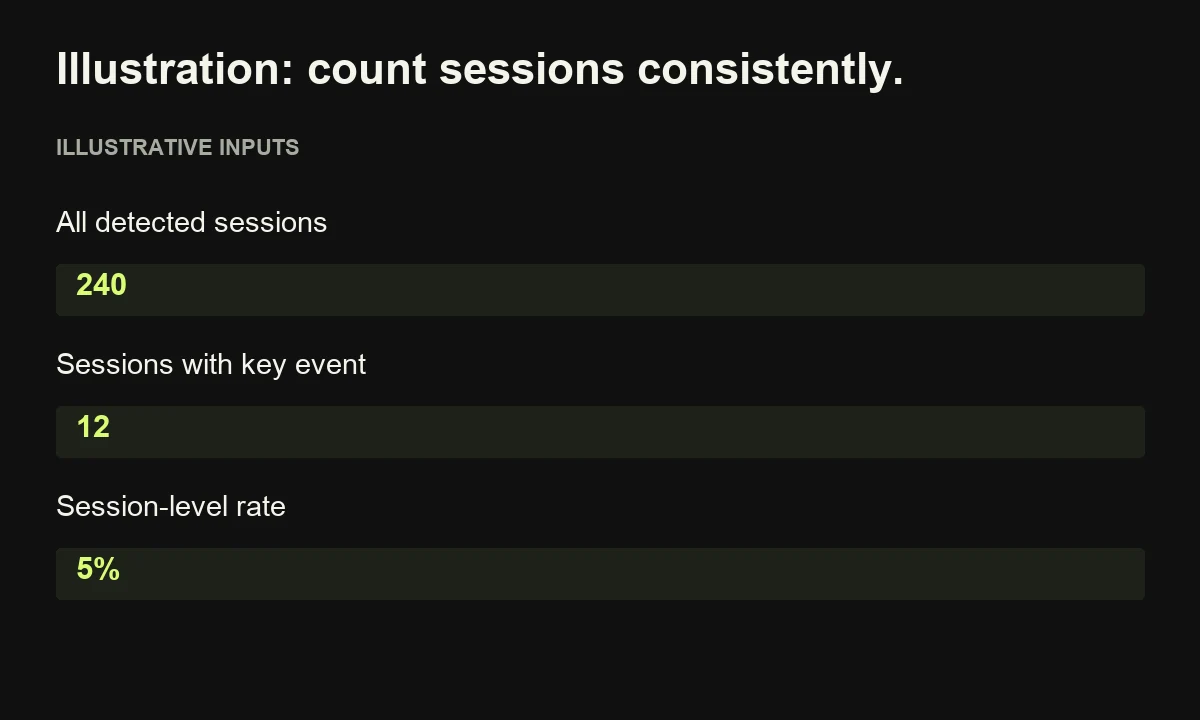
Use a clearly labeled illustration. Suppose a fictional site records 240 detected assistant sessions during a month. Twelve sessions include its chosen key event. The session-level rate is 12 divided by 240, or 5%. It is not the percentage of all AI users who converted, and it is not revenue attribution.
If that same month records 18 key-event occurrences, report that count separately. Several occurrences can happen within one session. Mixing event counts with sessions changes the calculation and can exaggerate apparent performance.
Keep a simple reporting table: detected sessions, landing page, sessions with the chosen event, event definition and qualified enquiries confirmed in the business system. State whether a figure counts sessions, events or people.
Review small samples cautiously. One additional enquiry can move a tiny segment's rate sharply. Look at the questions visitors ask and whether the landing page helps them evaluate the offer. The buyer-journey guide can help connect those pages with actual buyer decisions instead of choosing the next article solely from referral totals.
What this report cannot tell you
Does it count AI answers without clicks?
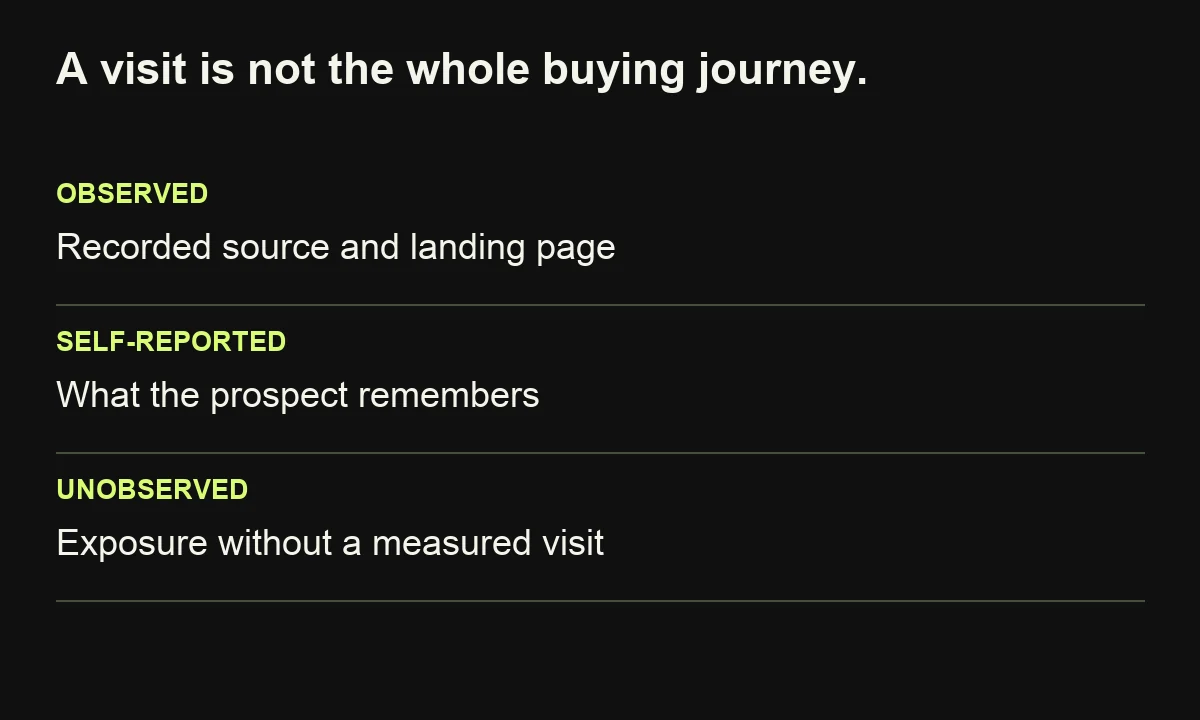
No. A website acquisition report measures recorded site activity. Someone can read an answer, remember your company and return later through another route. That earlier exposure is outside the session evidence unless you have a separate, credible observation.
Can Direct traffic be reassigned to AI?
Not simply because its source is missing. Keep unknown traffic unknown. An optional “How did you hear about us?” answer can add context, but self-reported discovery and observed referral source are different fields and may legitimately disagree.
Should every assistant visit receive the same landing page?
No. Inspect the destination and reader's likely task. An implementation guide, comparison and service page serve different decisions. Improve the answer and next step on the page that actually receives relevant visits before creating a generic AI landing page.
Use the report to make a bounded decision: improve one destination, investigate a source or correct a broken event. Review again with consistent definitions and enough new observations to learn something useful.
If the difficult part is turning those findings into useful content, share the page and the buyer question. A clear measurement boundary makes the editorial decision more reliable.