
AI summary
Give buyers a complete, useful explanation where they already consume content, then offer meaningful depth on the website. Start with one decision and one channel, and evaluate the work through distinct measures rather than expecting clicks to capture every interaction.
- Make the answer complete: Choose a recurring misunderstanding, explain it with defensible evidence and give the reader an action. The company becomes relevant through the problem it understands, without withholding the useful point behind a teaser.
- Give the destination depth: Use the website for implementation details, evidence and service scope. Make link promises specific and preserve the conditions attached to examples when adapting them into other formats.
- Run a bounded pilot: Assign editorial and factual owners, record audience questions and inspect qualified business activity. Treat exposure, response and enquiries as separate signals; simultaneous growth does not prove a particular post caused the result.
Zero-click marketing gives buyers a useful idea inside the place they already consume content, without making a website visit necessary to understand it. For B2B teams, the practical move is to publish complete, recognizable answers while keeping the website valuable for deeper evaluation. Measure audience response, qualified demand and visits as separate signals.
Amanda Natividad's original zero-click content explanation describes this principle of standalone value. The concept does not require every asset to be linkless, and it does not make website measurement irrelevant.
Start with one recurring buyer question and one channel where that audience is active. Prove that you can explain the issue clearly before multiplying formats. More distribution cannot rescue an idea that remains vague wherever it appears.
Choose the decision you want to influence
Pick a specific misunderstanding that affects a buying decision. “Educate the market” is too broad for a useful brief. “Help operations leaders distinguish implementation work from subscription cost” gives the writer a concrete job.
Write down the audience, its current assumption and the understanding you want to create. Add the evidence that makes your answer credible. That might be a documented process, an authorized example, a calculation or a clearly explained professional recommendation.
Then choose the smallest complete unit of value. A comparison can explain one important tradeoff. A short demonstration can show one diagnostic step. A native article can answer a difficult implementation question. The format should carry the answer rather than merely announce that another answer exists elsewhere.
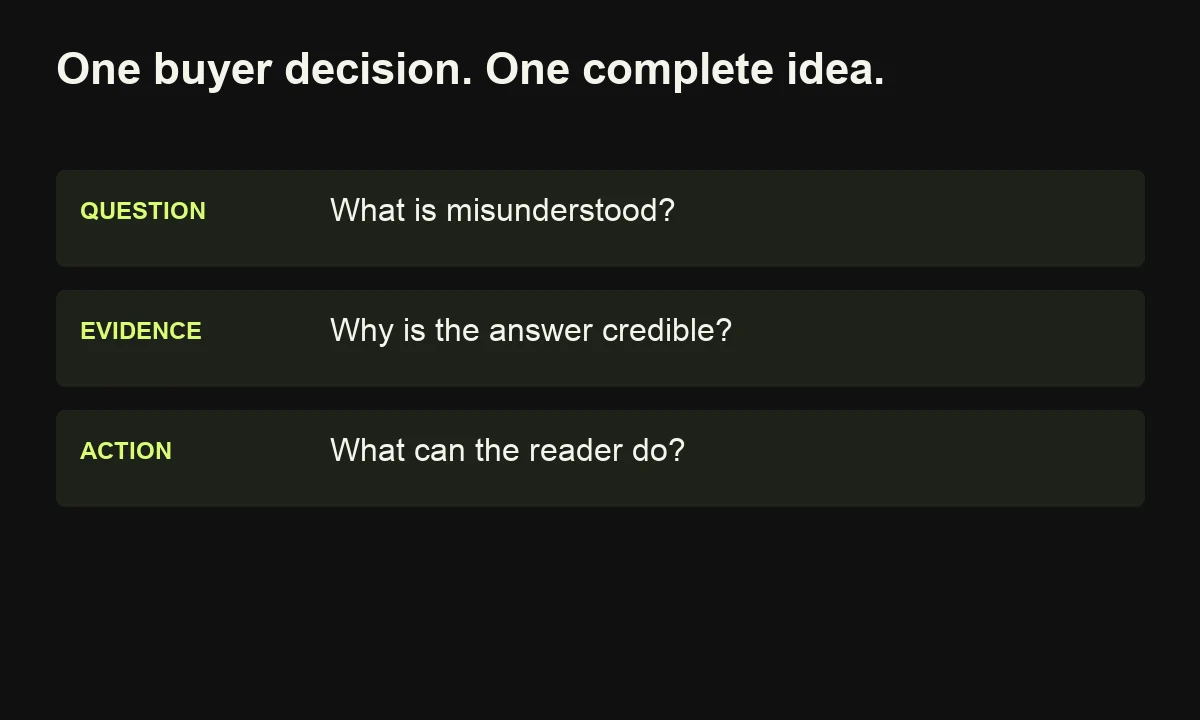
Use a recognition test: could the reader explain the idea to a colleague and identify why your company is relevant? If the post could be attributed to any supplier, make the reasoning and example more specific.
Keep claims within their evidence. An illustrative cost comparison is useful when its assumptions are visible. It becomes misleading when presented as the typical experience of every buyer. Editorial specificity earns its place through a defensible explanation, not invented certainty about the audience's results or a promise that the platform will reward the format.
Turn one useful idea into a complete native asset
Consider a hypothetical consultancy helping software teams improve onboarding. Its core idea is that an onboarding delay can come from an unresolved decision, even when every checklist task appears complete.
A weak post might announce a guide to better onboarding and ask readers to click. A stronger native post would explain the distinction directly: “Before adding another reminder, identify who can approve the integration scope. A completed checklist cannot substitute for that decision.”
The next lines can supply an example. A project has received credentials, completed a kickoff and assigned tasks, but no one has approved which historical records will migrate. Another automated reminder will not resolve the ambiguity. The team needs an owner, an agreed scope and a recorded decision.
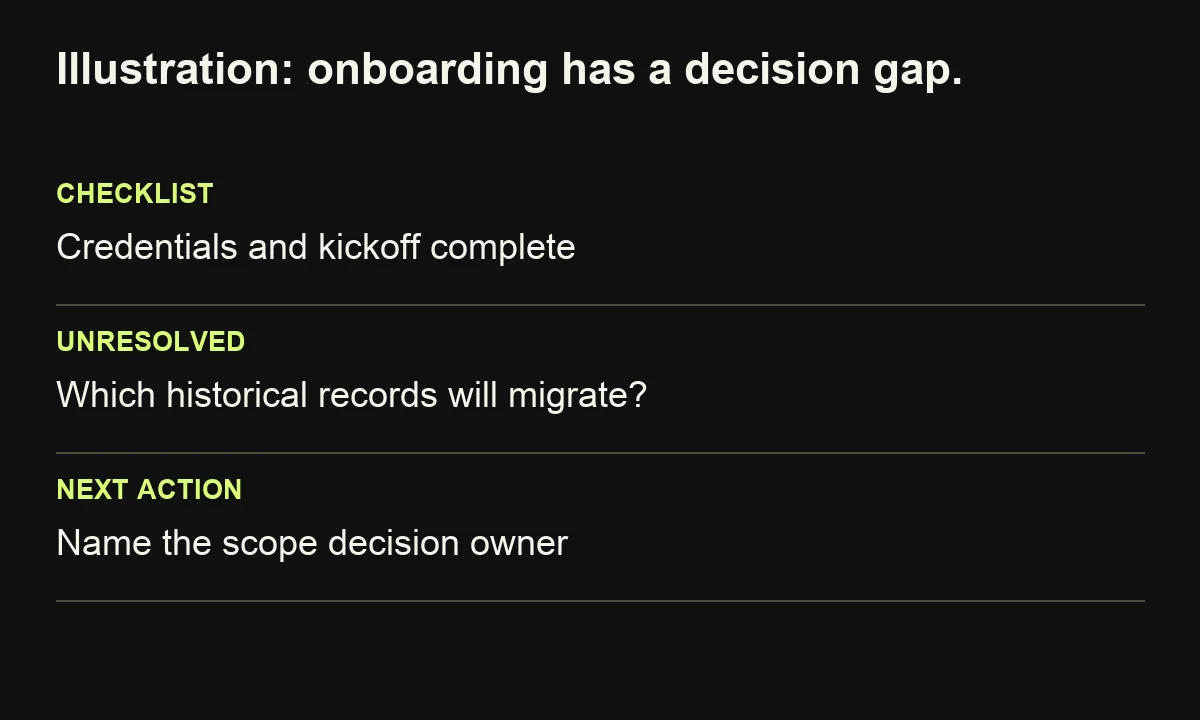
Close with an action: inspect one delayed project and record the unanswered decision beside its checklist. That is enough to help the reader without a visit. The accompanying website resource could offer a fuller diagnostic worksheet and explain exceptions.
This example is an editorial illustration, not a claimed client outcome. Its purpose is to show how a complete thought differs from a teaser. The company remains relevant through the problem it understands and the reasoning it demonstrates. A promotional paragraph is unnecessary when the example already establishes the connection.
Give the website a deeper job
Standalone distribution works best when the destination offers something beyond the same short answer. Use the website for implementation detail, evidence, comparisons, service scope and the next decision a serious buyer needs to make.
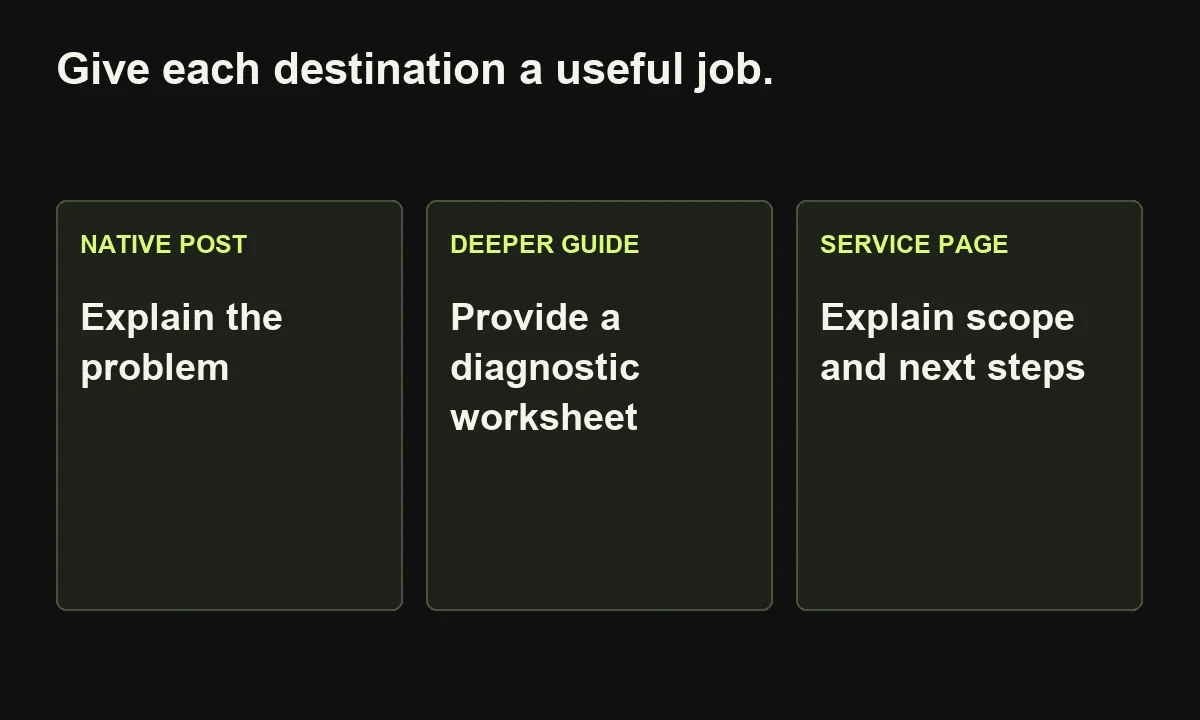
For the onboarding example, the native post explains the approval problem. The linked page can provide a diagnostic table, sample responsibilities and questions to ask before changing the workflow. A service page can explain the consultancy's role, boundaries and contact process.
Make the relationship explicit. A link promising a worksheet should reach a worksheet. A link offering a technical explanation should not land on a generic homepage that makes the visitor search again. The internal-linking guide explains how to connect these destinations around useful next questions.
Google's AI-feature documentation says established SEO practices remain relevant. Publishing useful native material is therefore compatible with maintaining crawlable, accurate pages on your own site. It is not a substitute for them.
Build a scorecard that admits what it cannot prove
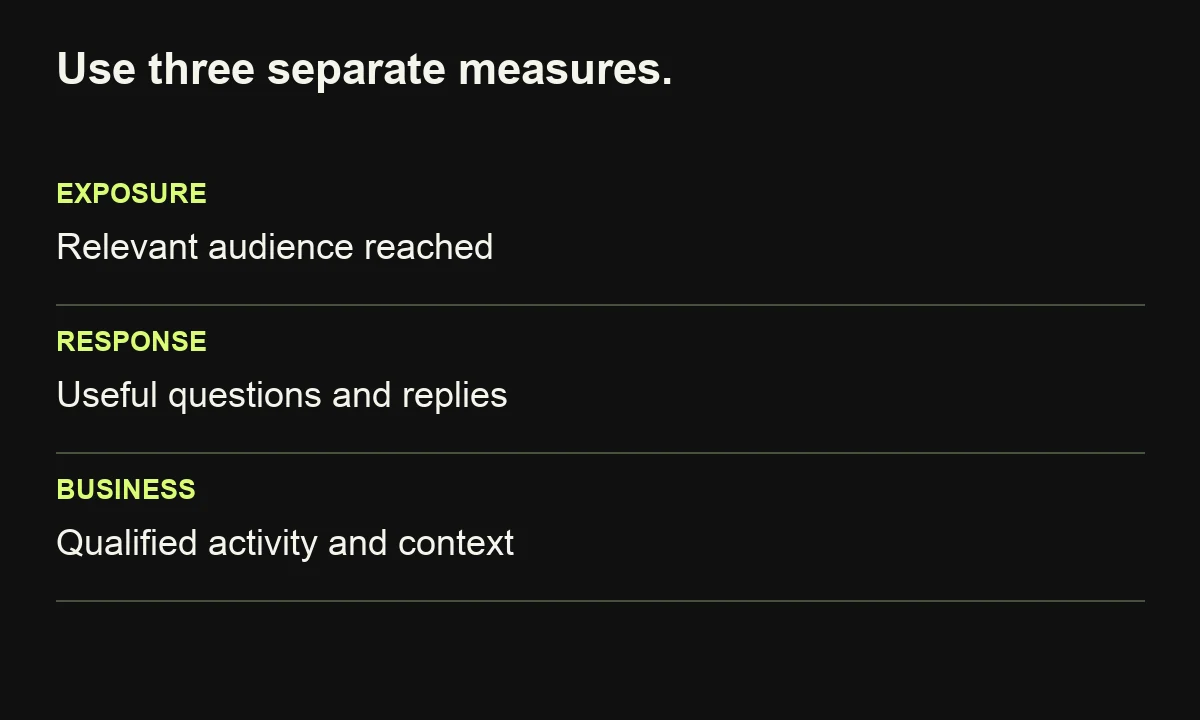
Measure three layers separately: whether the intended audience encountered the material, whether the idea produced meaningful response and whether qualified business activity followed. Do not compress them into a single invented influence score.
For exposure, use the channel's available reach or impression data, with its definitions recorded. For response, inspect relevant comments, questions, saves or replies. A hundred reactions from unrelated accounts may matter less than a practical question from an appropriate buyer.
For business activity, review qualified enquiries and the context prospects provide. An optional discovery question can reveal that someone remembers an example. Record their answer as self-reported context, alongside any observed referral information. Neither field should silently overwrite the other.
Avoid dividing unrelated populations. Total platform impressions are not unique qualified buyers, and enquiries can include people who never encountered the campaign. A conversion rate needs a defensible numerator and denominator.
The scorecard should support an editorial decision: continue an idea, explain it differently, change distribution or stop. Its purpose is learning, rather than making every campaign appear successful despite weak evidence.
Run a four-week editorial pilot
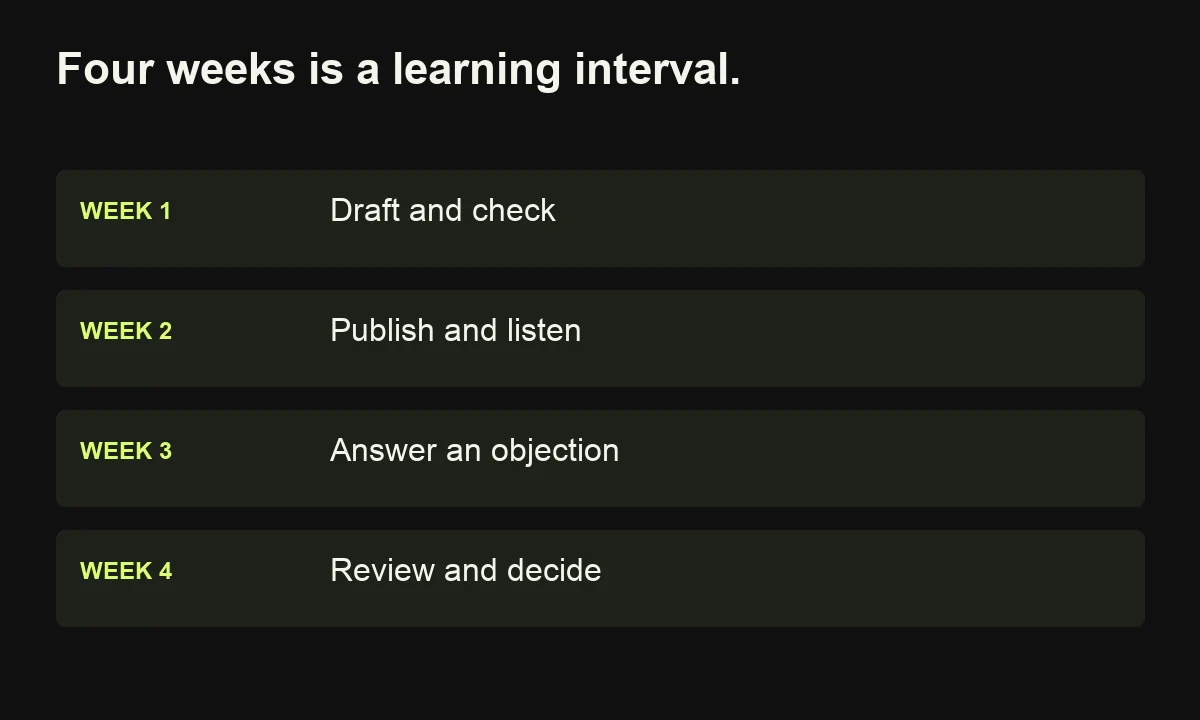
Use a bounded pilot to learn whether the idea deserves more work. Four weeks is a planning interval here, not a promised time to generate revenue. Choose one audience, one recurring decision and one primary channel.
In the first week, collect buyer questions and draft two complete explanations. Have a subject specialist check the reasoning. In the second, publish the clearest asset and record the actual questions it generates. In the third, address a meaningful objection with a new example. In the fourth, review the evidence and choose the next action.
Assign responsibilities before starting: an editor owns the argument, a specialist checks factual claims and a marketer records distribution and response. Keep the process light enough to repeat without turning every post into a committee project.
Use content repurposing to adapt useful evidence for another format, while preserving its conditions. A short video should not claim a universal rule when the article describes one specific case.
Common questions about zero-click marketing
Should we remove links from every post?
No. Choose links according to the reader's task and the channel's current capabilities. A complete answer can include an optional link. Blanket claims that every platform always penalizes every external link need platform-specific evidence and should not govern the entire strategy.
Does this mean giving away all our expertise?
Publish useful reasoning while respecting confidential information, intellectual property and the limits of a short format. Explaining how to recognize a problem does not reproduce the work of diagnosing a particular organization and implementing a solution.
Is website traffic still worth measuring?
Yes. Visits show recorded activity on your site and can reveal valuable evaluation behavior. They are one part of the evidence. Avoid celebrating reach while ignoring enquiries, or dismissing a useful asset solely because readers understood it without clicking.
The practical standard is simple: give the audience a complete idea, make its source recognizable and provide a worthwhile next step for people who need more. Keep the measurement honest enough to improve the work.
If your distributed content attracts attention but leaves the offer unclear, share the buyer decision you want to support. That is a concrete starting point for a better editorial brief.