
AI summary
Treat llms.txt as a small information resource with a defined consumer and maintenance owner. Google Search ignores the file for visibility and rankings, so approve it for a practical use rather than a promised citation uplift.
- Prioritize the real problem: Correct inaccurate pages, outdated documentation and unclear explanations before adding another reference. A compact guide can help direct an intended reader, but it cannot repair weak source material or establish search eligibility.
- Keep the scope useful: Select a few authoritative public destinations, explain their purpose and keep private information out. If Markdown alternatives are offered, decide how factual changes will stay synchronized with visible pages.
- Measure specific observations: Record retrieval, answer accuracy and task completion separately. A request to the file does not prove that an answer engine used it, cited the business or generated an enquiry.
An llms.txt file is an optional guide for agents using your website. It is not a Google ranking requirement. Create one when you can identify a useful reader or system for it, keep its links accurate and give maintenance an owner. Fix inaccurate pages, inaccessible documentation and weak explanations first.
The distinction matters when a proposal turns a small text file into an expensive visibility project. A file can be useful without being a ranking signal. A crawler fetching it does not demonstrate that an answer engine used it, cited your company or recommended your service.
The llms.txt proposal describes a Markdown resource that supplies context and links for agents. Its current version also discusses Markdown alternatives to web pages. That is a proposal for making information easier to use, with its own conventions and possible consumers.
Google's generative AI optimization guidance is explicit: Google Search ignores llms.txt files for visibility and rankings. Maintaining one for another system is a separate decision.
For a marketing team, the useful question is therefore concrete: which information should a visiting agent find, which system might use this guide and how will we know whether maintaining it is worthwhile?
What llms.txt does, and what other files do
Treat llms.txt as an editorial guide to selected information. It can explain what the company does, identify authoritative documentation and direct a reader toward important reference pages. It should reflect the same facts that people find on the website.
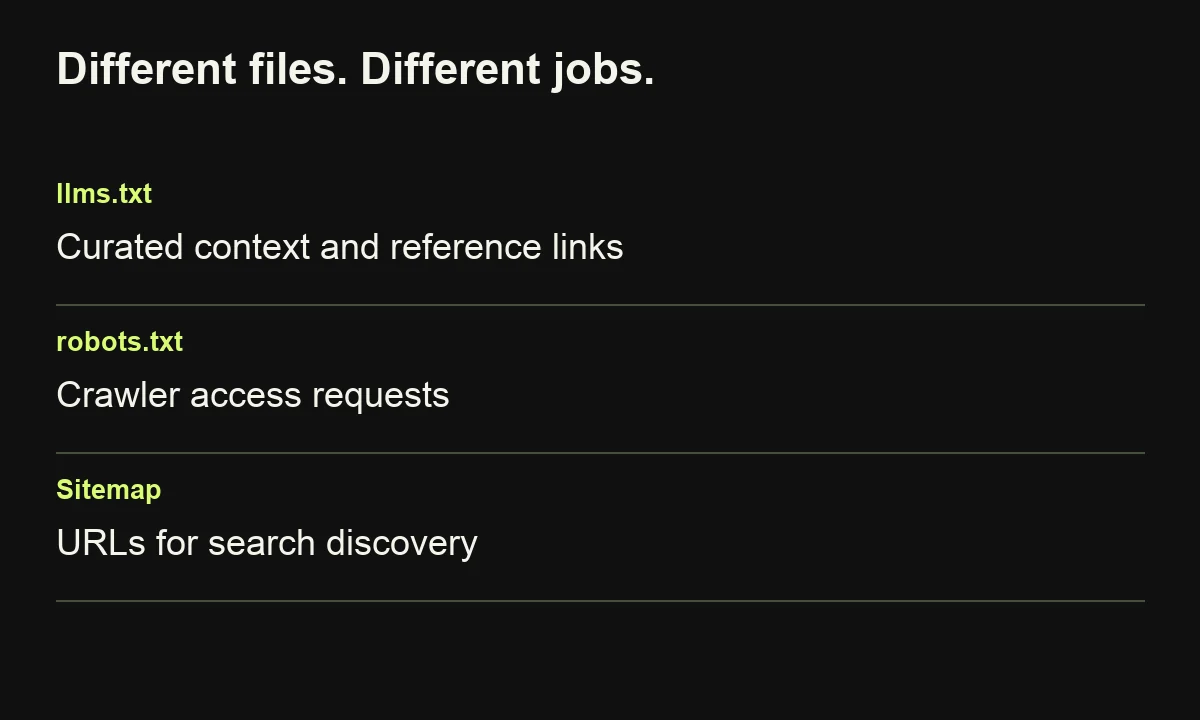
Other files have different jobs. Robots.txt manages crawler access requests; it is not a reliable way to keep confidential information out of public view. A sitemap helps search engines discover URLs. Neither should be replaced by a curated AI reading list.
Before creating anything, write a one-sentence purpose. For example: “Help documentation agents find the current integration guide and its limitations.” That gives the file a testable editorial role. “Make us rank in AI” does not.
Keep private pricing agreements, customer records and unpublished product plans out of every public resource. A plain-text format does not make information private. Review the destination pages as well as the index itself.
For a small service website with clear navigation and a few accurate pages, the additional benefit may be modest. For a documentation-heavy product with several versions, a carefully maintained guide may solve a more specific navigation problem. These are prioritization judgments, not measured performance claims.
Start with a small, accurate reference
Use the proposal's current format as your implementation reference. An initial file should be short enough for an editor to review completely, with a clear identity, a concise description and a few purposeful groups of links. Explain why each destination matters.
Here is an illustrative outline for a fictional scheduling product, Northstar. It is an editorial example rather than a complete specification:
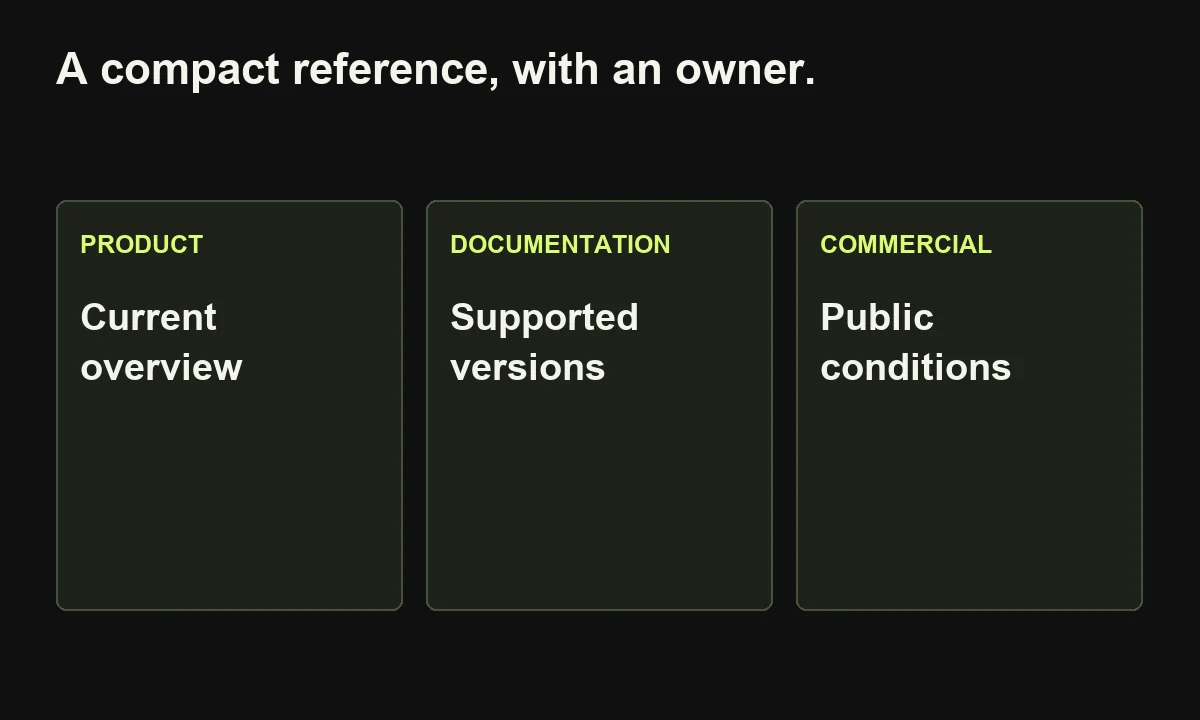
- Identity: Northstar provides appointment scheduling for small service teams.
- Product guide: Link to the current overview and explain the supported use case.
- Integration reference: Link to maintained API documentation and version information.
- Commercial reference: Link to current public pricing, including its conditions.
- Support: Link to troubleshooting and the contact route for unresolved issues.
Avoid filling the file with every blog URL. A comprehensive inventory already has other homes. Select the resources that answer recurring questions accurately, and prefer maintained destinations over promotional duplicates.
If you provide Markdown versions of pages, establish how they update when the visible page changes. Two manually maintained descriptions of the same product can diverge. A publishing process that derives both from the same reviewed source is easier to govern.
Review whether the outline remains useful without any claim about rankings. If it does, you have a plausible resource. If it does not, reconsider the work before expanding it.
Run a bounded implementation experiment
Consider a hypothetical documentation team receiving repeated questions about which integration version to use. Its goal is to make the current reference easier to locate, rather than increase a visibility score supplied by a vendor.
First, record the existing problem: outdated links in support replies, conflicting version descriptions or difficulty finding the migration page. Correct the underlying pages before adding a guide that points to them.
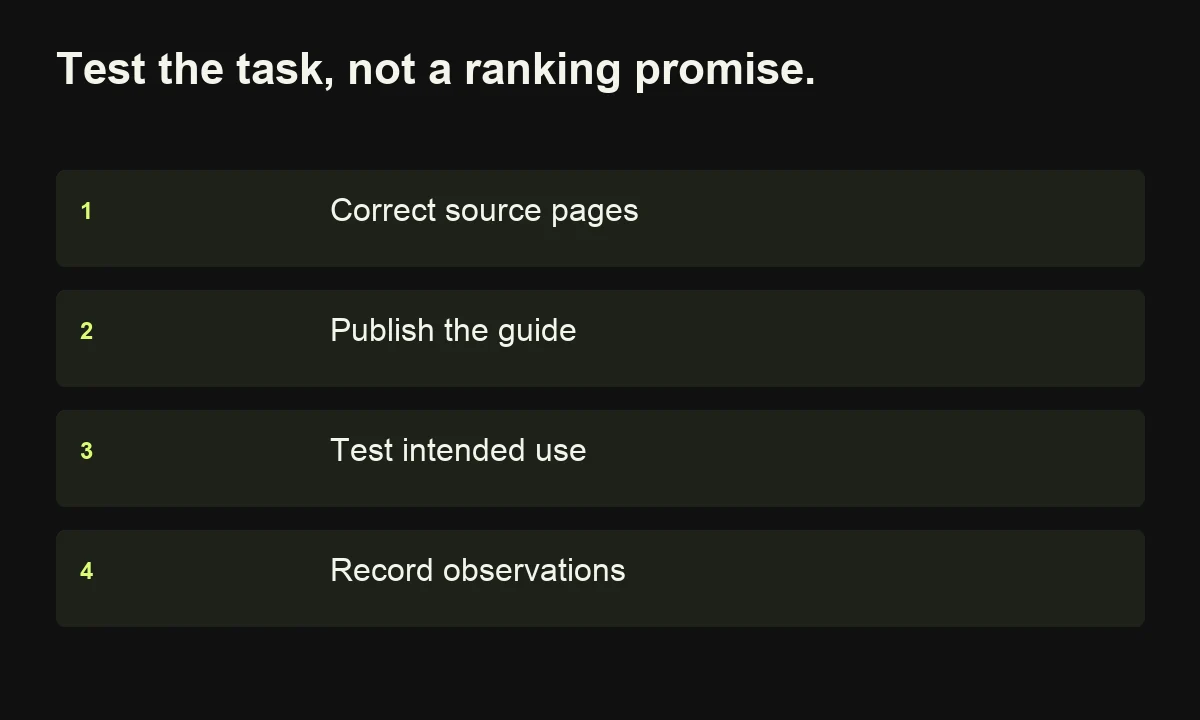
Next, publish a compact file containing the current guide, version reference and migration instructions. Ask an engineer and a support editor to check every link, summary and version statement. Record the release date and a copy of the reviewed file.
Then test the intended use. If a documented integration consumes the file, confirm that it retrieves the right destinations. Where appropriate, inspect server requests, while recognizing that a user-agent label alone may not establish a crawler's identity.
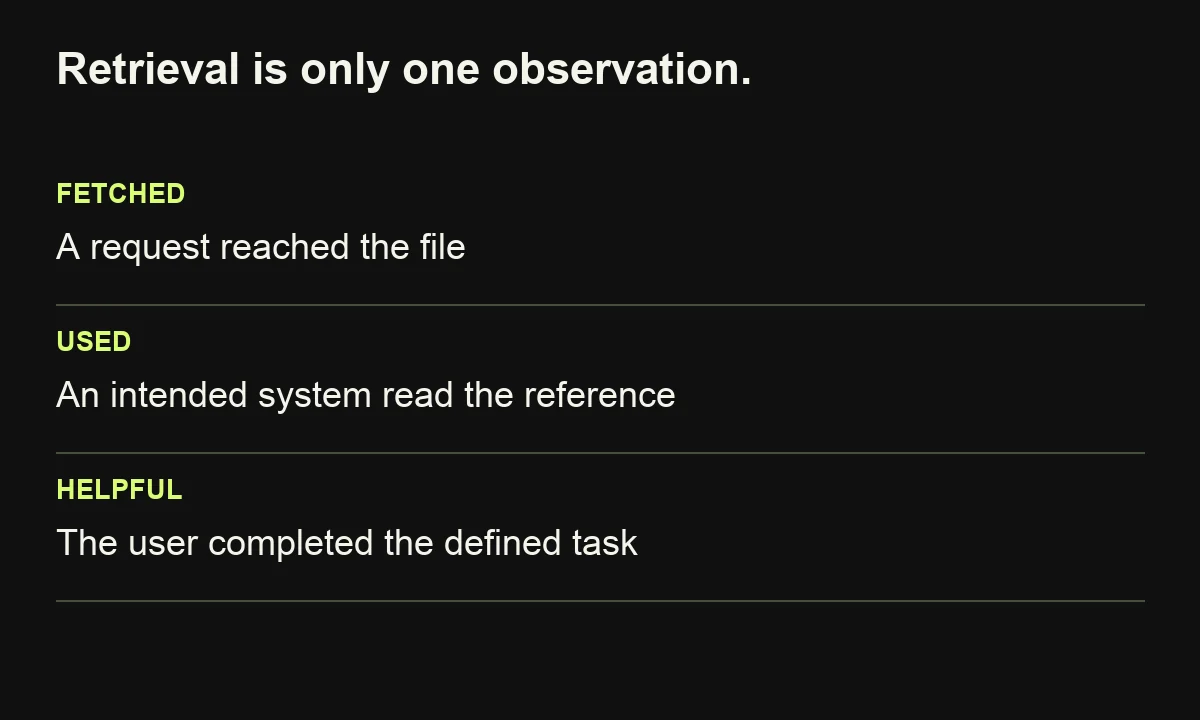
Finally, record observations separately: file fetched, destination retrieved, answer accurate, citation present, user task completed. These are different events. One does not establish all the others.
If no relevant consumer can be identified and the experiment produces no useful evidence, keeping the resource small is reasonable. Expanding it into hundreds of generated summaries would create more maintenance without resolving the original uncertainty.
Give maintenance a named owner
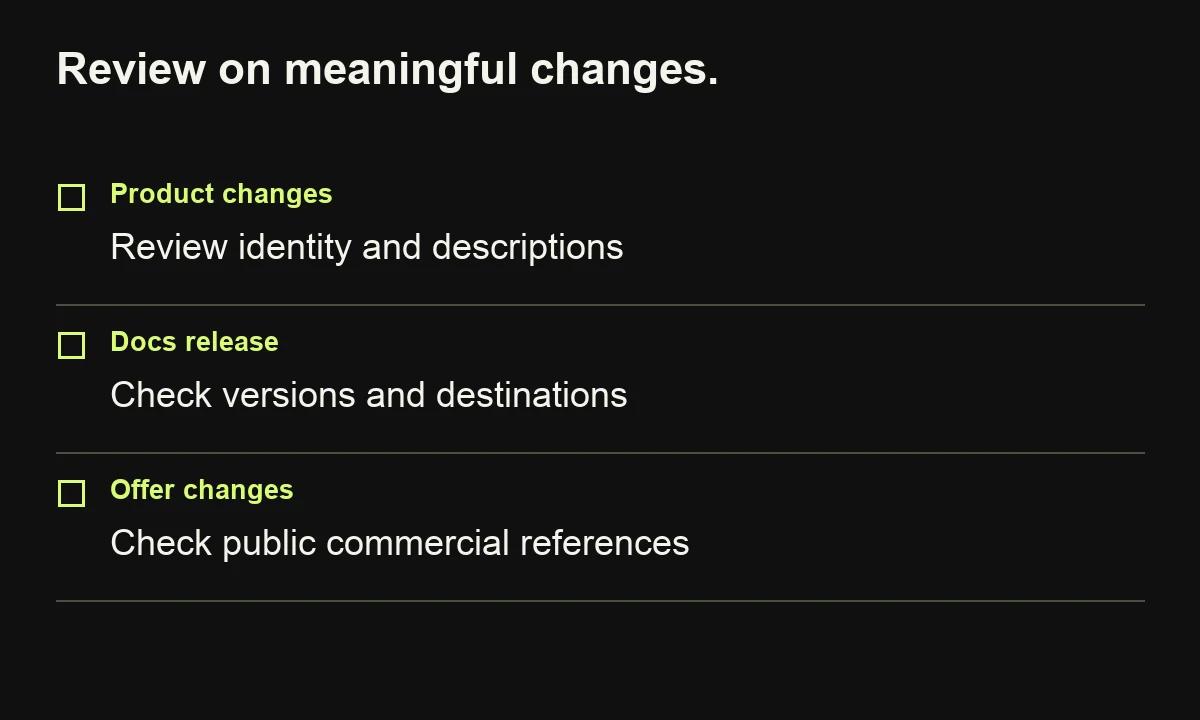
An optional resource still creates obligations. Add it to the same review process as product descriptions, documentation links and public pricing. When a service is retired or renamed, the guide should not preserve the old claim indefinitely.
Use a compact maintenance register with four columns: reference, responsible person, change trigger and last checked date. For the fictional Northstar example, the product marketer owns the overview, the documentation lead owns integration versions and the commercial owner reviews pricing links.
The change trigger is more useful than a ceremonial monthly approval. A documentation release, changed offer or moved support page should prompt a review when it happens. Periodic checks can catch changes that the normal workflow missed.
Before replacing the file, compare it with the previous version. Confirm that new destinations are public, old descriptions are removed where necessary and internal notes have not entered the published copy. Keep a recoverable version outside the web root.
Do not add unsupported testimonials or keyword lists to make the resource appear authoritative. The file's value comes from accurate guidance. If the website itself cannot explain the offer clearly, invest in the visible content first. The broader GEO guide explains how evidence and discoverability fit together.
Questions to ask before paying for llms.txt work
Do I need llms.txt for Google AI visibility?
No. Google's current guidance says it does not help or harm Search visibility or rankings because Search ignores it. Ask a supplier to distinguish Google eligibility work from support for other systems. A proposal should identify the intended consumer and deliverable.
Can I measure whether it works?
You can measure specific observations, such as requests to the file or successful retrieval by a known integration. Those observations do not establish ranking improvement or causal influence on an AI answer. Define the task and evidence before interpreting the result.
Should an agency create hundreds of Markdown pages?
Only when those pages serve a documented purpose and have a sustainable update process. A small project can become costly through duplicate-content maintenance. Ask how factual changes propagate, who owns failures and what happens when the website structure changes.
My recommendation is to approve a bounded deliverable: a reviewed guide, verified public links, a maintenance owner and an honest measurement note. Reject promises that a file will guarantee citations or enquiries.
If the larger problem is deciding what buyers need to understand, start with the content itself. Tell me where the current explanation breaks down, and we can identify the work that deserves priority.