AI summary
Generative engine optimization should improve how buyers understand your business through generated answers. A mention is incomplete success if the answer misstates your audience, capabilities, or evidence. Start with the meaning you need to preserve.
- Connect claims to sources: Map important offer facts to approved pages, supporting evidence, conditions, and review owners. Inspect external descriptions and visible citations before deciding what needs correction.
- Improve useful information: Answer real buying questions, explain prerequisites and alternatives, and keep limitations near claims. Preserve technical access and check current platform requirements rather than chasing a universal GEO shortcut.
- Measure representation and relevance: Keep comparable question sets and testing conditions. Review citations, factual accuracy, and qualified enquiries separately. Research percentages and sampled visibility scores are not promises of rankings, market share, or revenue.
Generative engine optimization (GEO) is the practice of improving how your business and information are discovered, represented, and referenced in AI-generated answers. It combines useful content, accessible sources, credible evidence, and ongoing evaluation. The goal is relevant, accurate visibility, not merely more mentions. No technique guarantees inclusion, recommendations, rankings, or sales.
Imagine a prospect asking an AI assistant which solution fits a difficult business problem. The answer combines a service page, an old review, and a competitor's comparison. Your name appears, but the explanation assigns you a capability you do not offer.
You gained visibility and inherited a misunderstanding.
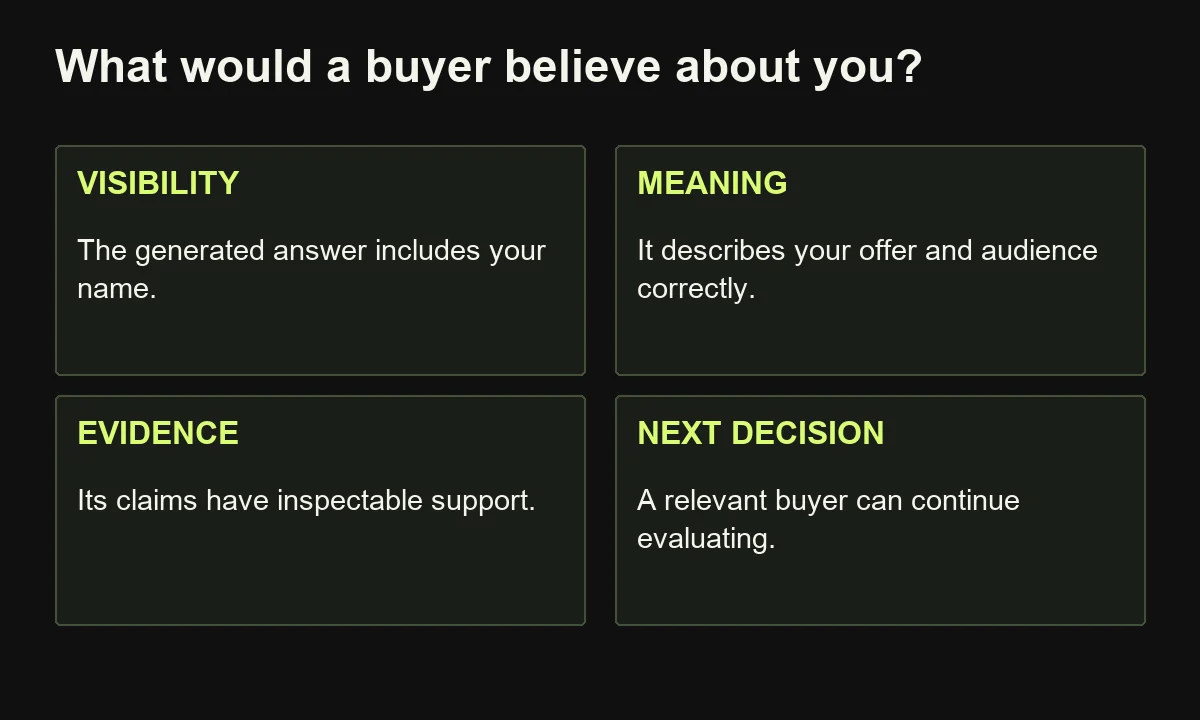
That hypothetical situation captures the strategic challenge of GEO: what would a buyer believe about you after reading the generated answer? Counting your name does not resolve that question.
This guide is for B2B founders and marketing leaders who want their expertise understood and their content worth referencing. It explains the research, mechanics, editorial work, technical checks, and measurement without pretending that marketers control an answer engine.
My proposed working document is a claim continuity map. It connects an important buying claim to its approved source, evidence, limitations, external descriptions, and observed representation. It is an editorial management tool, not a validated ranking model.
Use it to preserve the meaning of your offer as information moves between your website, other publishers, and generated responses.
GEO vs SEO vs AEO: are they different strategies?
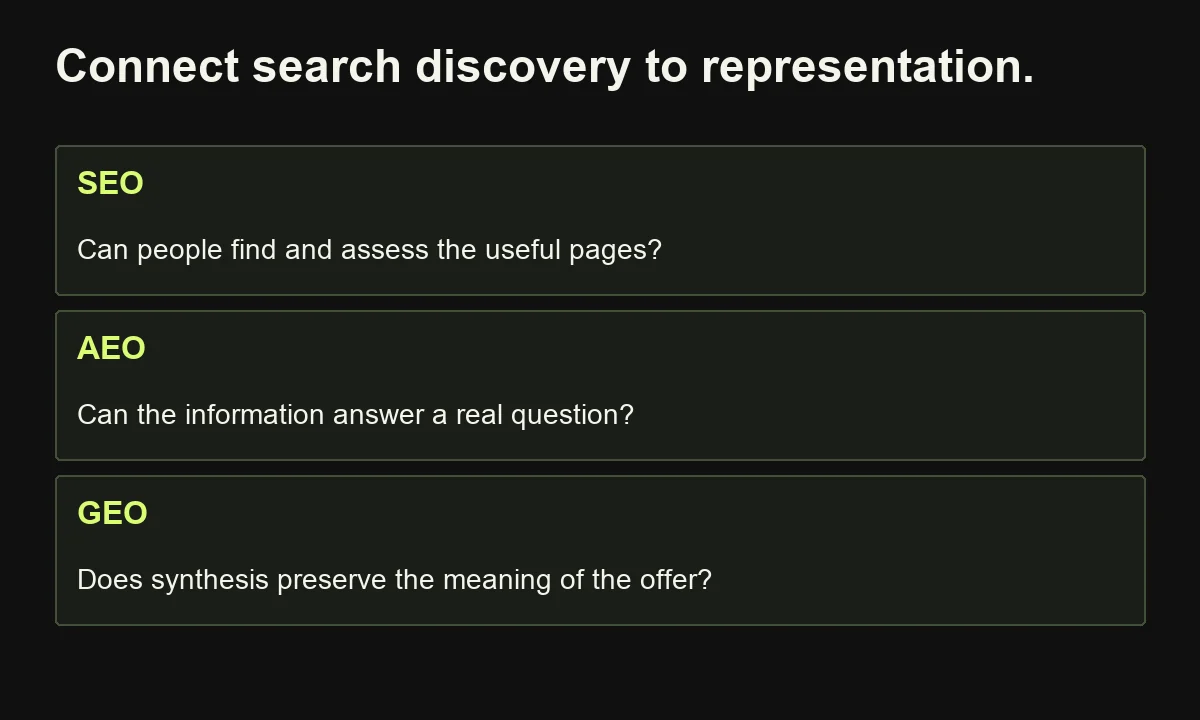
GEO emphasizes visibility and representation in generated responses. SEO addresses discoverability and performance in search. AEO focuses on direct answers, including experiences that may use generative systems. The terms overlap and have no universally agreed boundaries. Define the surfaces and business outcomes you care about before deciding whether you need separate workstreams.
| Term | Useful planning question | Shared foundation |
|---|---|---|
| SEO | Can relevant people find and assess our pages? | Accessible, useful information |
| AEO | Can our information help answer a real question? | Clear explanations and support |
| GEO | How are we represented when sources are synthesized? | Consistent facts and inspectable evidence |
This is an operating distinction, not a claim that three separate algorithms enforce those boundaries. Our AEO guide explains direct-answer planning in detail. This guide goes deeper into claim consistency, synthesis, and diagnosis.
Google's current guidance says its generative search features remain rooted in Search ranking and quality systems. From that platform's perspective, the foundations remain SEO.
For your team, the useful shift is adding questions that ordinary position tracking cannot answer: Is the description right? Are important conditions missing? Does a citation actually support the claim? Does the destination help the buyer continue?
Relevant experiences include Google AI Overviews, AI Mode, Microsoft Copilot, and Perplexity. Keep existing search work and add these checks. A new acronym does not justify discarding a useful website or creating three competing content calendars.
How do generative engines build answers?
A generative system can combine model knowledge, supplied context, and retrieved information to produce a response. Search-grounded experiences may retrieve pages and use them as supporting material. Some also issue related searches to explore a question. Processes vary by provider, interface, and mode; this explanation is a diagnostic model, not access to proprietary algorithms.
Two terms matter. Retrieval-augmented generation, or RAG, brings retrieved information into generation. Query fan-out means expanding an initial request into related searches. Google describes both in its generative search guidance.
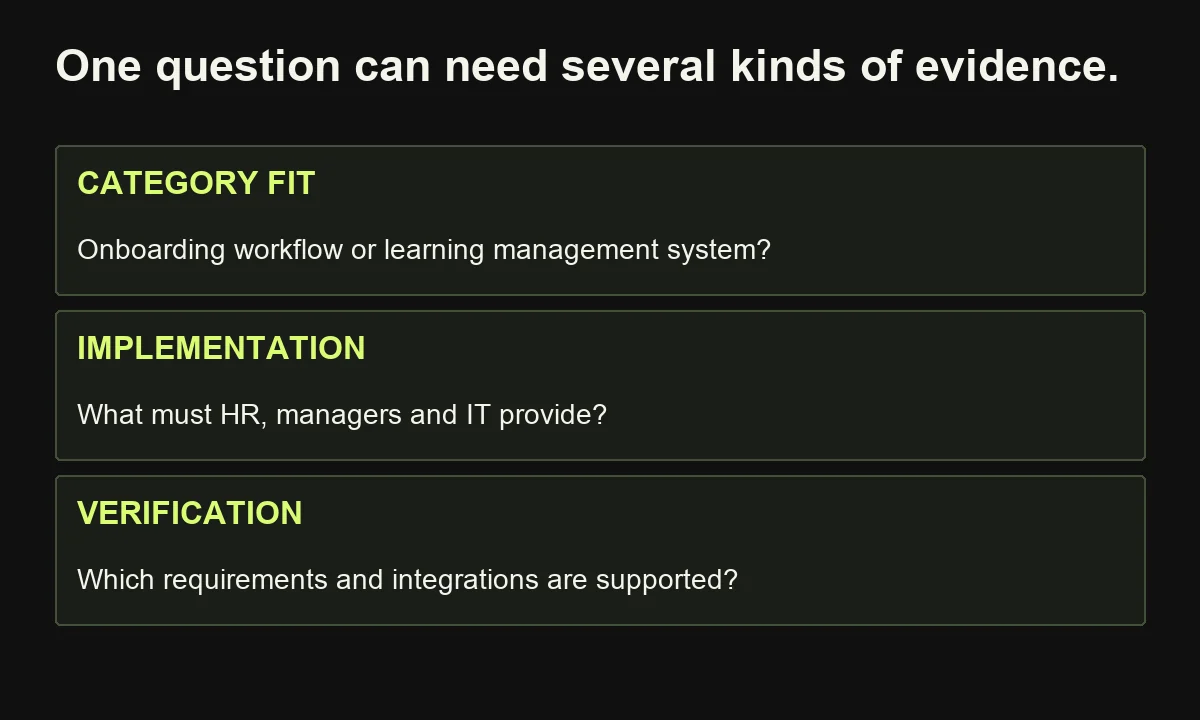
Consider a hypothetical buyer asking: “Which onboarding platform suits a distributed company with limited HR capacity?” Related questions might concern setup effort, manager responsibilities, integration requirements, or ongoing administration. Those are illustrative research branches, not observed platform queries.
Your product overview might explain category fit. A setup guide might establish prerequisites. A documented project might show an implementation under particular conditions. Together, they offer more useful information than one page repeating “best onboarding platform.”
However, a citation does not expose the full reasoning behind an answer. Nor does a crawl prove that information was used.
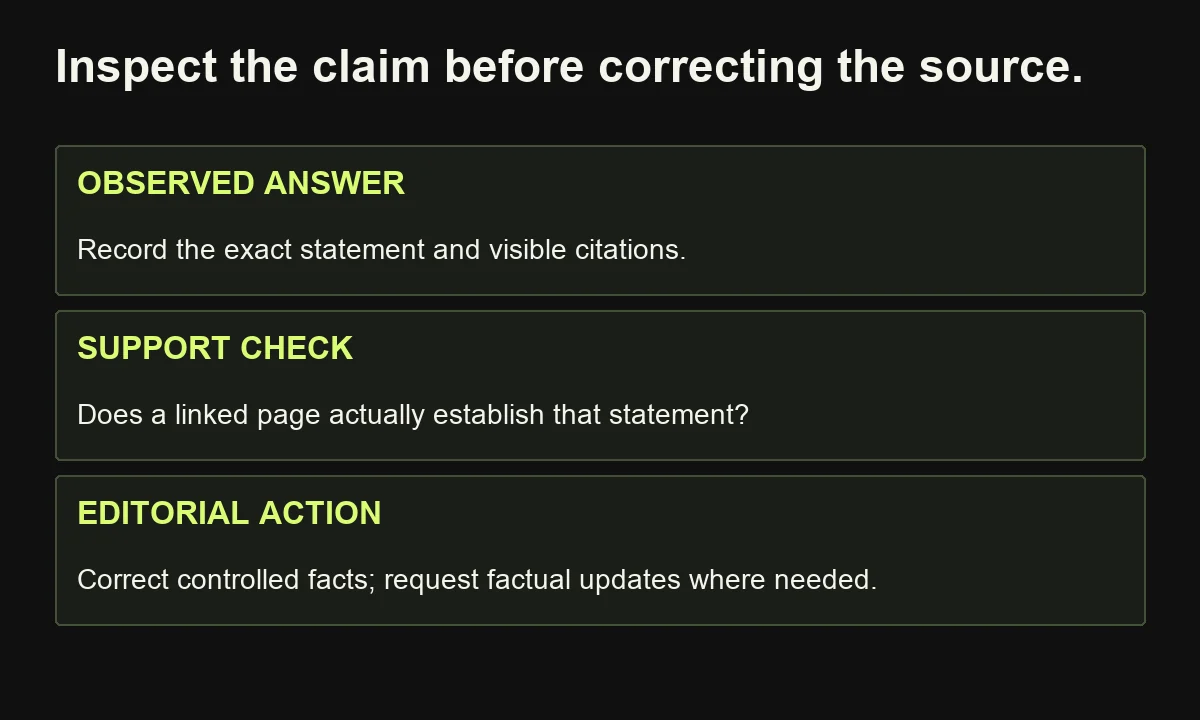
Inspect what is visible: the response, linked sources, claim support, and the relevant destination. Avoid reverse-engineering an entire system from one result. Your influence comes through better information and legitimate discoverability, while selection and synthesis remain outside your direct control.
What does the original GEO research actually show?
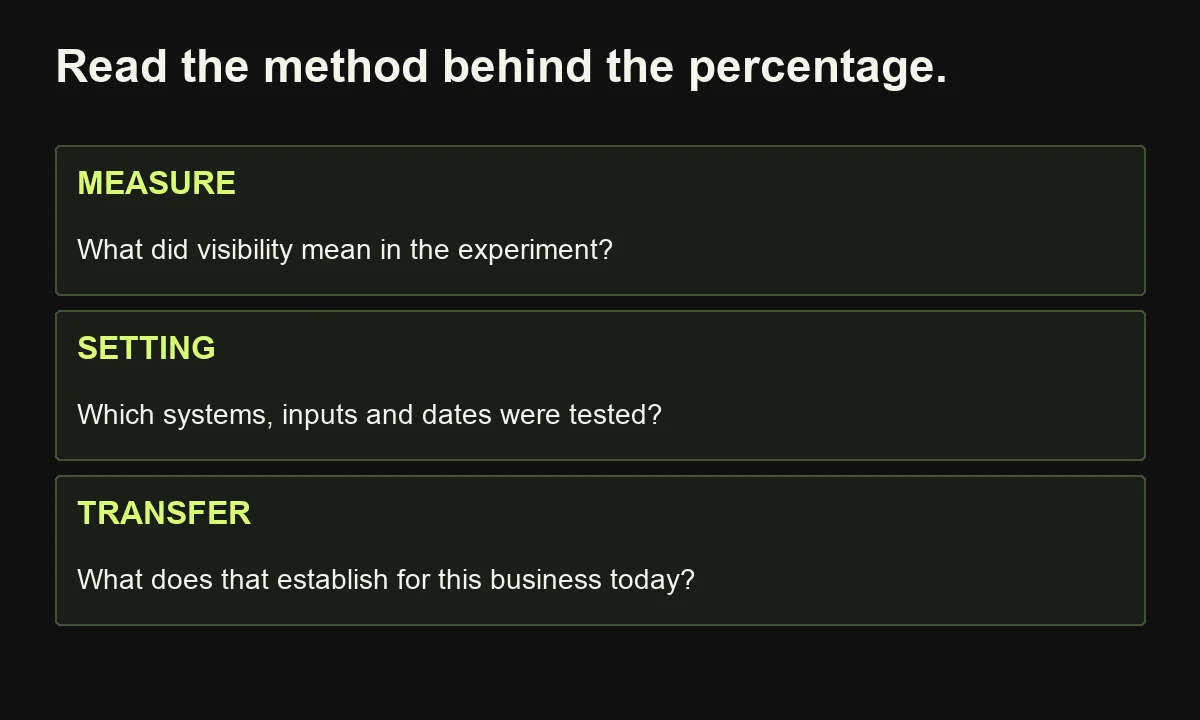
The original GEO research provides evidence that source changes can affect visibility under evaluated conditions. It does not establish a universal commercial playbook or promise that adding statistics will increase your traffic. Read the method, measure, and limitations alongside the headline result before applying an experimental finding to a current marketing decision.
The GEO paper by Aggarwal and colleagues, accepted at KDD 2024, introduced a framework and GEO-bench. It reported visibility improvements of up to 40% in its evaluated settings, with effects varying across domains.
Its visibility measures included position-adjusted word count and subjective impression measures. Those are not equivalent to qualified enquiries, revenue, or the probability that a current platform will recommend your business. Its deployed-engine check used Perplexity with supplied source files on 200 test samples. That is not an experiment proving improved rankings across the live web in 2026.
The practical lesson is to test source improvements and define the outcome precisely. It is not to decorate every paragraph with a number, borrowed quote, or citation.
For example, adding a reliable implementation constraint may improve a buyer's decision even if its effect on citation frequency remains unknown. Adding an irrelevant statistic may make the page longer without making the answer better.
When someone sells a GEO result, ask: What changed? Compared with what? Which engine and dates? What was counted? What else could explain the difference? These questions separate useful evidence from an impressive-looking percentage.
Which questions should a B2B GEO strategy prioritize?
Prioritize questions that influence a real buying decision and that your business can answer with relevant evidence. Include category fit, comparisons, implementation constraints, and verification questions. Combine customer research with search-language research, then label assumptions. A prompt invented by a marketer is a test idea, not proof that customers ask it.
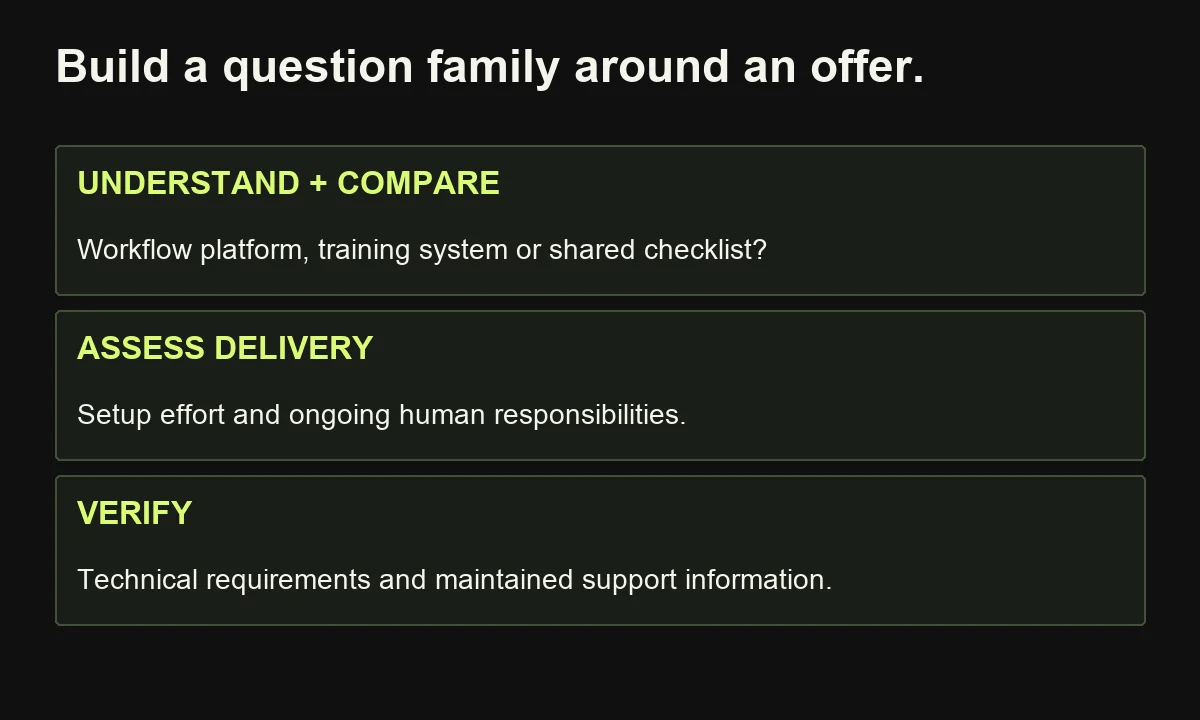
Build a question family for one important offer. For the hypothetical onboarding platform:
| Buying task | Question to investigate | Useful destination |
|---|---|---|
| Understand fit | Onboarding workflow or learning management system? | Category and use-case explanation |
| Compare | When is a shared checklist sufficient? | Fair alternatives guide |
| Assess delivery | What must HR and managers provide? | Setup and responsibility guide |
| Verify | Which integrations are actually supported? | Maintained technical documentation |
Use ICP and buyer persona research to understand whose concern each question reflects. The HR lead, IT reviewer, and budget approver may require different information.
Record the source of each question: interview, sales note, support request, search data, or hypothesis. Prioritize by decision importance, available evidence, and the gap in your existing content.
Cluster wording variations around a shared intent. A new page is justified when the buyer needs a genuinely different answer, not simply because an assistant produced another prompt variation. Cover the important decision thoroughly before expanding the question list.
How do you make your brand and offer unambiguous?
Define the material facts a buyer needs to understand your business, then inspect whether your public pages communicate them consistently. Start with category, audience, scope, capabilities, prerequisites, and limits. Consistency means avoiding contradictions, not copying one sentence everywhere. Different pages can explain the same offer at different levels of detail.
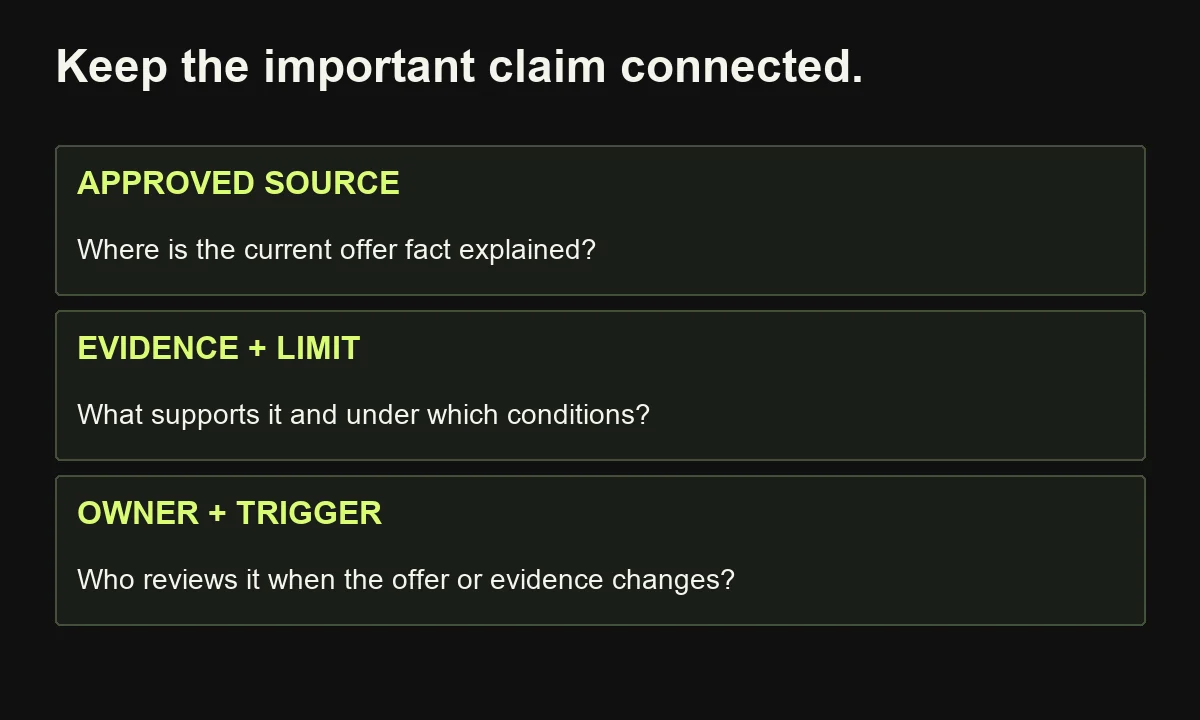
Create a compact claim continuity map:
| Claim | Approved source | Evidence or condition | Review trigger |
|---|---|---|---|
| Who the offer serves | Service or product page | Actual supported use cases | Offer changes |
| What it includes | Scope or documentation | Approved deliverables | Scope revision |
| What a project achieved | Case study | Method, period, contribution | Correction or new evidence |
| What it requires | Implementation guide | Technical and human prerequisites | Process changes |
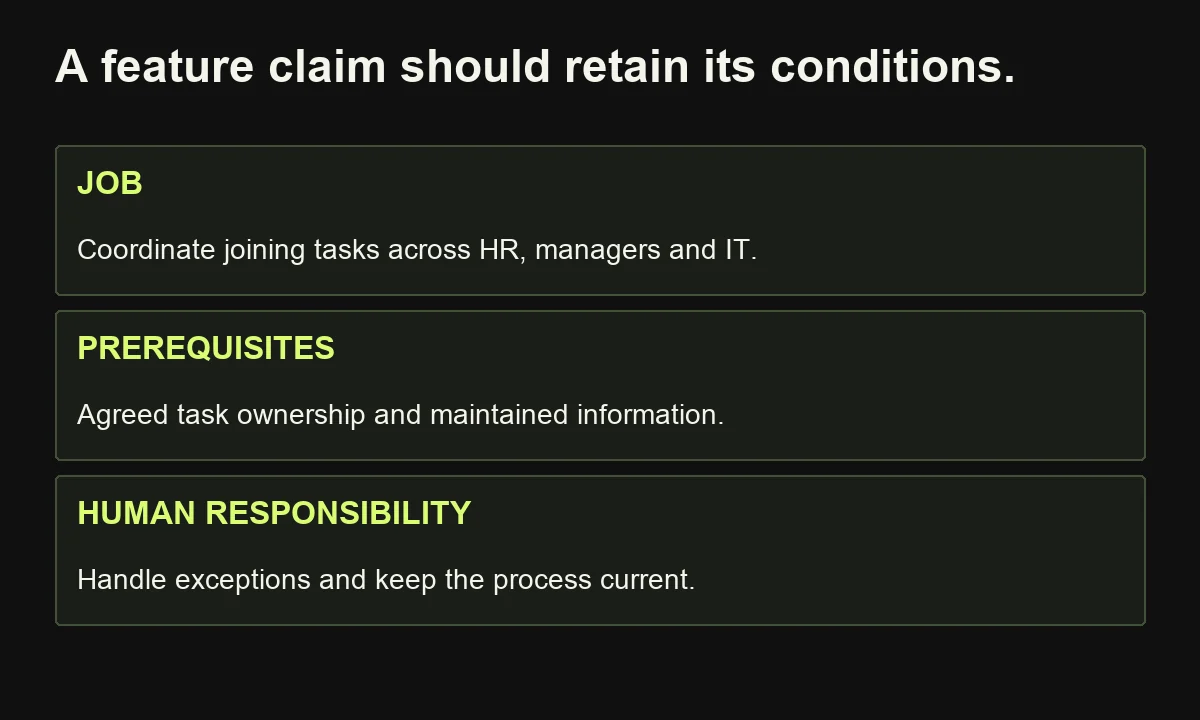
In the onboarding example, “coordinates joining tasks” should not silently become “replaces all employee training.” If the product needs an HR owner, that condition belongs near implementation claims.
Check the homepage, offer pages, author or company profile, case studies, and relevant external listings. Give each important fact an owner and a source people can inspect.
Also disambiguate similar names and explain relationships between the business and its products. Do not use inflated categories merely because they sound more impressive. The test is whether a prospect can describe what you actually provide without needing to untangle contradictory promises.
How should content be written for accurate synthesis?
Write explanations that remain accurate when separated from the surrounding page. State the subject, recommendation, applicable conditions, and important limits close together. Then provide the reasoning, evidence, and next step. This serves readers who skim or forward an extract; it is not a special paragraph format guaranteed to influence a model.
Consider a hypothetical onboarding software description.
Ambiguous: “Automate onboarding for every team and remove HR admin.”
More useful: “The platform coordinates joining tasks across HR, managers, and IT. It requires agreed task ownership and maintained employee information. It can reduce repeated coordination work, but people still handle exceptions and keep the process current.”
The second version makes the job, prerequisites, and human responsibilities visible. It does not fabricate a time-saving figure or suggest that software removes every administrative task.
Use comparison tables with explicit criteria. Explain when the simpler alternative is enough. Include edge cases, such as missing employee information or a task with no assigned owner, where they help someone assess implementation.
Keep essential information in readable text. Use diagrams to explain relationships rather than hide the only statement of a requirement inside an image.
Avoid vague superiority claims and disconnected fragments written solely to sound quotable. A short claim that drops its necessary condition is easier to repeat incorrectly. Your goal is a useful explanation whose meaning survives summarizing, not a sentence engineered only for extraction.
What evidence is worth creating and maintaining?
Create evidence that helps a buyer evaluate your claims: documented work, reproducible explanations, clearly labeled research, practical templates, and maintained product or service information. Choose the evidence for the decision it supports. A large resource library is less useful than a smaller set of reliable assets that answer important questions precisely.
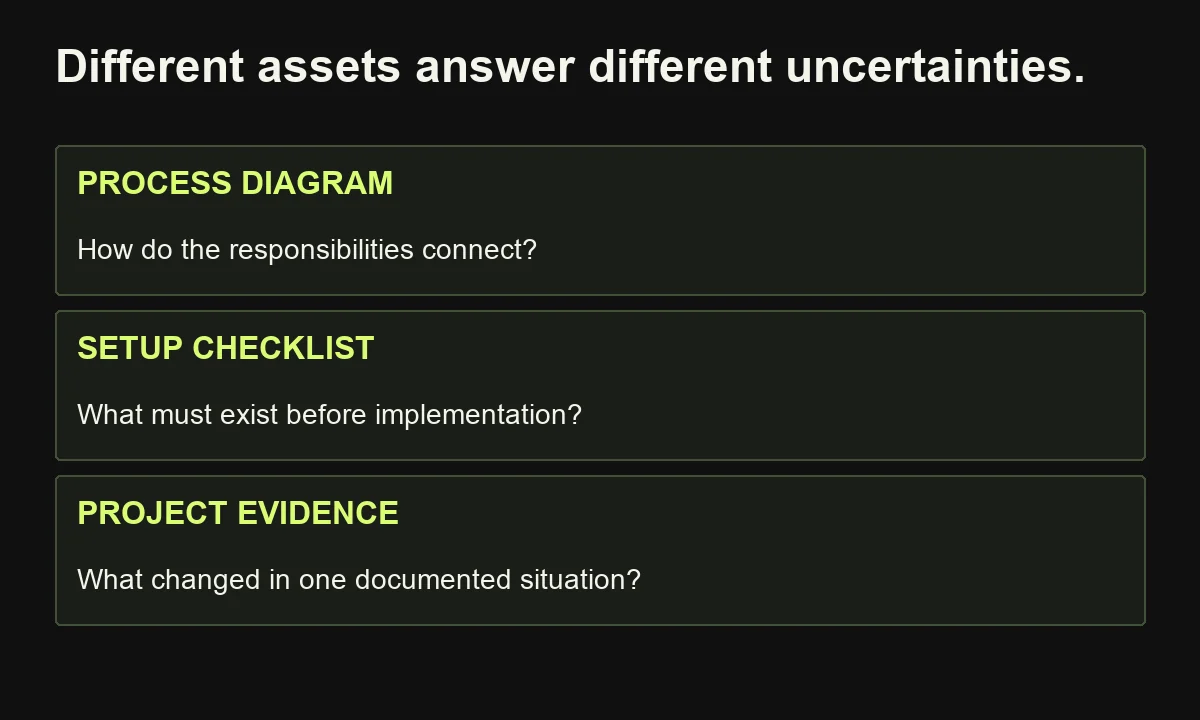
For the onboarding example, a process diagram can explain responsibilities, a setup checklist can reveal prerequisites, and a bounded case study can describe what changed in one project. None substitutes for the others.
For every important claim, retain the source, method, date, applicability, and limitations. For original research, explain who or what was studied and how the observations were collected. Show the denominator behind percentages and distinguish association from causation.
For project evidence, identify your actual contribution. A business result after a project is not automatically attributable entirely to your intervention. If permission or measurement is missing, narrow the claim instead of inventing detail.
An original contribution can also be a useful decision aid. This guide's claim continuity worksheet is a proposed planning resource, not experimental proof of citation gains.
Connect each evidence asset to the appropriate explanation and offer through relevant internal links. Let the reader inspect the basis of a recommendation at the point they need it. That relationship makes evidence usable rather than leaving it isolated in a portfolio section.
What role do third-party sources and digital PR play?
Relevant third-party material can help people discover and assess your business, and it may appear among the sources shown in generated answers. Review those descriptions for factual accuracy and context. Independent evidence has value because another party can evaluate it; manufacturing apparent independence undermines the credibility you are trying to build.
Start with public information already associated with you: professional profiles, partner pages, legitimate directories, published interviews, and reviews where relevant. Check category, scope, dates, and contact details. Request factual corrections where appropriate, without pretending you control an editor's judgment.
If an answer misstates a capability, inspect its citations. A linked review might be outdated, but it might not be the actual origin of that particular statement. Record visible support and uncertainty separately.
To earn new references, contribute something a relevant publisher's audience can use: a documented analysis, a clearly explained method, or an expert response grounded in evidence. A backlink or mention should have editorial purpose beyond an expected algorithmic reward.
Do not fabricate testimonials, run fake community conversations, or publish undisclosed self-recommendations. Avoid copying unsupported praise across dozens of sites.
Maintain your own accurate explanation alongside legitimate external references. If you correct a source, record the change and observe subsequent responses under comparable conditions. A corrected page is a completed editorial action; changed representation across every engine is a separate outcome that must be checked.
What technical foundations does GEO require?
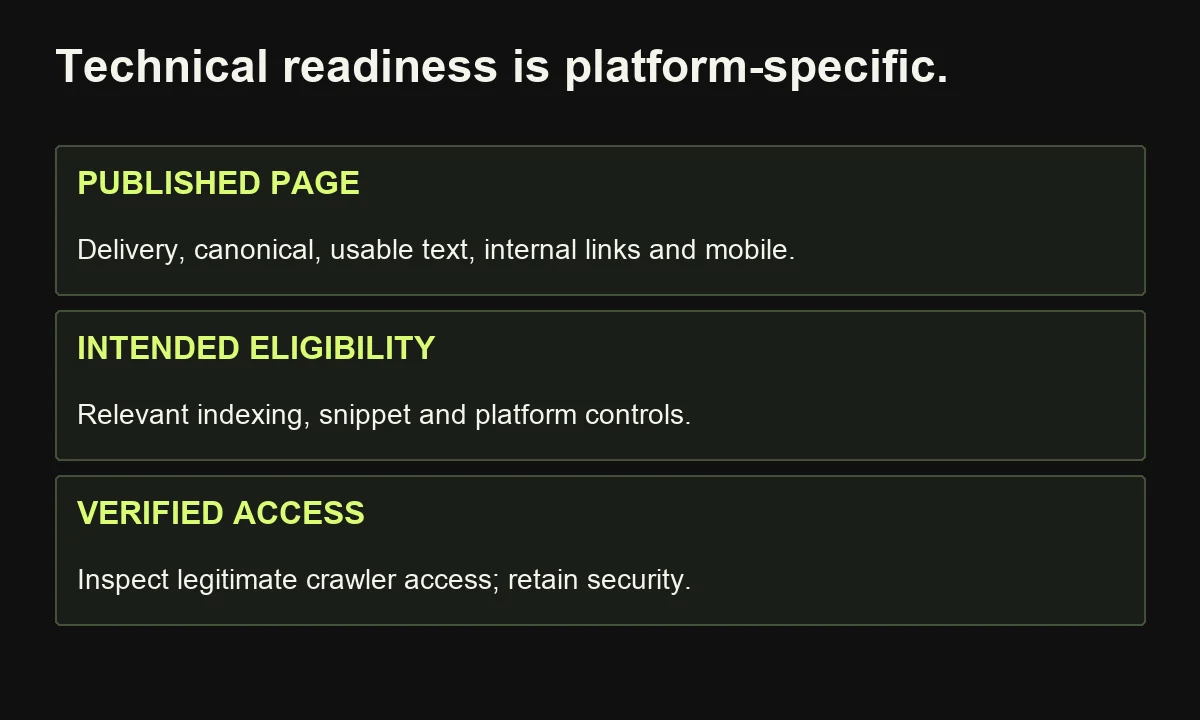
Technical work should make intended public information reachable, usable, and eligible for the relevant search experience. Inspect the actual published page and the controls that apply to the target platform. Necessary security and privacy protections should remain intact. Passing a technical checklist establishes readiness; it does not establish that a generated answer will select your page.
Check successful page delivery, canonical URLs, robots directives, important rendered text, internal links, mobile usability, and relevant crawler access. Include canonical, indexable pages in your sitemap and verify the live version after deployment.
For Google, its current guidance specifies indexing and snippet eligibility. The property's Search generative AI control also affects inclusion; check for an exclusion or inherited setting.
For other services, inspect their own documentation. Perplexity distinguishes its search crawler from user-requested fetching and describes their purposes. Search access and foundation-model training are different questions; do not assume one bot policy controls every use.
Google also says special AI schema and llms.txt are unnecessary for its generative search features. Accurate structured data can still serve documented purposes, but is not a GEO switch.
If a firewall interferes with intended access, diagnose the specific request using provider verification guidance. Do not disable protection broadly or trust a user-agent name alone. Fix the demonstrated barrier and then test again.
How do you measure GEO without misleading yourself?
Measure visibility, citation support, representation quality, and commercial outcomes separately. Keep the question set and testing conditions documented. A tool's sampled score is meaningful only in the context of its method. Do not treat a change in a small prompt panel as proof of market share, revenue impact, or a permanent platform preference.
Use official reporting where applicable. Google's Generative AI performance report provides impressions for AI Overviews and AI Mode, with page, country, date, and device views; insufficient impressions can prevent the report appearing. Microsoft's AI Performance announcement describes citations, cited pages, and sampled grounding queries across supported experiences, not ranking or placement.
For response reviews, save exact prompts, platform and mode, market, date, output, mentions, and source links. Record material errors, omitted conditions, and uncertain support separately.
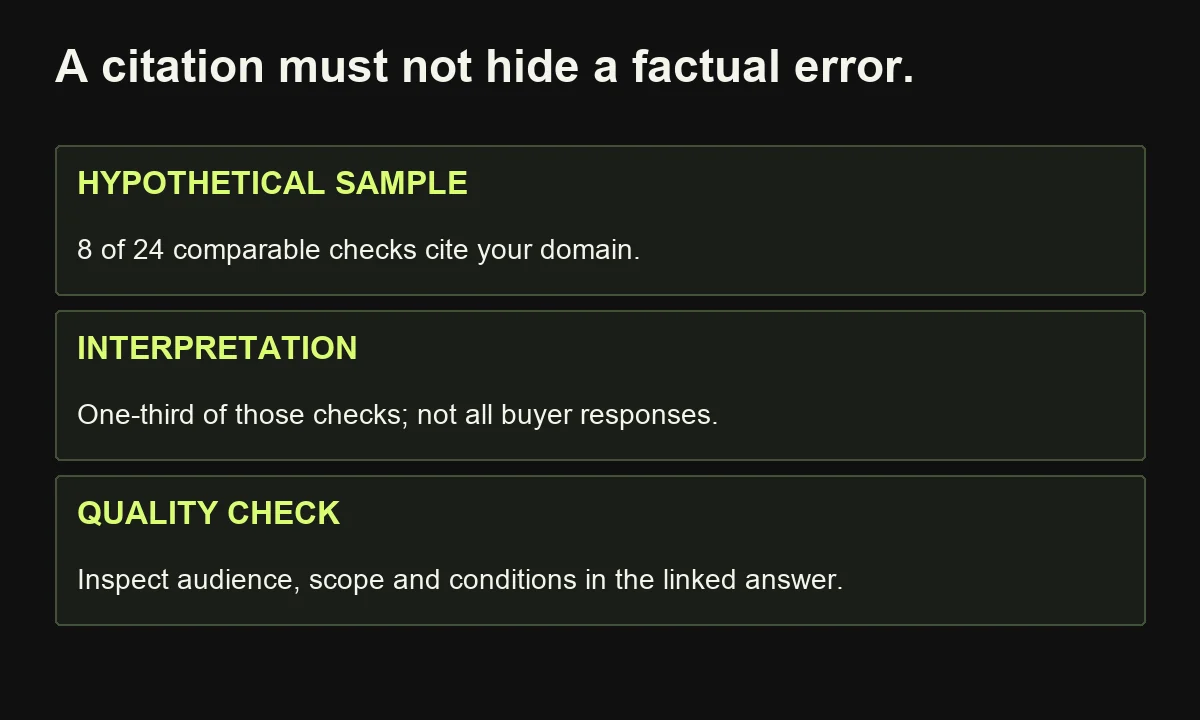
Suppose eight of twenty-four comparable checks cite your domain. That is one-third of those checks, not one-third of all buyer responses. If a linked answer misstates your audience, its citation should not conceal the error. These numbers are hypothetical, not our measured results.
Track relevant enquiries, referral visits, and self-reported discovery. Treat branded searches and direct traffic as clues with multiple possible causes.
Compare like periods and unchanged question sets. Report incomplete runs, changed settings, and platform updates so a convenient percentage does not outrun the evidence behind it.
How do you turn GEO into a practical workflow?
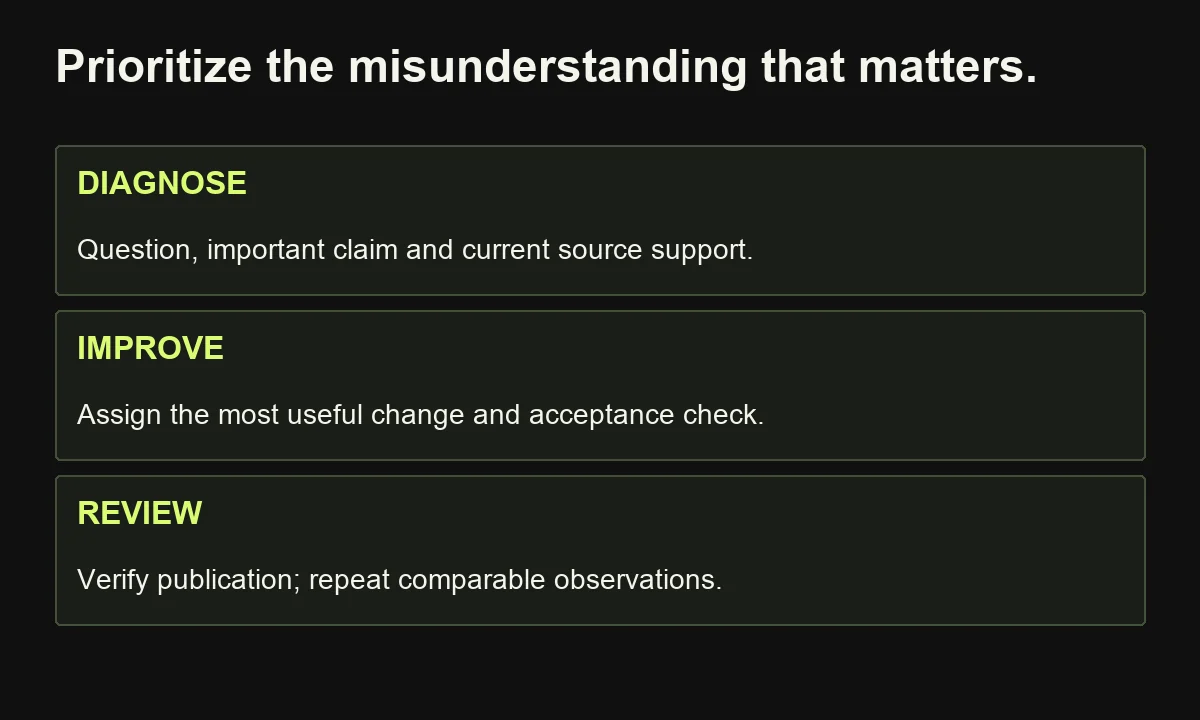
Start with one offer and a manageable set of important buyer questions. Establish what the current sources and answers say, choose the most consequential information gap, and make a reviewed improvement. Publish it correctly, record the change, and evaluate what happens. Expand only when the process produces useful work and interpretable observations.
Use the claim continuity and GEO review worksheet to keep research, decisions, and maintenance together:
- Record a buyer question and its source.
- Identify the claim a useful answer would need.
- Locate the approved source and supporting evidence.
- Note external descriptions and observed inconsistencies.
- Assign the page change, owner, and acceptance check.
- Verify publication and repeat comparable observations.
Prioritize material misunderstandings over cosmetic wording. Misstating who an offer serves can matter more than appearing one place lower in a tool's sampled answer display.
Budget for research, writing, technical review, and ongoing maintenance. AI can organize permitted source material and flag possible contradictions, but someone must inspect the evidence and decide what the business can responsibly claim.
A GEO tool can help collect observations. It cannot supply missing customer insight or make a weak argument persuasive by itself.
When hiring support, ask who owns buyer research, editorial recommendations, writing, and corrections. A clear working relationship matters because the information will change long after the initial article or audit is delivered.
Generative engine optimization: common questions
Is GEO just another name for SEO?
The practices overlap. GEO highlights representation in generated responses, while search foundations remain important. Specify the platform, information problem, and outcome rather than paying for an acronym without a defined scope.
Does adding citations guarantee AI visibility?
No. Cite sources because they support a claim. A relevant reference improves verifiability; it does not create a universal right to appear in generated answers. The original research does not promise a fixed uplift for every business.
How long does GEO take to work?
There is no universal timeline. Discovery, competition, information quality, platform behavior, and the existing website all matter. Agree deliverables and review points, then assess observed results without inventing a guaranteed citation deadline.
Should every prompt have its own page?
No. Group related questions by reader intent and create distinct pages when they provide distinct value. Publishing many near-duplicates makes maintenance harder and rarely supplies the evidence a buyer needs.
Can a small business do GEO?
Yes. Begin with accurate offer information, useful answers, evidence, and a modest review process. Tools become valuable when their coverage and saved effort justify the cost. You do not need to imitate an enterprise publishing operation.
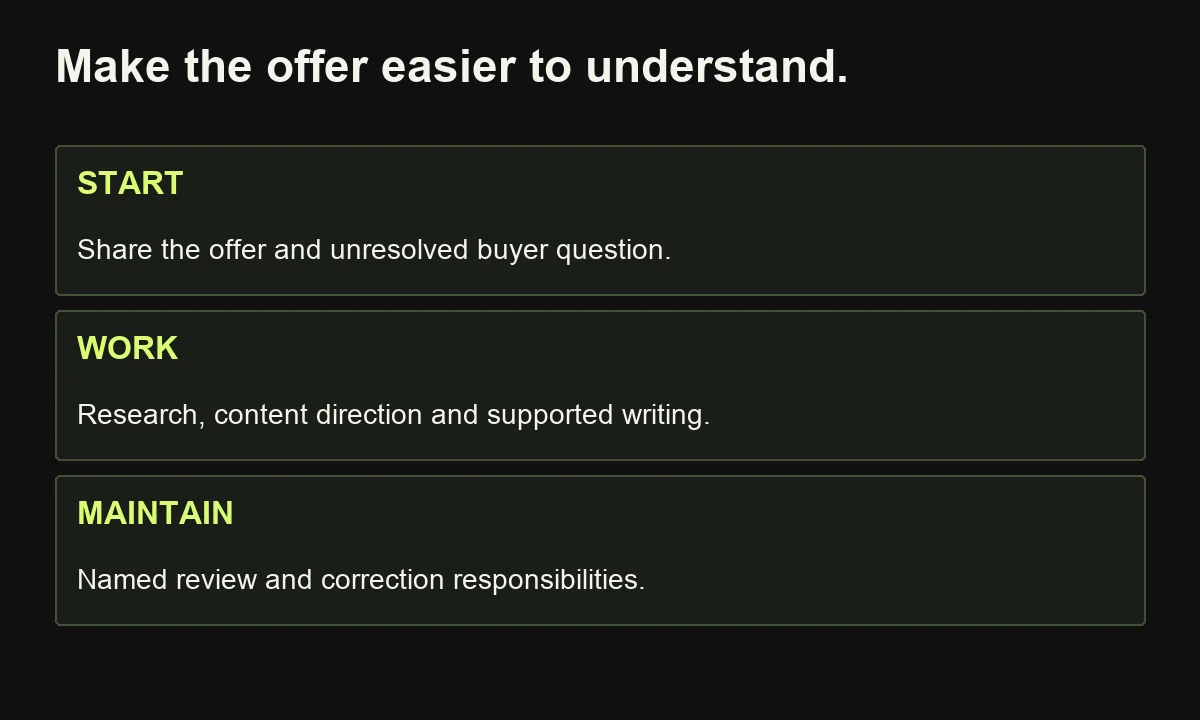
If AI answers or your website leave prospects unclear about what you actually provide, share your offer and the buyer question that needs a better answer. I can help assess the research, content direction, and writing needed to explain it properly.