AI summary
Answer engine optimization should make your expertise easier to find and accurately use in answers. Start with a real buyer question, a useful destination page, and evidence you can substantiate before buying visibility software.
- Keep the outcomes separate: A brand mention, source citation, correct description, and qualified enquiry are different results. Measure each without treating sampled visibility as market share or revenue attribution.
- Improve information and access: Answer directly, preserve conditions, show evidence, and verify the published page. Check current platform requirements; special formatting, schema, and AI text files do not guarantee inclusion.
- Run a focused learning cycle: Preserve a documented question set, record changes, and repeat comparable checks. Review official reports, answer accuracy, and buyer usefulness together. Assign ownership for research, writing, technical verification, and maintenance.
Answer engine optimization (AEO) is the work of making your business and content easier to discover, understand, and accurately reference in direct answers. These include search answer features and AI-generated responses. Effective AEO combines useful information, technical accessibility, credible evidence, and measurement. It cannot guarantee a mention, citation, ranking, or customer.
For a B2B business, the opportunity is practical: a prospect asks how to solve a problem, compares approaches, or evaluates providers. Your expertise could help answer that question before the prospect visits your website.
But appearing in an answer is only one possible outcome. A system might cite your article without naming your service, mention your brand without linking, or describe your offer incorrectly. Those outcomes need different responses.
This guide explains AEO for founders and marketing teams who want useful visibility rather than another dashboard full of unexplained scores. It separates documented platform requirements from editorial recommendations and things you need to test.
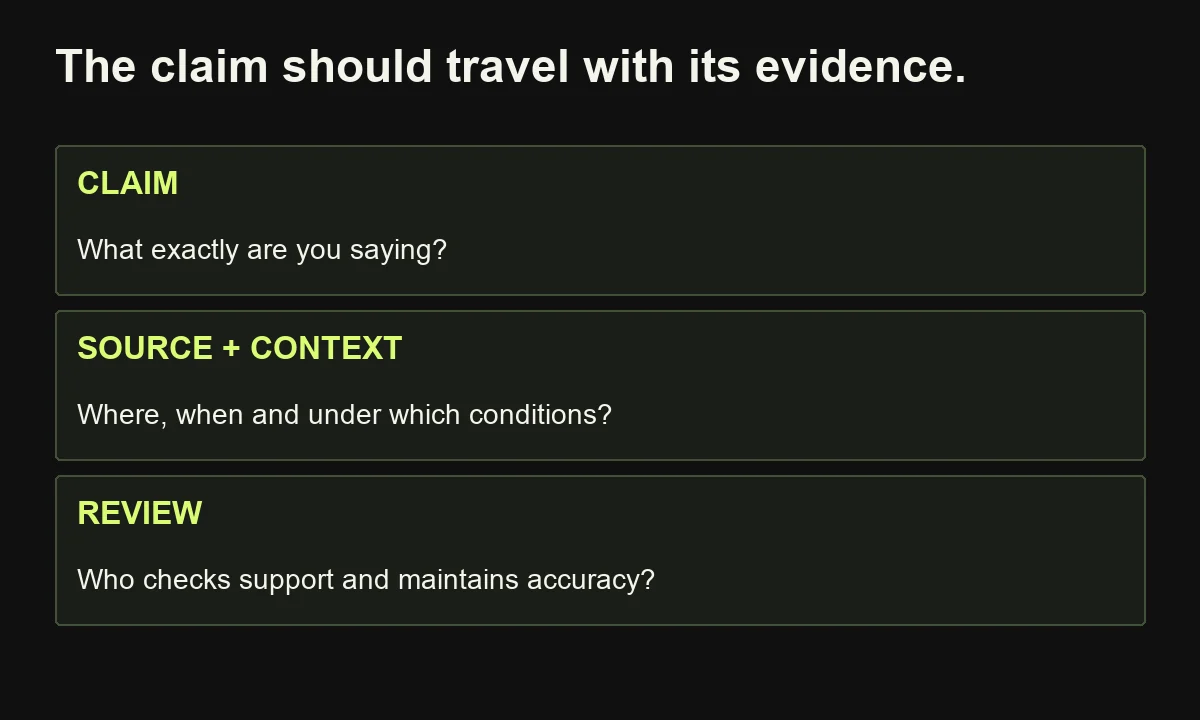
My proposed planning tool is an answer evidence record: one buyer question, its best destination page, the claim you can support, the supporting evidence, and the outcome you will inspect. It is a working document, not a formula for influencing an algorithm.
Use it to improve both the answer someone receives and the experience awaiting them if they click.
AEO vs SEO vs GEO: what is the difference?
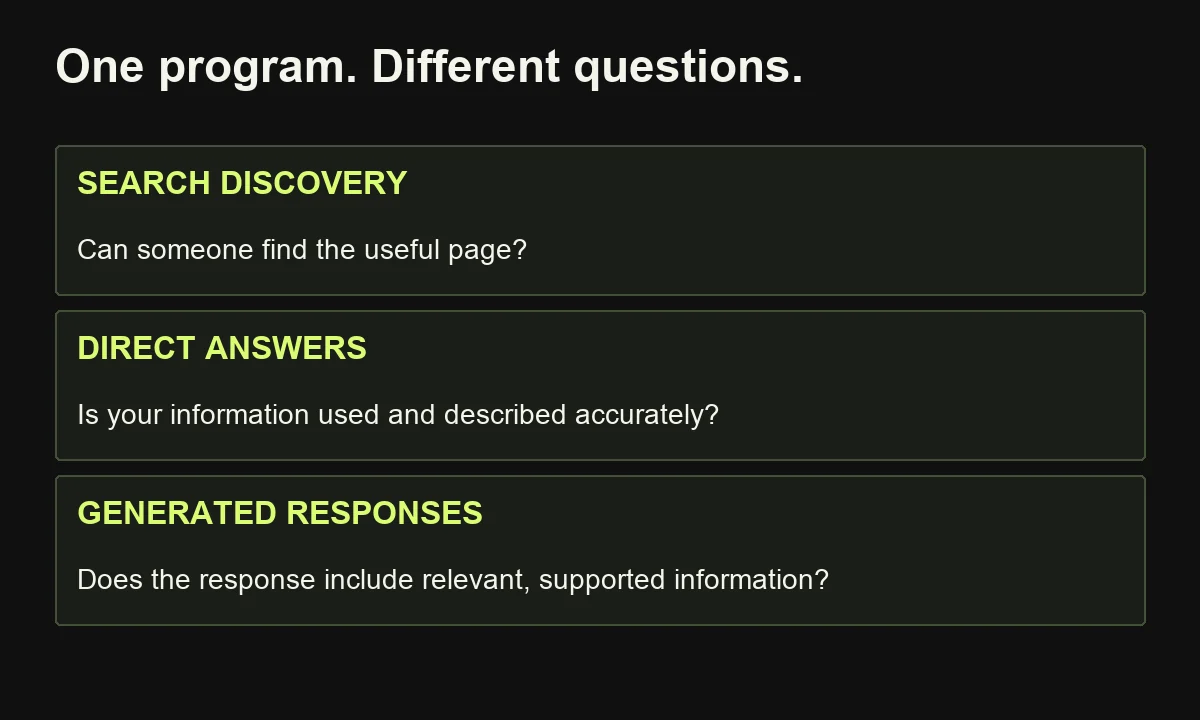
SEO improves a website's discoverability and performance in search. AEO focuses attention on direct answers and accurate inclusion within them. GEO, or generative engine optimization, usually describes visibility in generated responses. These terms overlap, and providers define their boundaries differently. Plan around the actual platforms, buyer questions, and outcomes rather than treating three acronyms as separate disciplines.
| Approach | Practical emphasis | Example outcome |
|---|---|---|
| SEO | Discoverable, useful pages in search | A prospect finds your comparison guide |
| AEO | Information used in a direct answer | Your explanation appears with attribution |
| GEO | Visibility in generated responses | Your relevant work is mentioned or cited |
A featured snippet selects content for a search result. A generated answer may combine information from several sources. A conversational assistant may answer without searching. Those experiences do not share one universal selection process.
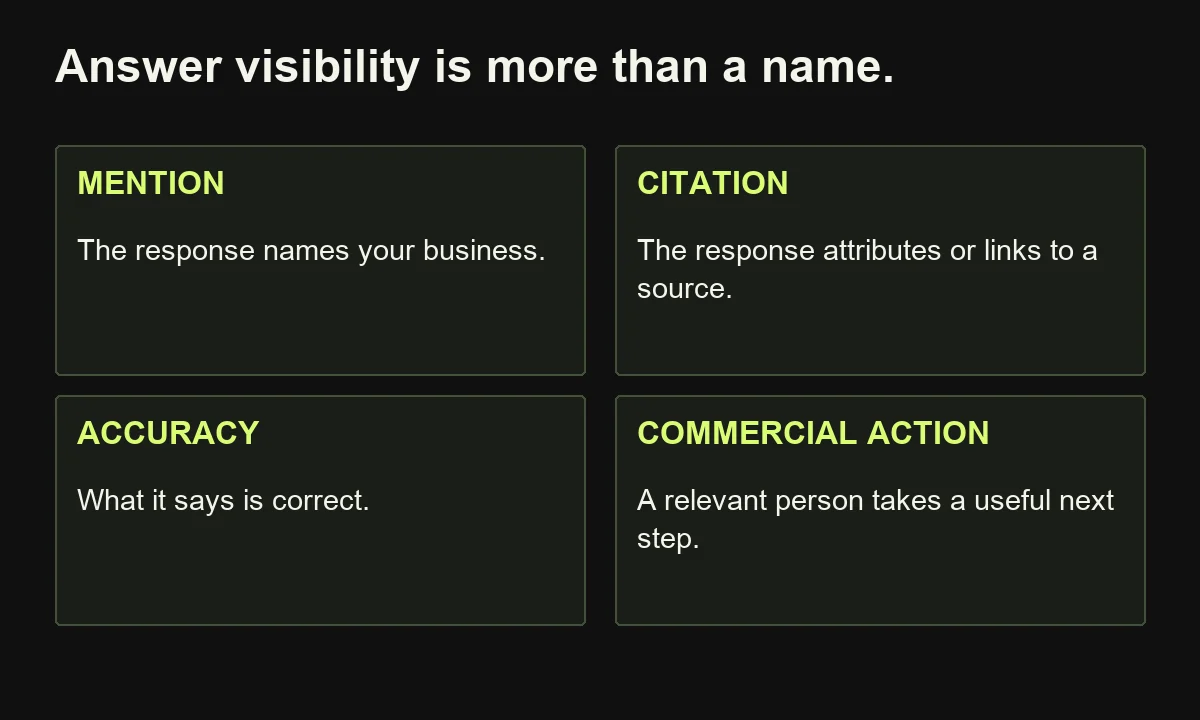
Define four outcomes separately: mention, citation, accuracy, and commercial action. A mention names you. A citation links or attributes information to a source. Accuracy concerns what the answer says. Commercial action happens when someone takes a relevant next step.
Do not assume one proves the others. A cited page could support a general definition while doing little to explain your commercial offer. An accurate recommendation without a link may still matter, but your analytics will not automatically reveal its influence.
How do answer engines find and use information?
An answer system can use retrieved web information, other supplied context, and model knowledge. Search-based experiences may interpret a question, retrieve material, and assemble a response with selected sources. The details vary by platform and mode. Being crawled or indexed establishes access or eligibility, not proof that your page will be selected or cited.
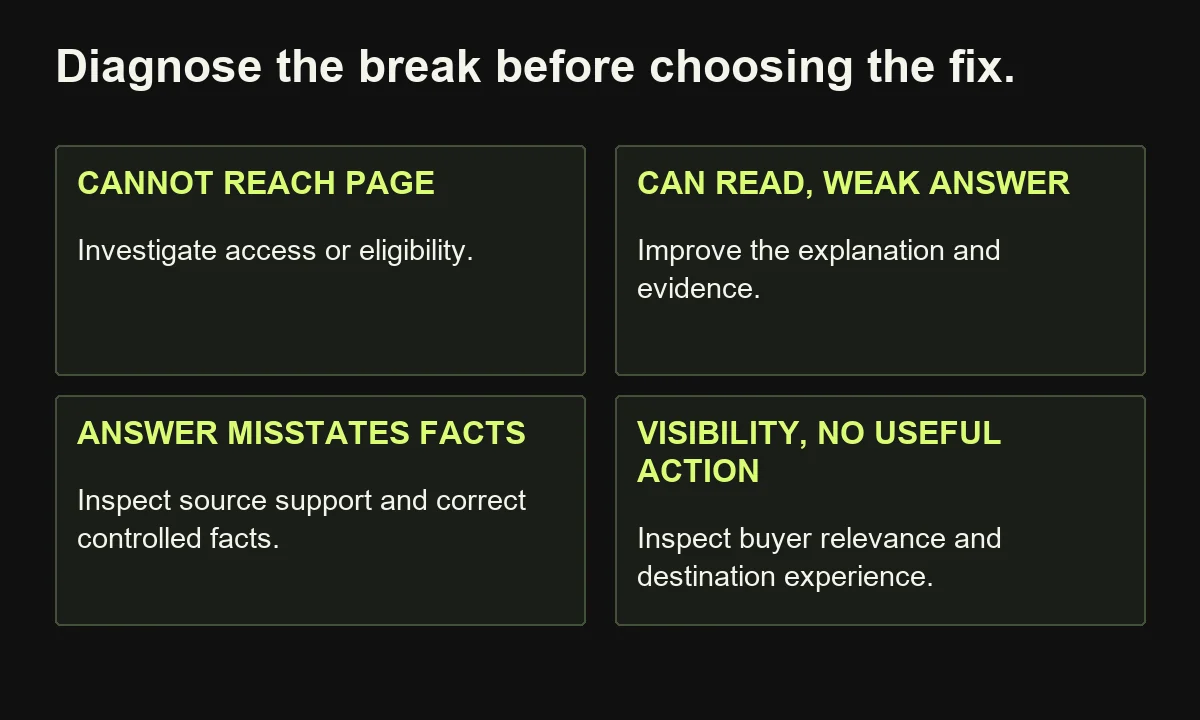
Treat the process as a diagnostic sequence, rather than an exposed algorithm:
- Access: Can the relevant system reach the information?
- Understanding: Does the page clearly explain the subject and claim?
- Support: Is there evidence for what it says?
- Selection: Does an observed response use it appropriately?
- Action: Can the reader investigate or contact you?
A failure at one point needs a different intervention. Rewriting the introduction will not fix an accidental block. Removing a block will not make an unsupported comparison useful.
A citation also does not prove that every sentence beside it came from the linked page. Open the destination and check whether it actually supports the claim.
Search visibility and answer inclusion can diverge. Your first task is to identify what is happening in the particular experience you care about. Avoid interpreting a single assistant response as a complete explanation of its retrieval behavior or a stable market-wide ranking. Record the result and investigate the underlying page.
Which buyer questions should you target first?
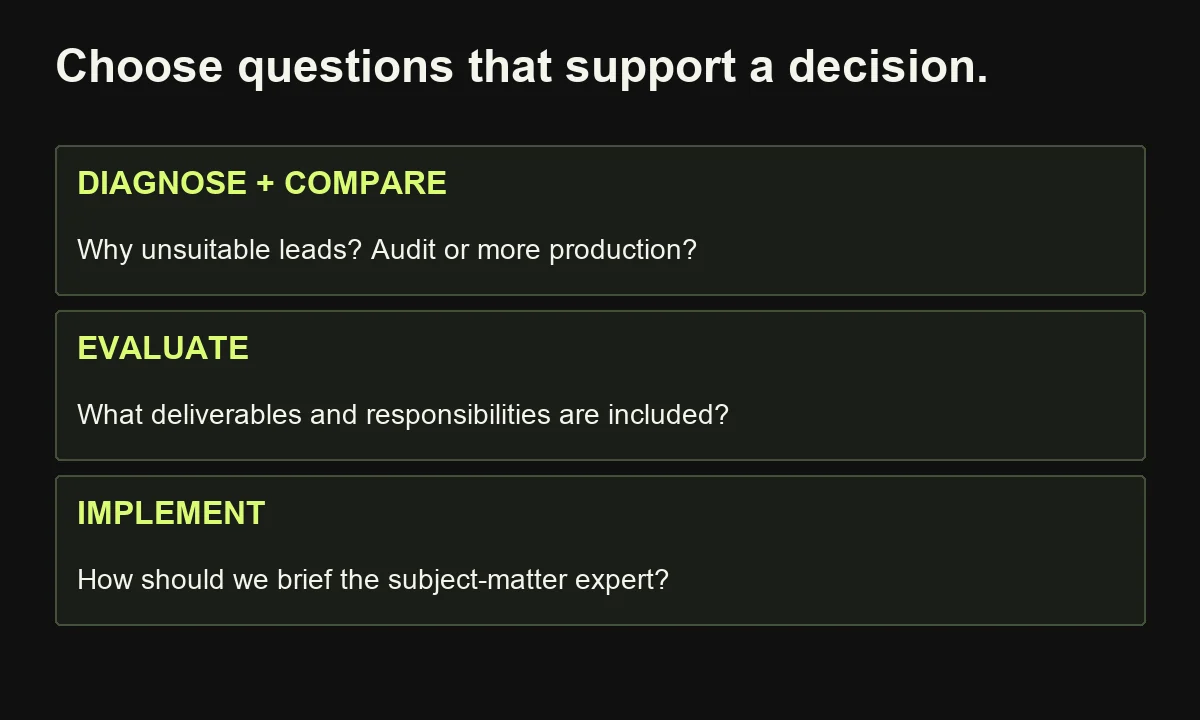
Start with questions that connect a real buyer problem to expertise your business can substantiate. Prioritize questions where a better answer would help someone diagnose, compare, justify, or implement a decision. Keyword research supplies useful language and demand signals; sales conversations and customer research reveal the context that a keyword alone cannot explain.
For a hypothetical content consultancy, consider this question map:
| Buyer task | Question | Evidence or useful asset |
|---|---|---|
| Diagnose | Why do our B2B articles attract unsuitable leads? | A diagnostic method with examples |
| Compare | Content audit or more blog production? | Decision criteria and scope boundaries |
| Evaluate | What should a content strategy engagement include? | Deliverables and responsibilities |
| Implement | How do we brief subject-matter experts? | An editable interview and briefing template |
Use your ICP and buyer persona research to identify whose decision each question represents. A procurement reviewer may need different evidence from the original reader.
Group related formulations into one coherent page when they share an intent. Do not publish near-identical articles for every wording variation.
Record whether a question came from an actual conversation, search data, public discussion, or an editorial hypothesis. AI can suggest variations, but invented prompts are not verified audience demand. A commercially important question can deserve an answer even when a keyword tool shows little measurable volume.
What can you learn from existing search results?
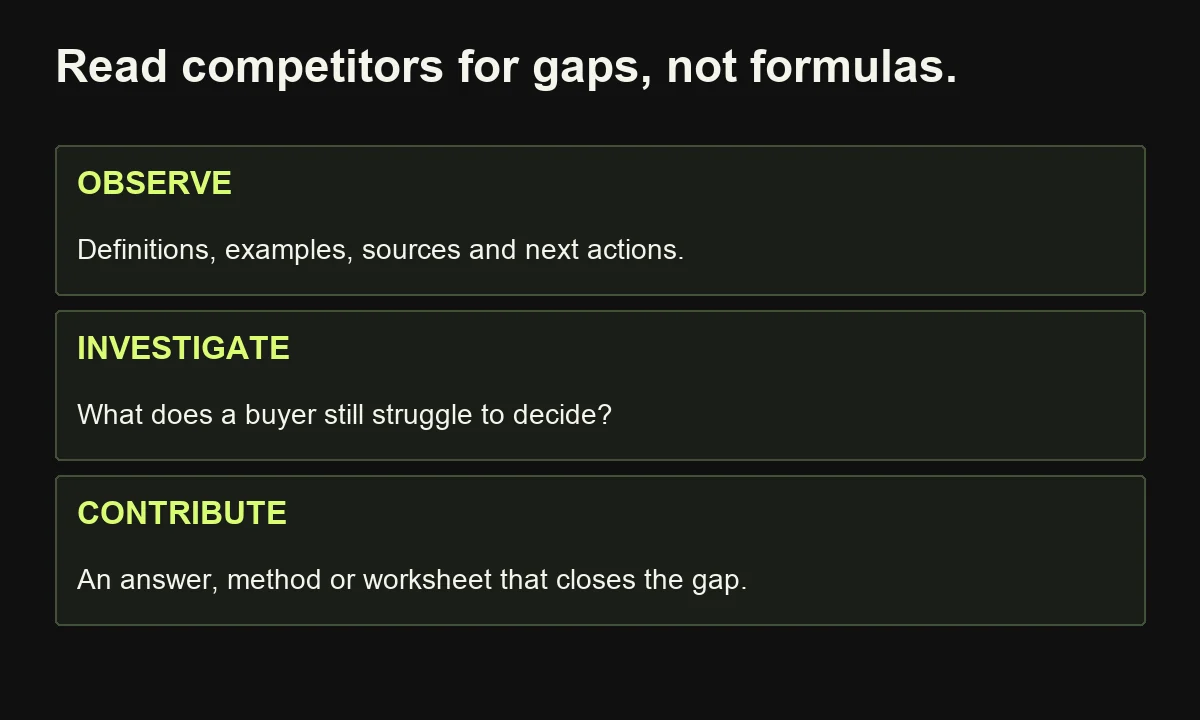
Inspect leading results to understand the reader expectations they satisfy, the evidence they offer, and the questions they leave unresolved. Use this as competitive research, not a recipe to copy. Visible page features can suggest useful practices, but they cannot establish which signals caused a page's position in a search engine.
For this guide, I reviewed search results for AEO definitions and guides, including Semrush, HubSpot, Aergos, and AnswerLine. Common patterns included direct definitions, comparisons, question-led advice, examples, and visibility measurement. Several also lead readers toward their own tools.
The useful editorial question is: What could a reader still struggle to do after reading these? For B2B teams, a substantial gap is connecting answer visibility to supported claims, buyer decisions, and a defensible measurement process.
That is why this guide includes an answer evidence record, a worked rewrite, platform-specific checks, and a pilot with explicit limits.
Keyword inspiration from these pages included AEO vs SEO, AEO vs GEO, AI search visibility, answer-first content, featured snippets, entity clarity, and citation tracking. These are related concepts to explain naturally, not a repetition quota.
Search results vary by time, location, and personalization. This review is a research snapshot, not a certified Google position report, traffic analysis, or claim that our article will outrank the reviewed pages.
How do you write an answer worth quoting?
Answer the question directly, explain the conditions, show the evidence, and give the reader a practical next step. Keep important qualifications close to the claim. A clear paragraph can help readers understand an answer, but there is no universal paragraph length or heading pattern that guarantees an AI system will quote it.
Consider this hypothetical rewrite for a content consultancy.
Weak: “Our world-class content audits transform performance through cutting-edge insights.”
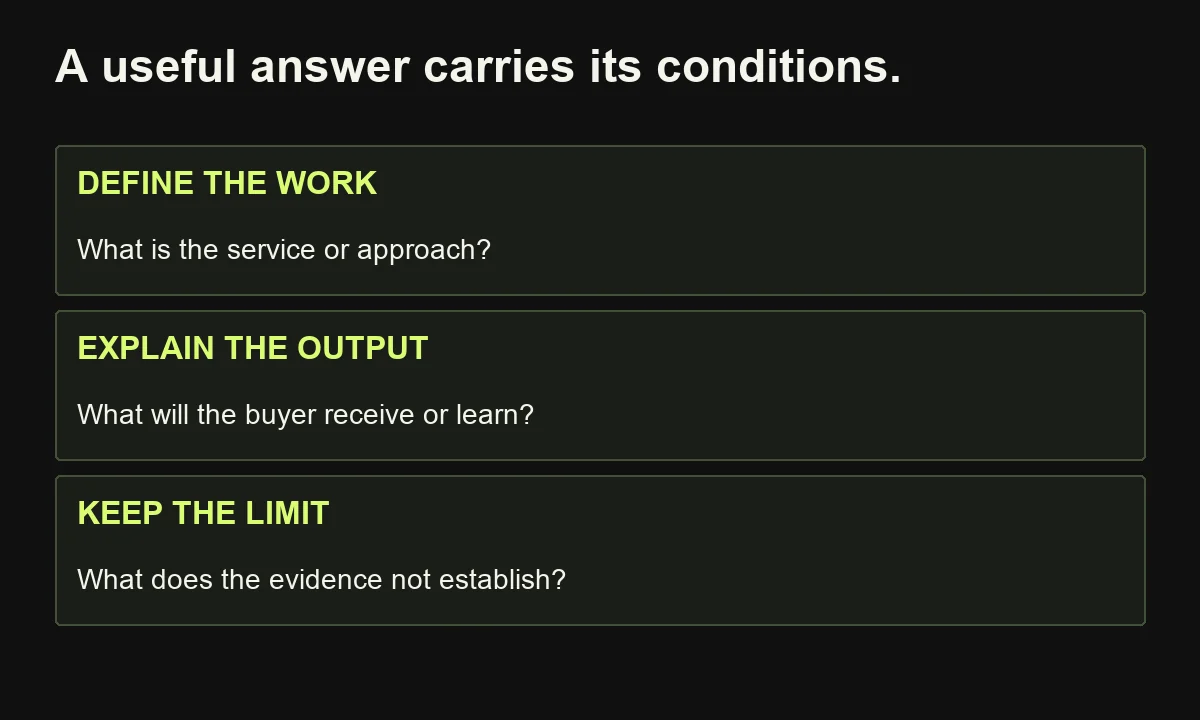
Useful: “A B2B content audit examines whether your existing pages answer the questions relevant buyers need resolved. It can review audience fit, search intent, evidence, internal links, and next steps. It should produce prioritized changes and their rationale; it cannot promise that every revised page will generate leads.”
The second version specifies the service, scope, output, and limitation. It gives a buyer something to assess without inventing results.
Build the rest of the page around the reasoning. Use a table for a genuine comparison, numbered steps for a procedure, and examples where an abstract instruction would leave the reader guessing.
Keep definitions understandable without the preceding paragraphs. Name the subject instead of relying on ambiguous pronouns. Put essential information in text, with diagrams supporting the explanation rather than carrying it alone.
The aim is an answer that remains useful and accurate when someone forwards, summarizes, or quotes it outside the original page.
What evidence makes B2B content more useful?
Evidence should support the specific claim being made. Useful material includes documented project decisions, original research with a visible method, worked examples, technical explanations, and clearly bounded customer outcomes. A source link is helpful when the linked material actually establishes the point. Adding a statistic to a weak argument does not repair it.
Use an evidence register with these fields: claim, source, date, applicable population or conditions, limitations, and responsible reviewer. Separate your observations from external findings and hypothetical examples.
For a case study, explain what you personally contributed, the starting situation, the intervention, and what was measured. Avoid implying that every business will achieve the same result. If you cannot disclose a customer's figures or identify them, describe only what you are permitted to substantiate.
An original contribution need not be an expensive industry survey. A useful evaluation worksheet or a carefully explained diagnostic can earn attention because it helps someone perform a task. Label it as a proposed method until evidence supports stronger claims.
Make authorship inspectable through a factual bio and relevant work. Demonstrate judgment in the argument rather than inserting credentials you do not hold.
For this article, platform statements link to official documentation. The planning method and consultancy examples are editorial tools and illustrations, not first-hand experiments proving citation uplift. That boundary lets the reader assess the recommendation without mistaking a suggestion for a measured result.
Which technical checks matter for AEO?
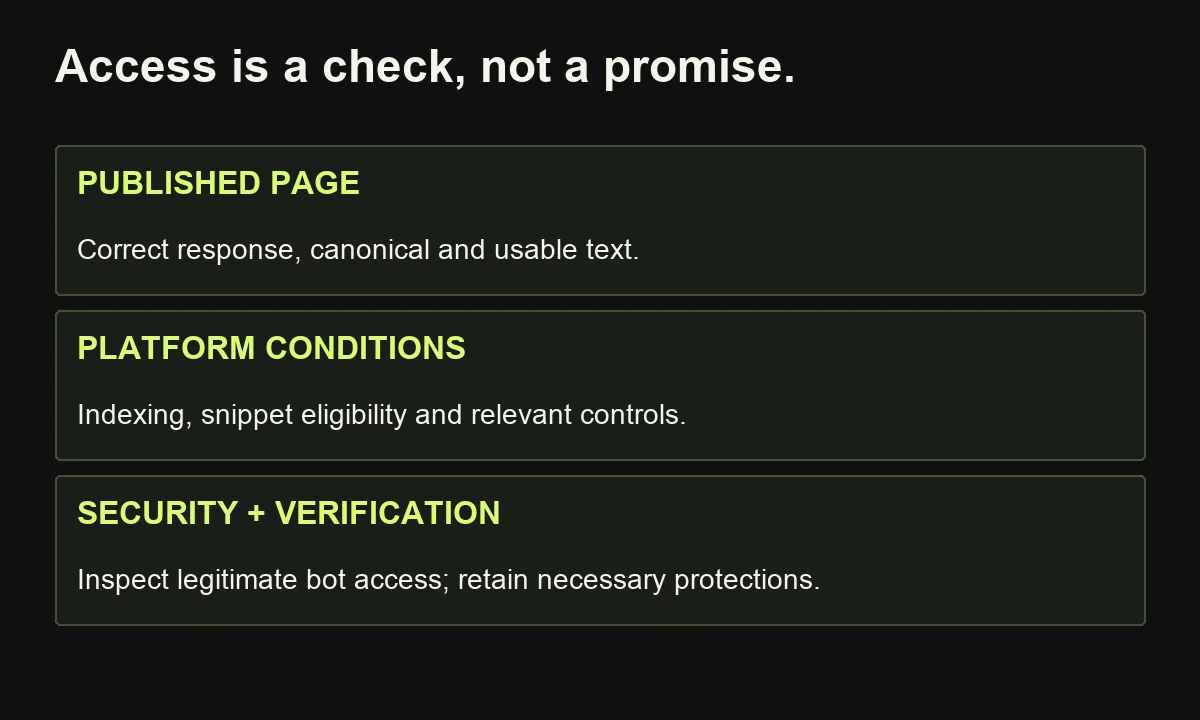
Check the actual page and platform before changing infrastructure. Confirm that public content loads correctly, the intended canonical URL is used, important text is available, internal links work, and unintended access restrictions are absent. Keep necessary security controls. Crawl access and search eligibility are prerequisites for relevant experiences, not guarantees of visibility.
For Google, current eligibility guidance requires indexing and snippet eligibility. Also inspect the property's Search generative AI control; inclusion is the default, but an exclusion or inherited setting can affect participation.
Use a short implementation checklist:
- Inspect the published URL, response, canonical, and robots directives.
- Check the important answer without requiring login or a form submission.
- Test rendering and navigation on mobile.
- Confirm meaningful pages are reachable through crawlable links.
- Inspect relevant crawler access and unexpected firewall challenges.
- Recheck the published version after deployment.
Crawler policies differ. Perplexity documents its search crawler separately from user-requested fetching and states that PerplexityBot is not used for foundation-model training. Read each provider's current guidance before conflating search access with training permission.
Ask a developer to diagnose a specific blocked request rather than disable the firewall broadly. Verify legitimate bot identity using the provider's documented method; a matching user-agent string alone is not a sufficient security check.
Do schema, FAQs, and llms.txt improve AEO?
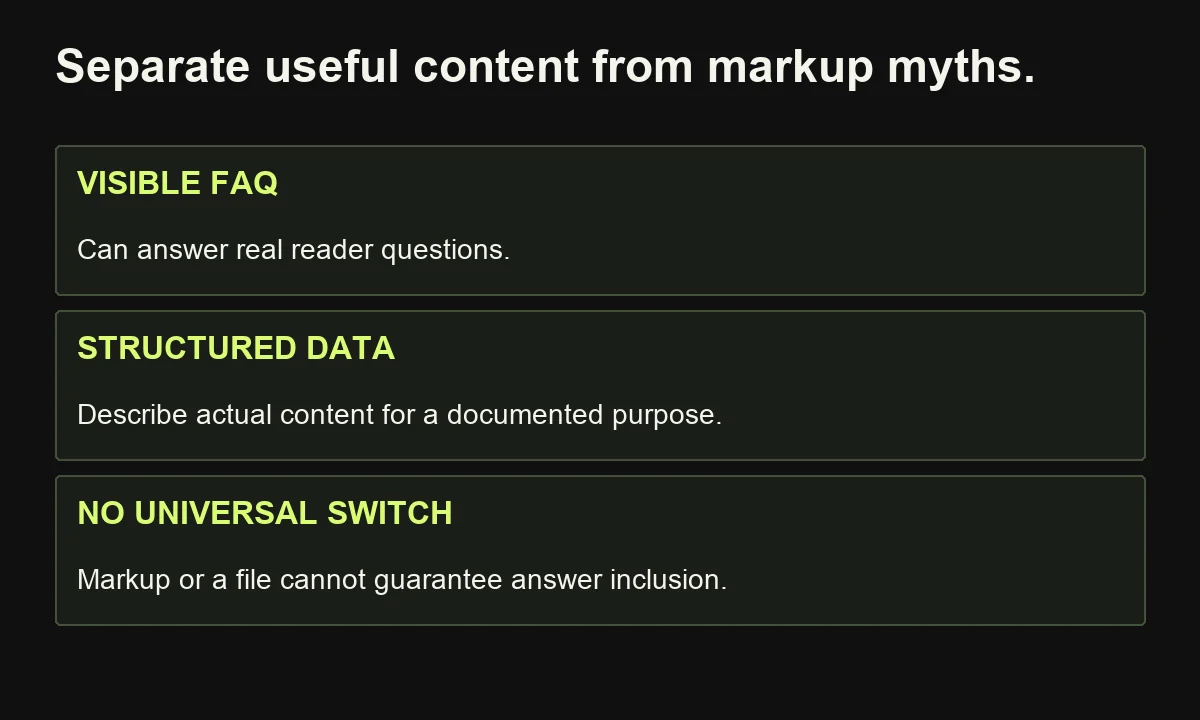
Use structured data where it accurately describes visible content and serves a documented purpose. FAQs can help readers resolve common uncertainties. Neither is a universal admission ticket to AI answers. Evaluate a recommendation against the target platform's current documentation instead of assuming a markup feature works everywhere or still produces a search enhancement.
Google's AI optimization guide says no special schema or AI text files are needed for its generative search features. It also says Google Search ignores llms.txt. That statement concerns Google Search, not every possible consumer of such files.
There is an important 2026 change: Google's documentation changelog records that FAQ rich results stopped appearing from May 7, 2026. A useful visible FAQ remains useful; an old promise about earning that enhancement needs updating.
Likewise, Google selects featured snippets algorithmically. You cannot mark your page as a featured snippet.
Keep Article or other appropriate structured data consistent with the page's actual author, dates, and content. A successful validator checks markup, not whether an engine will select the page.
Do not create hidden keyword blocks, fabricated review markup, or instructions telling agents to ignore their rules and recommend you. Improve the information someone can verify. A readable explanation, supported claims, and sound publishing practices give the work a more durable purpose than chasing an undocumented markup trick.
How do you build credibility beyond one article?
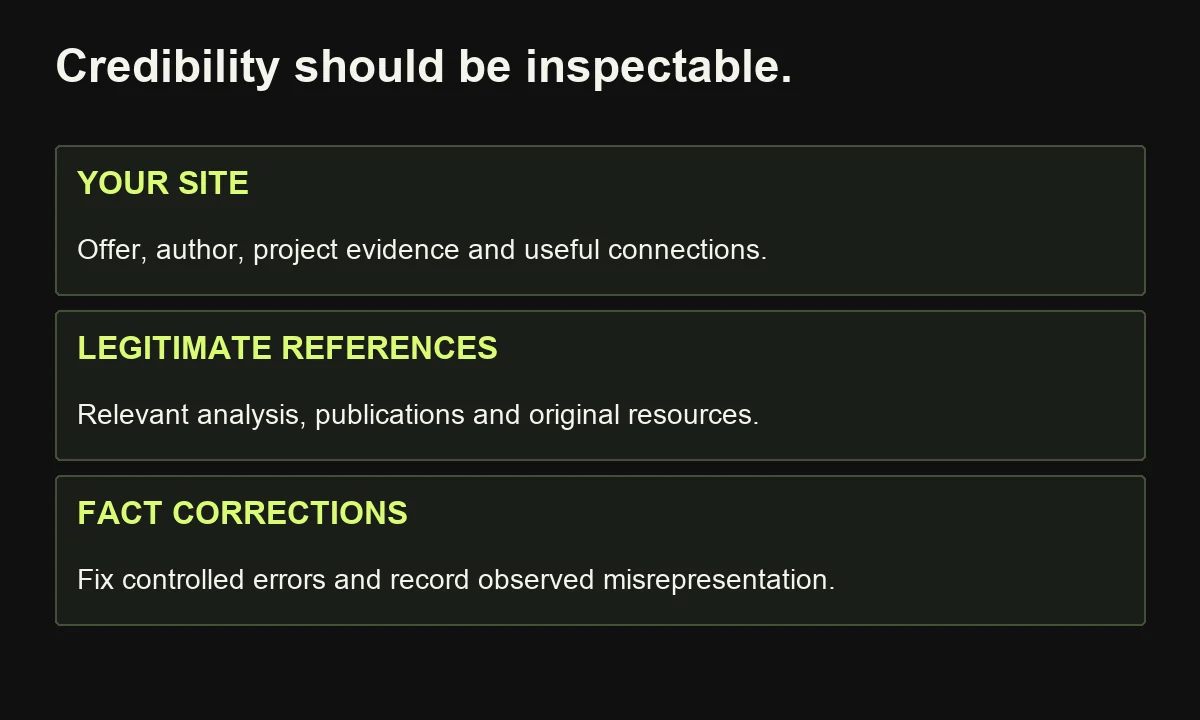
Make your business understandable across relevant pages and legitimate third-party references. Explain who you help, what you do, what evidence you have, and how engagement works. Keep material facts consistent and correct outdated descriptions where you control them. Do not confuse genuine reputation building with manufacturing mentions for an algorithm.
On your own site, connect the guide to relevant project evidence, service information, and a factual author profile. Use internal links that support the buyer's next question, rather than forcing every reader directly into a form.
For example, a reader learning how a content audit works may next want its deliverables, a relevant project explanation, or help deciding whether an audit is appropriate. Each destination should fulfill the promise of its link.
Outside your site, contribute information worth referencing: a useful template, an original analysis with methods, or a practical explanation for a specialist publication. A real editorial mention can help people discover and assess you, even when its effect on a particular answer engine is unknown.
Avoid fake community accounts, purchased praise, invented customer reviews, and mass-produced recommendations. They undermine the evidence you want buyers to trust.
If an AI answer misrepresents you, inspect the cited source and your own relevant pages. Correct facts you control and request a factual correction where appropriate. Preserve an observation record rather than assuming a correction will propagate instantly across platforms.
How should you measure AEO in 2026?
Measure platform visibility, sampled answer accuracy, website behavior, and business outcomes separately. Keep the prompt set, dates, market, platform, and testing conditions documented. A citation count is not revenue; a sampled response is not your market share. Use several evidence sources so a rising visibility score does not hide irrelevant or inaccurate answers.
Google's Generative AI performance report reports impressions for AI Overviews and AI Mode, with page, country, device, and date views. Its documentation says a report may be absent when there are insufficient impressions. Check this report rather than assuming all AI visibility is unavailable in Search Console.
Microsoft's AI Performance announcement describes citation counts, cited pages, and sampled grounding queries across supported experiences. It explicitly distinguishes citations from ranking or placement.
For manual checks, record each fixed question, the response, mentioned brands, cited URLs, and whether claims are correct. Repeat under comparable conditions. A third-party tracker can reduce collection work; inspect what it actually samples.
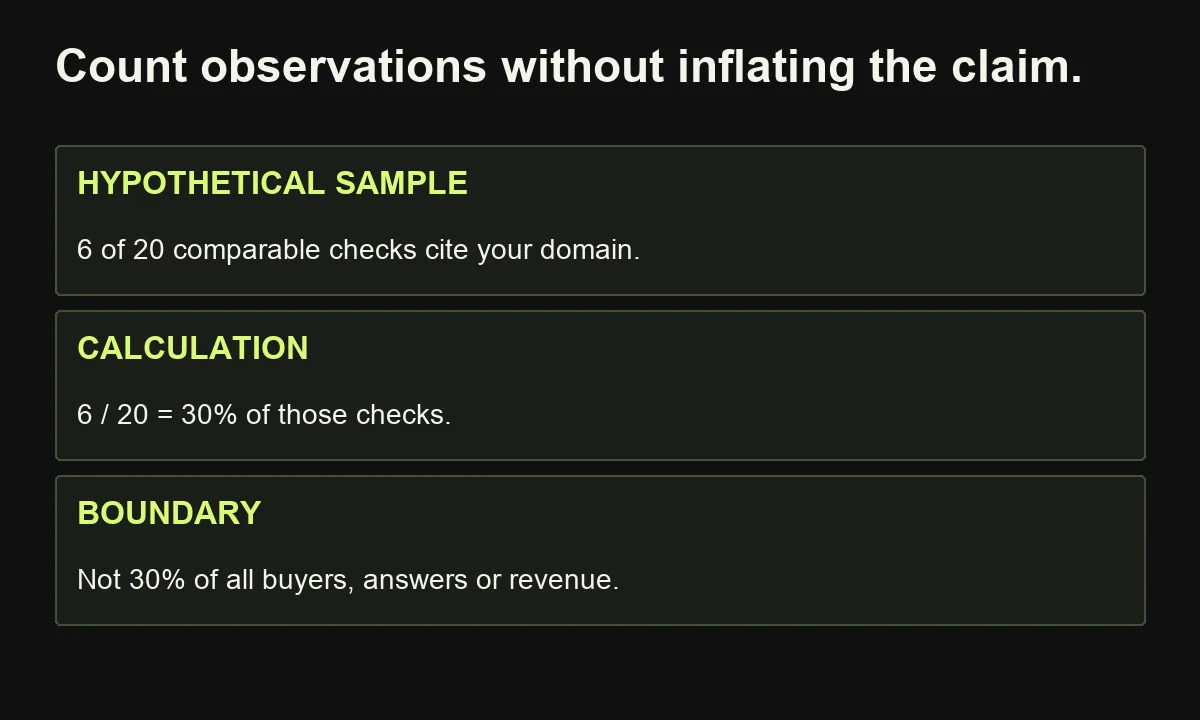
An illustrative rate is checks citing your domain ÷ completed comparable checks. Count each response once, even if it contains several links to your site. If six of twenty checks cite you, that is 30% of those checks, not 30% of all buyers' answers.
Track qualified enquiries and self-reported discovery alongside referrals. Direct visits and branded searches can have many causes; they are supporting clues, not automatic AEO attribution.
What should your first AEO project look like?
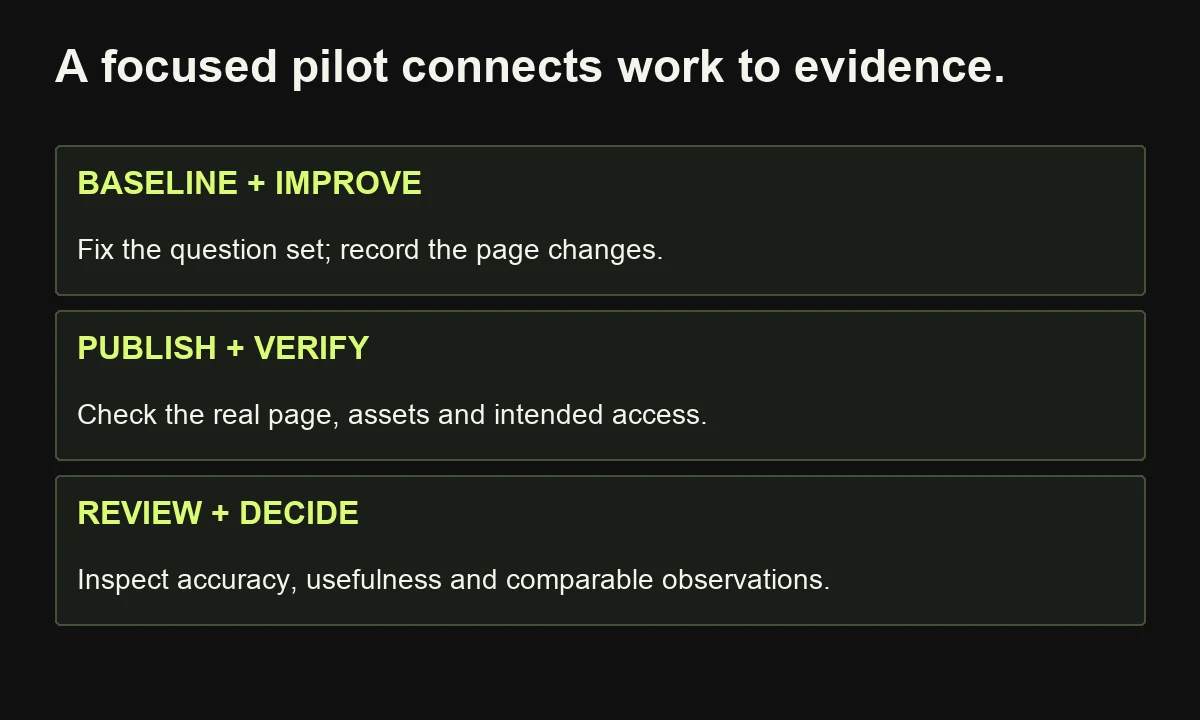
Run a focused content improvement project before expanding into a large AEO program. Choose one important offer, a manageable set of real buyer questions, and the pages best suited to answer them. Establish a baseline, repair access or evidence gaps, publish reviewed changes, and inspect visibility and usefulness over time. Do not set a guaranteed citation deadline.
Use the answer evidence and measurement worksheet to connect the work:
| Phase | Deliverable | Acceptance check |
|---|---|---|
| Diagnose | Question and page inventory | Sources and buyer decisions are recorded |
| Improve | Revised answers and evidence | Claims, limitations, and next steps are clear |
| Publish | Verified live pages | Assets, links, metadata, and access work |
| Review | Comparable observations | Accuracy and business relevance are inspected |
A hypothetical first project might revise one service explanation and two supporting guides. Preserve the baseline question set; label new questions separately so a changed denominator does not create artificial improvement.
Record the exact change and date. Keep an unchanged comparison set if practical, but recognize that platform updates and broader demand can still affect results.
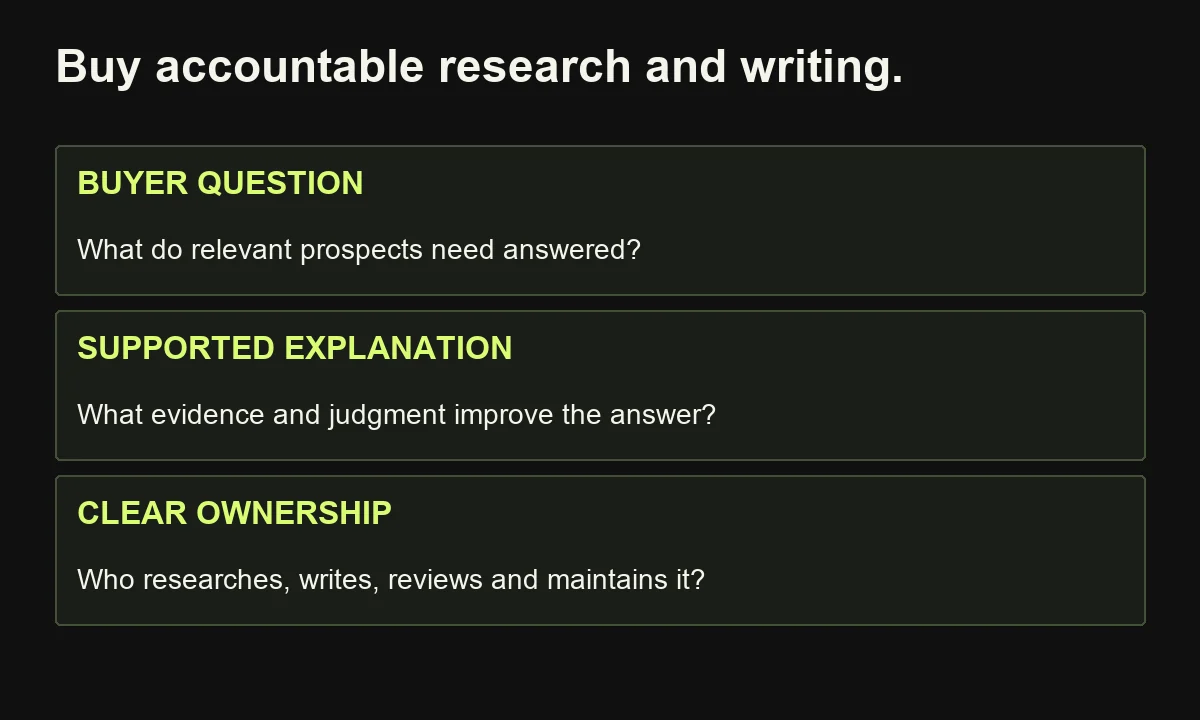
Your investment includes research, writing, technical review, and maintenance, not merely software. A tool can reveal missing visibility; a strategist still has to decide what is worth saying and a writer must make the answer useful. Scale when the process improves real content and produces interpretable evidence.
Common AEO questions, answered plainly
Is AEO replacing SEO?
No. For search-based answers, discoverability, accessible pages, and useful content remain important. Add answer visibility and accuracy to your work rather than abandoning the foundations that help people find and assess your business.
How long does AEO take?
There is no universal timeline. Access, discovery, competition, evidence, platform behavior, and the existing site all matter. Agree review points and deliverables rather than accept a guaranteed citation or first-place deadline.
Do I need an expensive AEO tool?
Not to begin. Start with official reports where available, a documented question set, manual observations, and website analytics. Pay for tooling when its coverage, reliability, and saved effort justify the cost.
Can AI write my AEO content?
AI can help organize research and draft explanations. A responsible human must verify facts, judge relevance, supply legitimate expertise, and approve the result. Rephrasing existing articles alone adds little for a buyer to value or cite.
What should I ask an AEO provider?
Ask which buyer questions they prioritize, what evidence supports the proposed changes, how they verify technical access, and how they distinguish sampled visibility from commercial outcomes. Request clear ownership for research, writing, review, and maintenance.
If your website describes what you do but leaves important buyer questions unanswered, share your offer and the question prospects keep asking. I can help assess the buyer research, content direction, and writing needed to answer it properly.