Internal linking for B2B websites should connect a buyer's question to the page best equipped to answer it. Blogs explain problems and approaches. Case studies provide bounded examples of work. Service pages explain fit, scope, and engagement. Link them where the reader needs that information, rather than wherever a shared keyword appears.
A prospect reads a useful article on your website. They understand the problem. Then they hit a familiar dead end: another article, another article, and a request to book a call.
Your case study might answer their next question. Your service page might explain what they would actually be buying. Both exist, but the article leaves the reader to find them.
That is the strategic problem this guide addresses: missing connections between understanding a problem, evaluating evidence, and choosing help.
I am writing for B2B marketing teams and specialist service businesses with an existing library of articles and project examples. The method below is an original planning framework for this guide. It combines search and accessibility guidance with buyer-focused editorial judgment; it is not a tested formula for rankings or conversion uplift.
What should an internal link help a B2B buyer do?
An internal link should help a buyer resolve a specific uncertainty: understand the approach, inspect relevant evidence, assess service fit, or choose a useful next step. Its value depends on the source page, the reader's current question, and the destination's actual content. A working link can still be a poor strategic connection.
Consider three questions a reader might ask after an article about slow content production:
- Approach: Is the bottleneck drafting, review, or approval?
- Evidence: Has this approach been applied under conditions resembling ours?
- Fit: What would an engagement cover, and what would our team need to provide?
Each question calls for a different answer. Sending all three readers straight to a contact form makes them ask you for information the website could provide.
Google's link guidance says links help it discover pages and assess relevance. It also recommends descriptive, natural anchor text and contextual internal references. Those are useful foundations. They do not tell you which case study supports a particular commercial claim. That requires a content decision.
A topic cluster groups related pages around a subject. A buyer-question map, as used here, records which uncertainty each page resolves and which relevant page should follow. Use both: topic relevance helps organize the library; the question map helps explain why a reader should move between assets.
How should blogs, case studies, and services connect?
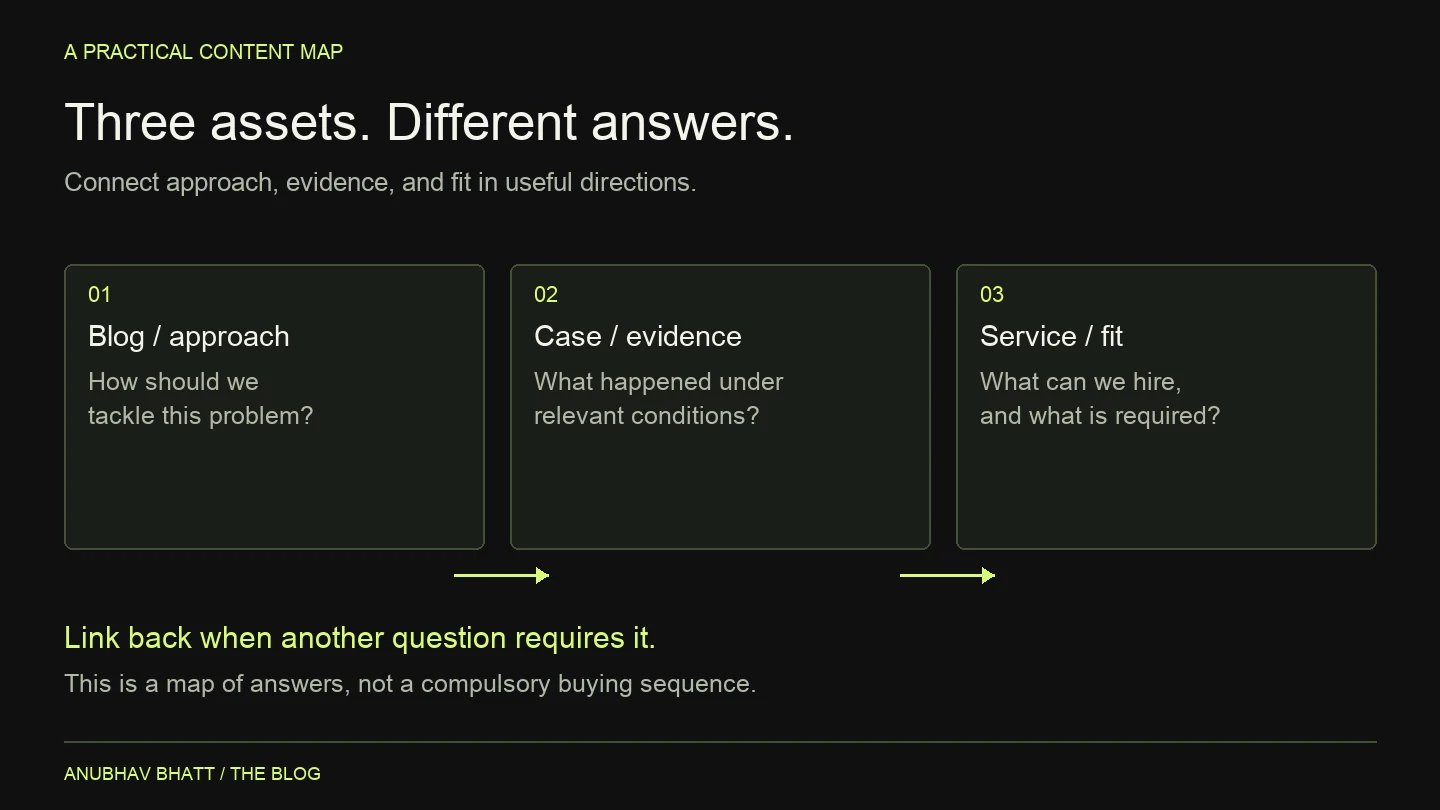
Connect blogs to evidence when readers need to assess whether an approach is credible, and to services when they need to understand delivery or fit. Connect service pages to relevant case studies and useful explanations. Give case studies routes to the applicable offer and method. Readers should be able to enter through any asset.
This is not a compulsory blog-to-case-study-to-service funnel. Someone may land on a service page first, receive a case study from a colleague, or already understand the problem.
Use the following roles as a starting point:
| Asset | Main question it should answer | Useful connection | Editorial safeguard |
|---|---|---|---|
| Blog or guide | How should we understand or approach this problem? | Relevant method, case study, or service scope | Explain the recommendation before asking for a sale. |
| Case study | What was done, in what context, and what happened? | Applicable service and supporting explanation | Keep the project's scope and limitations visible. |
| Service page | Is this the right help for our situation? | Relevant evidence, process detail, or contact page | Explain fit and responsibilities before the enquiry. |
Reciprocal links are a possibility, not a quota. A case study may need a service link because the reader wants comparable help. The service may need that case study as evidence. Neither direction is justified merely because the other exists.
Keep structural navigation and contextual links distinct. Menus, breadcrumbs, and category pages help people locate sections. In-content links explain a specific relationship at the point it matters. A footer link to “Services” does not explain which service addresses the problem in a particular article.
Google's site-structure documentation explains that page linkages help it understand relative importance and structure. That document focuses on ecommerce; applying the broader architecture idea to B2B services is a planning inference, not an ecommerce checklist to copy wholesale.
Build the link map around one commercially important problem
Start with one offer and the buyer questions that surround it. Inventory the pages that can answer those questions, inspect the destinations, and specify links only where an answer exists. Record content gaps separately. A useful first implementation repairs a coherent set of pages rather than scattering links across the entire website.
Here is a hypothetical example for a company selling content workflow consulting. The page names below are illustrative, not published pages or client results.
| Source page | Question left unresolved | Destination | Suggested anchor text |
|---|---|---|---|
| Guide: Why content approvals stall | How do we locate our bottleneck? | Workflow diagnostic guide | “map drafting, review, and approval delays” |
| Workflow diagnostic guide | What did a comparable intervention involve? | A case study documenting review-process changes | “review-process redesign in a small marketing team” |
| Workflow diagnostic guide | What help can we hire? | Content workflow consulting service | “content workflow audit scope and deliverables” |
| Consulting service | What evidence supports this approach? | The relevant project example | “how the review workflow was redesigned” |
| Project example | Does the same work fit our situation? | Consulting service | “requirements for a content workflow engagement” |
The second row is conditional. If your available case study is about faster drafting, it does not establish that you fixed an approval bottleneck. Do not use a loosely related success story to imply evidence you do not have.
That gap could justify a new method explanation, a documented project, or a more modest claim. Adding a link cannot repair missing evidence.
Translate the map into a link register
Give your editor or developer a brief that survives handover:
| Field | What to record |
|---|---|
| Source URL and section | The exact paragraph or module where the question arises. |
| Reader and uncertainty | Who needs the answer, and what remains unclear. |
| Destination URL | The preferred live URL, including a useful section anchor where appropriate. |
| Destination's answer | The heading or passage that fulfils the link's promise. |
| Anchor and surrounding sentence | The wording that sets an accurate expectation. |
| Evidence boundary | What the destination does and does not support. |
| Owner and review trigger | Who maintains it; which offer, evidence, or URL changes require review. |
This is a practical editorial register, not an SEO score. A row with no credible destination is a content task. A row with a good destination and no link is a linking task. Treating them differently prevents a technical clean-up from becoming a substitute for strategy.
Which case study should you link to?
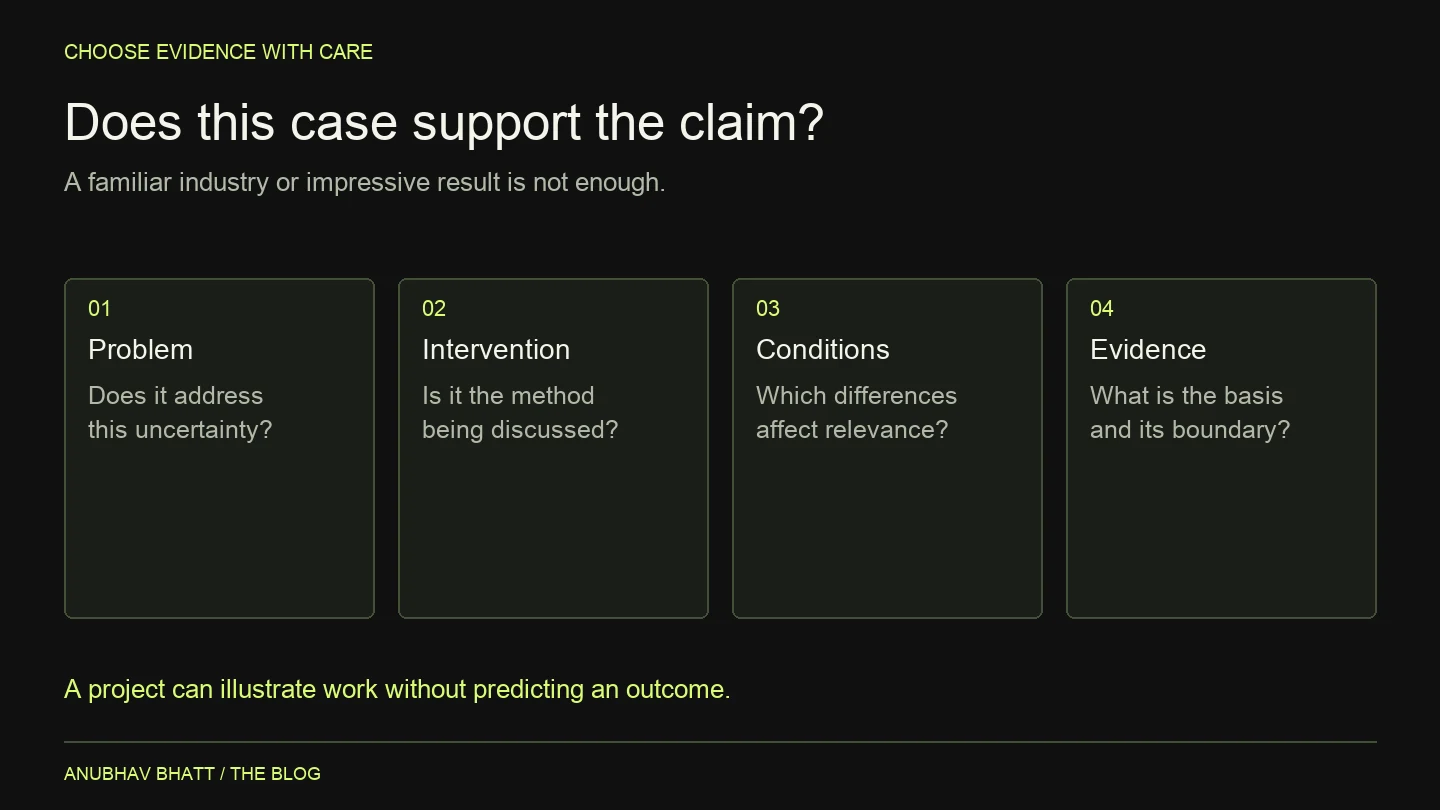
Choose a case study for the decision it informs, not simply for its largest result or most recognizable client. Check whether the problem, intervention, constraints, and evidence are relevant to the claim beside the link. Explain important differences. A project can illustrate an approach without predicting the reader's outcome.
A case study from the same industry can still be a poor match. Perhaps it involved a large in-house team, a different service, or a problem your reader does not have.
Use four questions:
- Problem: Did the project address the uncertainty raised by this page?
- Intervention: Did the work involve the service or method being discussed?
- Conditions: What differences in team, resources, regulation, or timing matter?
- Evidence: Can the reader see the basis and boundaries of the reported outcome?
In my published Ruh AI case study on content strategy and production, I describe positioning work alongside an automated workflow with human approval. That makes it a relevant example when discussing how strategy and production can fit together. It does not, by itself, substantiate a claim that adding internal links improved rankings or generated leads.
This distinction is worth making explicit on your own site. A link should carry the evidence's scope with it.
For example, introduce a project as “an example of redesigning the review process,” if that is what it documents. Avoid “proof this will double your leads” when the destination cannot establish that promise.
If no suitable customer example can be shared, publish a transparent process walkthrough or clearly labelled demonstration. It may help explain the work, but it is not customer evidence. Do not disguise it as a case study.
How do you write anchor text that earns the next click?
Write anchor text that tells readers what the destination will help them understand, then use the surrounding sentence to explain why it matters now. Keep the promise accurate and the language natural. The link should make sense to someone scanning the page and should lead to content that fulfils the expectation.
Nielsen Norman Group's explanation of information scent describes how people estimate a link's usefulness from its label, surrounding context, and prior knowledge. This is a navigation principle, not a promise that a particular phrase will increase B2B revenue.
Compare these examples:
| Weak connection | More useful connection | What changes |
|---|---|---|
| “Read our case study.” | “See how a review workflow was redesigned for a distributed team.” | The reader can identify the problem and context. |
| “Explore our solutions.” | “Review the audit's scope, deliverables, and team requirements.” | The destination's decision value is clearer. |
| “Click here for more.” | “Compare a strategy audit with a production workflow audit.” | The link names the choice it will help resolve. |
Use those stronger versions only when the destination contains the promised detail. More specific wording becomes misleading if the page does not deliver.
The accessibility benefit matters too. W3C's explanation of link purpose says users should be able to determine a link's purpose from its text or programmatically associated context. Meaningful wording helps people choosing links through assistive technology as well as those reading visually.
Place the connection after enough explanation for it to make sense. Do not interrupt every opening sentence with a sales link. If a reader needs to compare scope after a section on audit deliverables, that is a useful point to link to the offer.
A deep link to a maintained heading can be appropriate when the answer sits inside a longer page. Check that the section exists and makes sense when entered directly, including on mobile.
Design for the colleague who receives the page
Make each important destination understandable without the preceding article. A colleague may receive the link with little explanation and different concerns. Give the page a clear purpose, enough context to evaluate its relevance, and a route to the supporting method or offer. Internal linking should support evaluation across roles, not just browsing within one session.
The 2025 Edelman–LinkedIn report found that 55% of surveyed hidden decision-makers agreed that reviewing thought leadership was an important way to vet vendors. Its methodology lists 1,934 executives, the United States as the surveyed market, and March–April 2025 fieldwork. The figure concerns a subgroup and self-reported attitudes; it is not an internal-linking experiment.
The practical inference is to help additional stakeholders evaluate your thinking. A marketing lead may need an approach; an operations reviewer may need ownership and failure handling; procurement may need a clear scope.
Do not invent a page for every job title. Add material when the questions materially differ and your current pages cannot answer them clearly.
For a service page, that could mean one section explaining prerequisites and responsibilities. For a case study, it could mean making the project context explicit. For an article, it could mean linking to those sections where the reader needs them.
This extends the principle in my guide to successful B2B content: the argument should remain useful after it leaves the original reader's hands.
Audit technical reachability and editorial usefulness separately
Check whether important pages are discoverable through working links, then assess whether those links make sense to buyers. A crawl can expose broken destinations and pages with no incoming links. It cannot decide whether a case study supports the nearby claim or whether a service page answers the reader's next question.
For the technical review:
- Use real HTML links with destinations, rather than navigation that depends only on a script-driven click.
- Check that important pages have incoming links and are reachable from useful navigation or other pages.
- Inspect broken links, unnecessary redirects, and missing section anchors.
- Link consistently to the preferred URL. Google's canonicalization guidance recommends linking to the canonical version rather than duplicates.
- Confirm that pages intended for search are not accidentally blocked or marked noindex.
An orphan page has no incoming internal links in the set of pages you are examining. Finding orphans requires comparing a crawl against an independent URL inventory, such as CMS records and a sitemap; a crawl following links cannot discover every unlinked page by itself.
A service page can also be technically reachable but poorly connected editorially: it appears in navigation, yet no relevant article explains when a buyer should use it. Record that as a different problem.
Google's sitemap documentation explains that sitemaps aid discovery and do not guarantee crawling or indexing. A sitemap does not give readers a useful connection between an article and a service.
For the editorial review, inspect the source sentence, destination answer, case-study relevance, and next useful action. If the destination is inadequate, improve it before expanding the links pointing to it.
Google's Search Console Links report shows a sample, not a comprehensive current inventory of every link. Use it as an additional signal, alongside your own crawl and page inspection.
How should you prioritize internal linking work?
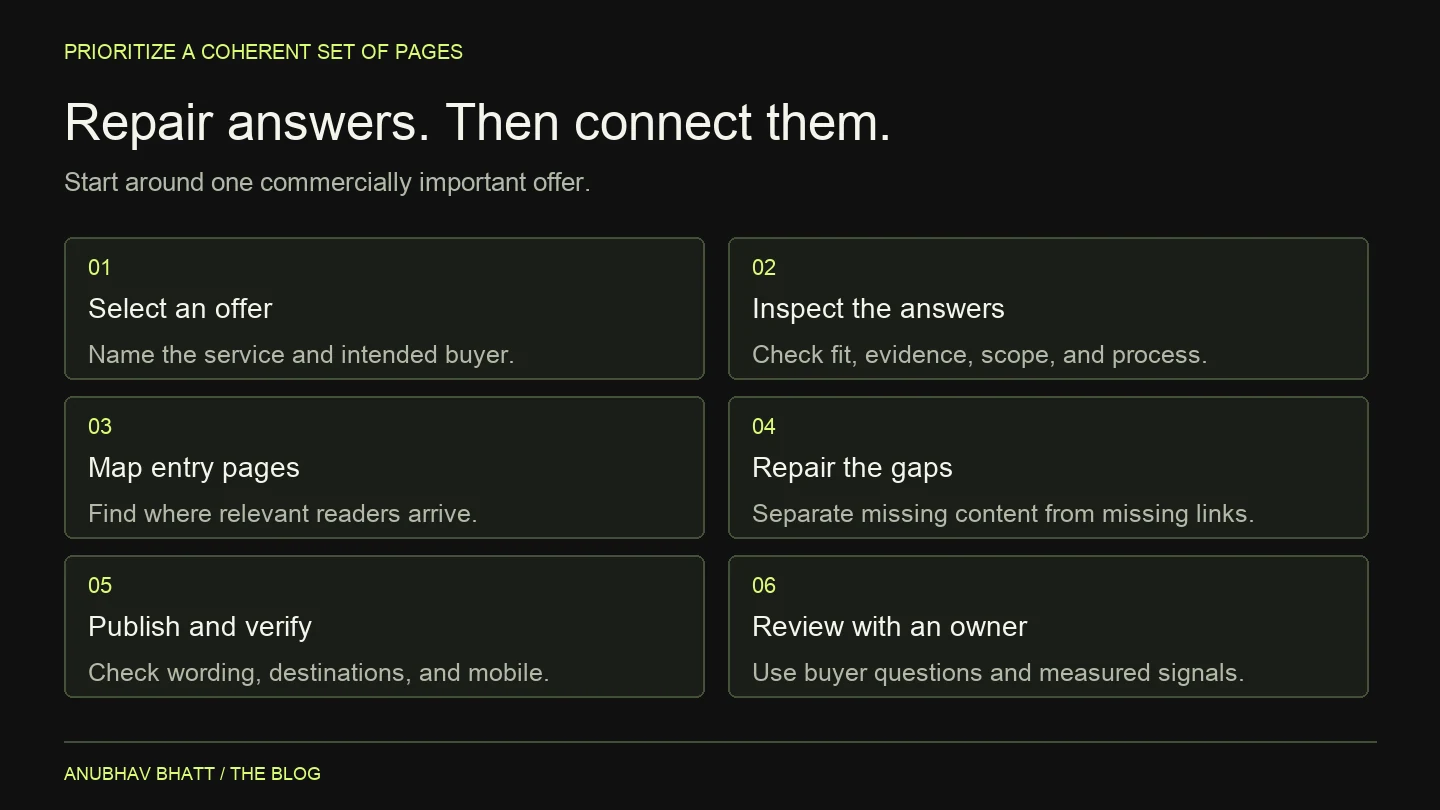
Prioritize connections around valuable offers and unresolved buyer questions, especially where relevant content already attracts attention or is regularly shared by sales. Repair the destination before sending more visitors to it. Then implement a small, coherent set of links and review the result before expanding across the library.
Use this sequence:
- Select an offer. Choose a service you want to sell and can explain clearly.
- Inspect its decision support. Can buyers assess fit, process, evidence, and responsibilities?
- Find relevant entry pages. Use search data, analytics, sales feedback, and the content inventory. High traffic alone does not establish commercial relevance.
- Repair the important gaps. Improve missing answers or misleading claims before adding connections.
- Publish the links and verify them. Check both directions where useful, actual destination content, and mobile navigation.
- Review with a named owner. Update the register when scope, evidence, URLs, or recurring buyer questions change.
For a small site, a spreadsheet is enough. For a large library, a crawler and CMS inventory help scale the discovery work. Automated suggestions based on shared terms still need editorial review: two pages can mention “automation” while addressing unrelated decisions.
A useful handover includes the map, proposed wording, content gaps, implemented changes, and verification record. If you are hiring help, the B2B content strategy audit guide explains how to assess the wider scope before commissioning work.
Measure whether the connections help buyers progress
Measure intended transitions and the quality of the resulting enquiries, alongside search visibility and sales feedback. Separate clicking a link, visiting a destination, and submitting a qualified enquiry. These are different signals. A before-and-after increase does not establish that internal linking caused the change, especially with small samples or other website changes.
Define the observation before implementing the link:
| Connection | Useful observation | What it cannot establish alone |
|---|---|---|
| Diagnostic guide to relevant case study | Readers choose to inspect the project example. | That they trusted it or decided to buy. |
| Case study to service scope | Readers investigate the applicable engagement. | That the service fits their needs. |
| Service to contact | Enquiries describe problems within your scope. | Incremental revenue caused by the link. |
For a link click-through measure, specify the numerator, denominator, and collection method. For example: measured clicks on a defined link divided by measured source-page views. That is an approximate page-level measure, not the share of all humans who saw the link; repeat views, repeat clicks, consent, blockers, and placement affect interpretation.
Google Analytics' enhanced measurement documentation defines its automatic click event around outbound links. Do not assume it records ordinary internal link clicks. A defined custom event can distinguish source, destination, and placement; verify collection before relying on the report. Do not send enquiry text, names, email addresses, or other personal details in those events.
For a low-traffic site, qualitative review may be more useful than a percentage: ask sales which linked assets buyers mention, what they misunderstand, and which questions recur. Report the actual counts alongside any rates. Keep a change log of campaigns, offer revisions, and other edits that could affect the result.
Frequently asked questions
How many internal links should a B2B blog have?
There is no fixed quota. Google's link guidance says there is no ideal number. Include links that provide relevant evidence, explanation, or a useful next step. Inspect the destination and the reading experience instead of adding links to meet a density target. Important pages still need discoverable incoming links.
Should every article link to a service page?
No. Link to a service when the reader's question concerns available help, scope, or fit and the destination answers it. A general educational article may need another explanation first. A relevant commercial connection is useful; an unrelated sales link creates work for the reader without resolving the question.
Do case studies need links back to services?
Often, when the service describes the kind of work performed and explains whether comparable help is available. Make that relationship explicit. A historical project may involve an offer you no longer sell, so review the current scope before adding a link. The project result is not a guarantee for a new engagement.
Does internal linking help AEO and GEO?
Clear connections can make supporting information easier to discover. Google's AI search guidance includes internal discoverability among SEO fundamentals and says no special AI schema is required for AI Overviews or AI Mode. This guidance concerns Google's features, not every AI system. Links do not guarantee indexing, citations, or recommendations.
Can internal linking fix weak content?
It can help readers find a useful answer that already exists elsewhere. It cannot supply missing evidence, clarify an unexplained service, or substantiate an exaggerated claim. Decide whether the problem is a missing connection or an inadequate destination. That distinction should guide both your audit and your budget.
Start with one connection worth making
Choose an article that matters to your intended buyers. Write down the question it leaves unanswered. Find the page that genuinely answers it, check the evidence and scope, and introduce the link with an accurate promise.
Then inspect the destination as if it had arrived in your inbox without explanation. Can you understand what it establishes, what it leaves open, and what to do next?
I work across B2B content strategy, writing, and marketing automation. If your website has useful assets that feel disconnected, send me your website and the service you want buyers to understand. We can work out whether you need a clearer content map, better supporting evidence, or stronger pages before adding more links.
Research note: Linked sources provide search, analytics, accessibility, usability, and buyer-research foundations. The question map, link register, relevance checks, and prioritization method are original editorial tools developed for this guide. The workflow example is hypothetical. The Ruh AI reference describes published first-party work; no internal-linking performance result is claimed.