Successful B2B content helps a relevant buyer make a better decision. It answers a real question, offers a defensible point of view, makes its evidence inspectable, works when shared internally, reaches people in a useful context, and gives them an appropriate next step. These principles matter across formats and channels.
Imagine a marketing director finds your article useful and forwards it to their CFO with one sentence: “This is the problem I was talking about.”
The CFO did not read your earlier posts. They do not know your terminology. They want to know what the problem costs, which options exist, and whether your recommendation deserves trust.
Can your content do that work without you in the room?
That is the question behind this guide. It is written for B2B marketing leaders and founders selling software, expertise, or services that buyers need to evaluate carefully. A purchase with several stakeholders needs more support than a clever headline and a form.
The six principles below combine established research with an original editorial checklist. They are not a formula that guarantees leads. Their value is practical: they help you decide what to commission, what to improve, and what to stop publishing.
1. Start with a buyer decision before choosing a format
Useful B2B content begins with something the reader needs to decide, understand, or explain. Define that task before choosing a keyword, format, or publishing date. A topic such as “marketing automation” is a subject area. A question such as “should we automate this workflow?” gives the content a purpose.
A topic list can look comprehensive while leaving the most important buying questions unanswered.
For example, a prospect considering a content automation service may need to decide:
- Whether the problem is slow production, unclear briefs, or too many reviewers.
- Which steps are suitable for automation and which require expert judgment.
- What a pilot must demonstrate before they commit to a wider rollout.
Those questions suggest a diagnostic guide, a workflow comparison, and a pilot checklist. “Ten reasons AI is transforming marketing” may answer none of them.
Use this brief sentence: “After reading this, [specific person] should be able to [specific decision or task], using [evidence or tool].”
Here is a worked example used throughout this article. It is hypothetical, not a client result:
After reading this, a B2B marketing lead should be able to choose between fixing approvals and automating drafting, using a simple breakdown of where production time goes.
That sentence also sets boundaries. The article does not need a history of artificial intelligence. It needs a way to distinguish two different problems.
Buyers still need people when context matters. Gartner's June 2025 buyer survey found that preferences shift by task: self-service suits general research, while assessing fit can call for seller input. The survey covered 632 B2B buyers in August–September 2024. These are reported preferences, not evidence that buyers never want a conversation.
Before approving the brief, ask: What should the reader be better equipped to do? If the answer is only “know more about us,” sharpen the task.
2. Offer a point of view with conditions, not a slogan
A useful point of view explains what you recommend, why you recommend it, and when the recommendation changes. It should help a buyer distinguish between options. Being provocative is optional. Being specific enough to evaluate is essential, especially when your advice could affect a team’s budget or operating process.
“Quality matters more than quantity” is agreeable, but it offers little help when a team needs to plan next quarter.
A more useful position is:
If review queues account for most of your content production time, diagnose approvals before buying a tool that drafts faster. If drafting is the main constraint, a controlled automation pilot may be worth testing.
This is a decision rule, not a claim about how every team works. It tells the reader what to examine and what might change the advice.
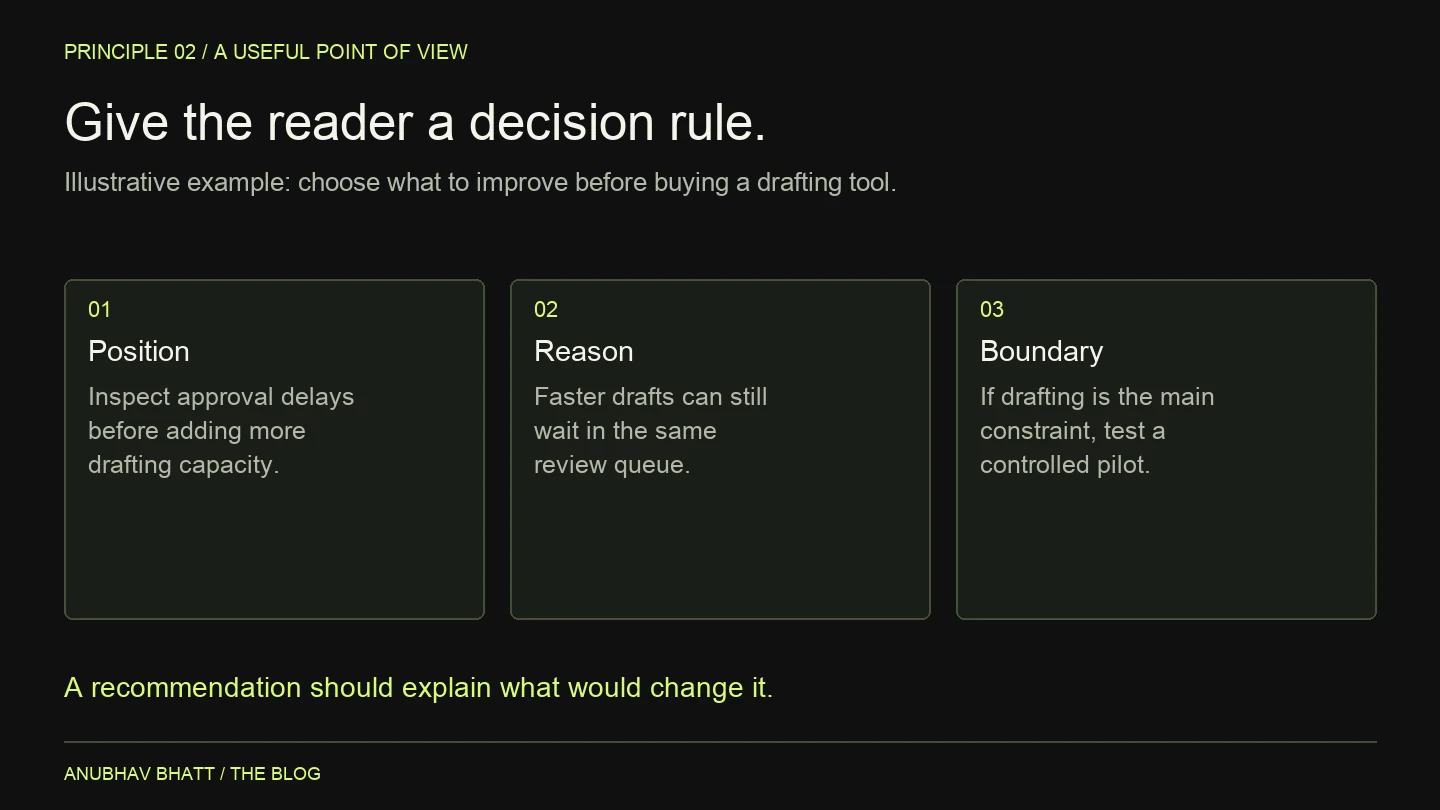
For each recommendation, include three parts:
| Part | Question to answer | Example |
|---|---|---|
| Position | What do you recommend? | Inspect approval delays before adding drafting capacity. |
| Reason | Why could this be the right choice? | Faster drafts may still wait in the same review queue. |
| Boundary | When would you recommend something else? | When drafting, rather than approval, accounts for most elapsed time. |
Google's people-first content guidance asks whether a page adds original analysis and substantial value beyond rewriting its sources. That is guidance for evaluating content quality, not a promise of a ranking position.
Originality can come from a useful distinction, a worked comparison, or a precise explanation of a trade-off. You do not need to invent a new theory or make an unsupported claim to sound different.
Before approving the draft, ask: Could a competent reader explain when our advice would not apply? If not, the argument may be too vague or too absolute.
3. Make the evidence as specific as the claim
Credible B2B content lets a reader inspect how a claim was reached. Link to the original source, identify the relevant population and date, and separate measured results from estimates or examples. The stronger your commercial claim, the more carefully you should describe its scope, method, and limitations.
A number can be accurate and still be misleading in context.
“Content production became faster” does not tell a buyer whether you measured drafting time, time awaiting approval, or the full interval from brief to publication. Those measures support different conclusions.
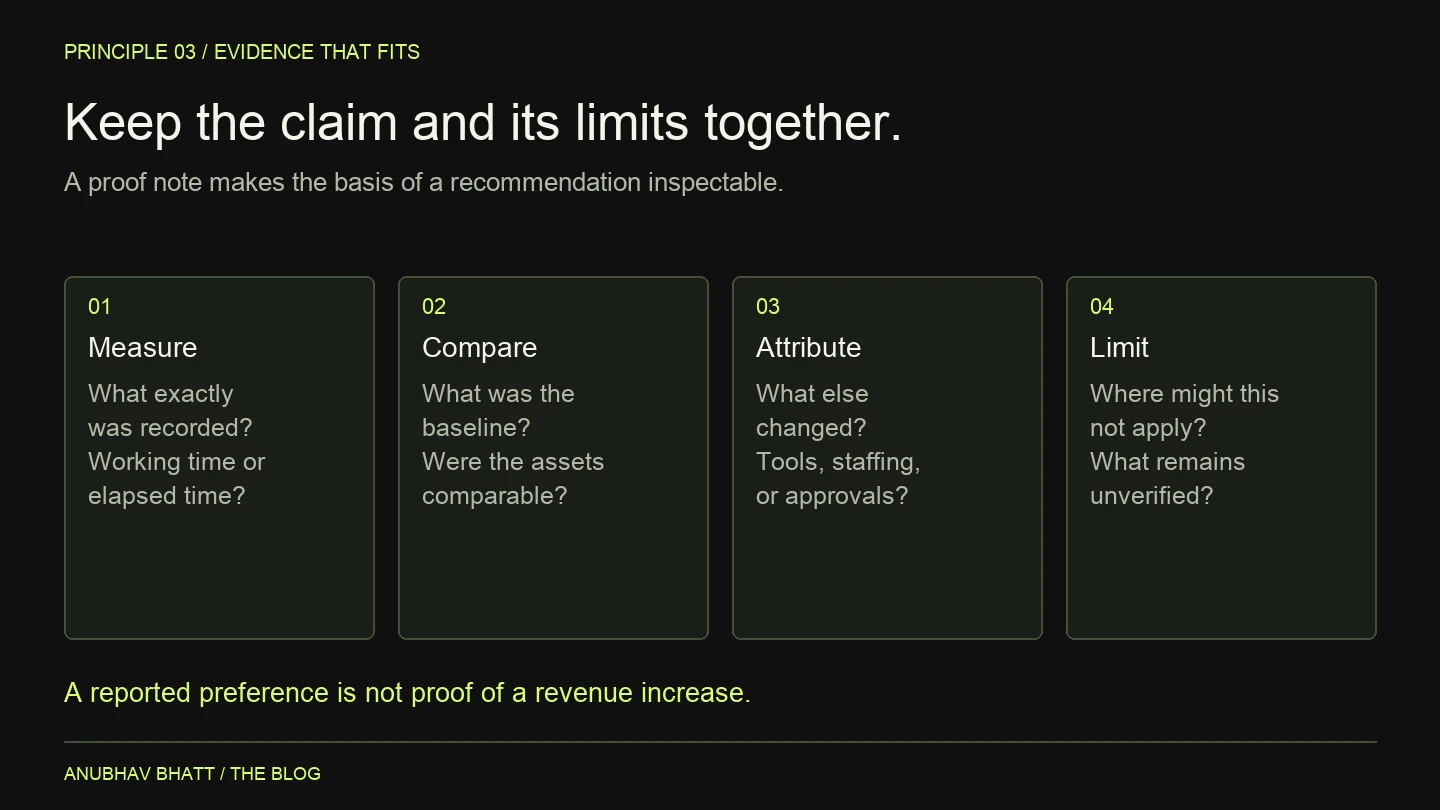
For the hypothetical automation article, a defensible proof note would specify:
- What was measured: working time or elapsed time, and which workflow steps.
- What was compared: the same type of asset under comparable review requirements.
- What changed: tools, staffing, approval rules, or several things at once.
- What remains uncertain: whether the same result would hold for another team.
Do not present invented pilot numbers as a case study. If you lack measured results, show the method a buyer could use to collect them.
An especially useful example of careful interpretation is John Dawes's 95–5 rule paper. It explicitly treats the ratio as a heuristic. Purchase frequency changes the share of buyers in-market during a given period. It does not establish that exactly 95% of your audience is unready to buy, or that you should allocate 95% of your content budget to awareness.
Match the evidence to the sentence. A survey can support “respondents reported this preference.” It cannot, on its own, support “publishing this type of content will increase your revenue.”
This also matters when AI tools summarize your work. A sentence that keeps the finding, source, and limitation together is easier to interpret correctly when extracted. It does not guarantee an AI citation or recommendation.
Before publishing, ask: If someone copied only this claim into a slide, would it still be accurate?
4. Write for the second reader in the buying group
Content intended for a buying group should remain understandable when someone forwards it without a long explanation. State the problem, recommendation, evidence, and trade-offs in plain language. Give other stakeholders enough context to assess the decision, while keeping detailed technical material available for those who need it.
Your contact may care about workload. Finance may care about recurring cost. Operations may care about reliability. A technical reviewer may care about access, data handling, and what happens when a process fails.
Do not force one article to answer every possible stakeholder question. Give it a clear answer and link to the relevant supporting material. The internal linking guide for B2B websites shows how to connect those answers across blogs, case studies, and services.
The 2025 Edelman–LinkedIn report found that 55% of surveyed hidden decision-makers agreed that reviewing thought leadership was an important part of vetting vendors. The full study included 1,934 executives; its methodology lists the United States as the surveyed market, with fieldwork in March–April 2025. The hidden-buyer finding is a subgroup result and a reported attitude, not proof of a purchase caused by an article.
A practical response is to add a short internal briefing note to an important guide:
Decision: Should we fix approvals or test drafting automation first?
Evidence needed: Time spent drafting, reviewing, waiting, and reworking comparable assets.
Trade-off: Faster production is useful only if accuracy and review requirements remain acceptable.
Next step: Inspect the workflow before choosing the pilot scope.
This makes the content easier to reuse in a real conversation. It also exposes gaps: if the briefing note cannot identify the evidence needed, the underlying argument probably needs work.
The writing principle has a long history. Nielsen Norman Group's 1997 web-reading research supported concise, scannable, objective writing over promotional prose. That was a web-usability study, not a modern B2B conversion experiment. Its useful editorial lesson is to make important information easy to find and evaluate.
Before publishing, ask: Can someone outside the original reader's function understand the recommendation without asking sales to translate it?
5. Build consistent associations across useful touchpoints
Distribution should connect a recognizable idea with situations in which buyers need it. Adapt the presentation to the channel, but keep the offer, evidence, and terminology consistent. Publishing the same argument in several useful contexts can support familiarity; publishing unrelated material everywhere is not a distribution strategy.
The 95–5 paper concerns advertising and brand memory. Applying its memory-building argument to editorial planning is a strategic inference, not a tested content prescription: some content can help people recognize a problem before they are ready to hire you.
For our hypothetical service, a coherent distribution plan could look like this:
| Buying situation | Useful asset | What should stay consistent |
|---|---|---|
| “Our production process feels slow.” | A public diagnostic article or short LinkedIn explanation | The distinction between drafting time and review delay. |
| “We need to compare approaches.” | A workflow comparison linked from the article | Scope, constraints, and the evidence required to choose. |
| “We need internal approval.” | A briefing note or scoped pilot proposal | The same assumptions and success criteria. |
There is no need to launch every channel at once. Choose where your intended buyers already look for advice and where your team can maintain useful material.
McKinsey's 2024 B2B Pulse survey reported an average of ten interaction channels across respondents' buying journeys. The survey involved nearly 4,000 B2B decision-makers across 13 countries. Those interactions included sales and purchasing touchpoints; the finding is not a recommendation to run ten social channels.
Consistency is operational as well as editorial. Gartner's 2025 survey also reported that 69% of buyers encountered differences between website information and what sellers told them. When your scope, pricing assumptions, or implementation process changes, update the places that explain it.
Before distributing, ask: What buying situation should someone associate with our expertise, and do all linked assets tell a compatible story?
6. Measure the next useful action and revise the content
Measure content against the task it was designed to support. Use attention metrics to diagnose reach and engagement, then examine whether relevant buyers take useful next steps. Track lead fit and sales feedback alongside analytics. A page view or attributed conversion is a signal; it does not establish incremental revenue.
An early diagnostic guide and a service comparison should not have identical success criteria.
For the diagnostic guide, examine whether relevant readers reach the comparison or use the checklist. For a service page, examine whether enquiries describe problems you can help solve. For a case study, ask sales which questions it resolves and which still recur.
Define qualified enquiry before reporting it. For a specialist service, that might mean a company in scope, a relevant business problem, and a feasible engagement. Pick the criteria that fit your offer rather than counting every form submission as equal.
Keep a simple review record:
| What to record | Why it matters |
|---|---|
| Intended reader and decision | Prevents judging every page by the same metric. |
| Relevant next step | Makes the call to action part of the content's purpose. |
| Visits, enquiries, and qualification counts | Keeps denominators visible, especially with small samples. |
| Sales questions and objections | Identifies missing explanations that analytics cannot reveal alone. |
| Other changes during the period | Helps avoid attributing an offer change or campaign effect to one article. |
| Owner, review date, and revision | Turns the findings into maintained content. |
For a small site, a few enquiries can move a conversion rate sharply. Review actual counts and the nature of the conversations before treating a percentage change as a reliable pattern. Ask buyers what they used to evaluate you, recognizing that recall is incomplete.
If readers frequently ask a question the article was meant to answer, revise it. If an asset draws the wrong audience, inspect its promise and distribution. If readers understand the problem but cannot evaluate your service, add the missing decision support before publishing more general advice.
Before celebrating performance, ask: What changed for the intended buyer, and what evidence do we actually have?
Put the six principles into one content brief
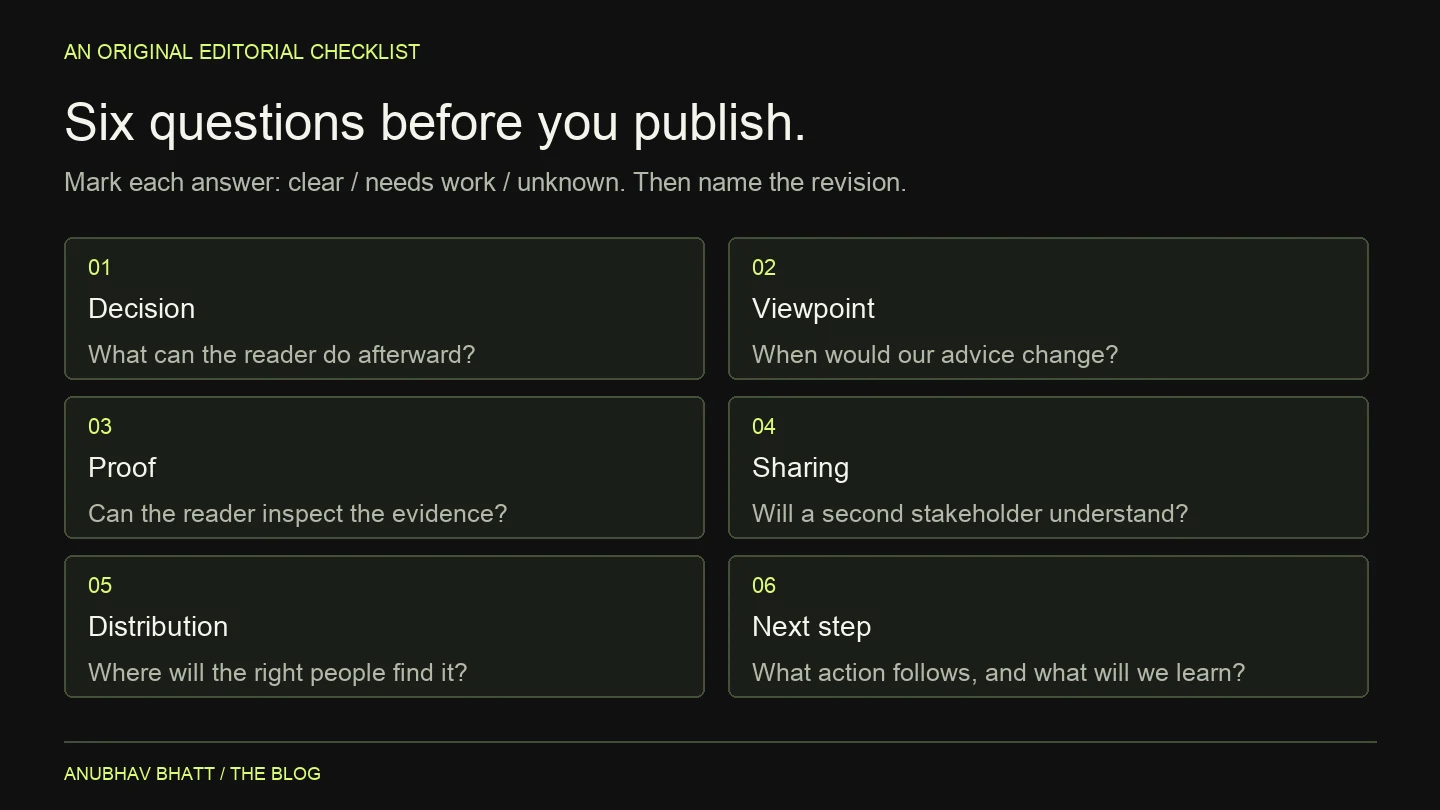
Use this original checklist to review an existing asset or brief a new one. It is an editorial tool, not a validated scoring model. Mark each answer clear, needs work, or unknown, then identify the evidence or revision needed. Avoid turning uncertainty into a reassuring total score.
- Decision: Who needs this, and what should they be able to do afterward?
- Viewpoint: What do we recommend, and when would that advice change?
- Proof: Can a reader inspect the source, method, scope, and limitations?
- Sharing: Will a second stakeholder understand the argument without us present?
- Distribution: Where will the right people encounter it, and does it match our other material?
- Next step: What useful action follows, and how will we review the result?
Start with one asset near a commercial decision: a service page, a comparison, or a frequently shared guide. Repair the weakest answer before expanding the calendar.
If those gaps are spread across your website, a B2B content strategy audit can help prioritize the work. If production speed is the problem, first distinguish strategy gaps from the workflow issues covered in the content automation consultant guide.
Frequently asked questions
What makes B2B content successful?
Successful B2B content supports a defined audience and business objective by helping a buyer understand, evaluate, or explain a decision. Relevant attention is useful, but it is not the only outcome. Assess the evidence, the next action, lead fit, and sales feedback against the asset's intended purpose.
Do these principles apply to SEO, AEO, and GEO?
Yes, as editorial principles: clear answers, useful distinctions, inspectable sources, and self-contained explanations help people evaluate content wherever they find it. Search engines and AI systems have different discovery and selection mechanisms. Good structure, bold text, or schema does not guarantee rankings, citations, or recommendations.
Should every B2B blog post ask readers to book a call?
No. Match the next step to the decision the reader is ready to make. An introductory guide may lead to a checklist or comparison. A service evaluation page can explain an engagement or invite a conversation. Keep important general information accessible rather than forcing every reader through a sales meeting.
How often should a B2B company publish content?
Publish at a pace that allows useful research, accurate review, distribution, and maintenance. A calendar should reflect buyer questions and available expertise, not an arbitrary daily quota. Some teams need new material; others need to repair existing service pages or evidence. These principles do not establish a universal publishing frequency.
Can AI write effective B2B content?
AI can assist with outlining, drafting, and organizing material. Someone accountable for the content still needs to verify sources, understand the buyer's problem, and review the recommendation. In Gartner's May 2026 survey release, 69% of respondents preferred validating AI-generated insights with sellers. The survey covered 645 buyers in August–September 2025; it measured preferences, not the quality of every AI answer.
Make your next piece easier to trust and use
A useful content brief gives the writer a decision to support, a position to examine, evidence to work with, and a next step that makes sense. It gives your reviewer something more concrete to assess than whether the copy “sounds good.”
If your team has plenty of content but prospects still struggle to understand your offer, tell me which page or buyer question is causing difficulty. I help B2B teams connect content strategy, writing, and practical workflows to the decisions their buyers need to make.
Research note: This article combines linked primary research and publisher guidance with an original editorial framework developed for this guide. The automation scenario is illustrative. No client results or conversion improvements are claimed.