AI summary
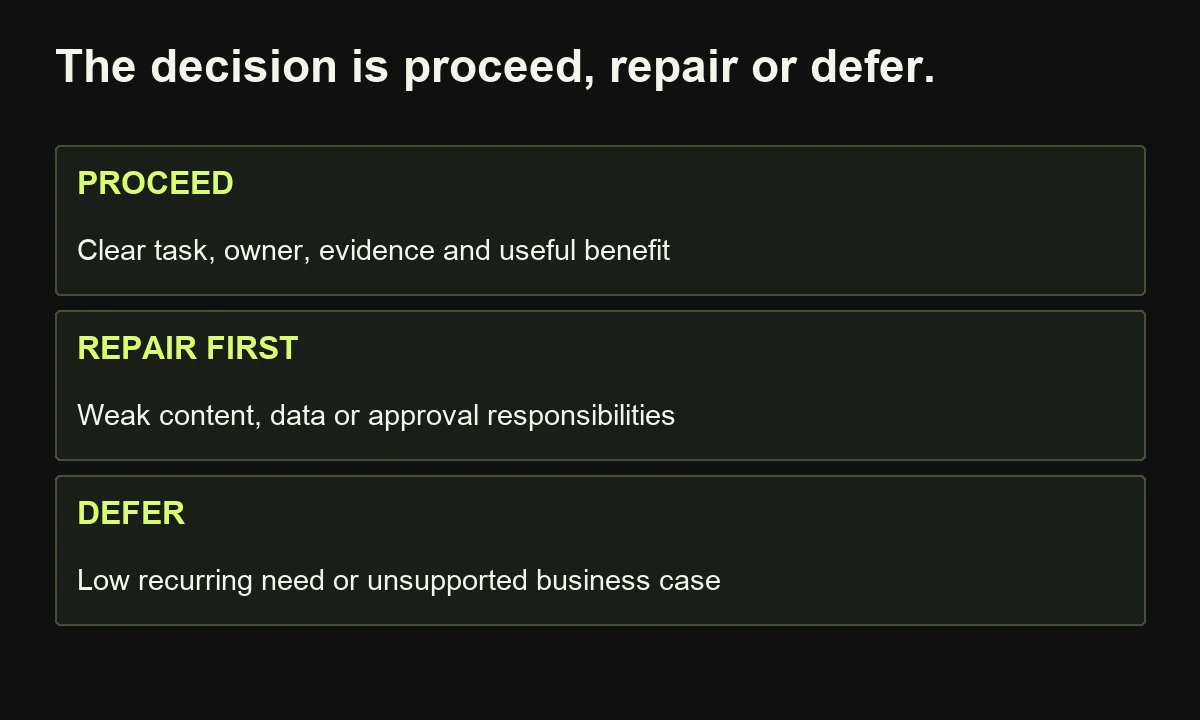
Marketing automation is worth funding when a defined workflow creates a verifiable benefit after its complete costs. Separate capacity gained from cash saved, and retain human ownership of strategy, quality, and exceptions.
- Choose the constraint first: Start with recurring work, usable inputs, and a clear output. Compare automation with simpler alternatives such as a native integration, template, or better approval process.
- Count the whole investment: Include setup, subscriptions, usage, review, maintenance, and changes. Estimate ordinary runs, failures, retries, and busy-month volume before comparing platforms.
- Keep two benefit ledgers: Recovered hours are capacity. Avoided expenditure and evidenced additional contribution support a financial case. Never count the same benefit twice.
- Prove it in a pilot: Test real inputs and exceptions, assign accountable people, and compare quality, effort, cost, and outcomes before expanding.
Marketing automation is worth the money when a defined workflow produces enough useful time, avoided expense, or measurable commercial benefit to cover implementation and ongoing costs. Start with a recurring bottleneck, test the complete process, and retain human ownership of strategy, quality, and exceptions. Buying software alone does not establish a return.
The wrong buying question is “How much marketing can this platform automate?” The better one is “Which constraint will it remove, and what will we do with the improvement?”
A system can save ten hours without reducing expenditure. It can deliver emails faster without improving their relevance. It can route enquiries accurately while sales still lacks a useful response. Those outcomes deserve different business cases.
This guide assumes a B2B marketing team or service business evaluating its first serious automation investment. The principles also apply to larger teams, but implementation complexity changes the calculation.
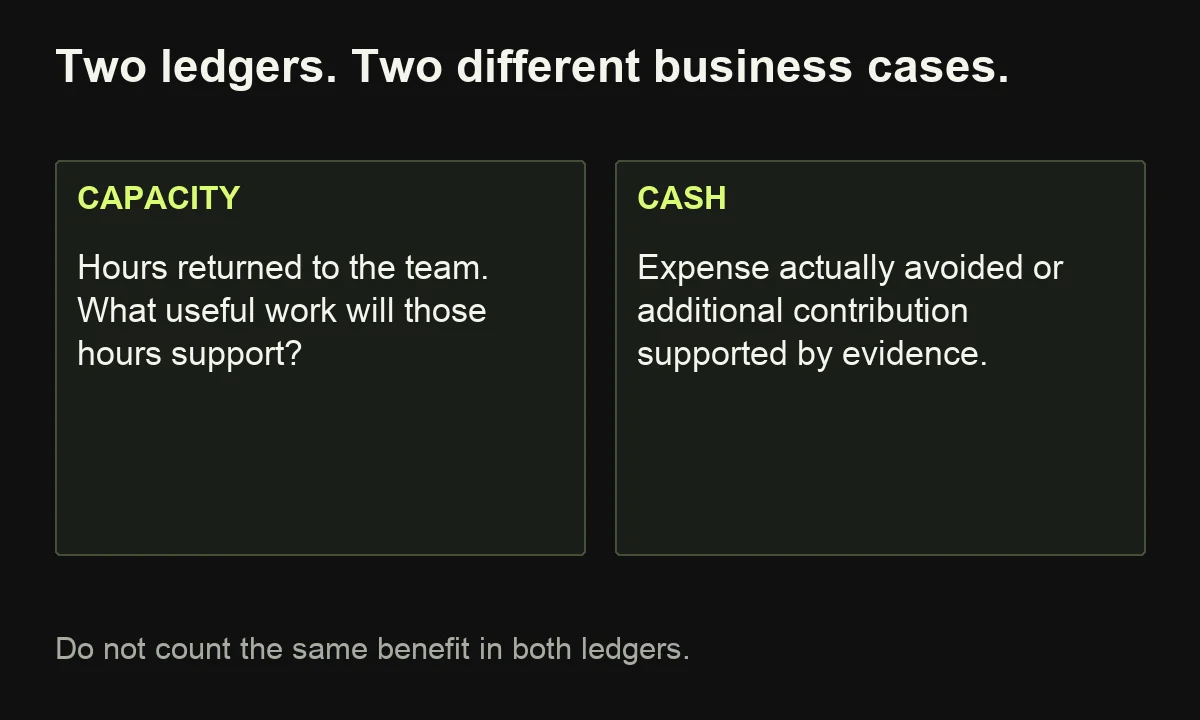
My proposed approach uses two ledgers: capacity and cash. Track time returned to the team separately from money that genuinely enters or leaves the business. Then assess quality and reliability before deciding whether to expand.
This is an original planning method for this article, not a validated ROI model. The figures below are hypothetical assumptions, not market prices, quotations, or client results. Use your own records before buying.
What is marketing automation, and does it require AI?
Marketing automation uses triggers, rules, and connected software to carry out recurring marketing tasks. It can capture enquiries, update a CRM, send approved messages, route work, and assemble reports. AI adds interpretation or generation where useful; a dependable rules-based workflow does not need AI in every step to create value.
Salesforce's definition describes managing processes and campaigns across channels through workflows. In practice, separate three capabilities:
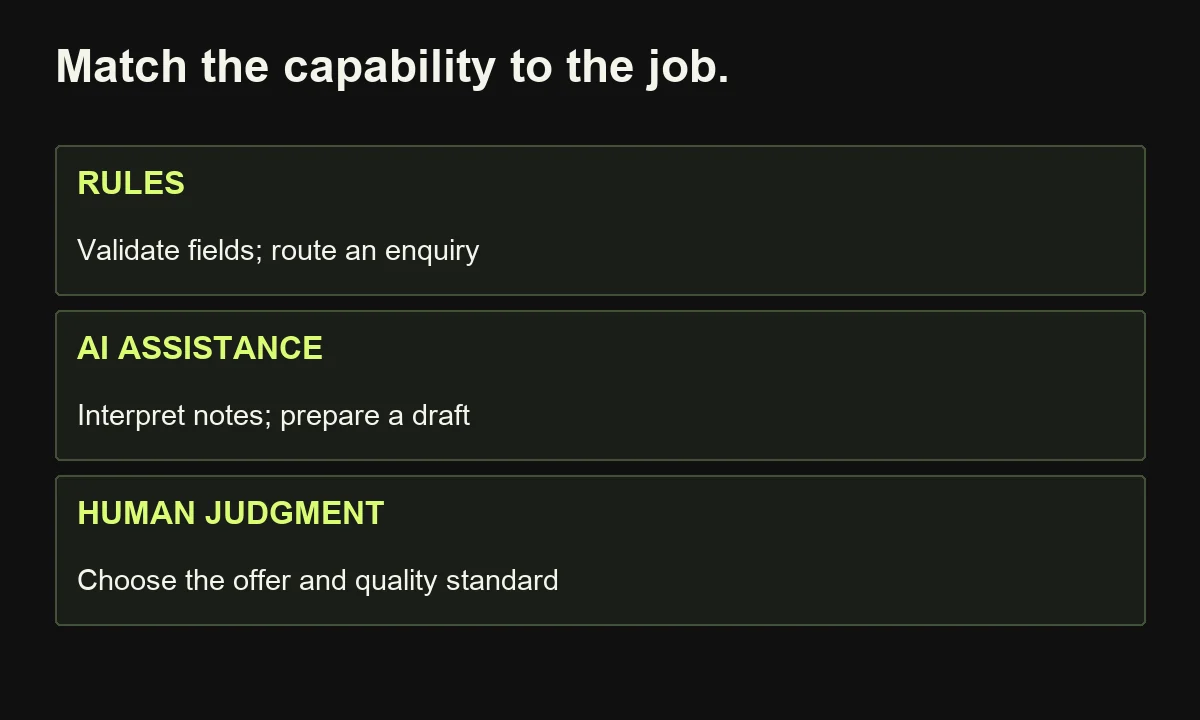
- Rules: if a complete enquiry arrives, create a record and assign an owner.
- AI assistance: summarize the enquiry or suggest which documented service may fit.
- Agent actions: choose among permitted tools or next steps within defined boundaries.
That distinction changes the cost and testing requirements. Checking whether an email field is present needs an exact rule. Interpreting a paragraph may benefit from AI. Deciding which prospects the business should pursue requires commercial judgment.
Consider a webinar workflow. Registration triggers an approved confirmation. Attendance data helps select a relevant follow-up. AI can prepare a transcript summary, while an editor checks claims before new content is released.
Marketing automation software is infrastructure for execution. It does not supply positioning, a valuable offer, or permission to contact someone.
If your core question is how AI fits into the wider marketing operation, my AI marketing guide covers assistants, specialist tools, and custom workflows in greater detail. Here, the focus is the investment decision.
When is marketing automation worth the investment?
Automation becomes a strong candidate when a task repeats, its inputs are usable, the desired output is clear, and someone owns the process. Its value depends on volume, effort removed, error reduction, and useful downstream work. A frequent task with unresolved strategy may need redesign before it needs automation.
Choose the smallest workflow that removes a meaningful constraint. Good candidates might include enquiry capture, webinar administration, approved email delivery, content review routing, or regular reporting.
For each, write a one-sentence investment hypothesis: “We will reduce manual enquiry transfer so the team can respond with complete information.” Specify what improvement would justify the effort.
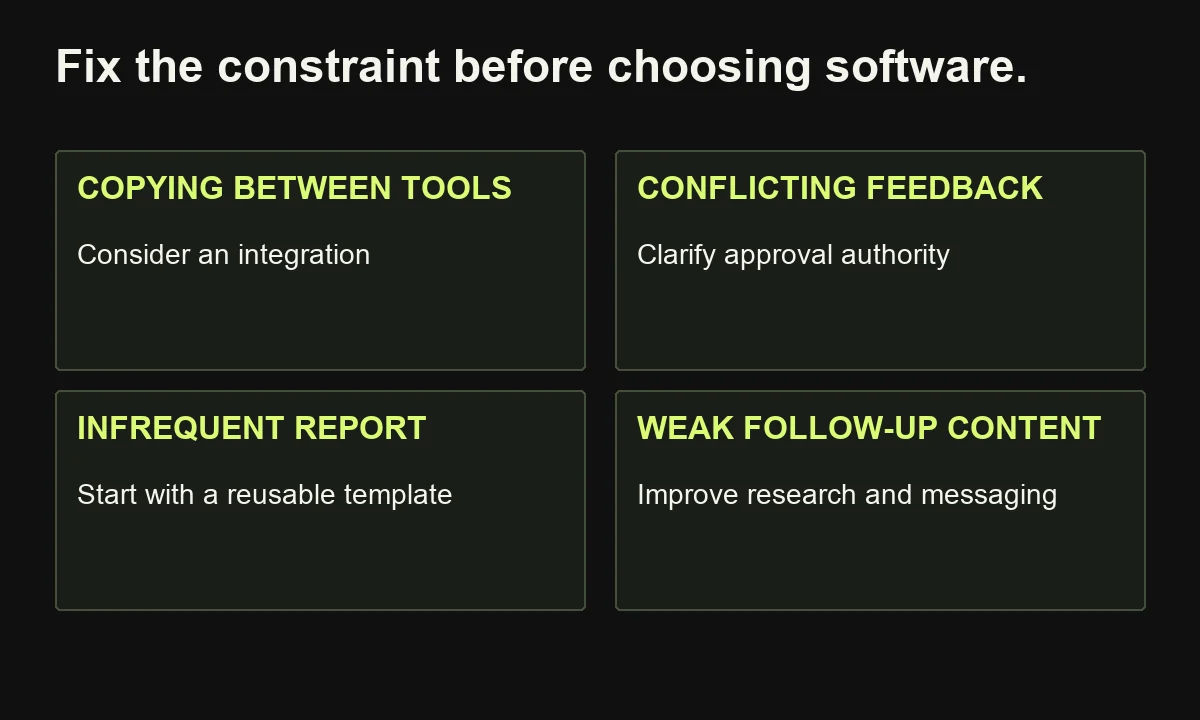
Compare automation with the practical alternative:
| Observed constraint | Alternative to consider |
|---|---|
| Repeated copying between tools | A native integration or connected workflow |
| Contradictory approval feedback | Clear decision rights and a better brief |
| Occasional report preparation | A reusable template before a complex system |
| Follow-up messages lack substance | Buyer research and stronger content |
Automating an unnecessary step preserves its cost in a different form. Remove duplication and simplify the process before building connections.
Start by observing actual work rather than estimating from memory. Record task frequency, active staff minutes, elapsed waiting, corrections, and missed handoffs. Ask the people doing the job where exceptions arise.
A workflow worth funding should improve an identified problem compared with a credible alternative, not merely look impressive in a demonstration.
How much does marketing automation really cost?
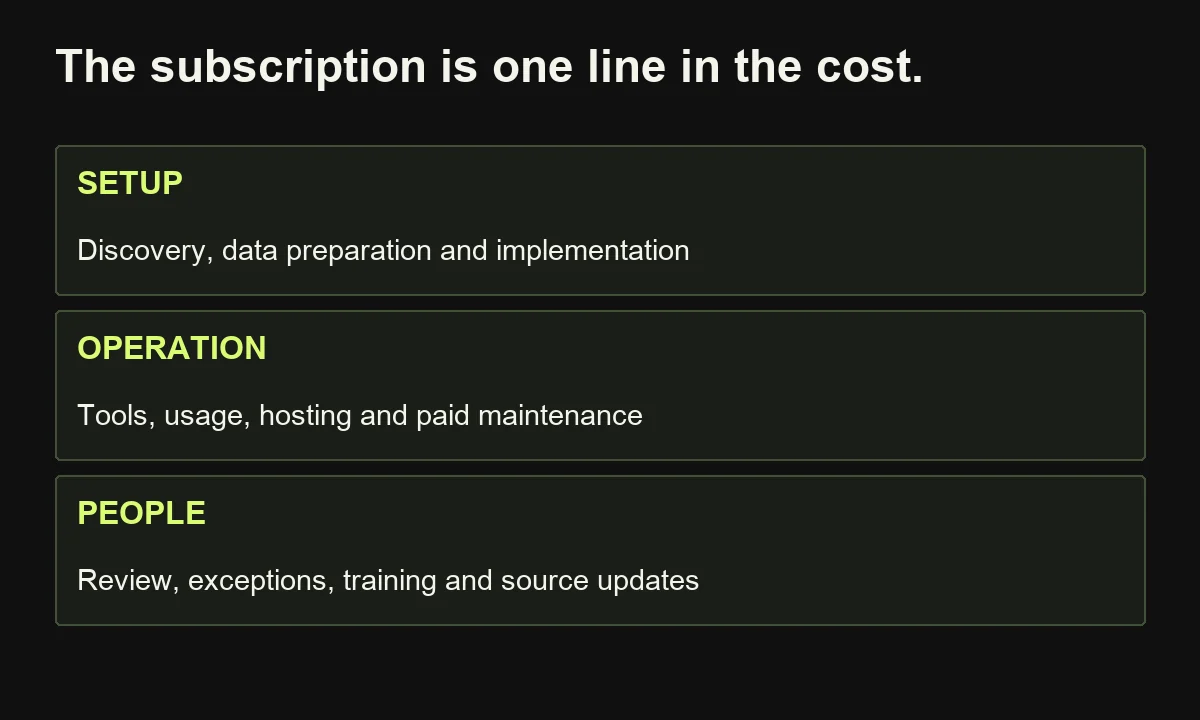
The total cost includes discovery, implementation, subscriptions, usage, data preparation, content, training, review, maintenance, and eventual changes. Compare proposals against the same workflow and realistic volume. A low monthly subscription can conceal substantial operating effort; a higher-priced platform may replace existing costs, but that replacement must be demonstrated.
Build a cost register with three groups:
- One-time work: process mapping, integration setup, cleaning records, configuring permissions, testing, and documentation.
- Recurring expenditure: platform fees, connected tools, model usage, email sending, hosting, and paid support.
- Internal effort: reviewing outputs, resolving exceptions, maintaining source material, and checking reports.
Count incremental costs against your current process. Do not charge the project for an existing CRM twice. Equally, include an upgrade required to unlock the integration.
Pricing units matter. Zapier documents task-based usage, including product-specific rates and exemptions. n8n describes execution-based billing for its paid plans. These are different units, so headline allowances are not directly comparable.
Sketch one ordinary run, a failed run, and a retry. Ask how each affects usage and what happens at the plan limit. Estimate low, expected, and busy-month volumes.
A quote should also explain ownership and exit: who controls the accounts, whether records can be exported, and what happens when a provider or integration changes. Cheap setup with an opaque handover can become expensive dependence.
How do you calculate marketing automation ROI without overstating it?
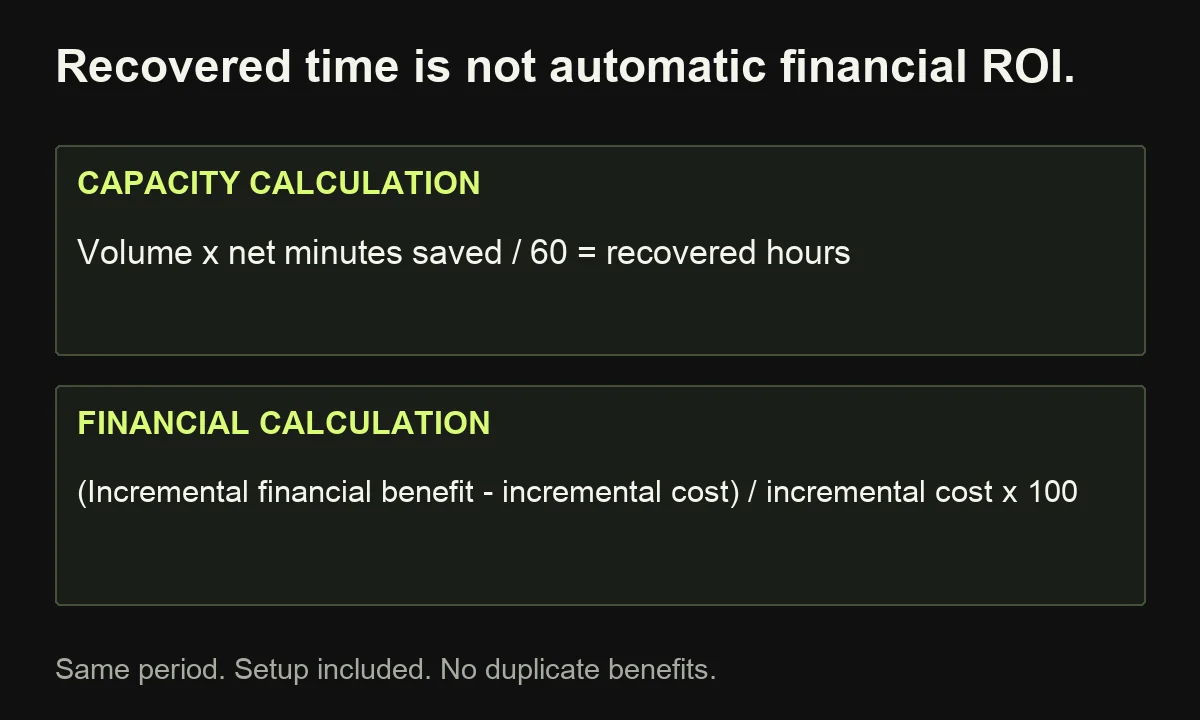
Calculate financial ROI using incremental financial benefit and incremental cost over the same period. Record capacity gains separately unless they produce a financial change. Include setup, operation, and human effort, and avoid counting the same benefit twice. A time estimate multiplied by an hourly rate is capacity value, not automatically cash savings.
For the capacity ledger, use:
Recovered hours = task volume × net minutes saved per task ÷ 60.
Net minutes saved must already include preparation, review, correction, and exceptions. Measure active effort consistently; faster turnaround and fewer staff minutes are different observations.
For the cash ledger, record expenditure actually avoided or additional contribution supported by evidence. Contribution means revenue remaining after the variable costs of supplying the additional work. Do not enter the full value of every influenced sale as automation benefit.
A practical financial calculation is:
Financial ROI = (incremental financial benefit − incremental cost) ÷ incremental cost × 100.
Use a stated assessment period and include setup once within that period. Payback answers a different question: how long recurring net financial benefit takes to recover setup expenditure, assuming the benefit persists.
If a sales improvement cannot be separated from a new offer or campaign, record it as unresolved rather than giving automation full credit.
My recommendation is to approve the operating case and financial case separately. A capacity improvement can be worthwhile even when the financial ledger has not yet demonstrated a positive return.
What does a realistic break-even example look like?
A break-even calculation should show the assumptions, the recurring benefit, the operating costs, and the effect of lower volume. Keep hypothetical capacity value separate from demonstrated financial savings. The useful output is a threshold you can test, not a persuasive percentage built from optimistic inputs or an industry average.
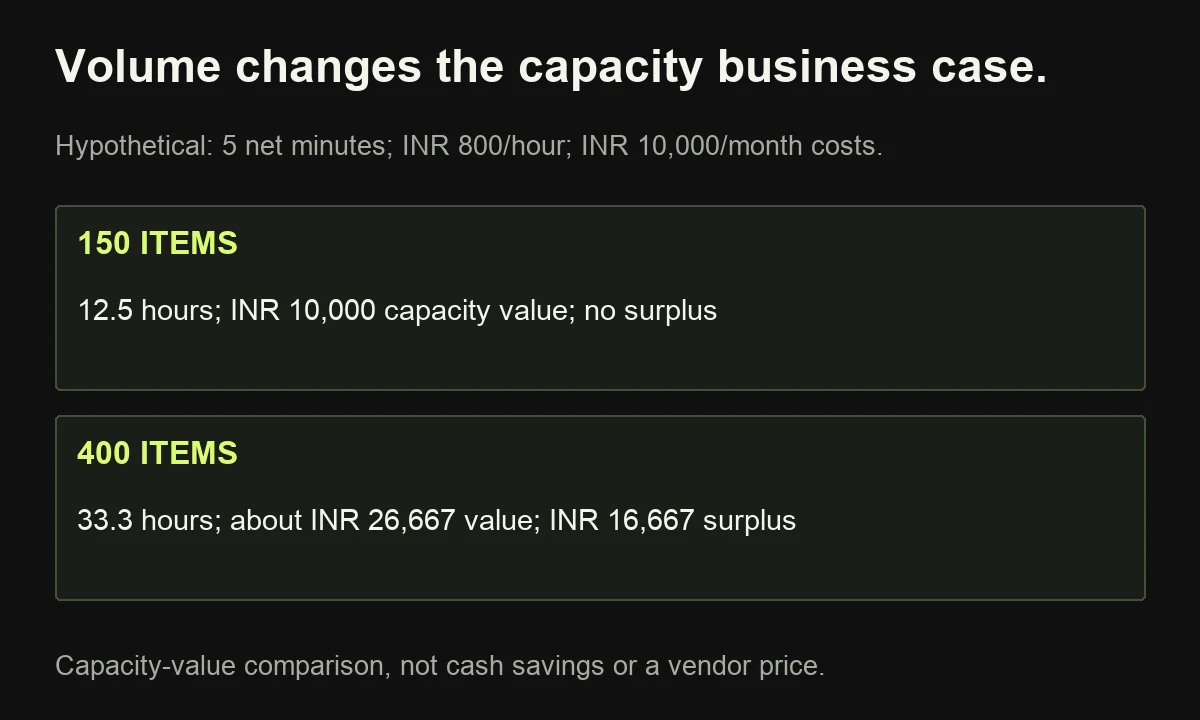
Suppose a team processes 400 items monthly, recovering five net minutes per item. That returns approximately 33.3 hours. At an assumed internal rate of ₹800 per hour, capacity value is approximately ₹26,667.
Assume incremental tools cost ₹6,000 monthly and external maintenance costs ₹4,000. The remaining capacity value is approximately ₹16,667 monthly. A hypothetical ₹30,000 setup is covered in about 1.8 months on that capacity-value basis. This is not financial payback if payroll remains unchanged.
For a separate cash case, suppose the same workflow genuinely avoids ₹18,000 of otherwise necessary contractor expenditure monthly. After ₹10,000 operating costs, net financial benefit is ₹8,000. Financial setup payback is 3.75 months, assuming immediate, sustained savings. Do not add the same contractor saving to labor capacity value.
At only 150 monthly items, five minutes each returns 12.5 hours, valued at ₹10,000. That merely covers the assumed operating cost on the capacity basis; setup remains unrecovered.
Download the editable automation business-case worksheet to replace these inputs. Its formulas are planning arithmetic, not predictions about your business.
Which marketing workflows should you automate first?
Prioritize workflows with recurring demand, reliable inputs, clear acceptance criteria, and manageable exceptions. Lead capture, administrative handoffs, and approved message delivery can be easier starting points than autonomous campaign strategy. Select the workflow that addresses your team's actual constraint; there is no universal sequence or guaranteed highest-return use case.
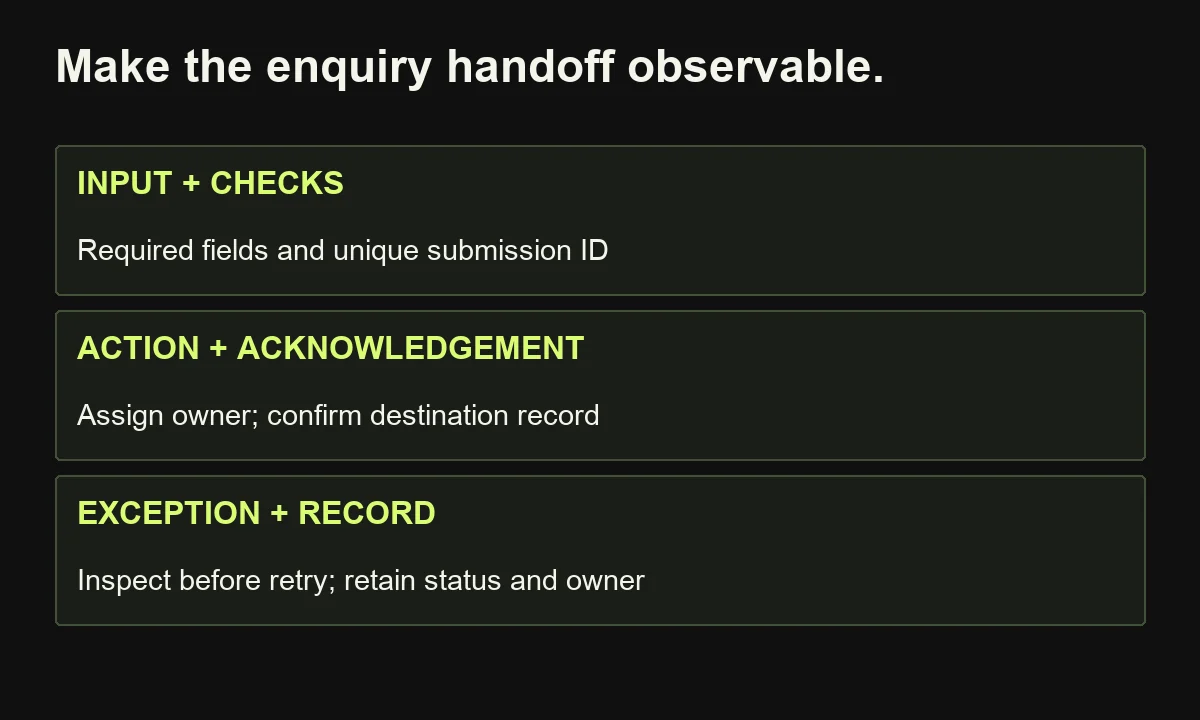
For a hypothetical enquiry workflow, define the contract before choosing nodes:
Input → checks → action → acknowledgement → record → exception owner.
A form submission needs a unique identifier, required fields, and an appropriate destination. The system validates the input, prevents duplicate creation, assigns a responsible person, and records the destination's acknowledgement. If acknowledgement is missing, inspect the destination before retrying; the write may already have succeeded.
For email nurturing, establish audience eligibility, approved content, scheduling, suppression, and exit conditions. A prospect who has unsubscribed or already purchased should not continue through an inappropriate sequence. Check the receiving system's actual behavior rather than assuming the diagram enforces it.
For content repurposing, retain the source, draft version, reviewer decision, and approved output. Track claims back to their evidence. See my content automation consultant guide for scope and handover questions.
Start with one connected process and one accountable owner. A dozen loosely supervised automations can create more reconciliation work than the manual process they were intended to replace. Reliability should precede expansion across channels.
Where does a human belong in an automated marketing system?
People remain responsible for the purpose, evidence, permissions, quality standard, and response to exceptions. Routine execution can proceed within approved rules; new claims, unusual situations, and consequential changes need defined review. The appropriate human-in-the-loop design depends on the action, rather than requiring a person to click approval for every harmless transfer.
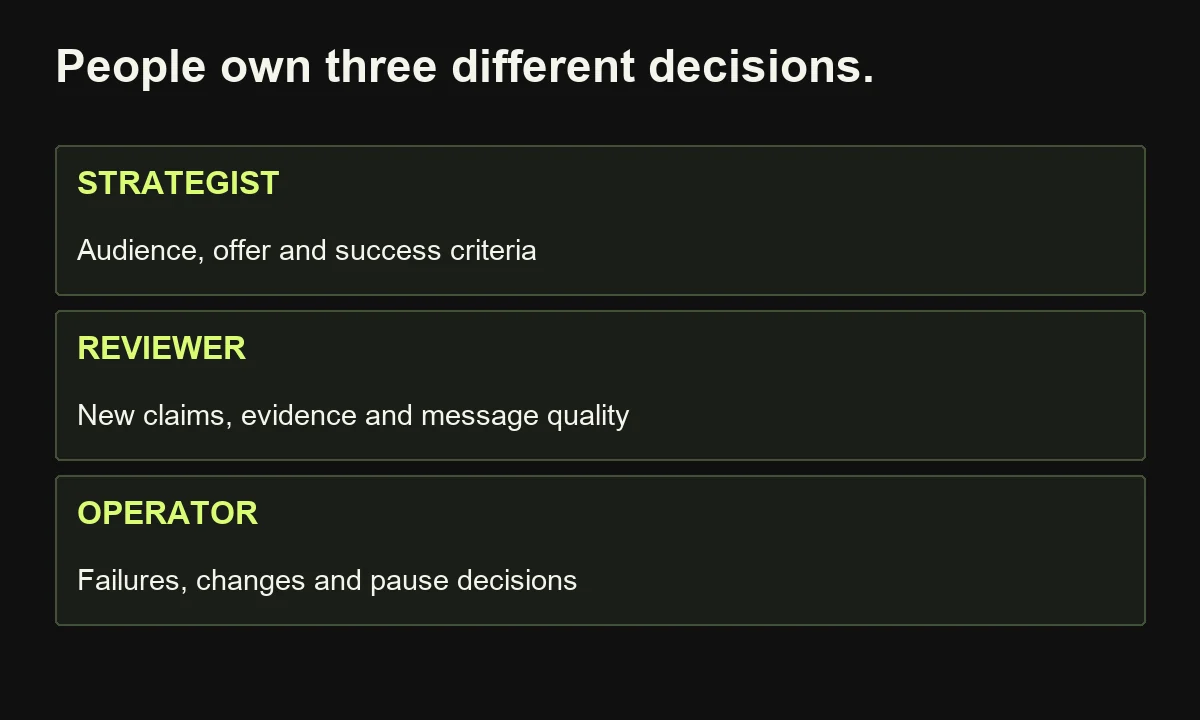
Keep three human roles visible:
- Strategist: decides which audience and problem deserve attention, what the offer promises, and what success means.
- Reviewer: checks new messages, interpretations, and claims against evidence and brand standards.
- Operator: investigates failures, updates integrations, and decides when to pause or change the workflow.
One person may hold several roles. The essential point is accountable judgment.
n8n supports human review before selected agent tool calls. Zapier's Human in the Loop step can collect review input. Configure the downstream action to depend on the trusted decision; adding a review screen alone is not the whole approval design.
AI is an augmentation: it can help examine evidence, prepare alternatives, and reduce repetitive work. Its output still needs a standard and an owner.
In my Ruh AI case study, I describe connecting positioning and content strategy with an automated production process that retained human approval. This first-party account illustrates the approach, not a transferable ROI benchmark. The valuable expertise is knowing what to automate, what evidence to preserve, and which decisions people must own.
Should you choose a marketing platform or custom automation?
Choose a marketing platform when its maintained capabilities fit your campaigns, customer records, and team's operating needs. Choose connected workflows when the problem crosses existing systems and requires specific handoffs. Test both against the same job, including review and maintenance. A custom setup offers flexibility; it also creates responsibilities someone must manage.
Platforms such as HubSpot Marketing Hub combine marketing capabilities within a wider customer platform. Workflow tools such as n8n or Zapier can connect systems you already use. These categories can coexist; this is not a tested vendor ranking.
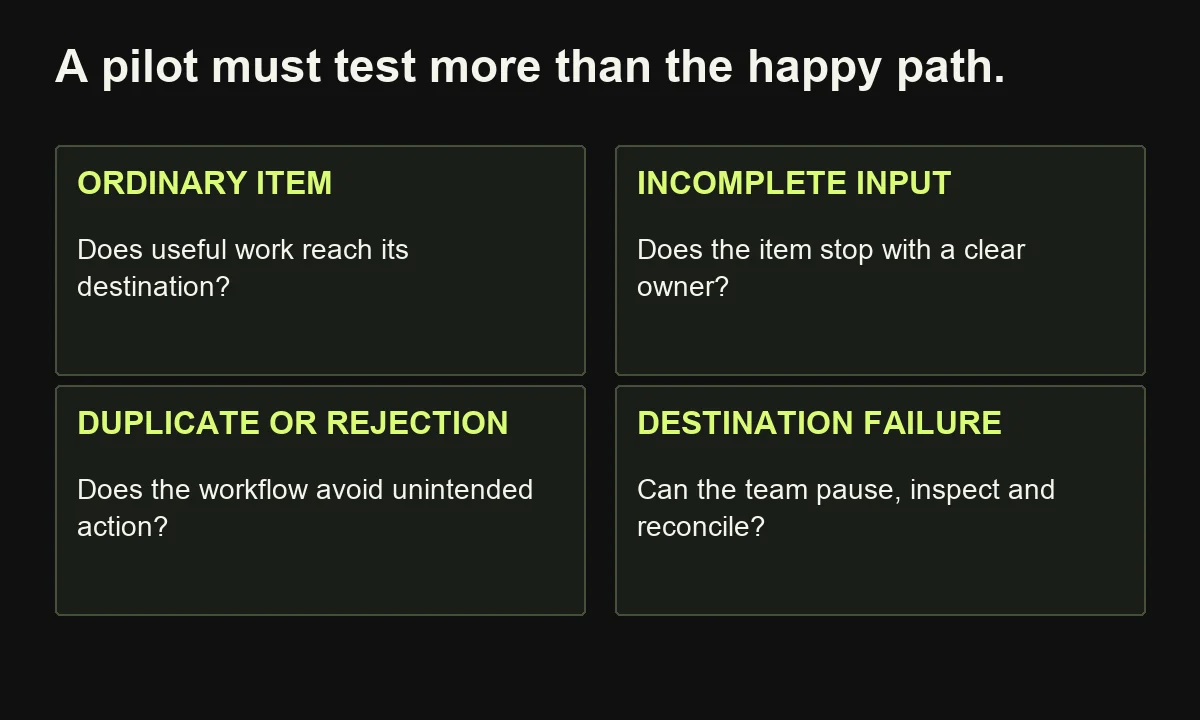
Ask providers to demonstrate an ordinary item, incomplete input, duplicate, rejected output, and unavailable destination. Check account permissions, exports, usage limits, error visibility, and who maintains changes.
Self-hosting is not synonymous with zero cost. n8n's hosting documentation describes responsibilities around deployment and administration. Include hosting, updates, backups, monitoring, and technical support in the comparison.
Use a short pilot with recorded acceptance criteria:
- Establish the current process and quality baseline.
- Test representative inputs, including failures.
- Run a limited live trial with monitoring and a pause procedure.
- Compare full effort, cost, quality, and useful business outcomes.
Define who can restart the workflow and how missed items will be reconciled. A rollback should preserve the records needed to finish outstanding work manually. Scale only when the actual results justify the additional responsibility.
Frequently asked questions: is marketing automation worth the money?
Is marketing automation worth it for a small business?
It can be, when recurring work or missed handoffs justify the complete cost. A small business may start with native integrations and approved email sequences. Low volume, unstable offers, or poor data can make manual improvements the better first investment.
Can marketing automation increase revenue?
It can support timely follow-up and useful buyer journeys. Revenue improvement still depends on demand, offer quality, content, sales execution, and other activity. Test the relevant outcome; do not convert every attributed sale into incremental revenue caused by automation.
Can I automate marketing for free?
Free plans may support a limited pilot. Check their current allowances, required integrations, and operating costs. Internal setup, review, and maintenance consume resources even when the software invoice is zero. The right comparison is the finished process, not the entry price.
How long does it take to see a return?
There is no universal timeline. Use actual task volume, net effort saved, setup expenditure, and recurring cost to estimate a range. Review whether the predicted benefit materialized. A successful demonstration does not establish sustained performance or financial payback.
Before buying, name the workflow, its owner, and the benefit you can verify. If the process or content needs clarification, share where your marketing work gets stuck. I can help connect the strategy, writing, and workflow design into a scoped pilot your team can evaluate and maintain.