AI summary
AI creates marketing value when it improves a defined job, uses reliable evidence, and helps people make better decisions. Start with one bottleneck, prove the benefit, then expand.
- Choose the job before the tool: Use assistants for research and drafts, specialist tools for focused workflows, and n8n or Zapier for repeatable handoffs. Compare them on real work.
- Make quality repeatable: Supply buyer context, approved facts, sources, and brand examples. Keep human ownership of strategy, claims, and publication; build explicit approval into automated workflows.
- Measure business value: Track qualified enquiries and useful output alongside total effort, review, corrections, and costs. Faster drafting alone does not establish return on investment.
- Scale what survives a pilot: Test representative tasks, data permissions, duplicates, and failures. Expand only when quality and operational reliability hold up.
Use AI in marketing by choosing a specific job, supplying reliable context, and reviewing the output against a clear standard. Start with research, analysis or drafting. Connect tools into repeatable workflows when the process is understood. Measure the finished work and business outcomes, while keeping people responsible for strategy and important decisions.
The opportunity is larger than generating more posts. AI can help a small team examine customer feedback, explore campaign ideas, adapt creative, and reduce the administrative work between a brief and a useful asset.
That makes human expertise more valuable: someone still needs to choose the problem, judge the evidence, and recognize an idea worth pursuing.
AI marketing includes several capabilities. Generative AI produces drafts and media. Predictive systems estimate outcomes from patterns. Workflow automation connects steps; an AI agent can select actions within the tools and permissions you provide.
This guide focuses on B2B marketing teams and service businesses. It covers general assistants, dedicated AI marketing tools, and custom workflows using platforms such as n8n and Zapier. Examples are illustrative, not reported client results.
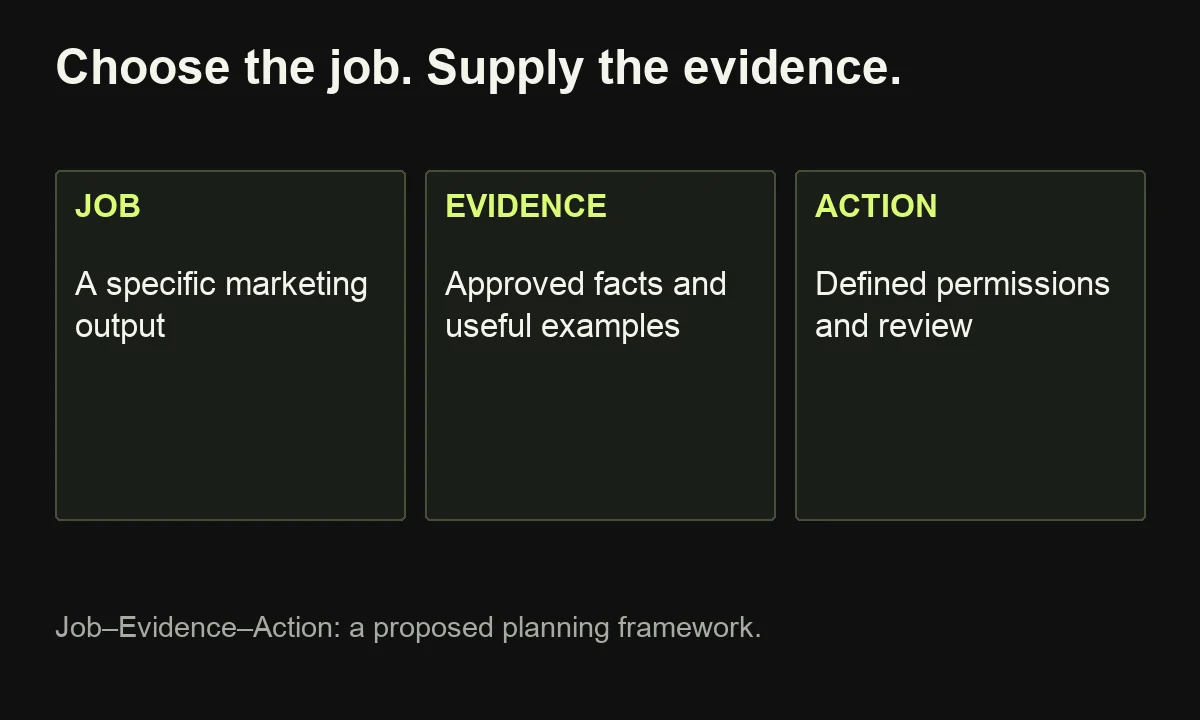
My proposed planning method is Job–Evidence–Action: define the work, identify the information it needs, and specify what the system may do. It is a practical editorial framework, not a validated performance formula.
Where should you start using AI in marketing?
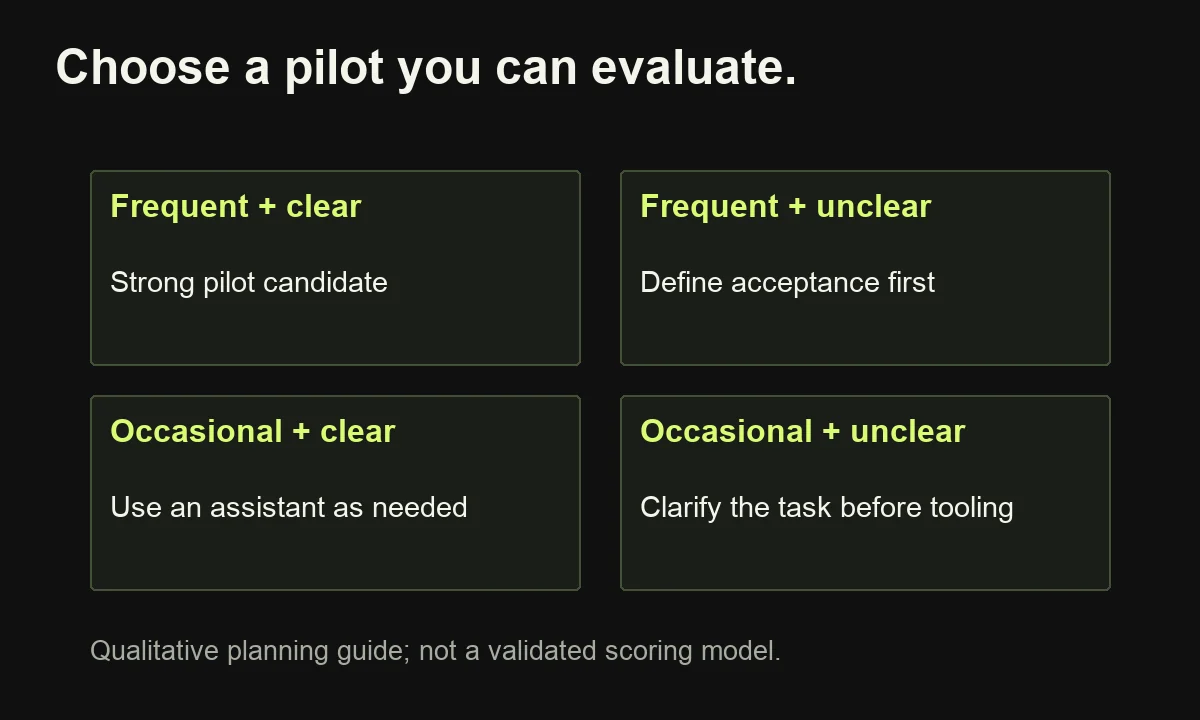
Start with a frequent, well-understood task whose output someone can evaluate. Good early candidates include summarizing approved customer interviews, preparing content briefs, repurposing an existing article, and organizing campaign reports. Choose one bottleneck, establish the current workload, and compare the AI-assisted process with the way your team works today.
List the recurring steps behind a marketing deliverable. For an article, those might be gathering evidence, choosing an angle, outlining, drafting, reviewing, formatting and distribution.
Mark which steps consume time and which require distinctive judgment. AI might help organize research and produce alternative structures while the strategist decides what the article should contribute.
Use the AI marketing pilot worksheet to answer three selection questions:
- Job: Is the desired output specific enough to assess?
- Evidence: Do we have reliable inputs and examples?
- Action: Can we trial it without making an irreversible commitment?
A promising pilot has a clear owner and a visible standard. “Help with marketing” has neither.
Harvard Business School's research on the technological frontier examined how AI's usefulness varied across consulting tasks. That 2023 study is not a benchmark for your marketing team; it supports testing capabilities at the task level.
Choose a small pilot that frees attention for better work. Record time, quality and review effort before introducing AI.
How do you use everyday AI chatbots effectively?
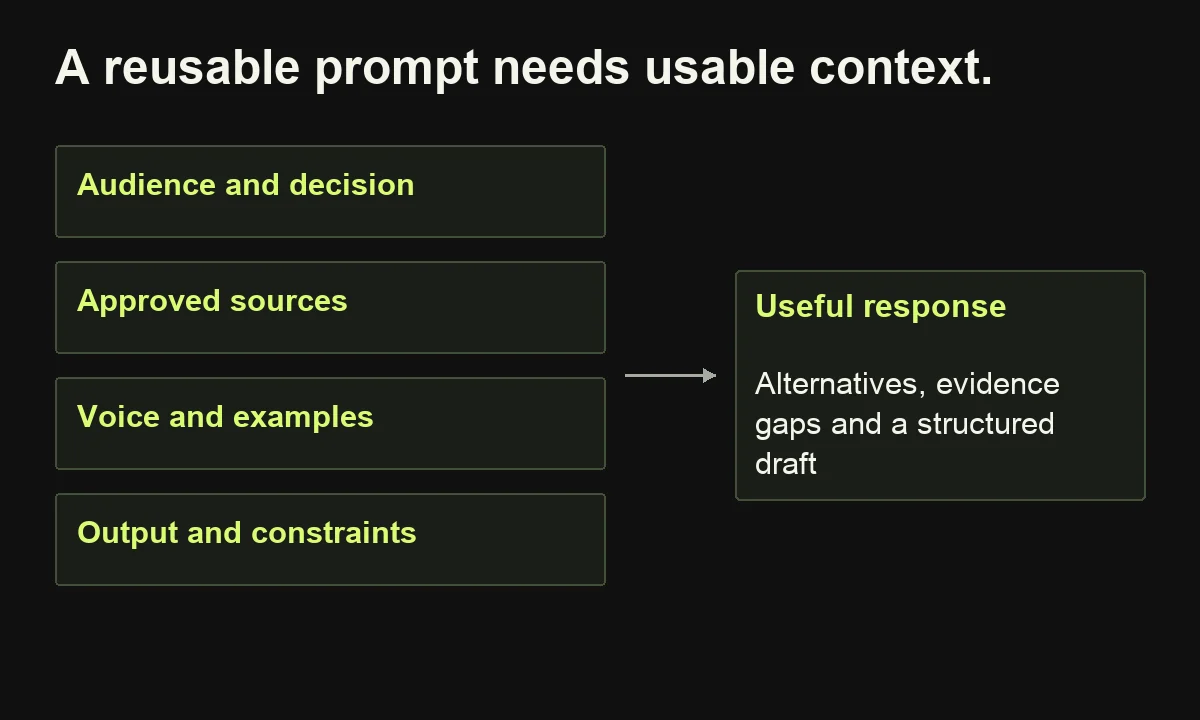
Use a general AI assistant as a working partner with a brief, reference material and a defined output. Give it the audience, business objective, approved facts, tone and constraints. Ask for alternatives or gaps, then verify the result. A detailed brief usually provides a better basis for useful work than a vague instruction.
ChatGPT, Claude and Gemini are examples of this category; choose a workspace appropriate for your data and tasks. File support, research capabilities and usage limits vary. Gemini's documentation describes file analysis, while Claude's project documentation explains organizing reference knowledge.
Try this reusable prompt:
Help plan a comparison article for marketing managers choosing between hiring writers and improving approvals. Use only the attached interview notes and service brief for factual claims. Identify the reader's decision, propose three angles, and outline the strongest one. Separate supported observations from assumptions. Flag missing evidence. Use plain language and do not invent quotes or results.
Review the proposed angles before requesting a draft. Then ask the assistant to challenge its recommendation: what conditions would make another approach more suitable?
Keep approved voice examples and product facts in a maintained reference set. When the offer changes, update those inputs. A saved prompt is useful, but reliable context is what makes it reusable.
Apply the same pattern to email variations, outlines and interview questions.
Build a reusable context pack, then run a review loop
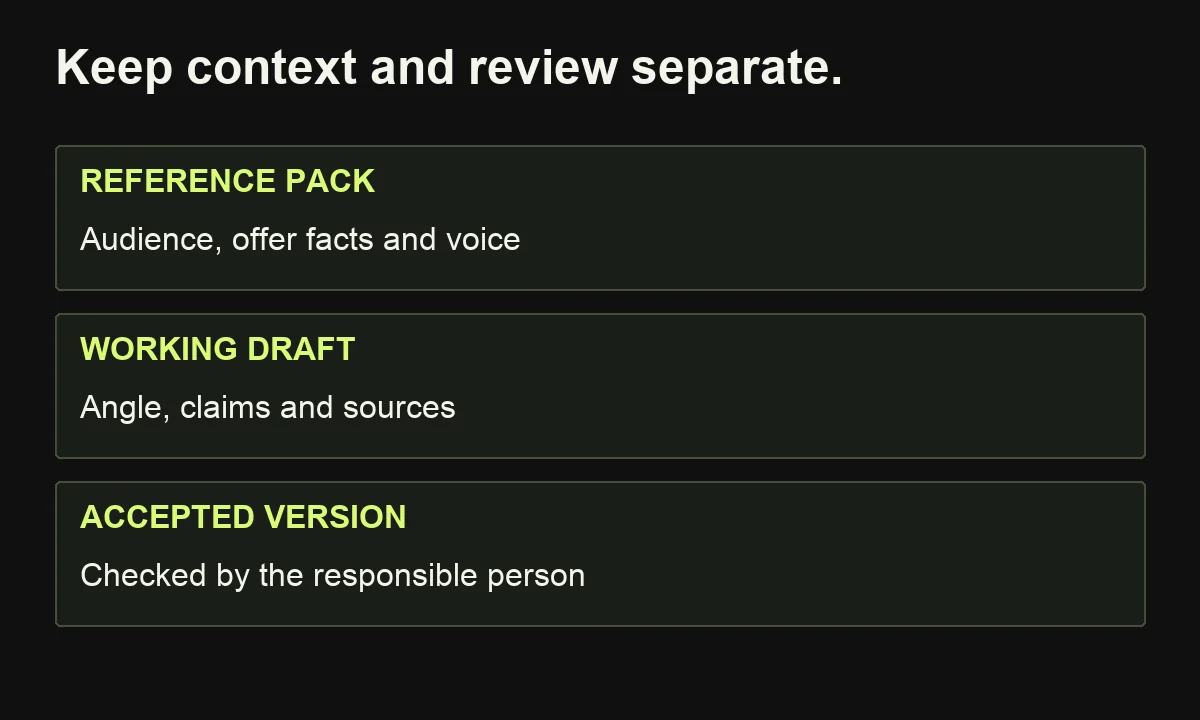
Create a short reference pack before asking for repeated outputs. Include the intended audience, the decision you want to support, current offer facts, approved claims, two voice examples, and explicit exclusions. Give each document a name, owner and review date so colleagues know which version to trust.
For a hypothetical workflow consultancy, the pack might state: the reader manages a small content team; the offer diagnoses drafting and approval delays; pricing requires a scoped brief; the consultancy does not promise a fixed lead increase. Those details prevent an assistant from filling gaps with plausible but inaccurate sales claims.
Use three separate passes:
- Plan: ask for the reader's decision, alternative angles and missing evidence. Select the angle yourself.
- Draft: provide the chosen outline and ask for source references beside factual claims. Request an explicit unknown when evidence is missing.
- Review: ask a fresh set of questions: Does the argument answer the brief? Which statements overreach? Where would a skeptical buyer need more detail?
The AI review is an additional inspection, not independent verification. Open the sources and check important claims yourself.
Save the prompt, reference version and accepted output together. When the offer changes, update the pack before reusing the prompt. If outputs repeatedly miss the mark, identify whether the problem is missing context, an unclear assignment, or an unsuitable tool.
How can AI improve customer research and strategy?
AI can organize customer language, compare interview themes, and surface questions that deserve investigation. Use it to assist analysis of real evidence, then check the interpretation against the original material. Treat generated personas and market hypotheses as starting points for research, not substitutes for customers or proof of demand.
Supply permitted interview transcripts, support themes, sales objections or survey responses. Ask the model to group observations by problem, desired outcome and purchase concern, with references to the source passages.
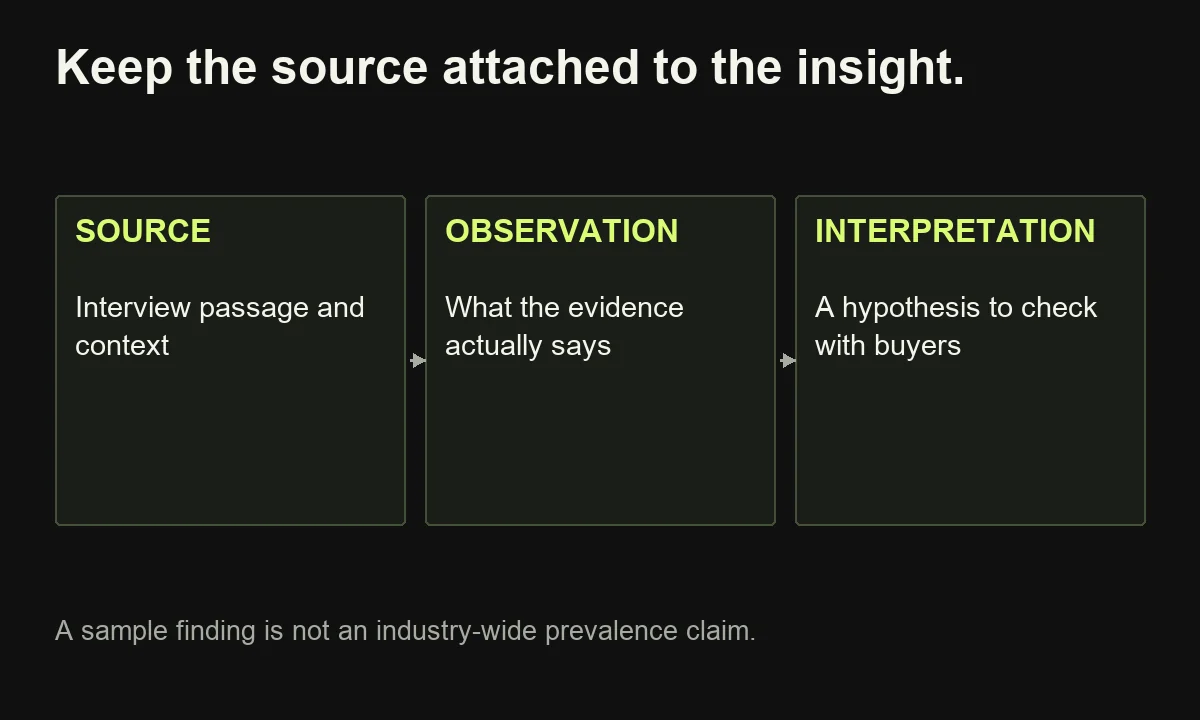
Distinguish how often something appears in your sample from how common it is in the market. Five interviews revealing an approval problem do not establish its prevalence across an industry.
AI can also help compare public competitor messaging. Record the page, access date and actual claim. Ask what questions remain unanswered, rather than asking it to invent a competitor's strategy from a homepage.
Use the findings to shape segmentation and positioning. A marketing manager concerned with production capacity may need a different argument from an operations leader concerned with accountability.
Then connect those questions to the content journey. My guide to TOFU, MOFU and BOFU explains how recognition, evaluation and decision support differ.
The strategic benefit is better visibility into the evidence. AI helps you examine more material; the team decides which insight matters, what remains uncertain, and whether the proposed message deserves testing with actual buyers.
Turn interview notes into an evidence table
Give each permitted interview or source passage an identifier before analysis. Ask AI to return a table with source ID, buyer role, observed problem, desired outcome, proposed theme, and an evidence reference. Require it to distinguish the person's words from its interpretation.
An illustrative record could contain: source I03; role, marketing manager; observation, drafts wait for several reviewers; desired outcome, clearer approval ownership; interpretation, process clarity may matter more than drafting speed. This is synthetic material showing the method, not a customer quote.
Inspect every row supporting an important recommendation. Check whether the summary preserves exceptions, whether two apparently similar complaints have different causes, and whether the evidence supports the proposed theme. Record conflicting observations instead of asking the model to force agreement.
Then translate a supported finding into a testable message:
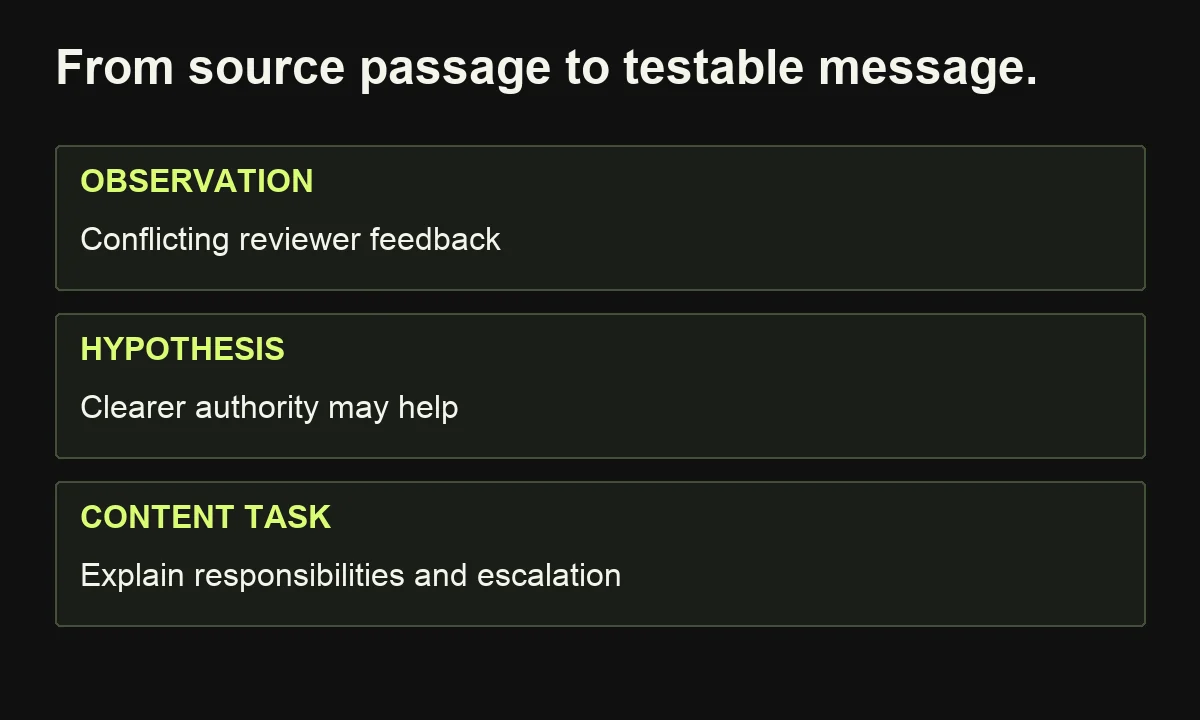
- Evidence: reviewers provide conflicting feedback.
- Buyer question: how should approval authority be assigned?
- Message hypothesis: clearer decision rights may reduce avoidable revision cycles.
- Content task: explain an approval map with responsibilities and escalation rules.
Avoid promoting the hypothesis into a promised result. Test it through further conversations or a small relevant campaign.
Finally, note who is missing from the sample. Interviews with content writers may reveal production friction while saying little about procurement criteria. That gap should change the research plan, not invite AI to invent the absent buyer's opinion.
How do you create content and visuals with AI?
Use generative AI to expand ideas, structure drafts and adapt approved material for different formats. Preserve a clear source of truth for claims and let editors and designers make the final choices. The goal is useful finished content with a distinctive point of view, rather than maximizing the number of generated assets.
Start with an approved argument and evidence pack. Request an outline, identify unsupported sections, and draft in manageable pieces.
Repurposing works best when the original contains substance. A researched report can become a comparison article, presentation, email sequence and social post. Each version needs its own audience, context and next step.
For images, use AI to explore concepts, storyboard a video, or produce suitable illustrations. Use accurate diagrams for processes and real screenshots for actual product behavior. Never present a generated interface or customer photograph as documentary evidence.
Adobe's Firefly FAQ explains commercial-use conditions. Check the relevant feature's terms and any third-party rights before releasing work.
Keep brand colors, typography and image direction consistent. Compress website media, write meaningful alt text and reserve dimensions to avoid layout jumps.
Editors should inspect the argument, factual support and usefulness. Designers should inspect hierarchy and clarity. AI can accelerate exploration while those people retain the standards that make the work recognizably yours.
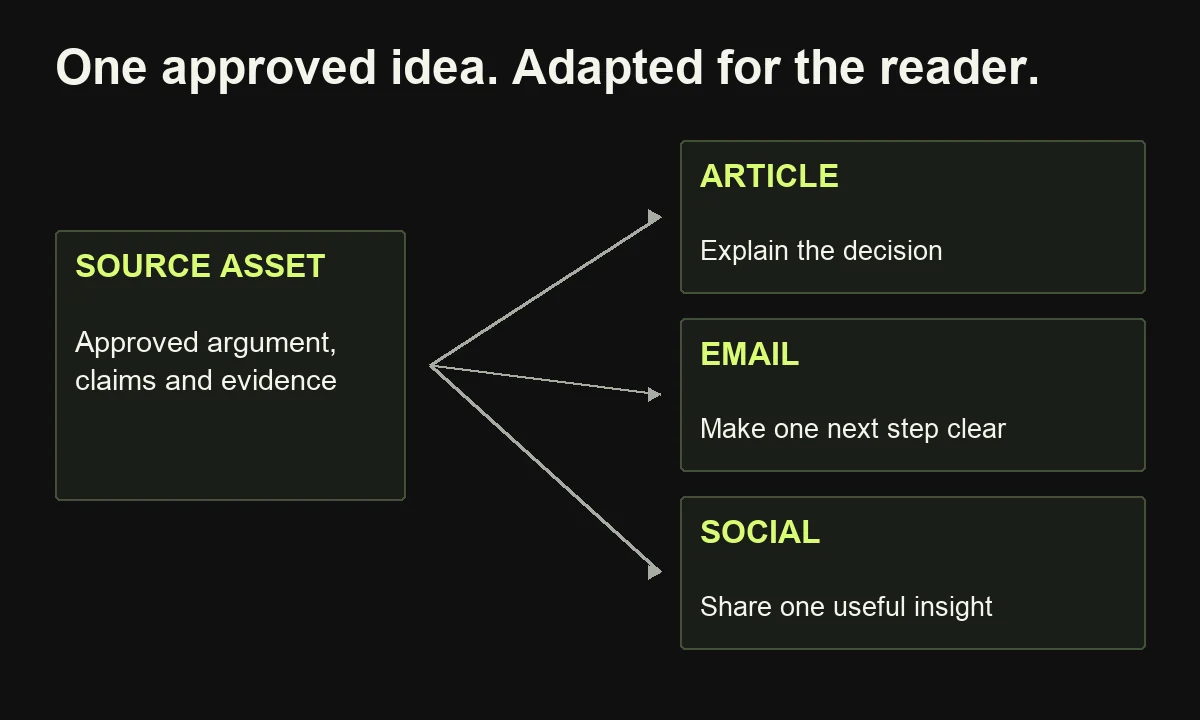
Repurpose the argument, not just the wording
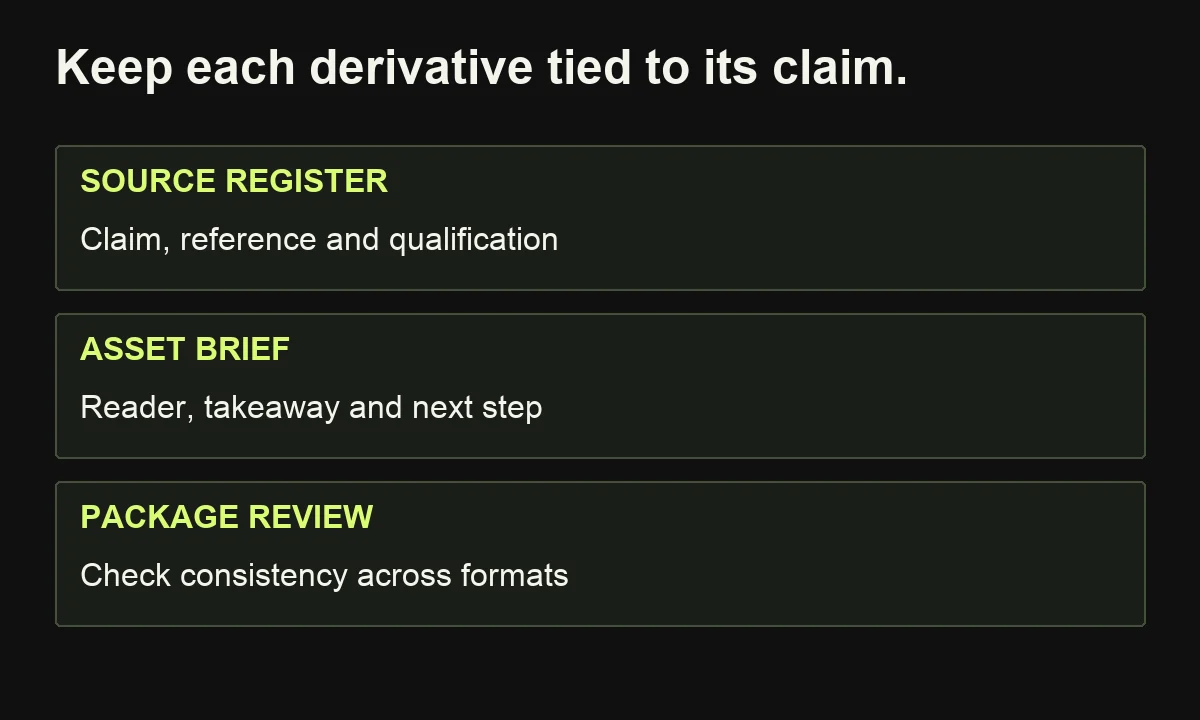
Before turning a webinar into multiple assets, create a claim register. Record the claim, supporting passage or timestamp, qualification, and permitted use. Mark whether the speaker describes an observed outcome, gives an opinion, or proposes a hypothetical example. Preserve those differences in every adaptation.
Suppose a permitted webinar explains why content approvals stall. The main article might compare unclear ownership with limited reviewer capacity. An email could focus on one diagnostic question. A social post could illustrate a single responsibility map. A presentation might help a manager explain the proposed change internally.
Ask AI for a brief for each asset before drafting: intended reader, one useful takeaway, supporting evidence, format constraints and next step. Reject briefs that repeat the same summary across every channel.
For a visual, describe what it must explain. A useful instruction is: show how a draft moves between author, reviewer and final approver, with a distinct return path for revisions. Specify the real responsibilities before requesting stylistic variations.
Review the complete package together. Does an email exaggerate the article's conclusion? Does a diagram imply a guaranteed outcome? Does the social post omit an important condition? Those inconsistencies can survive when each asset is approved separately.
Keep the approved source linked to each derivative. If the underlying claim changes, you can identify which assets need correction instead of rediscovering the whole package later.
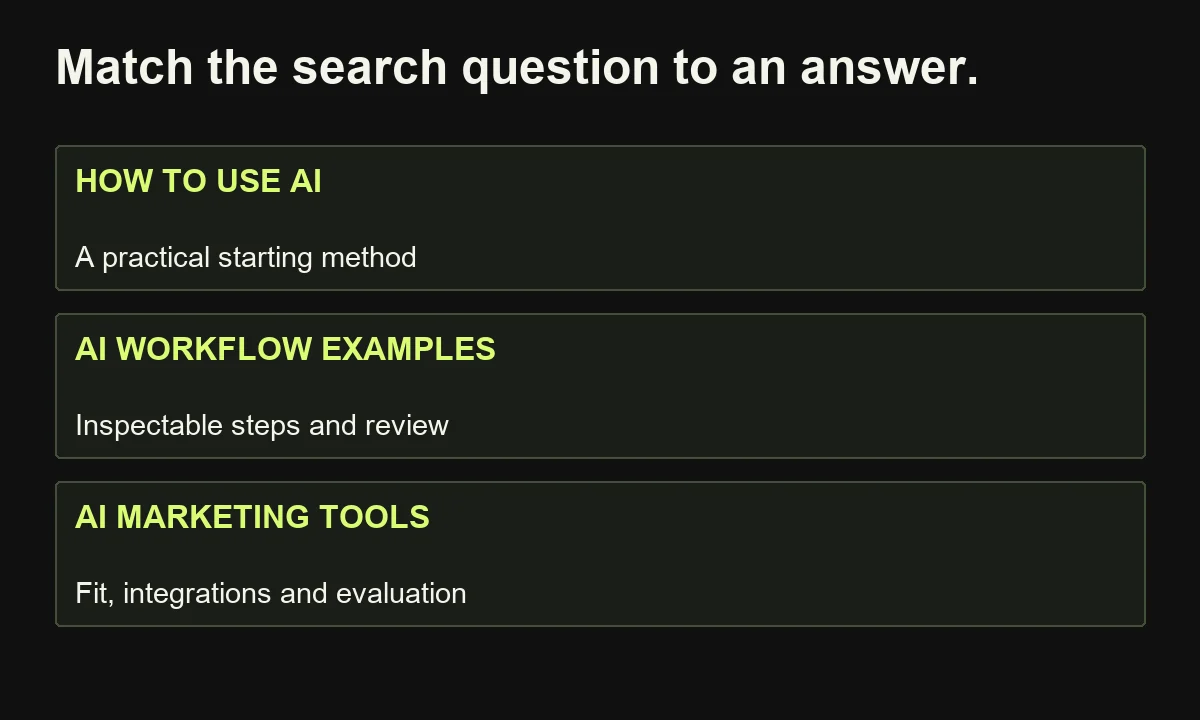
How does AI support SEO, AEO and GEO?
Use AI to analyze reader questions, organize search intent, find content gaps and improve explanations. Keep source verification, technical access and original expertise central. For answer and generative engines, provide clear, useful statements with supporting evidence. Neither AI-written text nor a particular formatting pattern guarantees search rankings or citations.
Start with the question behind the query. A buyer searching “AI marketing automation examples” needs something different from someone comparing workflow platforms.
Ask the assistant to group queries by decision, then inspect current results yourself. Search-volume estimates and keyword difficulty require appropriate data; a model's confident number is not research.
Google's 2026 AI search guidance emphasizes distinctive, useful content and foundational SEO. It treats AEO and GEO as part of improving the search experience, rather than a separate set of guaranteed shortcuts.
Write concise opening answers, explain your method, and keep evidence boundaries visible. Add relevant internal links, accurate article metadata and diagrams that clarify the argument. Structure the page so readers can find answers without losing context.
A deliberate meta description should summarize the answer honestly. It can help communicate the page's promise; it does not force an engine to display that text or recommend the page.
Use the assistant to inspect missing questions and unclear passages. Then add the observations, examples and judgment it cannot obtain from a generic summary. My blog ranking guide covers the wider process.
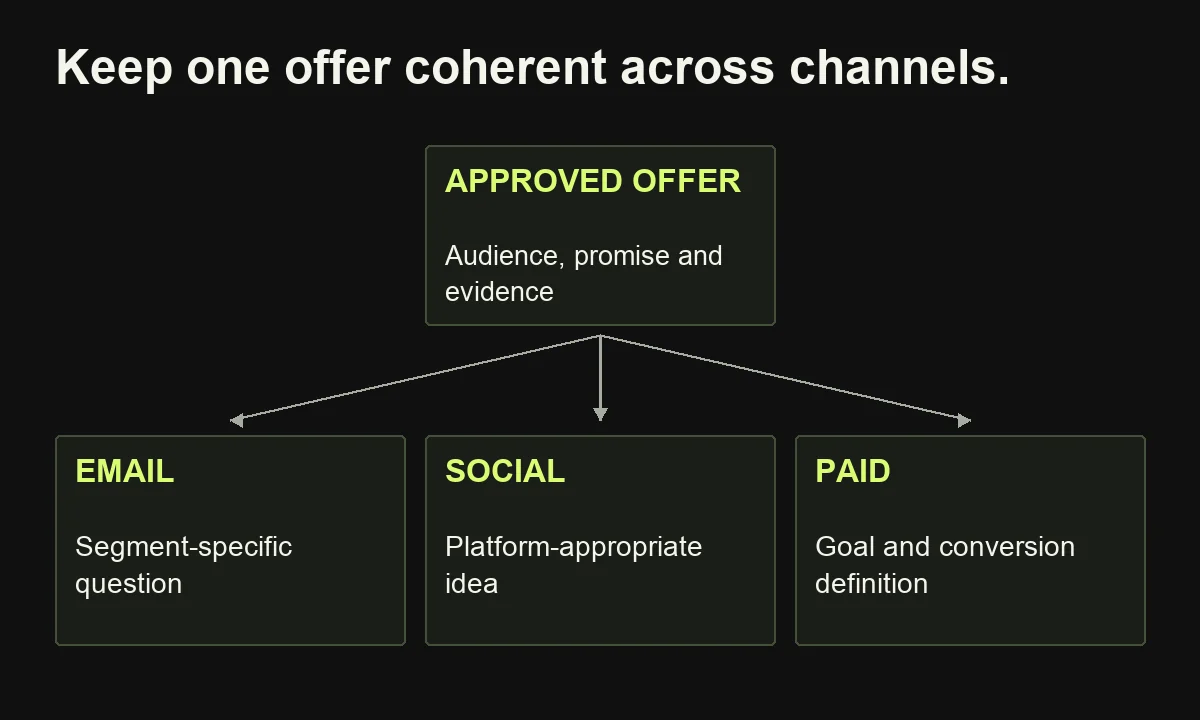
How can AI help email, social media and paid campaigns?
AI can develop campaign variations, adapt messages to relevant segments, and assist with optimization inside advertising platforms. Start with a clear offer, accurate audience information and a measurable goal. Keep the campaign's promise consistent across channels, and judge performance through meaningful outcomes rather than the volume of variations produced.
For email marketing, draft versions for different buyer questions. An existing customer evaluating an upgrade needs different information from someone exploring the category. Personalization should use relevant, permitted information and preserve subscription preferences.
For social media, turn one strong idea into several platform-appropriate treatments. Ask for different openings and examples, then select the version that adds something useful. Scheduling does not replace participation in the conversation.
For paid advertising, distinguish creative assistance from predictive optimization. Google Smart Bidding uses AI to optimize bids for conversions or conversion value at auction time.
The team still sets the offer, budget, conversion definitions and business objective. If measurement treats every enquiry as equally valuable, optimization may reward the wrong outcome.
Test hypotheses, not arbitrary differences. Compare a problem-led message with a method-led message while keeping other conditions reasonably consistent. Document what changed and avoid calling a small result conclusive.
A coherent campaign uses AI to explore possibilities, while marketers decide what deserves investment and whether the response represents useful demand.
Design a campaign test before generating variations
Write a one-page test brief before asking AI for copy. Define the audience, offer, channel, comparison, primary outcome and conditions for interpreting the result. The assistant can help draft the brief, but the marketer should approve the hypothesis and measurement.
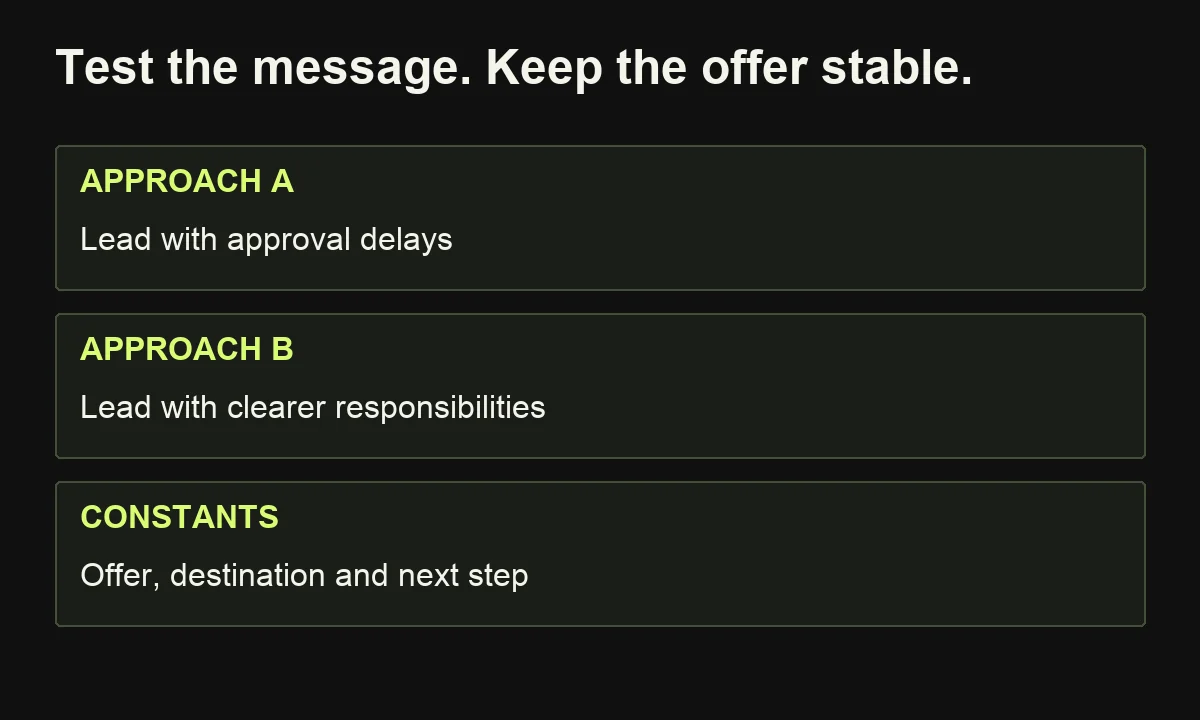
For the hypothetical consultancy, compare two ways of explaining the same audit. Version A leads with approval delays. Version B leads with clearer responsibilities. Keep scope, pricing explanation, destination page and next step consistent so the test is about the message rather than two different offers.
Ask AI for three variants within each approach. Choose one representative version from each, check factual claims, and review how the message continues on the landing page. More variants are useful for exploration; launching all of them may divide a small audience too thinly.
Use a randomized comparison where the channel supports it. A before-and-after comparison can be affected by seasonality, audience changes or other campaigns. Record those differences rather than treating every change as the effect of AI.
Define a qualified enquiry using agreed fit criteria. Inspect enquiry quality alongside clicks and form completions. A higher click rate can coexist with less relevant demand.
Set the review window and decision rule before looking at results. When the sample is too small to distinguish the approaches reliably, record the outcome as inconclusive and use it to refine the next test.
When should you choose dedicated AI marketing tools?
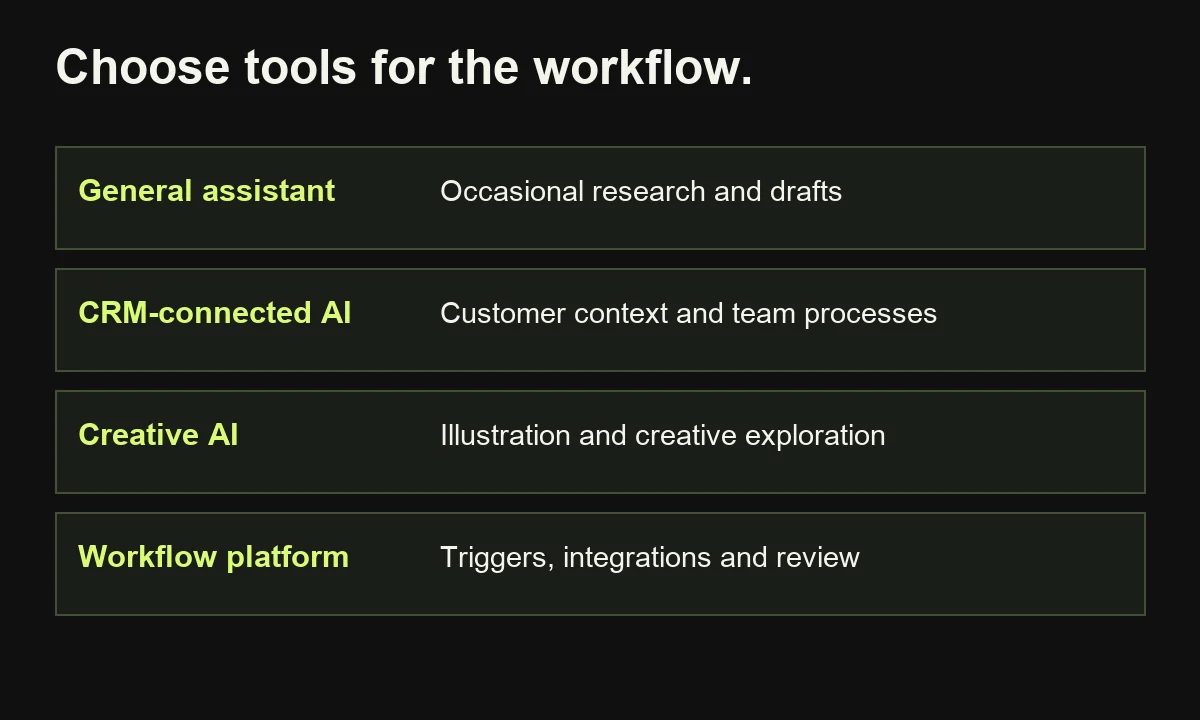
Choose a specialist tool when it improves a recurring workflow beyond what a general assistant provides. Look for relevant context, collaboration, integrations and review controls. Compare the finished process on your own material, including setup and corrections. A persuasive demonstration does not establish that the tool fits your team's actual work.
Consider three different needs:
- Customer context: HubSpot's Agent Hub documents tools for configuring and managing AI agents within its platform.
- Brand consistency: Jasper's Brand Voice applies maintained voice information to supported content workflows.
- Creative production: Firefly provides generative creative capabilities, with feature-specific usage conditions.
These examples illustrate categories, not a tested ranking of vendors. Features and plan access change; inspect current documentation before purchasing.
Build a comparison around one real assignment. Give each candidate the same approved brief, source material and quality criteria. Record the time to an acceptable result, missing capabilities, reviewer effort and export quality.
Check integration fit too. An assistant inside your CRM may reduce copying between systems. A separate content tool may help editors but introduce another place to maintain product facts.
Calculate the full cost: subscription, model usage, implementation, review and maintenance. Start with the smallest setup that supports the job. Add another tool only when it solves a demonstrated constraint, rather than because its feature list is longer.
Run a tool trial using an acceptance checklist
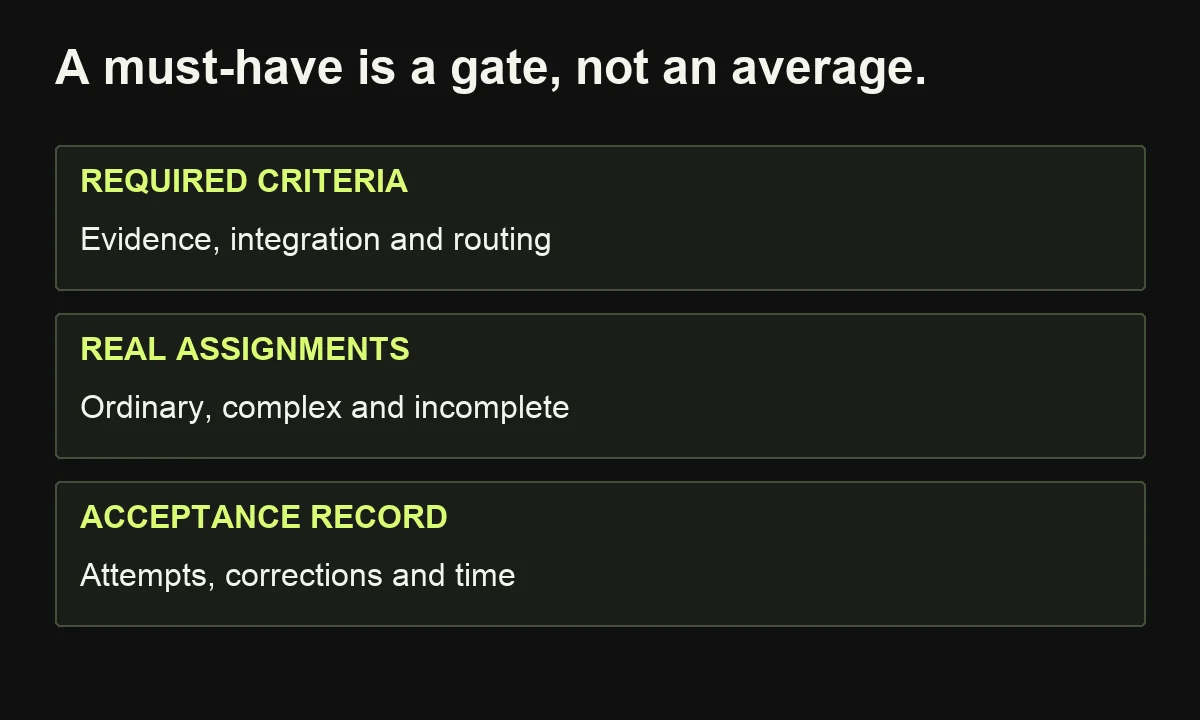
Prepare a small representative test set before comparing vendors. Include an ordinary assignment, a complex assignment and an incomplete brief. Use the same approved material and output requirements so you can assess how each setup behaves, not just how polished its best demonstration looks.
For a content assistant, require accurate offer facts, traceable evidence, suitable voice and a useful next step. For a research assistant, require inspectable sources and a distinction between findings and assumptions. For an automation platform, require correct routing, review status, error visibility and an exportable record.
Classify each criterion as a must-have or a preference. A missing required integration can outweigh attractive writing. A polished draft with unsupported claims fails the evidence criterion. Avoid hiding a failed must-have inside an average score.
Record the number of attempts, corrections and minutes to an acceptable result. Have the people who will actually use and review the work participate; an expert operator's successful trial may not represent everyday team use.
Also test maintenance: change one approved product fact and see where it must be updated. Check whether permissions separate writers, reviewers and administrators. Inspect what happens when a connected account becomes unavailable.
At the end, choose the smallest setup that passes required criteria and improves the workflow. Record unresolved gaps and an owner for each. A purchase decision should explain why the tool fits this job, not declare it universally best.
What is the difference between AI automation and an AI agent?
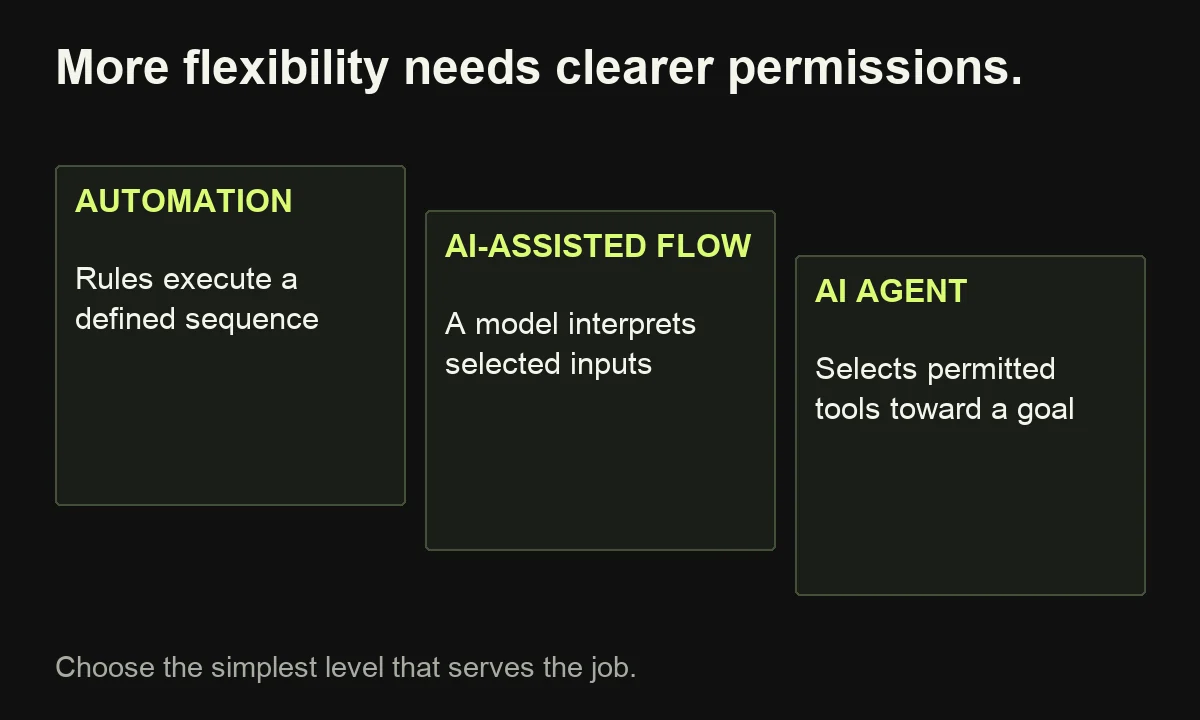
An AI automation follows a workflow you define, using AI for selected steps. An AI agent can choose which permitted tools or actions to use toward a goal. Both can help marketers, but greater flexibility requires clearer boundaries. Begin with a predictable workflow when the task and sequence are already understood.
A conventional automation might copy a form submission into a lead sheet. An AI-assisted version could classify the enquiry and prepare a summary. An agent might decide which approved knowledge source to consult before drafting a response.
Use deterministic rules for exact operations such as checking required fields, identifying duplicate submissions and enforcing approval status. Use AI where interpretation is useful, such as grouping objections or summarizing a brief.
n8n and Zapier connect systems; they do not replace the need to design the process. A workflow needs an input, a trigger, decision rules, destinations, error handling and an owner.
n8n documents human review before agent tool calls. Zapier's Human in the Loop step can collect review input within a Zap.
For marketing, a useful boundary is allowing systems to prepare work while requiring approval for chosen public or commercial actions. Specify those actions explicitly. Avoid treating “the model sounds confident” as an approval rule.
What does a practical AI marketing workflow look like?
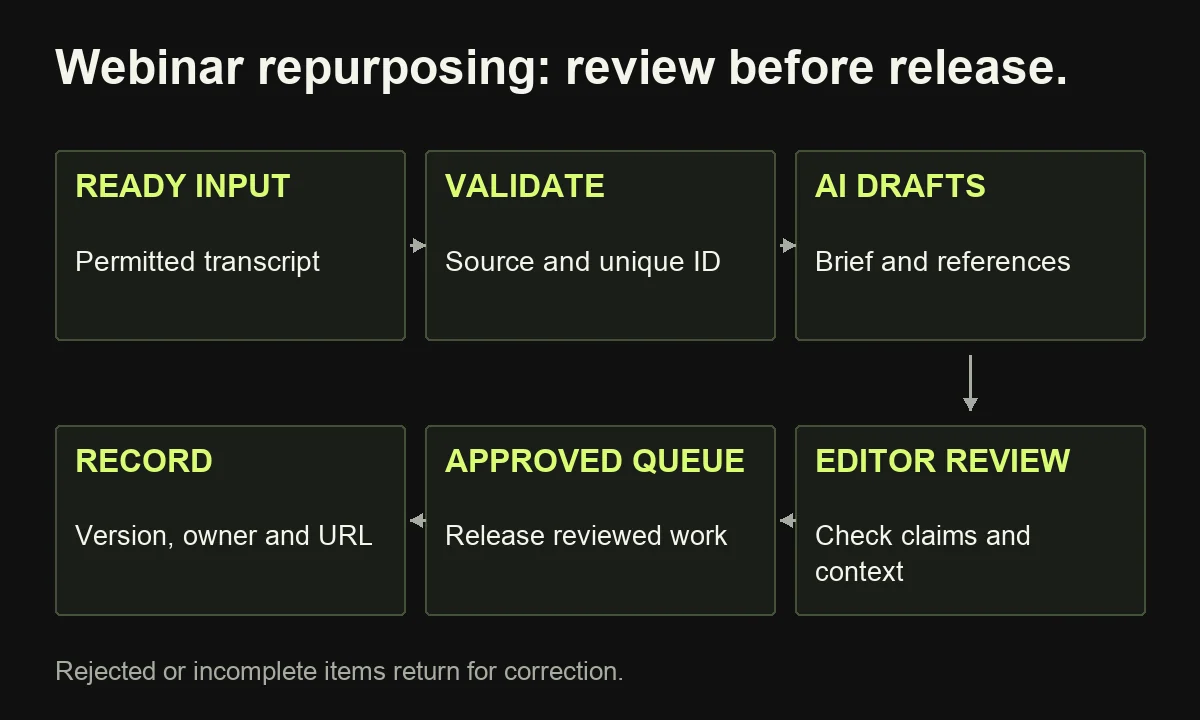
A useful workflow turns approved inputs into a reviewed output, with visible status at each step. For example, a webinar repurposing system can prepare an article outline, email draft and social variations from a transcript. An editor checks claims and context before approved assets move into the publishing queue.
Here is an illustrative n8n or Zapier design:
- Trigger: a team member marks a permitted transcript ready.
- Validate: confirm required fields, source access and processing status.
- Prepare: attach the approved offer, audience brief and voice examples.
- Generate: request structured drafts with source references and unresolved questions.
- Review: an editor checks meaning, evidence, originality and destination links.
- Release: approved versions enter the appropriate queue; rejected versions return for revision.
- Record: save the version, reviewer, status and resulting publication URL.
Store and check a unique input identifier before creating outputs so retries skip already processed items. If a required source is missing, stop that item and notify its owner. Keep failed items separate from approved work.
Test with an incomplete transcript, repeated input and a draft containing an unsupported claim.
This is a design example, not a deployed integration or an advertised performance result. Start by preparing drafts only. Automate further steps once the team has checked the workflow's behavior and understands how to pause or correct it.
Configure the n8n version with explicit data and status
Start with a sheet or database containing one record per permitted transcript. Useful fields include input ID, source location, source version, audience, offer reference, status, reviewer and approved version. Begin with manual activation while testing; add a scheduled trigger once the behavior is understood.
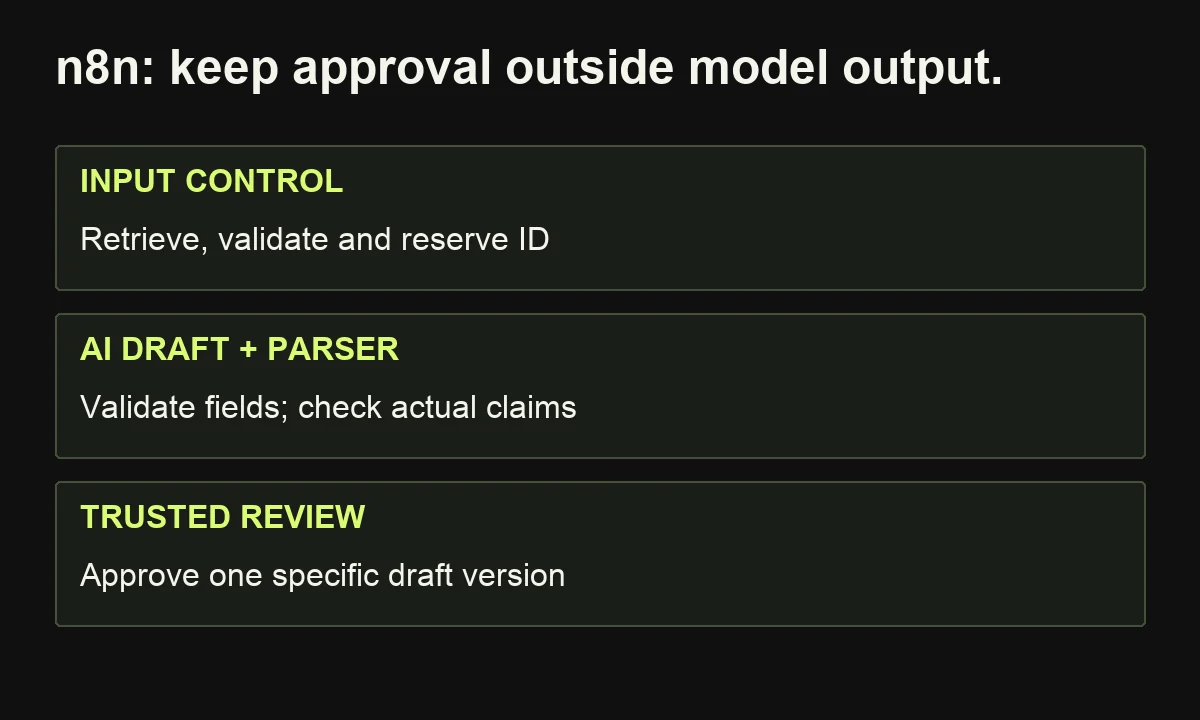
In n8n, connect the trigger to source retrieval, field validation and a stored-ID check. Reserve the input in one indivisible operation before generation so two runs cannot claim it simultaneously. When runs can overlap, use storage that supports that reservation; separate checking and writing can let both runs start.
Use an AI step for drafting, then validate its output structure. n8n's Structured Output Parser supports a JSON Schema describing expected fields and data types. A schema checks structure; it does not establish that the content is true.
Request fields such as article outline, email draft, social variants, source references and unresolved questions. Route empty required fields, invalid responses and missing sources to correction.
Create approval status through a trusted reviewer action. Never let model-generated text authorize its own publication. Keep the reviewed version separate from a regenerated draft.
Release only the specific version approved, then save destination URLs and completion status. If publication times out, check the destination before retrying; a missing acknowledgement does not necessarily mean nothing was published. Keep a visible pause control and a named workflow owner.
Build the Zapier alternative around the same contract
In Zapier, use a ready record as the trigger, retrieve its approved references, and apply a Filter so incomplete or previously completed records stop. Choose the AI action appropriate to your account, then map its results into draft fields rather than directly into a publishing action.
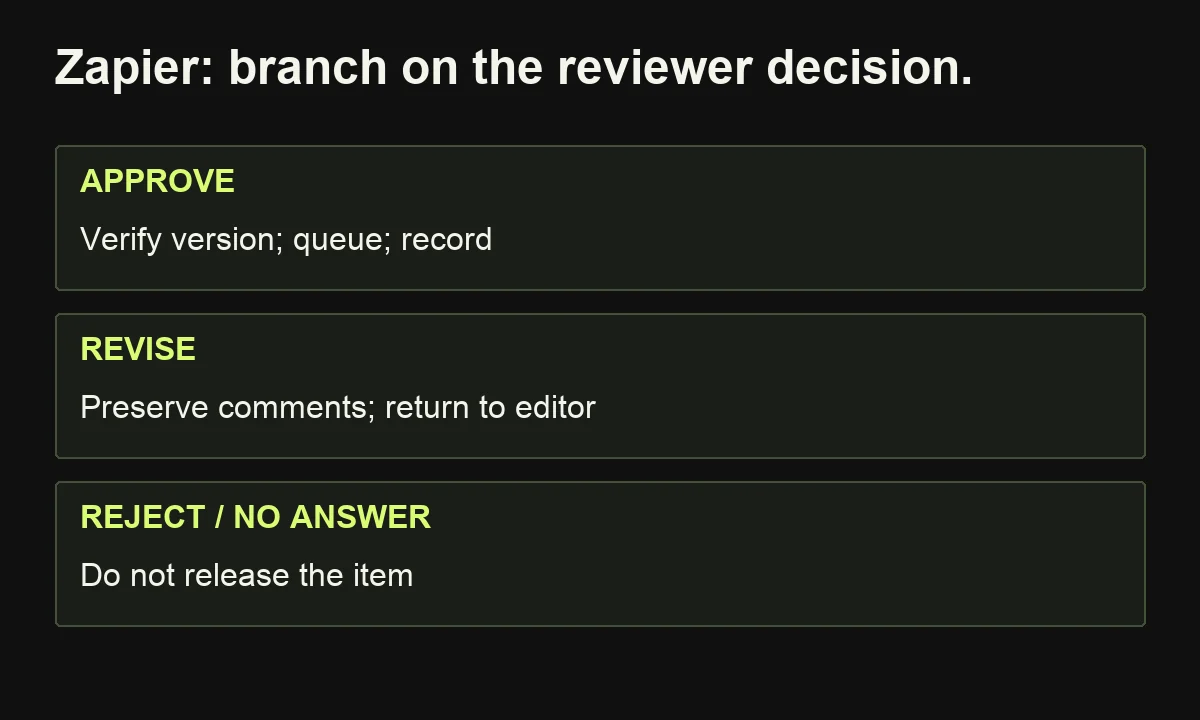
Use a Human in the Loop step to request the reviewer's decision and comments. Map the returned decision into a subsequent Filter or Paths branch. Merely adding a review form does not make every downstream action conditional on approval; you must specify that condition.
An approved path should verify the draft version, create the intended queue item, and record the result. A revision path should preserve comments and return the item to editing. A rejection or unanswered review should not be interpreted as permission to release.
Keep the input ID attached to each step. If the workflow retries, check stored completion records before creating another output. If the destination supports a unique request key, reuse it on retries so the same request is recognized. Otherwise, check for duplicates and reconcile the stored record with the destination.
Test four scenarios before activation: missing reference, repeated input, rejected draft and successful publication followed by a failed acknowledgement. Inspect both the automation history and the destination.
n8n and Zapier differ in implementation and plan features. This walkthrough describes a design contract, not an importable workflow. Confirm available actions, reviewer access and execution limits in your actual account.
How do you measure the value of AI in marketing?
Measure AI-assisted work through time to an acceptable output, quality, total cost and relevant business outcomes. Compare equivalent assignments and include human review. Track productivity separately from campaign performance: producing an asset faster does not establish that it generated more demand, improved conversion, or caused a sale.
Define acceptance: supported facts, suitable voice, complete brief, working links and approvals. Record rejected outputs and corrections. Compare active working time or elapsed time consistently; do not mix them.
Use this basic operational calculation:
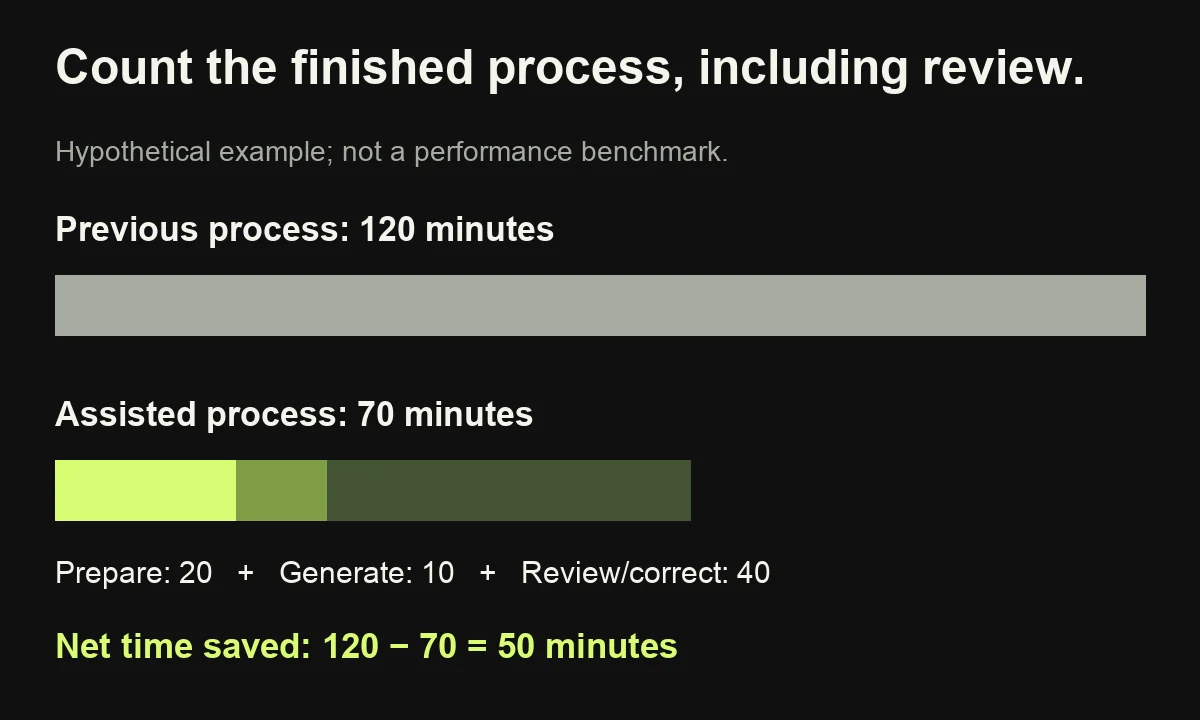
Net time saved = previous end-to-end time minus AI preparation, generation, review and correction time.
Suppose a hypothetical task previously took 120 minutes. The assisted process takes 20 minutes of preparation, 10 minutes of generation and 40 minutes of review and correction. Net time saved is 50 minutes. That example illustrates the calculation; it is not a client benchmark.
For costs, include tool fees, usage, setup and maintenance alongside staff time. Spread setup costs over a stated period and realistic task volume, not an assumed unlimited scale.
For campaign analysis, give AI a cleaned, permitted export with metric definitions and date ranges. Ask it to show calculations, distinguish observations from hypotheses, and flag missing data. Reconcile totals with the source. For business outcomes, examine qualified enquiries, opportunity progress or a designed experiment; record what changed.
Add a learning measure: which corrections recur? If the same product fact needs fixing repeatedly, improve the source material or workflow.
Separate capacity gains from a financial return
A useful cost review starts with actual records. Log active staff minutes, tool usage and corrections for equivalent tasks. If you also report elapsed turnaround time, keep it in a separate column. Parallel work can improve turnaround without reducing staff effort by the same amount.
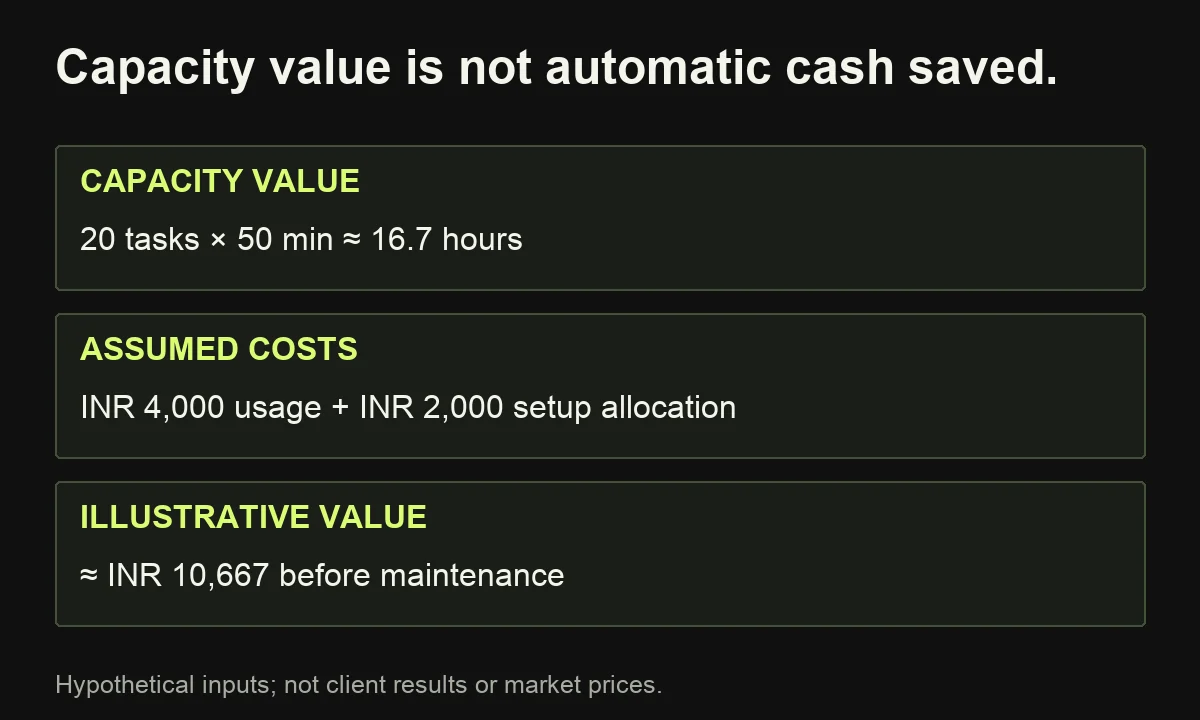
Here is a hypothetical calculation. A team performs twenty equivalent tasks each month. Each previously required 120 active staff minutes; the assisted process requires 70. That frees 1,000 minutes, or about 16.7 hours, monthly. At an assumed internal cost of ₹1,000 per hour, the capacity value is roughly ₹16,667.
Suppose incremental software and model usage cost ₹4,000 monthly, while a ₹12,000 setup cost is allocated across six months. The illustrative monthly value after those costs is about ₹10,667, before ongoing maintenance or other costs. These numbers are invented assumptions for explaining arithmetic, not a market price or client result.
Freed capacity is not automatically cash saved. If salaries remain unchanged, describe how the time is used: more customer research, faster delivery, improved review, or additional accepted work. Count financial savings only when expenditure actually changes.
For campaign outcomes, retain the qualification rule, audience, timeframe and comparison. Treat a revenue claim as a separate evidence question. A faster drafting process does not by itself prove that the resulting campaign caused more sales.
How do you roll out AI responsibly without slowing everything down?
Give the team a maintained knowledge base, clear permissions and a manageable pilot. Decide which information can enter each tool, who checks the work, and how errors are corrected. These practices make AI easier to use consistently: people can experiment within understood boundaries instead of negotiating every assignment from scratch.
Build a reference pack containing current product facts, approved claims, voice examples, relevant research and important exclusions. Assign an owner and review date. Retrieval-augmented generation means retrieving relevant reference information to help ground a response; it still needs evaluation.
Check data retention, training settings, access controls and contractual terms for the specific workspace. Remove unnecessary personal details. Use synthetic or anonymized material for early workflow tests, and follow your organization's privacy obligations.
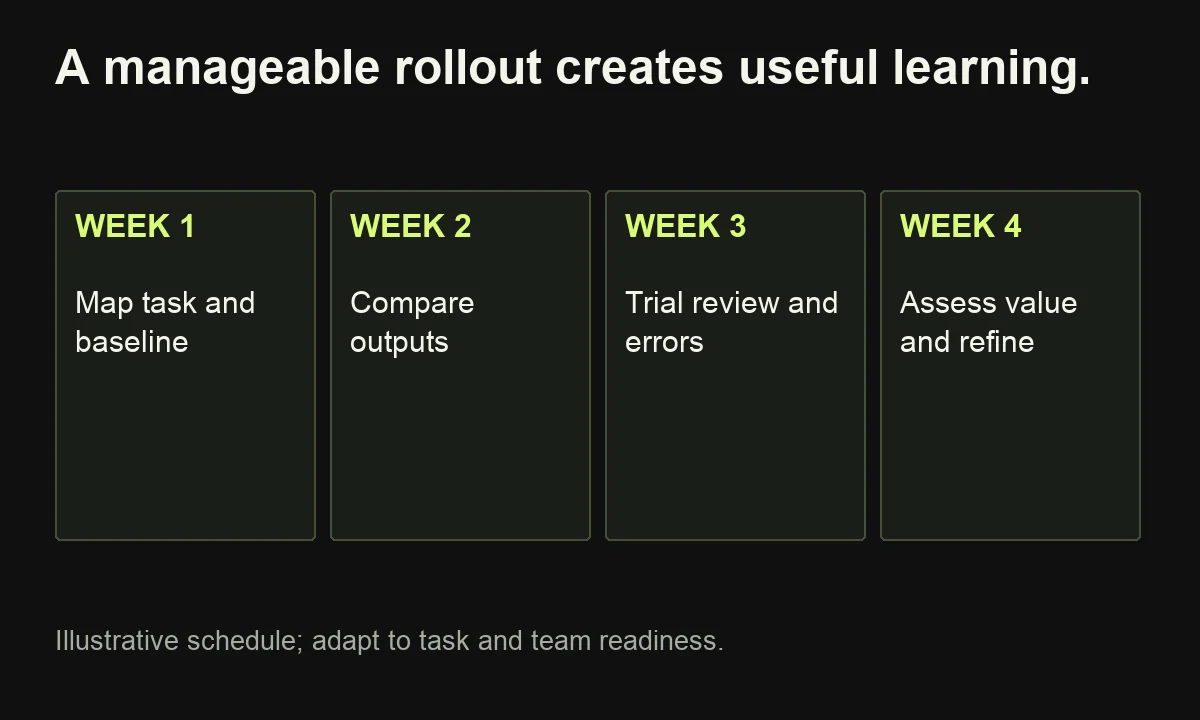
A practical four-week rollout could look like this:
- Week one: map the task, gather inputs and establish a baseline.
- Week two: compare assistant outputs on a small representative sample.
- Week three: trial the workflow with explicit review and error handling.
- Week four: assess quality, time, cost and the next improvement.
The schedule is a planning example, not a promised implementation duration.
For broader content operations, my automation consultant hiring guide explains what to ask about scope, review and pilots. Hire for workflow judgment and maintainability as well as tool familiarity.
Frequently asked questions about using AI in marketing
Can a small business start without a large budget?
Yes. Start with one permitted task and tools you already have. Trial available entry-level features before buying additional subscriptions. Account for review time and usage limits; “free to try” does not mean a complete production workflow has no cost. Expand when the pilot demonstrates useful value.
Can AI replace a marketing strategist?
AI can assist research, comparisons, drafts and analysis. A strategist remains responsible for choosing a commercially relevant problem, interpreting evidence and deciding what the brand should say or do. Design the work so AI increases that person's capacity to make and execute good decisions.
Which AI marketing tool is best?
The best fit depends on the task, inputs, integrations, review requirements and budget. Compare candidates using the same real assignment. Choose the setup that produces acceptable work reliably and fits your process; there is no universal winner across research, creative production, campaigns and automation.
Can AI help with website enquiries?
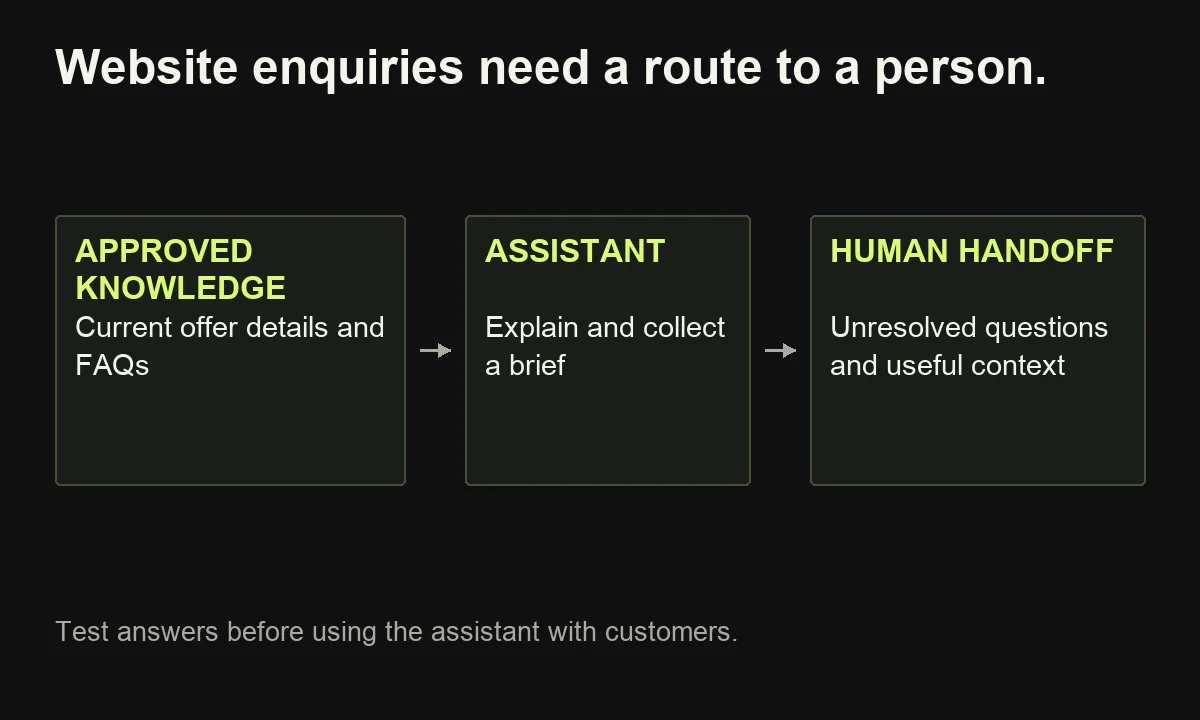
Yes. An assistant grounded in approved FAQs can explain offers, collect a brief and route enquiries. Give visitors a clear route to a person. Restrict promises to documented information, and test answers before using it with customers.
Start with a job worth improving. Tell me where your marketing work gets stuck, and we can identify a useful pilot, the evidence it needs, and how to judge the result.