To rank a blog in 2026, choose a query your business can credibly answer, satisfy the reader's intent, contribute something worth referencing, and make the page accessible to search engines. Then build relevant connections and use search data to diagnose the next constraint. Publishing a longer article is not a substitute for those decisions.
A blog can be indexed and still be invisible. It can rank and attract the wrong readers. It can appear in an AI answer without earning a visit. It can receive visits without generating useful enquiries.
These are different problems. Treating them all as “we need more SEO” creates expensive, unfocused work.
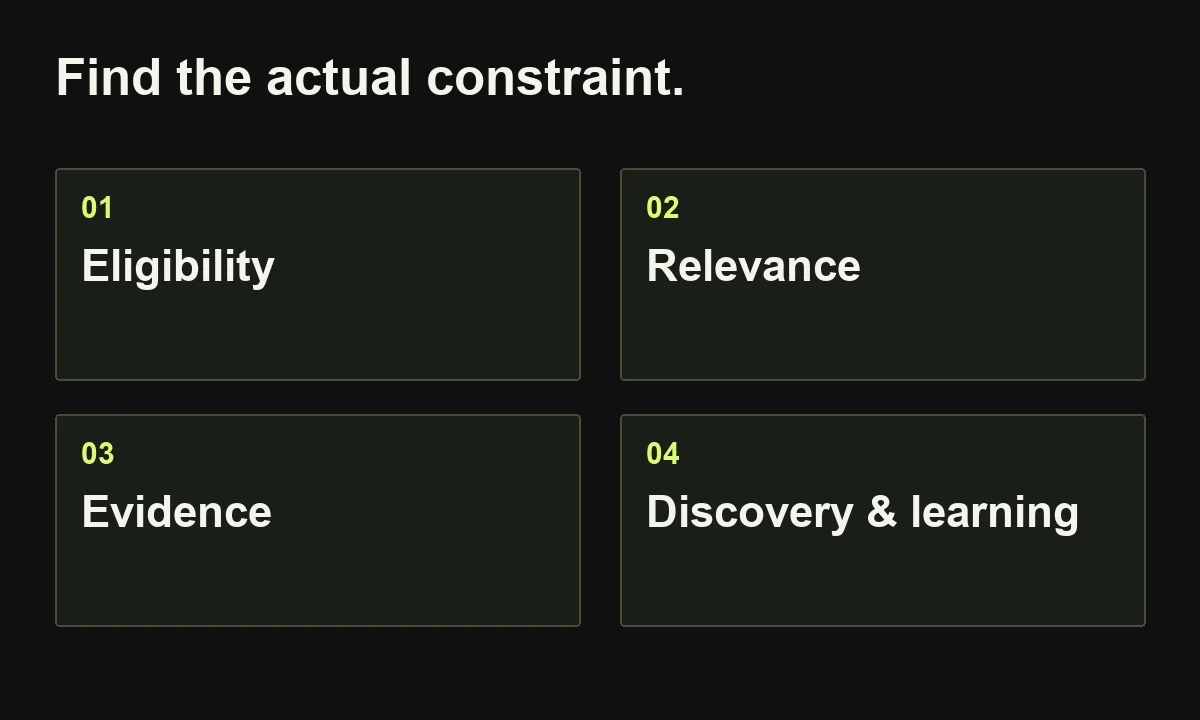
My approach is to separate eligibility, relevance, evidence, discovery, and learning. Those five gates provide a practical way to decide what deserves attention before commissioning another article or buying another tool.
This guide is written for B2B marketing teams, founders, and specialist service businesses. It covers the editorial and technical work behind an individual blog post, with examples you can adapt to an existing content library. Large migrations, multilingual implementations, and regulated advice need additional specialist review.
The framework and worksheets are original planning tools developed for this article, not measured ranking factors. The examples are illustrative. Search guidance was checked on 12 October 2026; sources are linked beside the relevant claims. AI assisted research and drafting, with source checks, editorial revision, and website verification before publication.
1. What does “ranking a blog” actually mean?
Ranking means a page appears in search results for a particular query, market, device, and moment. It is not one permanent position that everyone sees. Define the queries and audience you want before measuring success, and distinguish search visibility from visits, citations, and commercially useful actions on your website.
For a B2B content consultancy, ten visits from marketing leaders evaluating a content audit may be more useful than a thousand visits from people looking for a dictionary definition. That is a strategic preference, not a prediction about conversion rates.
Write a brief with four decisions:
- Reader: Who has the problem, and what responsibility do they hold?
- Task: What should they understand, compare, or do after reading?
- Discovery: Which query family could bring that person here?
- Business connection: Which relevant next step can the website support?
For example: “A SaaS marketing manager needs to understand why existing articles receive impressions but few relevant clicks, and decide whether to revise the content brief or commission an audit.”
That brief is more useful than “rank for content marketing.” It identifies a reader, a symptom, and a decision.
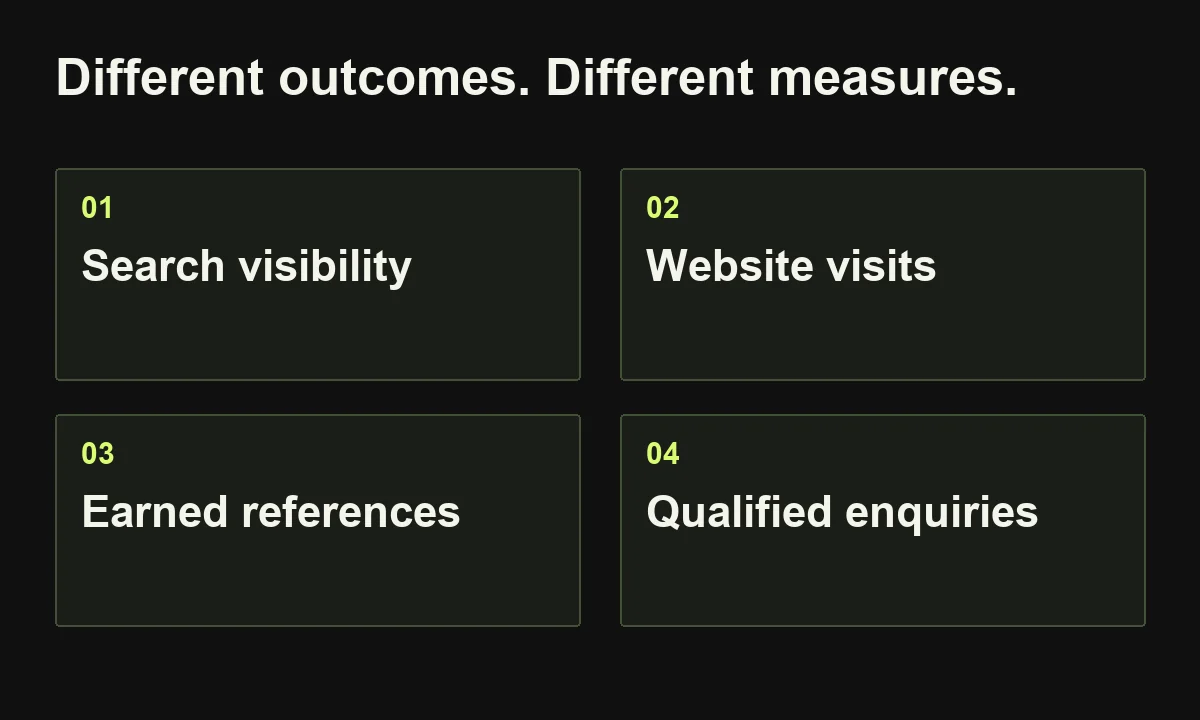
Choose separate measures for search impressions, organic visits, earned references, and qualified enquiries. Do not combine them into an invented visibility score. A rise in one can coexist with a fall in another, and your response should depend on which objective matters.
2. Choose keywords by opportunity, not volume alone
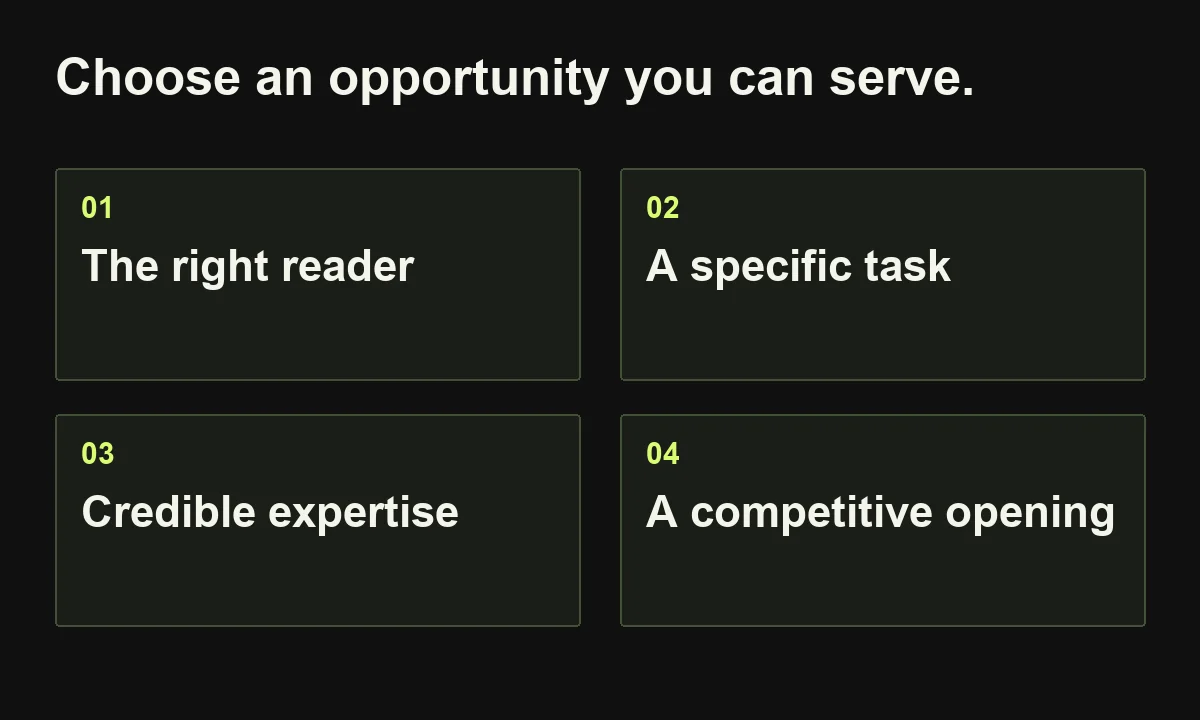
A useful blog keyword sits at the intersection of audience relevance, answerable intent, credible expertise, and a realistic competitive opening. Search volume helps estimate demand; it does not establish whether your business can earn attention or benefit from it. Begin with customer language, then validate it against actual search results.
Gather questions from sales conversations, support requests, proposal objections, and existing Search Console queries. Remove personal information before using these materials in public research or AI tools.
Group phrases by the task behind them. “Content audit checklist,” “content audit deliverables,” and “content audit consultant” may describe related needs, but not the same page promise.
Inspect the current results for your intended country and language. Record the date and device. Note whether readers are being served guides, service pages, videos, product comparisons, or discussions. Examine relevant results rather than copying their headings.
A keyword tool's difficulty number is a vendor estimate. Use it as a screening input, alongside the strength and specificity of competing pages. It cannot tell you the article's probability of ranking.
For a smaller specialist site, a narrow question with a clear commercial context is often a sensible starting point: “what should a B2B content strategy audit include?” is a more focused brief than “marketing.”
For this guide, the primary query is how to rank a blog in 2026. It is a broad, competitive topic chosen for its strategic relevance; no verified low-difficulty or search-volume claim is being made.
3. Find the evidence gap in the search results
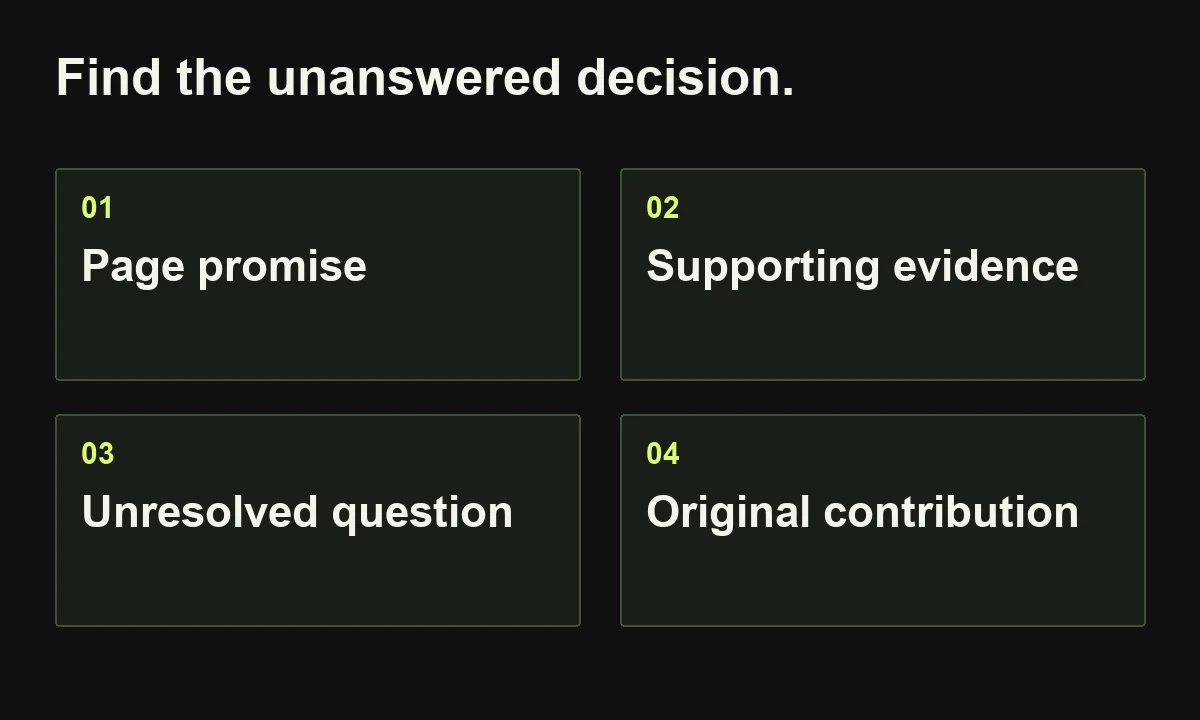
Search intent tells you what the reader wants. An evidence gap tells you what competing answers leave unresolved. Look for missing examples, untested assumptions, outdated instructions, and decisions that existing articles describe without helping the reader make. A useful gap must matter to the audience, rather than merely make your outline different.
Create a small result-review table:
| Question | What to record |
|---|---|
| What is the page promising? | The reader, task, and format. |
| What supports its advice? | Documentation, original research, examples, or assertion. |
| What remains unclear? | A decision the reader still cannot make. |
| What has changed? | Dates, interfaces, policies, and unavailable features. |
| What can we contribute? | Evidence or analysis we can actually produce. |
Suppose several articles recommend improving click-through rate. An actionable gap might be explaining when a weak CTR reflects poor positioning, when it reflects the query mix, and when it reflects the search interface. Adding another headline checklist does not resolve that distinction.
Test your proposed angle with this sentence: “The reader can now decide ___ because we show ___.” If the second blank contains only “more tips,” sharpen the research.
This is also the stage to reject a topic. If you lack the necessary evidence or cannot improve the answer, narrow the scope, interview a relevant practitioner, or update an existing page instead. Originality starts with the research decision, not a clever introduction.
4. Give other writers a reason to cite you
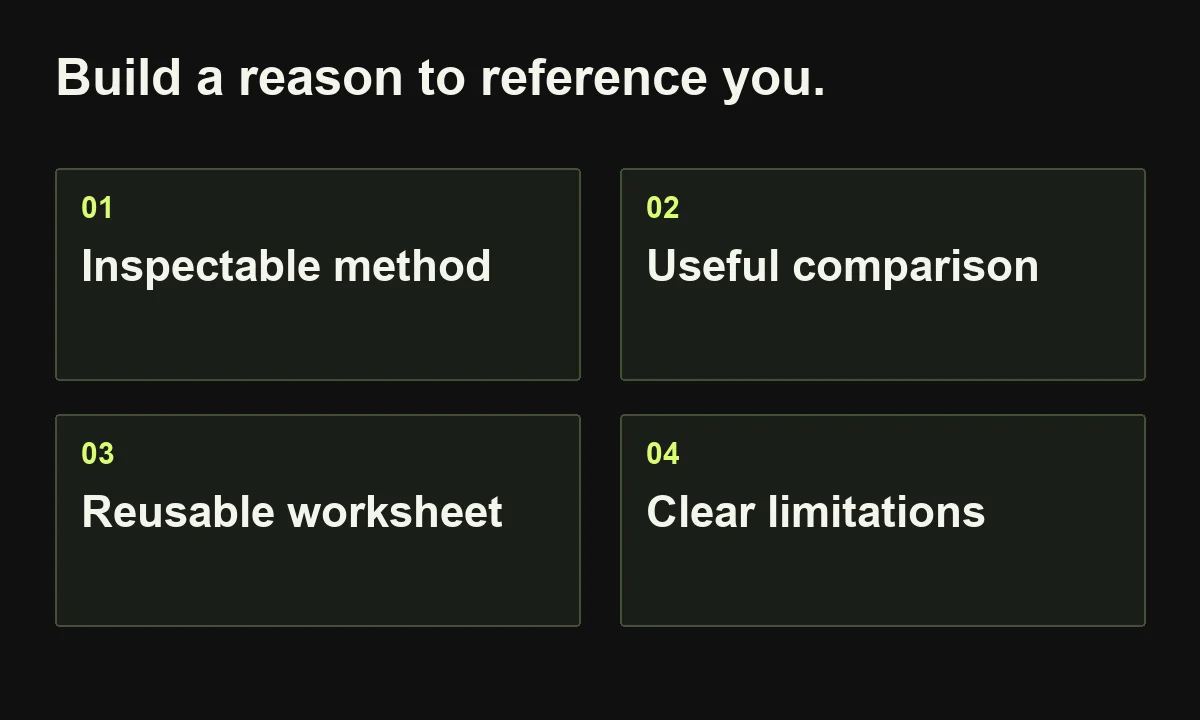
A page earns a plausible reason to be referenced when it supplies something another writer needs: inspectable evidence, a useful definition, a comparison with stated criteria, or a practical tool. Familiar advice can help, but length alone gives an editor little reason to link.
Design one reference asset before drafting. Possible assets include an original dataset with a documented method, an interview synthesis with consent and attribution, a reusable worksheet, or a worked example that exposes the reasoning behind a recommendation.
If you publish research, record the sample, collection period, exclusions, definitions, and limitations. Do not turn five customer conversations into a claim about every B2B buyer. If you publish a framework, call it a framework; do not disguise editorial judgment as research findings.
The reference asset in this guide is the five-gate blog diagnostic. It separates problems that are commonly bundled together and connects each to an observable check. You can download the blog ranking diagnostic worksheet, adapt it, and use it in your own content review.
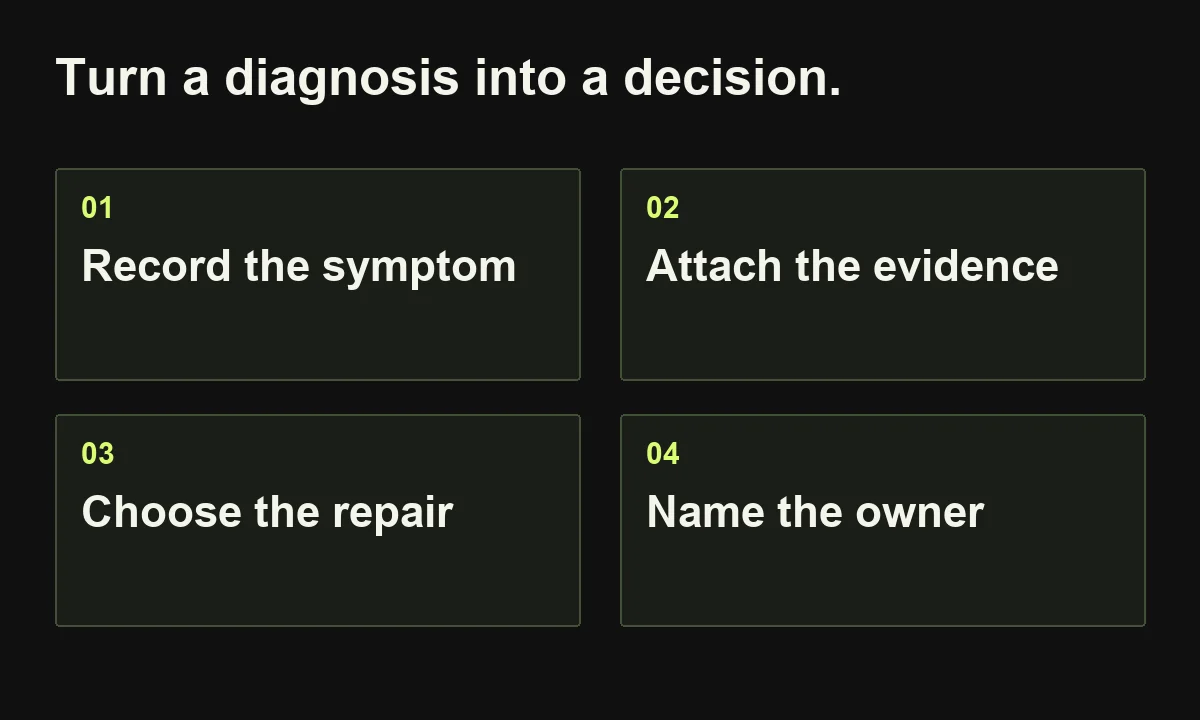
The worksheet does not calculate a ranking score. Its purpose is to make decisions reviewable: name the symptom, record the evidence, choose the next action, and assign an owner.
Make citation easy with a stable URL, clear author attribution, descriptive section headings, and source links. Give readers useful material before asking them to become leads. Accessibility is part of usefulness, not an optional layer added after publication.
5. Use the five gates to prioritize the work
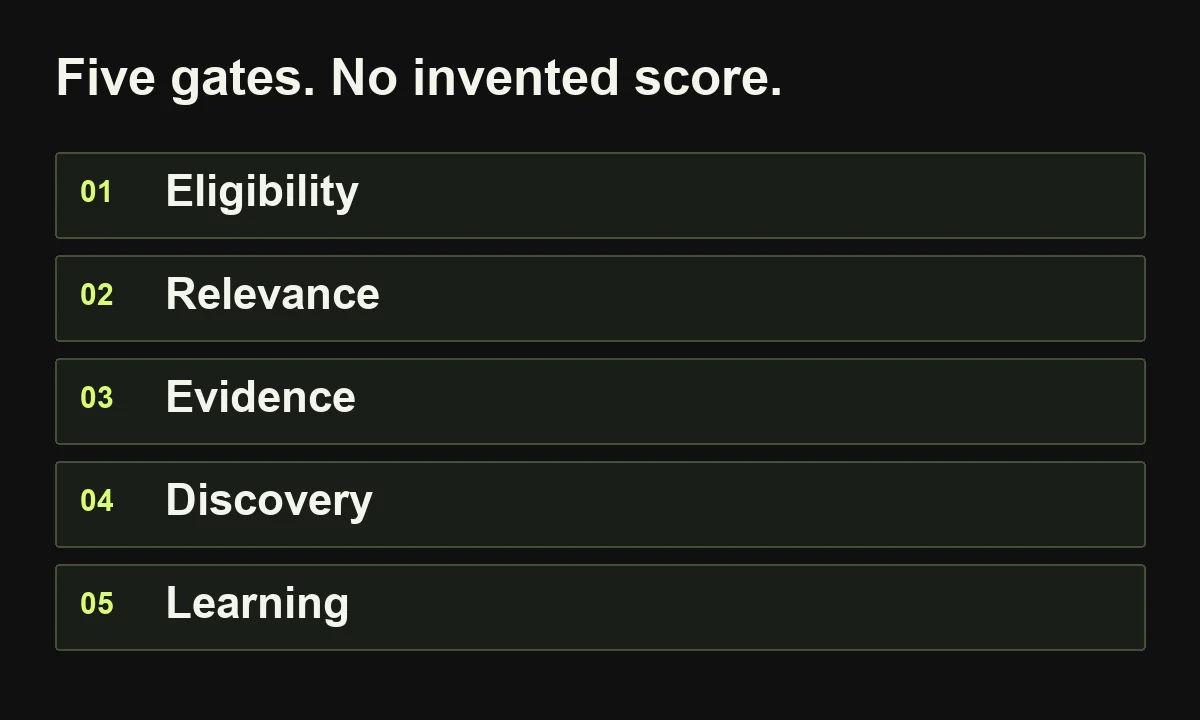
The five gates are an editorial diagnostic: eligibility, relevance, evidence, discovery, and learning. Start with the earliest unresolved gate and record what would establish that it is working. Passing a gate does not guarantee rankings; it removes an identifiable uncertainty so the next decision can be made with better information.
| Gate | Practical question | Observable check |
|---|---|---|
| Eligibility | Can search access and index this page? | Status, directives, rendered content, indexing report. |
| Relevance | Does it answer the intended searcher's task? | Result review and a reader-based brief. |
| Evidence | Is its contribution credible and inspectable? | Sources, method, examples, and limitations. |
| Discovery | Can people and search find useful routes to it? | Internal links, distribution, earned references. |
| Learning | Can the team tell what to improve next? | Query data, outcomes, revision log, named owner. |
Consider two imaginary pages. Page A is useful but has an accidental noindex. Page B is accessible but offers generic advice for a highly specific question. They need different interventions.
Buying links for Page A ignores an eligibility problem. Repeatedly requesting indexing for Page B ignores an editorial one.
For each gate, use confirmed, unresolved, or needs repair, and attach the evidence. Avoid assigning arbitrary weights or averaging the labels into a score. A spreadsheet showing “86% optimized” can conceal the single issue that matters most.
This framework extends the approach in my guide to successful B2B content principles: useful answers need credible support and a clear next decision.
6. Build the article around decisions, not keywords
Structure a blog so readers can locate an answer, understand its reasoning, and apply it under the right conditions. Give each major section one question or task. Open with a direct answer, then add evidence, examples, trade-offs, and the next action. Keywords should describe the material rather than interrupt it.
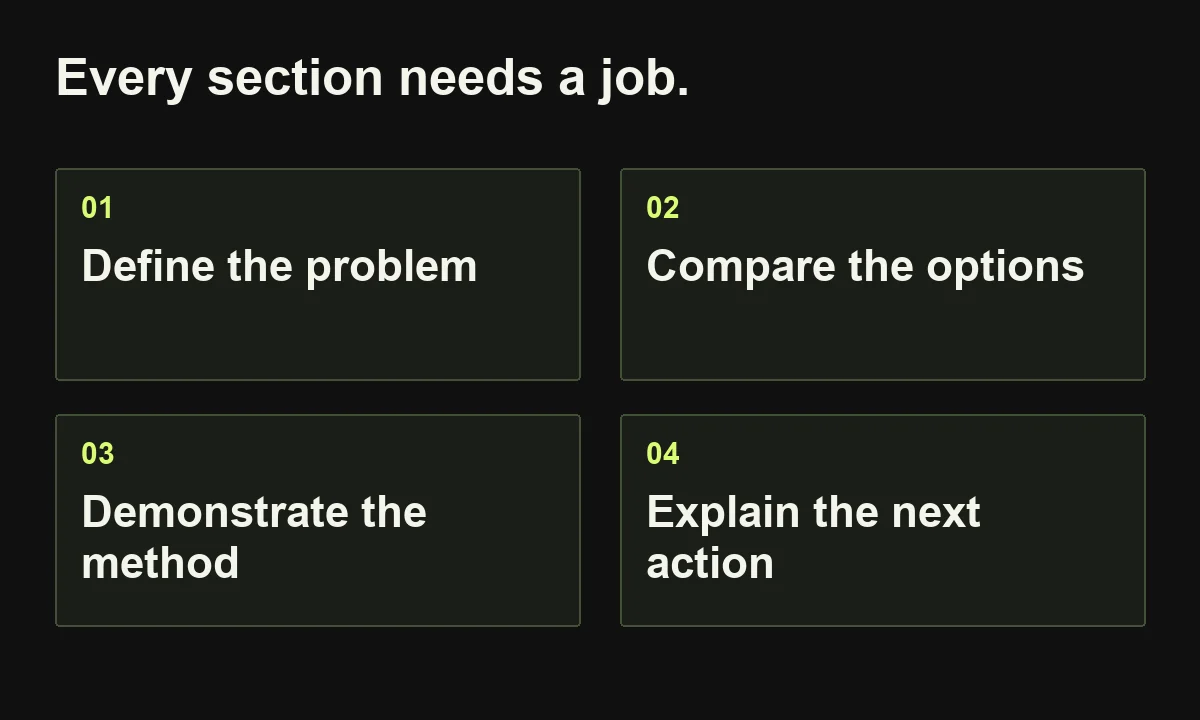
Before drafting, label each section by its job: define, compare, diagnose, demonstrate, or implement. Remove sections that repeat the same job without adding a new decision.
Use a single descriptive H1, logical H2 and H3 headings, short paragraphs, and tables where readers need to compare alternatives. Include a contents list for a long guide. Readers should be able to enter through a deep link and still understand the section.
A concise opening answer is useful because it respects the reader's time. It is not an official requirement to place exactly fifty words under every heading.
Likewise, 2,500 words is an editorial scope, not a ranking threshold. Google's people-first content guidance explicitly rejects the idea of a preferred word count. It also distinguishes E-E-A-T from a specific ranking factor.
Use semantically related terms only when they clarify the subject. An article about blog SEO naturally discusses indexing, search intent, internal linking, title tags, backlinks, and measurement. Calling these “LSI keywords” does not create a special Google optimization requirement.
Completeness means answering the reader's consequential questions. It does not mean adding every vaguely related topic until the page becomes difficult to use.
7. Make expertise visible through the work
Show expertise by making your reasoning and evidence inspectable. Explain why a recommendation applies, what would change it, and where the reader can verify the supporting facts. Accurate authorship and relevant background help provide context; confidence cannot replace evidence.
For an article that recommends a workflow, include an example input, a decision rule, and an output someone could reproduce. For a comparison, disclose the criteria and the conditions under which the recommendation changes.
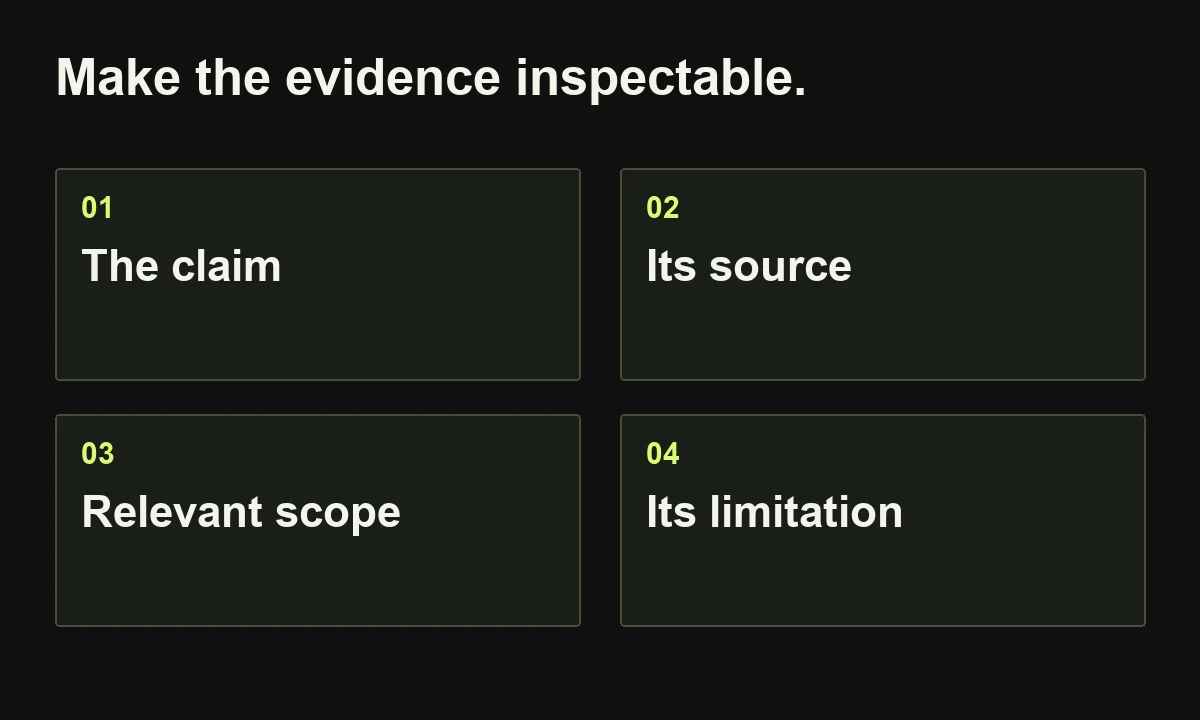
A useful evidence note has four parts: claim, source, scope, limitation. “This tool reduced drafting time” is incomplete without the task, comparison, measurement method, and other changes that occurred.
Keep editorial proposals separate from observed results. The five gates in this article are a proposed review method. They are not presented as a client-tested formula or an explanation of Google's private ranking weights.
Use a real byline and link to a relevant author profile. Where client work helps establish context, describe the actual intervention and retain its boundaries; see my selected work. A result from one project cannot predict another project's outcome.
Do not invent quotes, credentials, endorsements, or experiments to make a guide appear authoritative. If first-hand evidence is unavailable, publish a documented analysis and say how it was prepared.
Your strongest credibility signal is often the moment you explain when your own advice would be wrong. That gives the reader a way to evaluate it, rather than asking them to accept your confidence.
8. Remove crawl, index, and canonical problems
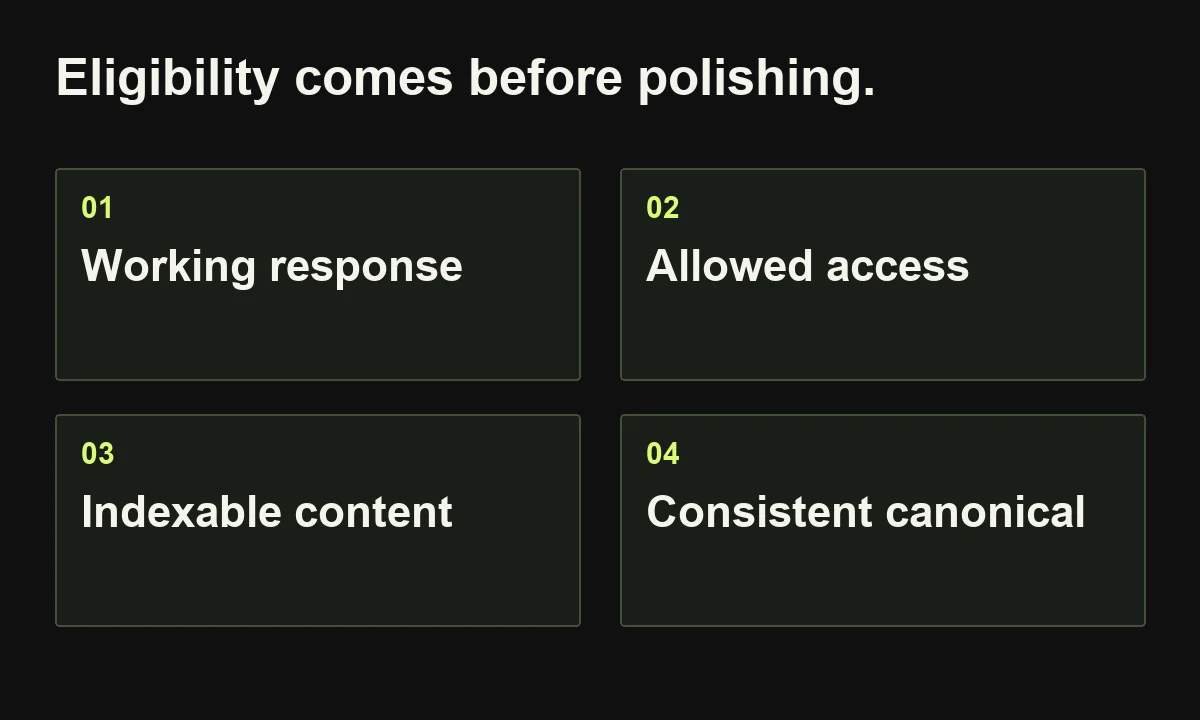
A blog cannot compete in Google Search if it fails the basic eligibility requirements. Check that Googlebot can access it, the page returns a working response, and its content is indexable. Then inspect the actual URL in Search Console. A browser successfully opening a page does not establish that Google has indexed it.
Google's technical requirements specify access, a successful HTTP response, and indexable content. These are minimum conditions, not a guarantee of inclusion.
Review the published page's robots meta tag and X-Robots-Tag header, along with robots.txt and hosting protections. An accidental noindex, login requirement, bot challenge, or broken server response deserves attention before another rewrite.
A robots.txt block controls crawling; it is not a reliable method for removing a URL from search. Google generally needs to crawl a page to see its noindex instruction.
Choose one preferred URL. Google's canonical guidance describes canonical annotations and redirects as signals. Keep internal links, sitemap URLs, and canonical declarations consistent. A canonical is not a command guaranteeing Google's selection.
If an article has unnecessary duplicates, investigate them before deleting anything. An HTTP/HTTPS or trailing-slash variant is a different problem from two genuinely useful articles discussing adjacent questions.
Use the URL Inspection report to compare your intended page with Google's selected canonical and latest crawl information. Record the finding, rather than assuming a plugin's green indicator proves the deployed configuration is correct.
9. Make discovery and rendering reliable
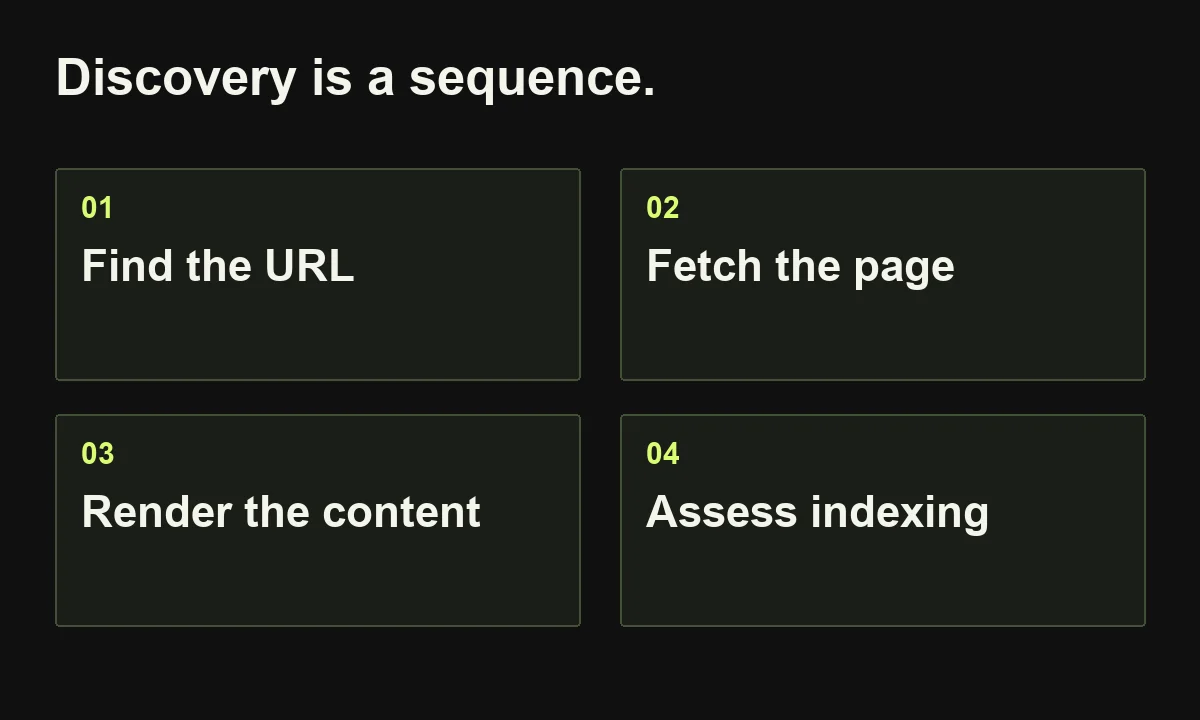
Connect a new post from a relevant, discoverable page and include its canonical URL in the XML sitemap. Check that important text and links are present in the rendered page, particularly if the site relies on JavaScript. Discovery, crawling, rendering, and indexing are related stages; completing one does not prove the next.
A blog linked only from an obscure archive page has a weaker discovery route than one linked contextually from a relevant guide. Avoid leaving a new URL orphaned while expecting the sitemap to do all the work.
Google's sitemap guidance treats the sitemap as a way to communicate preferred URLs. It does not guarantee that every listed page will be crawled or indexed. Supply accurate modification dates when used; do not update them simply because a build ran.
For JavaScript-heavy sites, inspect what a crawler receives and what the rendered HTML contains. Google's JavaScript SEO documentation explains the additional rendering stage. Important content should not depend on a user clicking a control that the crawler may never activate.
Use ordinary crawlable links rather than click handlers masquerading as navigation. Check the destination and visible anchor text after deployment.
You can request a recrawl through Search Console, but repeated requests do not make crawling faster. Treat the request as a submission, not a promise about timing. Repair the issue once, verify it, and allow the system to process the change.
10. Write titles and snippets that keep their promise
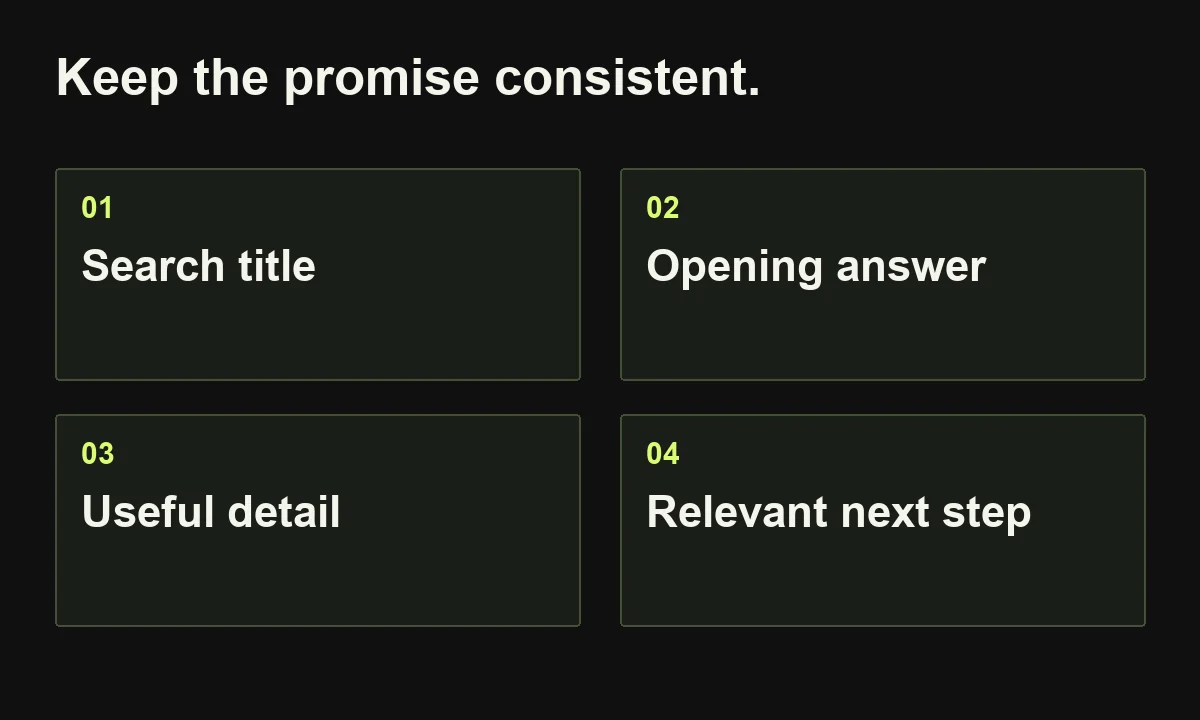
Write a title that identifies the topic and the value of the page without exaggerating its contents. Use the description to explain the reader's benefit accurately. Search engines can generate different titles and snippets, so evaluate the result readers actually see instead of treating your metadata as a fixed advertisement.
For example, “B2B Content Audit: What to Check Before Hiring” is more informative than “The Ultimate Secret to Explosive Content Growth.” The first promises a decision aid. The second creates expectations the article may not satisfy.
Put the main subject naturally in the title, H1, introduction, and relevant sections. Use a short, descriptive slug. Avoid changing an established URL merely to squeeze in another variation of the keyword.
An under-sixty-character title and under-160-character description are useful editorial constraints, not universal Google cutoffs. Display varies, and Google may choose other text. Its title-link guidance recommends descriptive, concise titles; its snippet guidance explains how descriptions and page content can be used.
Align the promise across the title, opening, and actual answer. If a title says “template,” provide a usable template. If it says “cost,” explain the pricing basis rather than hiding every useful detail behind a sales enquiry.
When impressions are relevant but clicks are weak, examine the visible result, query intent, position, and competing features together. A more dramatic adjective will not repair a page that offers the wrong answer to the wrong searcher.
11. Connect the article to a useful content system
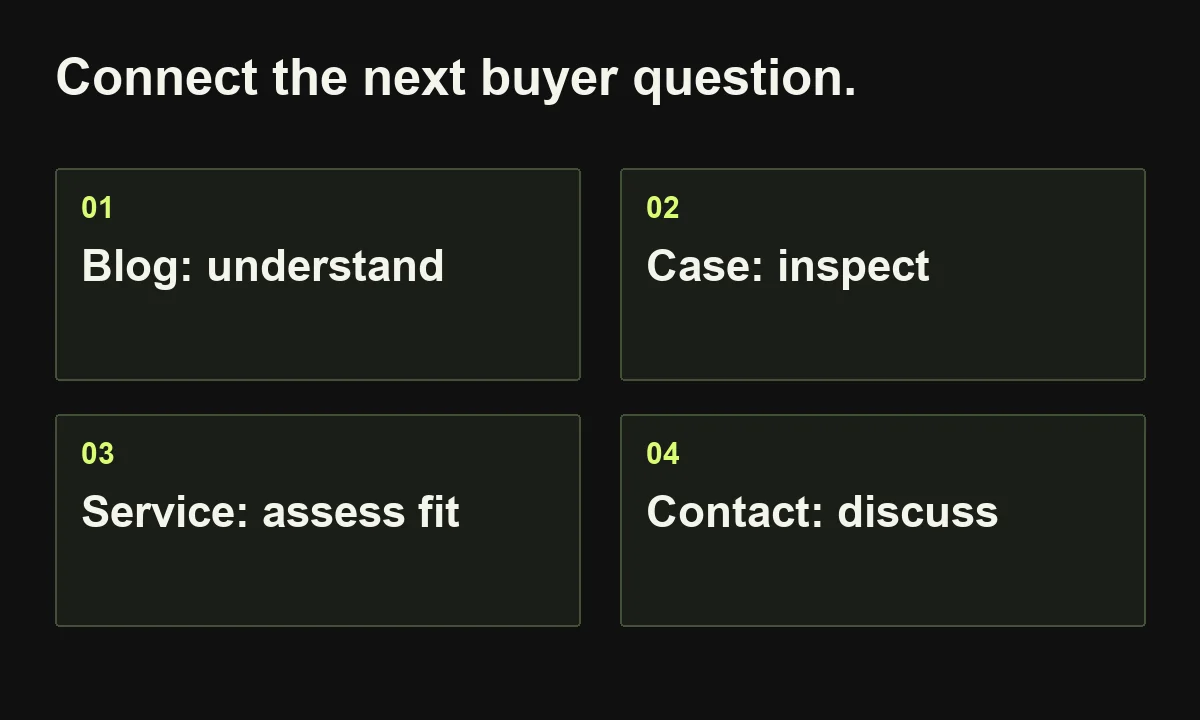
Internal links should connect a reader's current question to the page best equipped to answer the next one. Link a blog to relevant explanations, bounded case evidence, and appropriate service information. Add incoming links from existing pages where the new guide genuinely helps. Do not manufacture a cluster by repeating the same anchor everywhere.
Google's link best practices recommend crawlable links and descriptive, natural anchor text. A contextual link also needs an editorial reason.
Build a short register: source URL, reader question, destination URL, suggested anchor, and owner. For this guide, a reader needing more detail about connection design can use internal linking for B2B websites. A team deciding whether to commission a diagnostic can read the content strategy audit guide.
Check overlap before commissioning a new post. Two articles can share vocabulary while serving different tasks. Trouble arises when their promises, evidence, and intended query groups are effectively indistinguishable.
If pages overlap, compare their queries, incoming links, usefulness, and business role. You may differentiate them, consolidate them with a carefully mapped redirect, or preserve both. “Cannibalization” is a diagnosis to investigate, not a reason to delete every repeated keyword.
Keep a coherent subject focus across the site. Publishing dozens of unrelated articles to chase temporary demand can dilute the editorial purpose even when every page has a technically valid title tag. A useful library should let buyers deepen their understanding without repeatedly starting again.
12. Make images improve the answer without slowing it down
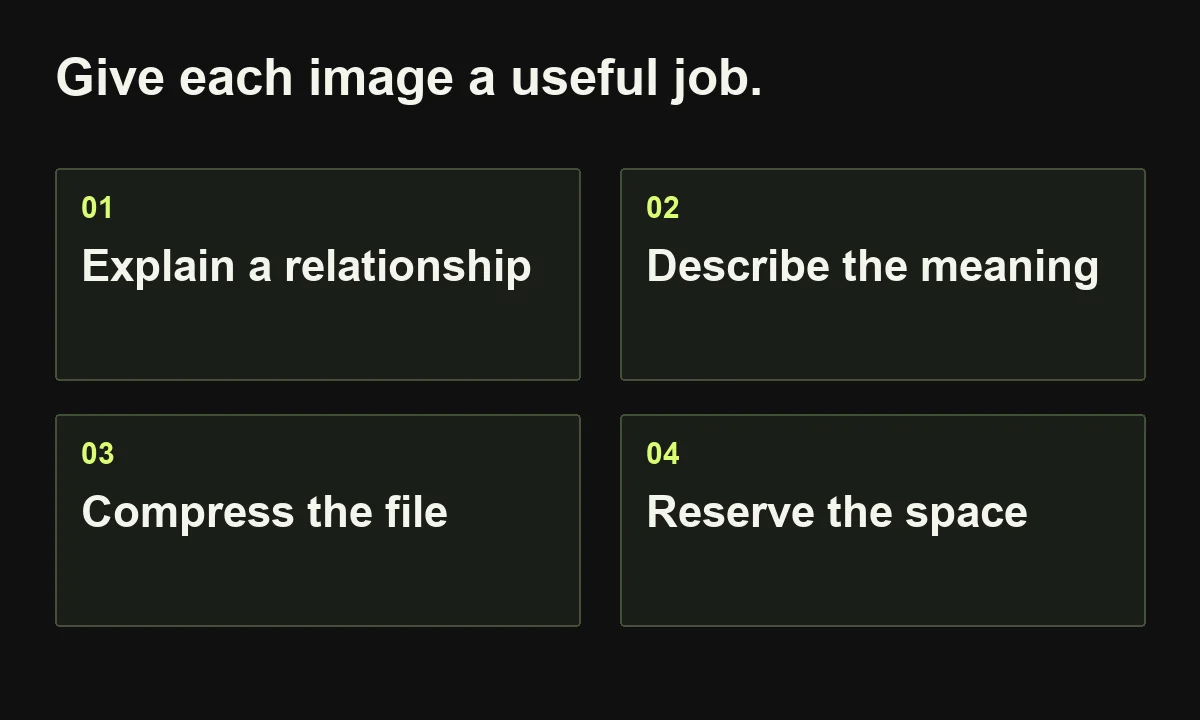
Use images to explain a relationship, demonstrate a process, or make evidence inspectable. Every visual should have a specific job. Compress the files, reserve their dimensions, and keep the important meaning in accessible text. A decorative image repeated every few paragraphs can increase page weight without improving anyone's understanding of the topic.
A dated screenshot with relevant interface context can help explain a technical walkthrough. For an original framework, a diagram can make the relationships easier to remember. Do not draw a fictional analytics dashboard and present it as a real result.
Google's image guidance recommends descriptive filenames and relevant alt text. Describe the actual image; do not fill the alternative text with repeated target keywords. Put essential findings in the article as well, so they remain usable without the picture.
Use compressed WebP or another suitable supported format. Supply responsive sizes where needed. Lazy-load images below the opening view; avoid delaying the prominent cover that readers immediately need. Set width and height so the browser can reserve space.
On mobile, check small labels, contrast, image sharpness, and whether a table or figure causes horizontal overflow. Compression is successful only when the information remains legible.
This guide uses original diagrams at roughly 200–250-word intervals because the visual rhythm is part of its editorial brief. That spacing is a design choice, not a Google ranking instruction. Each diagram summarizes a different decision rather than presenting invented performance data.
13. Check performance as a reader experience
A technically accessible blog can still be unpleasant to use. Check loading, interaction responsiveness, layout stability, mobile reading, and intrusive overlays. Repair the bottlenecks that interrupt the article rather than chasing a laboratory score as if it were a direct promise of higher rankings. Good performance supports a useful page; it cannot create missing substance.
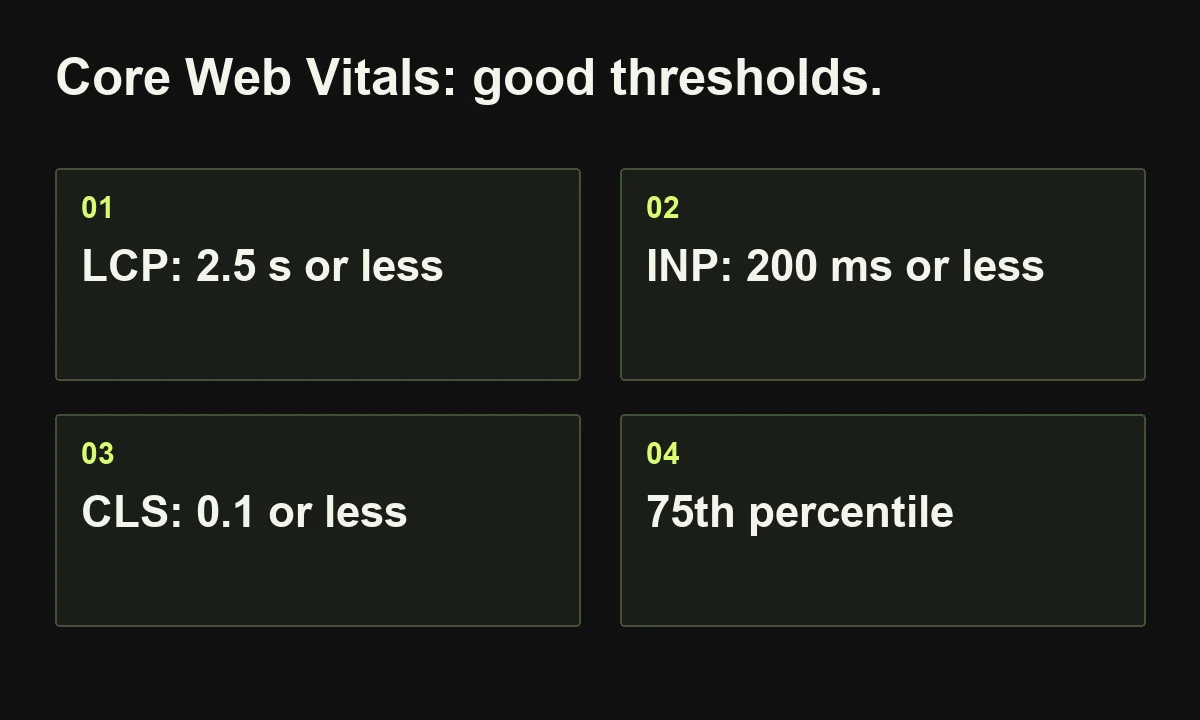
The current Core Web Vitals are Largest Contentful Paint, Interaction to Next Paint, and Cumulative Layout Shift. Their good-experience thresholds are LCP at or below 2.5 seconds, INP at or below 200 milliseconds, and CLS at or below 0.1, assessed at the 75th percentile, with mobile and desktop considered separately.
Use PageSpeed Insights to inspect field data when available and laboratory diagnostics to find potential repairs. A small site may not have enough field observations for a reported result. Missing field data is not a passing score.
For an image-heavy guide, start with oversized media, missing dimensions, excessive scripts, render-blocking resources, and a slow initial server response. Test the real article, not just the homepage.
Google's page-experience guidance makes clear that good scores do not guarantee top placement. A fast page that never resolves the reader's question is still an incomplete answer.
Assign each repair to a specific observation. “Reduce the cover transfer size” is actionable; “make SEO faster” is not. Retest after a meaningful change and keep the result alongside the release date, rather than repeatedly testing unchanged pages.
14. Use structured data accurately—and retire old advice
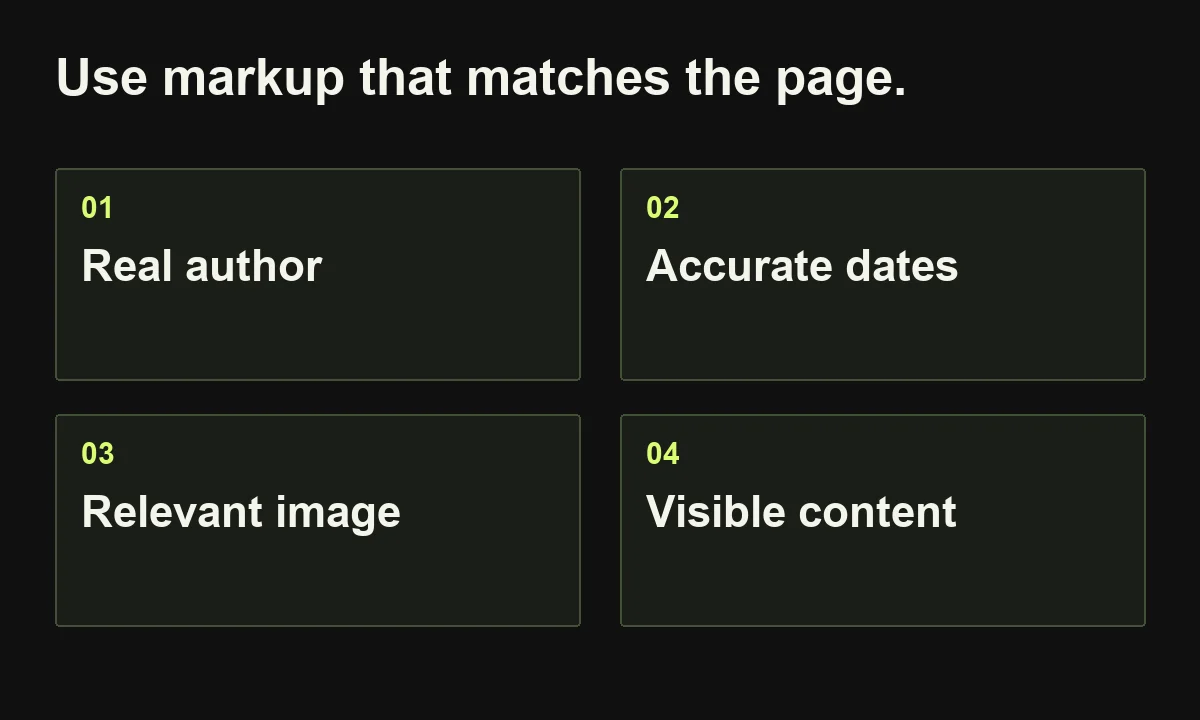
Structured data should describe the content a visitor can actually see. For a blog, Article or BlogPosting markup can identify the headline, author, dates, and representative image. Validate the markup and keep it consistent with the page. It is not a substitute for accessible content, reliable evidence, or a coherent article.
Google's Article documentation supports Article, NewsArticle, and BlogPosting. Use the appropriate type and truthful properties. Do not add ratings, professional credentials, or publication dates that are not supported by the page.
A major 2026 correction concerns FAQs. Google's documentation changelog states that FAQ rich results stopped appearing on 7 May 2026, with the documentation removed in June. Advice to add FAQPage schema specifically to obtain that Google rich result is now outdated.
A useful FAQ section can still serve readers. Keep it when it answers genuine follow-up questions. You do not need to manufacture repetitive questions or inject markup to justify the section.
This article uses BlogPosting metadata and a visible FAQ. It does not promise FAQ rich results or treat an automated validation pass as evidence that a search engine will display a particular enhancement.
Review structured data whenever the visible content changes. A replaced cover should also change the image reference. A substantive review may justify an updated date; rebuilding HTML without revising the article does not. Consistency is a maintenance responsibility, not a one-time plugin setting.
15. What changes for AI search, AEO, and GEO?
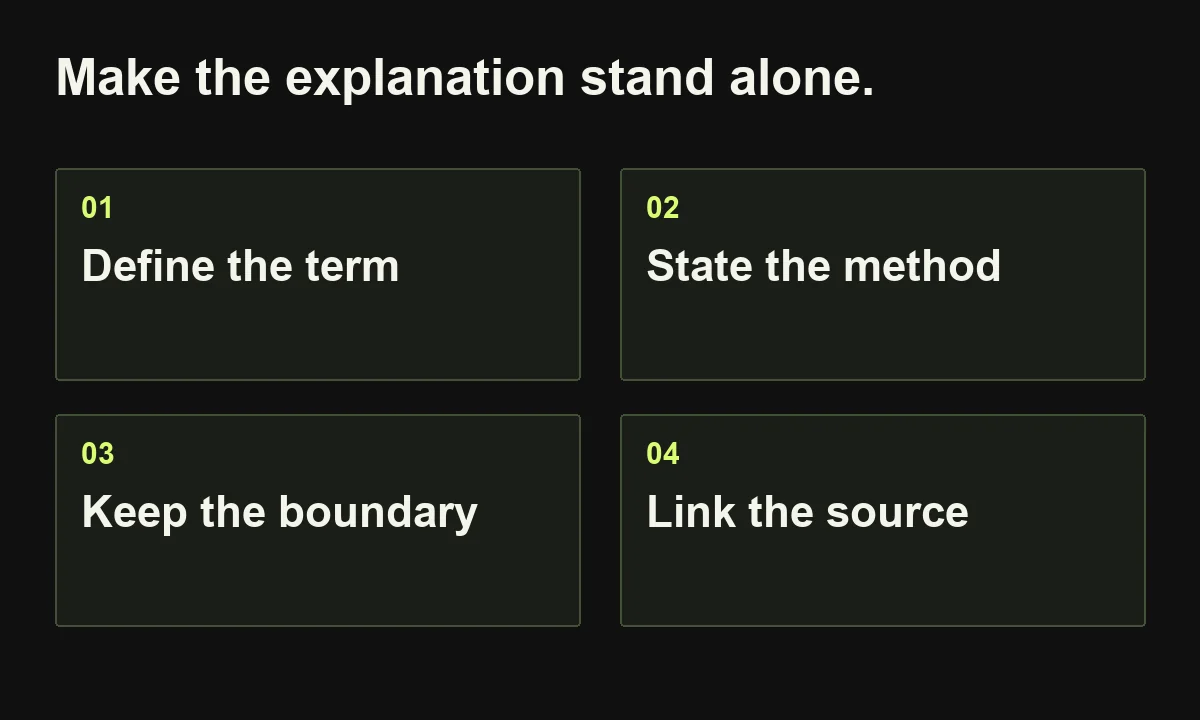
AI-search visibility adds another discovery surface, but it does not remove the need for accessible, useful, credible pages. Write claims that retain their meaning when quoted, define terms clearly, and place limitations beside the findings they qualify. Treat those practices as good communication, rather than a guaranteed method of securing an AI citation.
AEO usually refers to answer engine optimization; GEO to generative engine optimization. These labels are not a universal specification shared by every platform.
Google's current generative AI optimization guide emphasizes non-commodity content and established SEO foundations. It says Google Search does not use llms.txt to improve rankings or visibility, does not require artificial content chunking, and has no special schema requirement for generative search.
A practical implication is to stop designing a page around a supposed hidden AI formatting trick. Provide the method, example, boundary, and source that make the explanation worth using.
For example, “improve CTR” is a fragile instruction. “Compare CTR for the same relevant query group, country, device, and position range before changing the title” is a more self-contained recommendation. It says what to compare and reduces the chance of an inappropriate conclusion.
Different AI products have different retrieval behavior and reporting. Do not assume visibility in one proves visibility in another. An observed citation records one answer, not a permanent placement.
Keep the article useful even when no AI system cites it. That is the part of the asset your business can control.
16. Use AI assistance without outsourcing the evidence
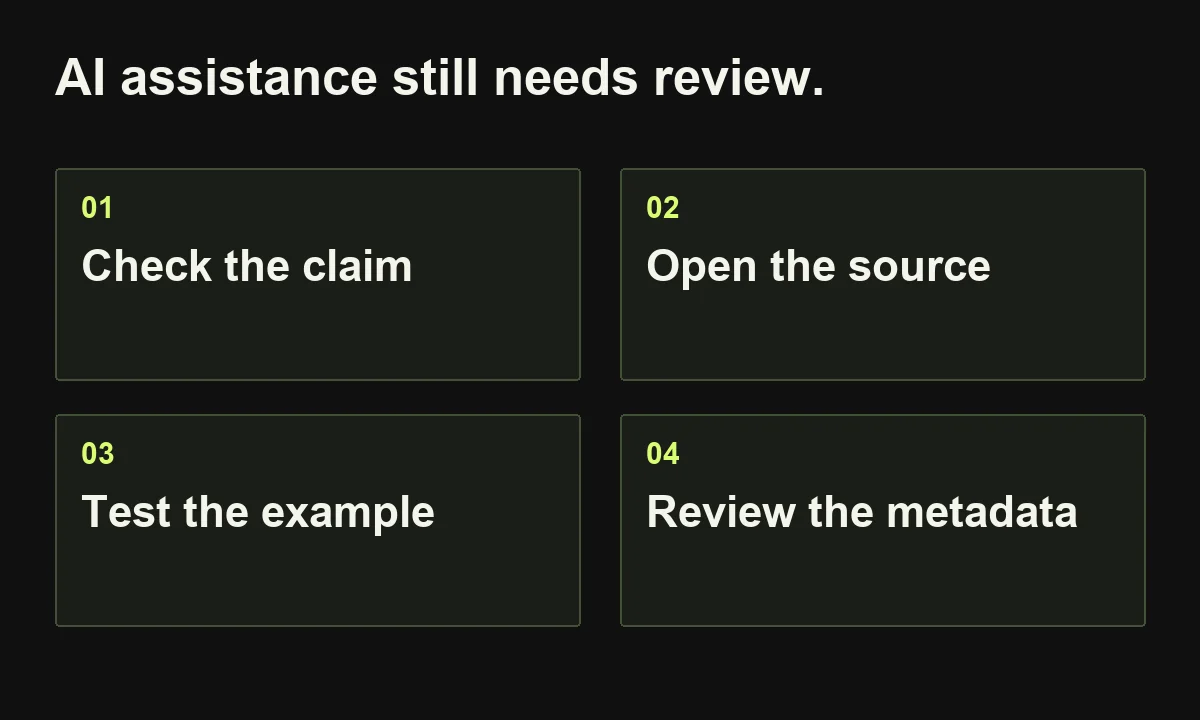
AI can help organize notes, explore alternative outlines, and identify questions to investigate. It cannot certify that a claim is true or that a cited source supports it. Keep source checking, original contributions, and final editorial decisions explicit, particularly when the article could affect an important business decision.
Google's guidance on generative AI content, updated on 1 October 2026, stresses accuracy, relevance, manual fact-checking, and useful context about how content was created. It also warns that generating many pages without adding value may violate scaled-content-abuse policies.
Use a claim register while drafting. For every statement that could be wrong, record its source, the exact supporting passage or observation, and the qualification the published sentence needs.
Separate four categories: documented platform guidance, directly observed evidence, an illustrative example, and your editorial recommendation. A plausible AI sentence should not quietly move from the fourth category into the first.
Ask a reviewer to challenge the article's most confident claims. Which assertion is unsupported? Which example resembles a real result without being one? Which product interface or policy changed since the source was published?
Check titles, descriptions, alt text, and schema too. These fields also need editorial attention.
The practical safeguard is a traceable revision process. Record what was checked, what remains uncertain, and what the article deliberately does not claim. Publishing fewer defensible pages is a more coherent content strategy than filling a calendar with unverified explanations.
17. Earn backlinks through relevance and distribution
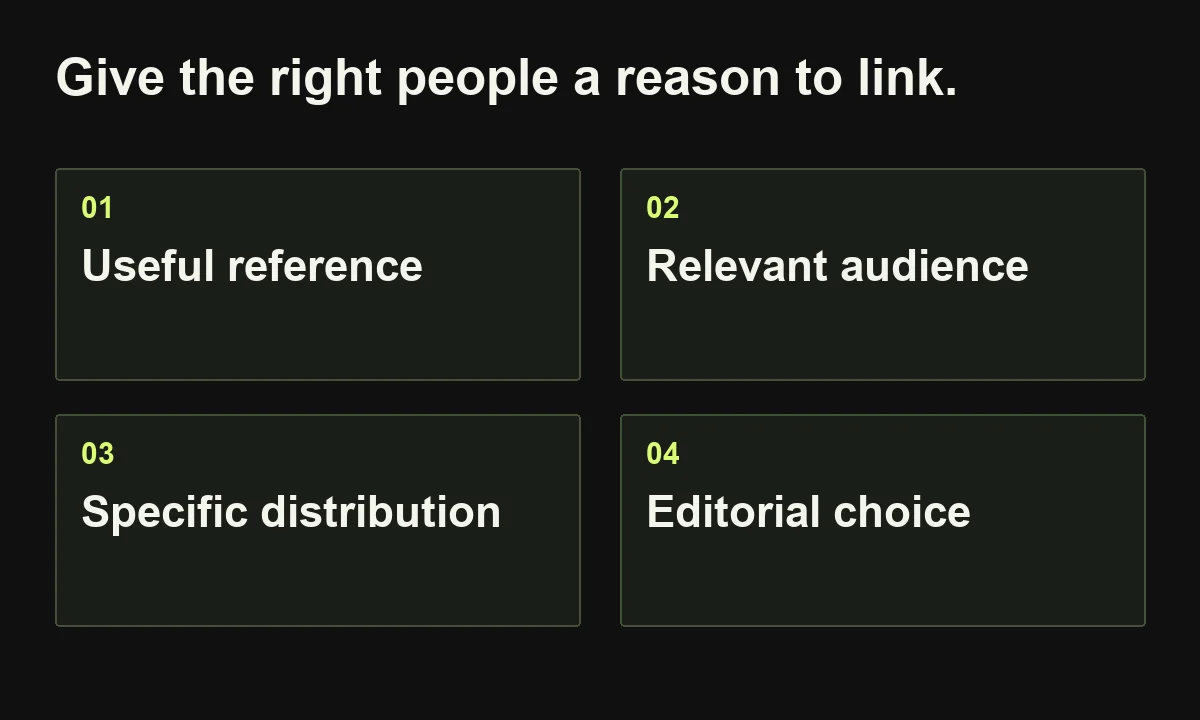
To make backlinks plausible, publish something useful to a defined group and help that group discover it. Identify who might reference the material, what they would use, and why their audience needs it. The editorial value of the asset comes first. Distribution makes it visible; outreach cannot create evidence that the page lacks.
For this guide, plausible reference audiences include content editors, SEO educators, and B2B marketing teams that need a review worksheet. A directory submission offers little help here.
Build a distribution brief: asset, reader, publication, reason for sharing, and supporting evidence. Do not scrape thousands of addresses and send everyone the same message.
Share a useful extract in channels where your audience already participates, with enough context to be helpful independently. Where appropriate, offer an original diagram or worksheet for editorial use and provide a clear attribution reference. An editor should remain free to decide whether to use or link it.
Google's spam policies identify paid ranking links, excessive exchanges, and automated link creation as link spam. Qualify advertising or sponsorship appropriately rather than disguising it as independent editorial endorsement.
Track earned referring pages and the usefulness of their context, not only a tool's domain score. A relevant reference can bring qualified readers even when a proprietary authority metric looks modest.
There is no defensible promise that a guide will earn backlinks simply because it is detailed. Build the reason to cite it, then distribute it responsibly.
18. Measure search, AI visibility, and business outcomes separately
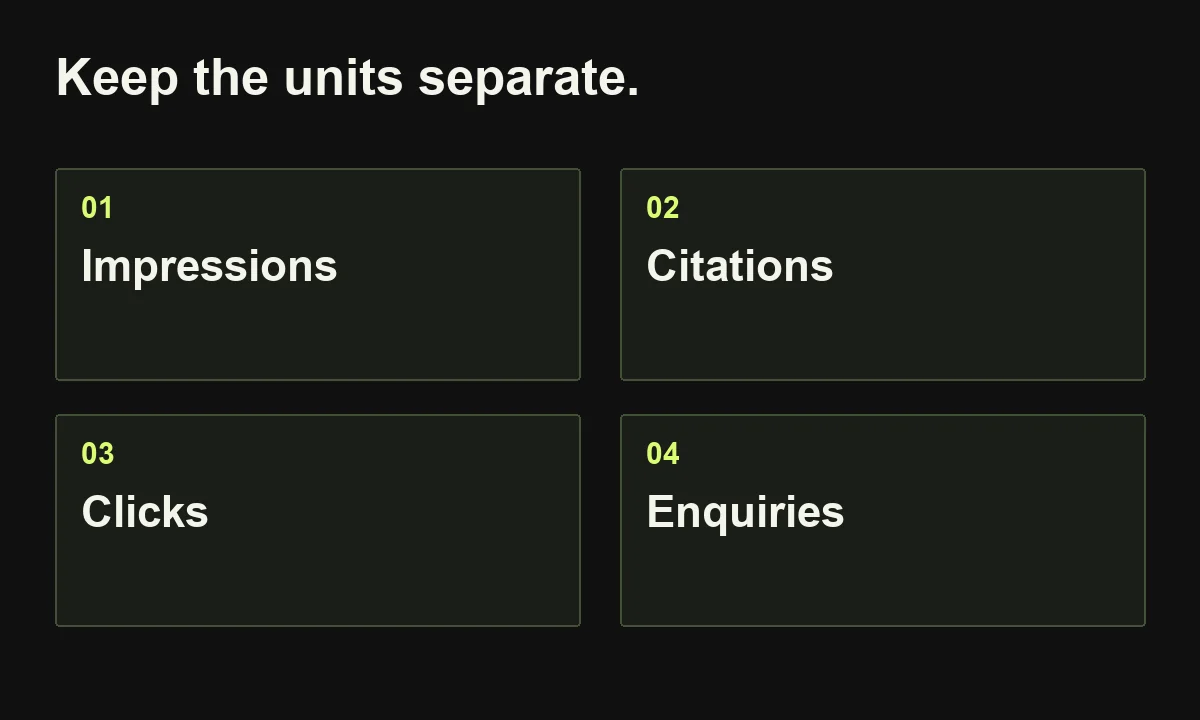
Use Search Console to understand discovery and search performance, analytics to understand on-site actions, and available first-party AI reports to understand their own visibility surfaces. Keep the units separate. An impression, citation, click, and enquiry are different observations; a change in one does not prove the cause or commercial value of another.
Filter performance data to the article and relevant query groups. Compare country, device, date range, and search type. Google's measurement definitions explain that position is averaged across impressions, so it is not a single stable rank for the whole article.
Do not repeat the older assumption that Google provides no separate AI visibility insights. Its June announcement, updated in August 2026, says new generative-search insights include impressions and page/country information, with worldwide availability noted as of 31 August. Inspect the reports available in your verified property and read their definitions before comparing them with standard search data.
Bing's AI Performance expansion introduced preview capabilities for intents, topics, citation share, and comparisons. Bing explicitly describes citation share as observational, not traffic share or a content-quality score. It covers supported Microsoft and partner experiences, not every AI engine.
For leads, count acknowledged submissions or meaningful conversations rather than button clicks alone. Ask how the prospect found you when appropriate. Attribution remains imperfect; preserve that uncertainty rather than assigning every enquiry to the latest published article.
19. Diagnose the symptom before rewriting the page
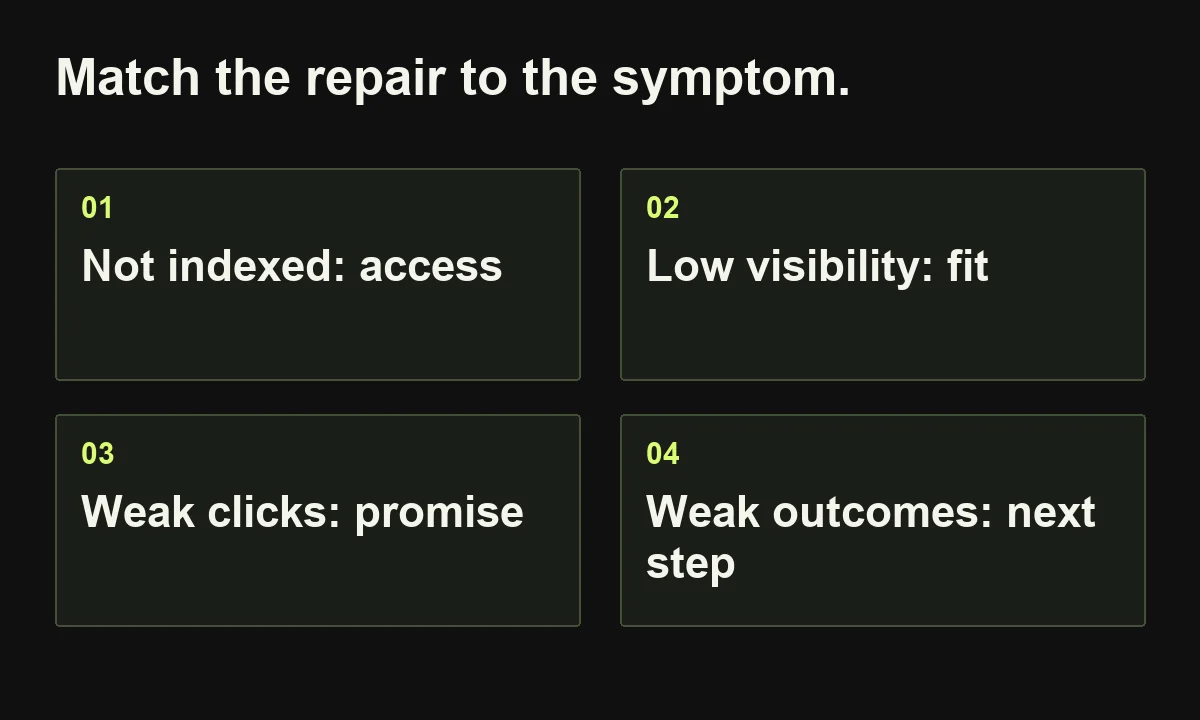
A ranking problem needs a specific diagnosis. First establish whether the URL is indexed, whether it receives relevant impressions, whether those impressions produce visits, and whether visitors find a useful next step. Change the layer implicated by the evidence. Rewriting the entire article every week makes it harder to learn what mattered.
| Symptom | Check before acting | Possible next action |
|---|---|---|
| Not indexed | Access, directives, canonical, inspection status. | Repair eligibility; improve discovery; investigate reported exclusion. |
| Indexed, little relevant visibility | Intent, query demand, competing answers, distinctive value. | Rework the brief or evidence; choose a narrower task. |
| Relevant impressions, weak clicks | Query mix, position, visible result, competing features. | Improve the promise or accept a different discovery objective. |
| Visits, little useful engagement | Answer quality, mobile usability, next-step fit. | Repair the reading experience or offer connection. |
| Earlier performance falls | Demand, technical changes, competitors, site-wide patterns. | Identify the change before choosing a revision. |
These are hypotheses, not proof of causation. Use Google's traffic-drop guidance to investigate demand shifts, technical issues, and broader patterns.
Keep a revision log with the problem, explanation, intervention, date, and follow-up window. Where possible, change one meaningful layer at a time. Low traffic may require longer observation before a reliable comparison is possible.
If the diagnosis concerns the whole library, start with a B2B content strategy audit rather than treating every underperforming article as an isolated writing problem. The next useful action may be consolidation, better evidence, or a different topic—not more paragraphs.
20. A practical first-month plan
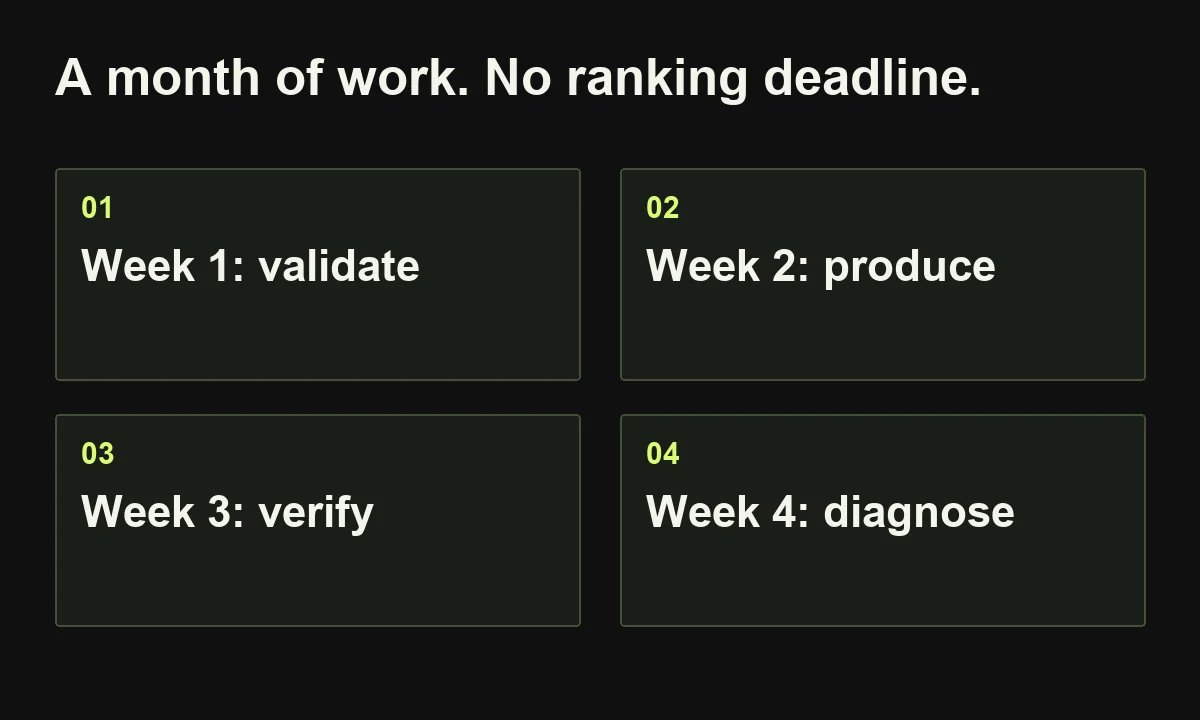
Use the first month to establish eligibility, publish a defensible asset, connect it to the library, and collect enough information to choose the next revision. This plan does not promise rankings within thirty days. Competition, demand, site context, and processing time can all affect what happens after publication.
Week one: validate the brief. Identify the reader and decision, inspect current results, select the query family, and name the evidence gap. Decide whether to create a new page or improve an existing one. Assign an owner to each missing input.
Week two: produce the asset. Draft the answer, develop the reference tool or worked example, verify claims, and prepare compressed visuals. Review the title and opening together. Ask someone resembling the intended reader which decision remains unclear.
Week three: publish and verify. Check the deployed response, canonical, directives, internal links, sitemap, structured data, mobile layout, and image delivery. Inspect the URL in Search Console and request indexing if appropriate. Share a useful extract through relevant channels.
Week four: diagnose, do not panic. Look for eligibility problems and early query patterns. Record distribution feedback and observed references. Resist drawing a causal conclusion from a handful of clicks. Set the next review date according to the available data.
Budget for evidence and implementation, not just writing. If you hire help, ask for a query brief, source register, original contribution, technical handoff, and measurement plan. Those deliverables make the engagement reviewable; a promised ranking position does not.
Frequently asked questions about ranking a blog in 2026
How long does a new blog take to rank?
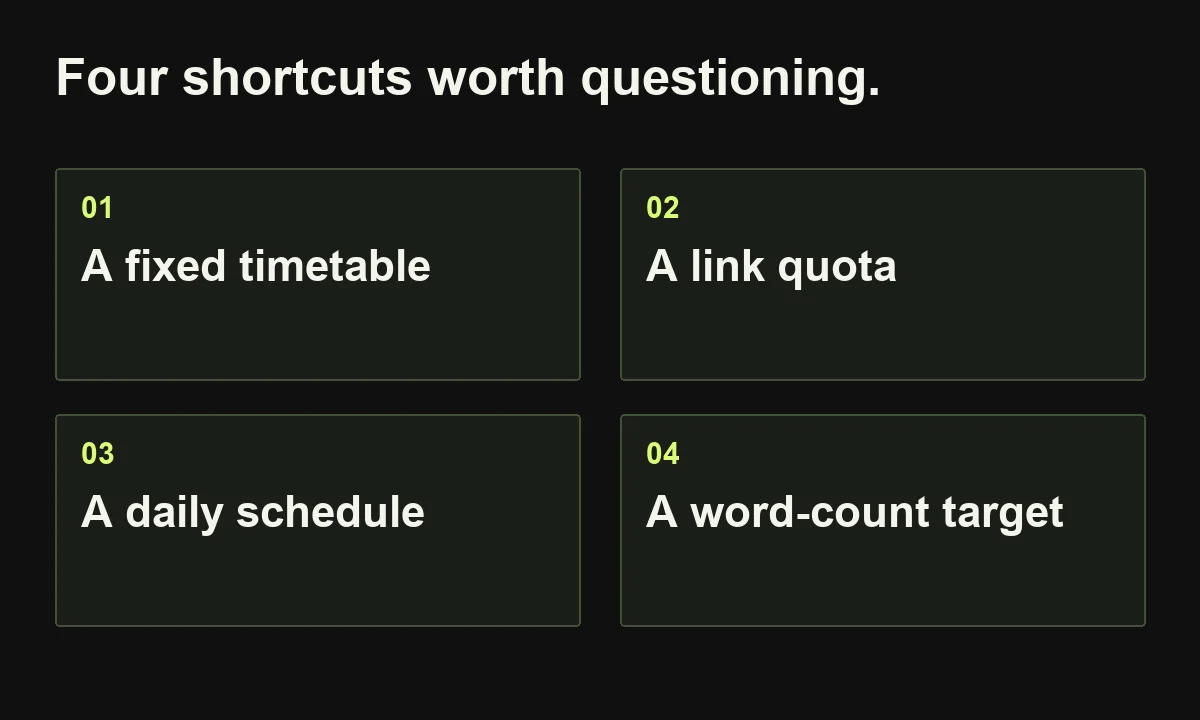
There is no universal timetable. Separate being discovered, indexed, receiving relevant impressions, and earning competitive placement. Check technical eligibility early, then evaluate the page against its intended query and competing answers. A review after thirty days can inform the next action; it does not establish a deadline Google must meet.
Can a blog rank without backlinks?
It is possible, but that does not tell you whether your particular page will compete. Investigate the query, site context, internal connections, and competing content. Develop material worth referencing and make it discoverable. Do not buy a fixed number of links because someone says every new article needs them.
Does publishing every day improve rankings?
A daily schedule is not a substitute for relevance and evidence. Set a publishing pace your team can support with useful original contributions, source checks, and maintenance. If the next article repeats an existing answer, improving that answer may be the better use of the available time.
Is a longer article always better?
No. Use enough detail to resolve the consequential questions. A long guide is justified when readers need definitions, trade-offs, implementation, examples, and troubleshooting. Extra sections that repeat the same advice make the page harder to use. This guide is deliberately detailed because the topic spans several distinct decisions.
What should you do next?
Start with one commercially relevant article and a recorded symptom. Use the five gates to establish what is confirmed, what needs repair, and what remains unknown. Assign the next action to an owner and name the observation that will help you evaluate it. Repeat that process across the library before increasing production.
You can use the diagnostic worksheet during an editorial meeting. It includes checks for audience fit, evidence, indexing, connections, performance, and outcomes. Fill the evidence column with actual observations, not optimism. Leave a field unresolved when you have not verified it.
The distinction I would keep returning to is this: an optimization changes a page; a diagnosis explains why that change deserves to be made. Without the diagnosis, publishing teams can spend weeks polishing the wrong answer or promoting a page that cannot be indexed.
If you are hiring a strategist, ask them to show the reasoning behind their priorities. They should be able to explain which decisions they can influence, what evidence they need from your team, and which outcomes remain uncertain. Ask how findings become an implementable brief and how the next review will work.
If your B2B blog receives impressions but struggles to earn attention or relevant enquiries, tell me which page is underperforming and what you have observed. I work on B2B content strategy, research-led writing, and practical content systems. We can start by identifying the constraint and deciding what work would actually help.