AI summary
AI can change the cost and organisation of content work without eliminating the business need for reliable information. Adapt by assessing individual tasks and proving the usefulness of the finished work, rather than assuming either permanent job protection or inevitable replacement.
- Delegate with clear boundaries: Check whether context is complete, results can be verified and mistakes have serious consequences. Give each workflow an accountable owner and an exception path.
- Invest in useful distinction: Develop customer evidence, clear recommendations and practical examples. AI can help explore and express ideas; a human label alone does not make content valuable.
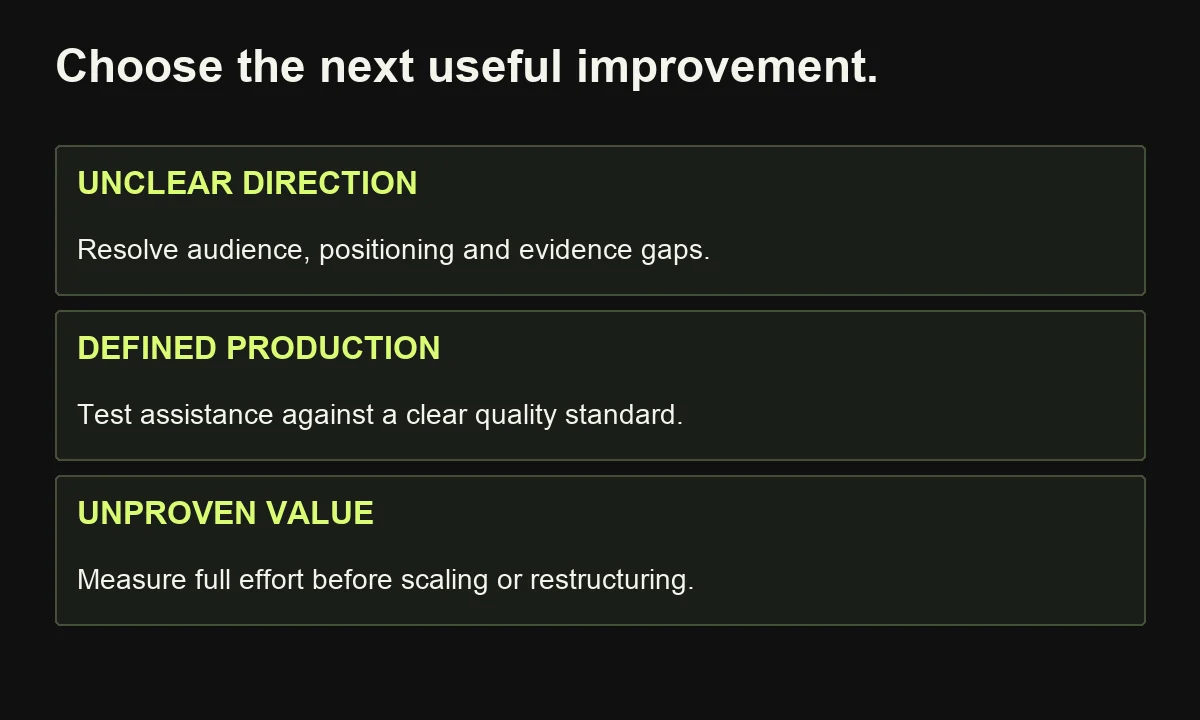
- Measure the whole process: Include research, preparation, editing and corrections when evaluating efficiency. Separate recovered capacity from cash savings. Pilot one workflow before scaling, and monitor factual accuracy alongside discovery and qualified business outcomes.
The future of content marketing is not safe from AI-driven change, but that does not make the discipline obsolete. AI can accelerate research, drafting and distribution. Businesses still need reliable information, clear positioning and accountable decisions. The practical response is to redesign specific tasks while measuring quality, cost and commercial usefulness.
“Will AI replace content marketers?” combines several questions that deserve different answers. Can software perform more of the work? Yes. Will some buyers spend less on routine production? That is a credible risk. Does either point establish that every business can replace its content team? No.
Content marketing connects what a business knows with what its audience needs to understand. Writing is central to that work, but so are investigation, editorial choices, distribution and learning from results.
My position is straightforward: do not build a career or a content programme around an assumption of permanent protection. Build a process whose contribution you can explain and verify. AI can be part of that process without becoming the person responsible for it.
This guide separates evidence from prediction, offers a practical task assessment and shows how to adapt in B2B and consumer marketing. It complements my implementation guide to using AI in marketing; the question here is how to preserve useful work as the economics change.
1. What does the evidence actually tell us?
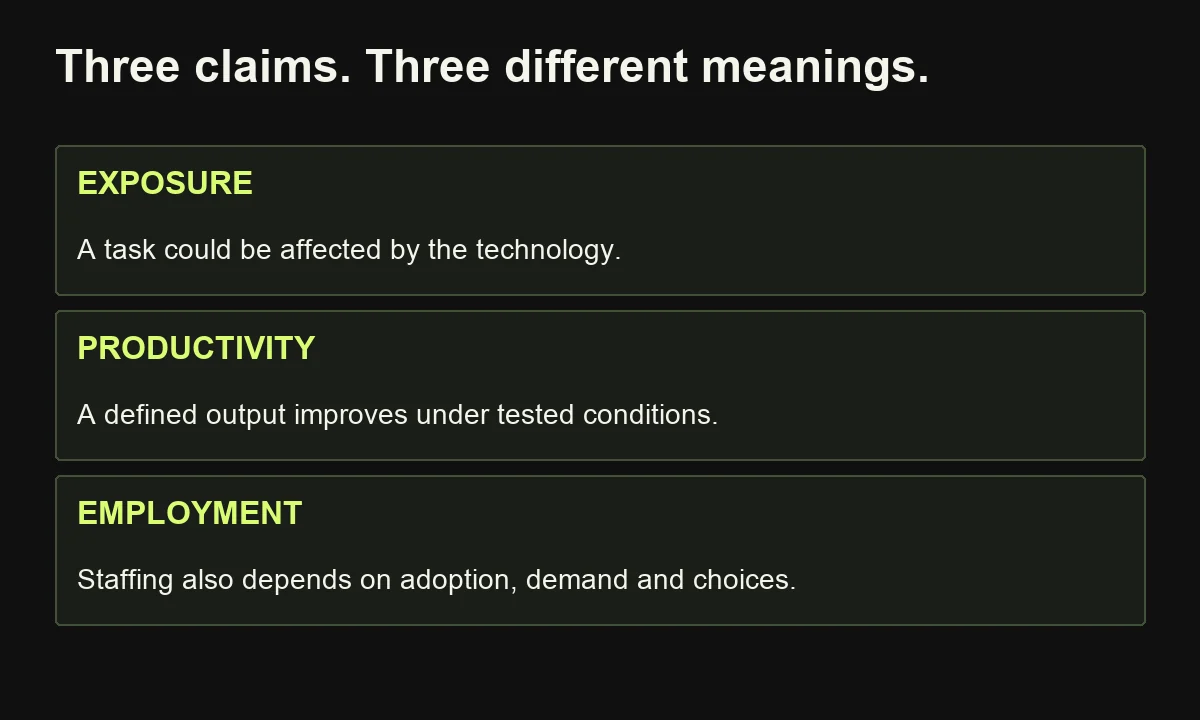
Research supports task-level disruption and productivity gains in particular settings. It does not establish a universal timeline for replacing content marketers. Exposure estimates describe technical possibilities; experiments measure outcomes under specific conditions. Neither should be presented as a prediction of what will happen to your team or your income.
The International Labour Organization's 2025 occupational analysis estimates that about a quarter of global employment has some exposure to generative AI. It explicitly distinguishes potential exposure from actual impact and concludes that transformation is the more likely overall effect because occupations contain varied tasks.
That is a global occupational assessment, not a content-marketing redundancy forecast.
Noy and Zhang's writing experiment, available in an early working-paper version, found faster completion and higher evaluated quality on selected professional writing tasks. It did not test an entire marketing programme, customer acquisition or long-term staffing decisions.
Use those distinctions when evaluating dramatic headlines. Ask what was measured, who participated, what tools they used and what counted as success. A strong result on a bounded writing assignment is a reason to test assistance, not permission to remove research, review or accountability from every assignment.
The practical implication is experimentation with defined boundaries, rather than either denial or a wholesale replacement decision.
2. Which content marketing tasks face the most pressure?
Tasks are easier to delegate when the inputs are complete, the desired output is clear and errors can be detected cheaply. This makes some production work a sensible starting point for AI assistance. It does not make every apparently simple assignment safe to automate without understanding its consequences.
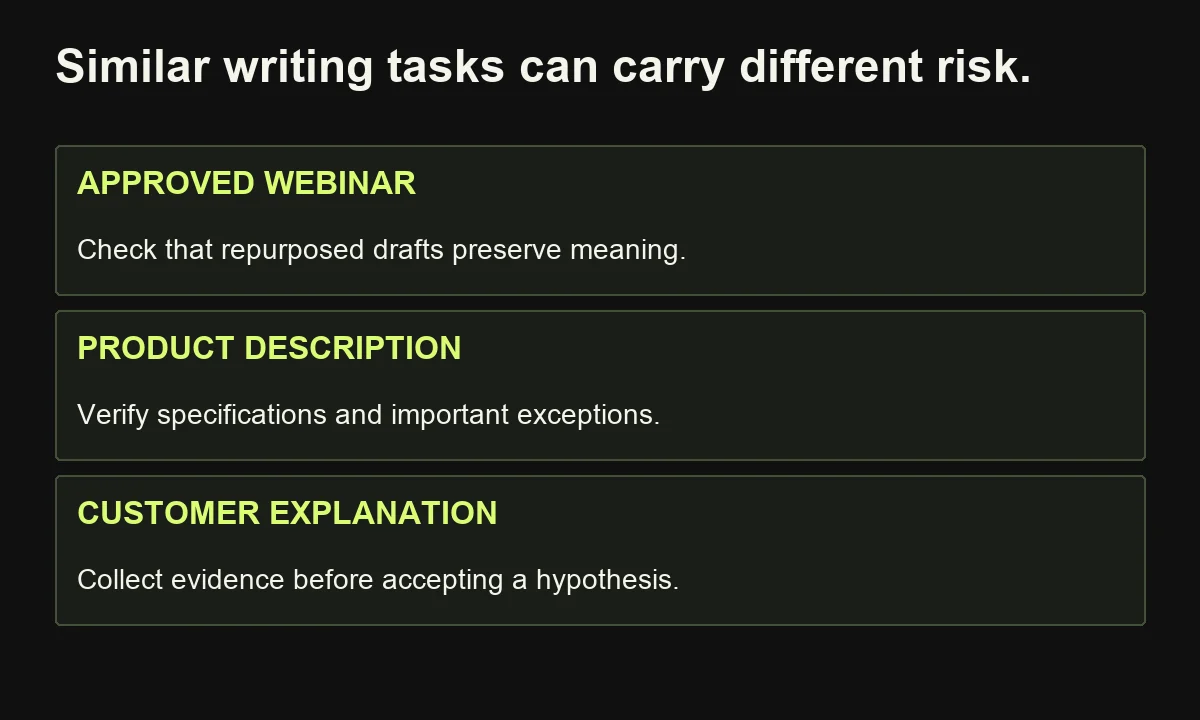
Consider three different requests:
| Assignment | Sensible AI contribution | Essential check |
|---|---|---|
| Turn an approved webinar into social drafts | Extract themes and propose versions | Preserve meaning and speaker approval |
| Update product descriptions from verified specifications | Prepare consistent copy | Check every specification and exception |
| Explain why customers reject a new service | Organise research and suggest hypotheses | Obtain customer evidence before accepting conclusions |
All three involve words. Their uncertainty is different.
A routine description can become a high-consequence task if it includes compatibility, safety or warranty information. Conversely, a complex report can contain low-risk formatting work that is easy to assist.
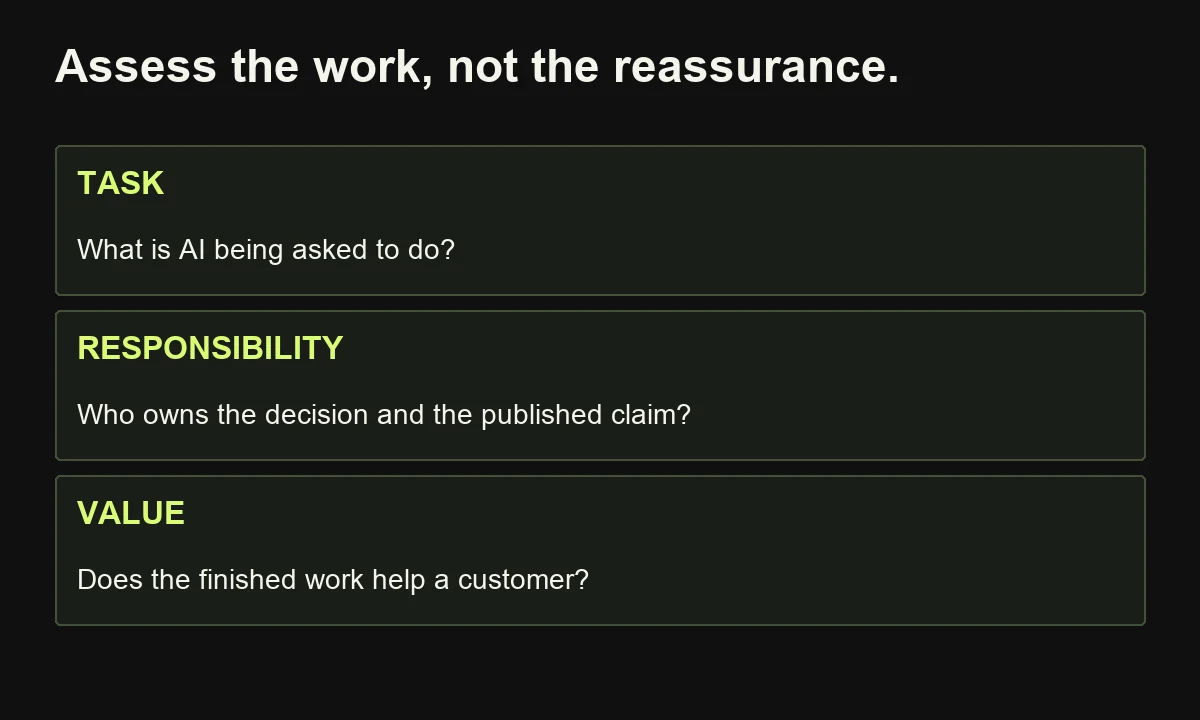
This is why I would audit assignments before job titles. Record the decision being supported, the available evidence and the cost of being wrong. Then identify the parts AI can perform, the parts it can assist and the parts requiring a responsible person's approval.
The aim is a useful division of work. “Let AI do the writing” is too broad to function as an operating instruction.
3. A practical framework: context, checking and consequence
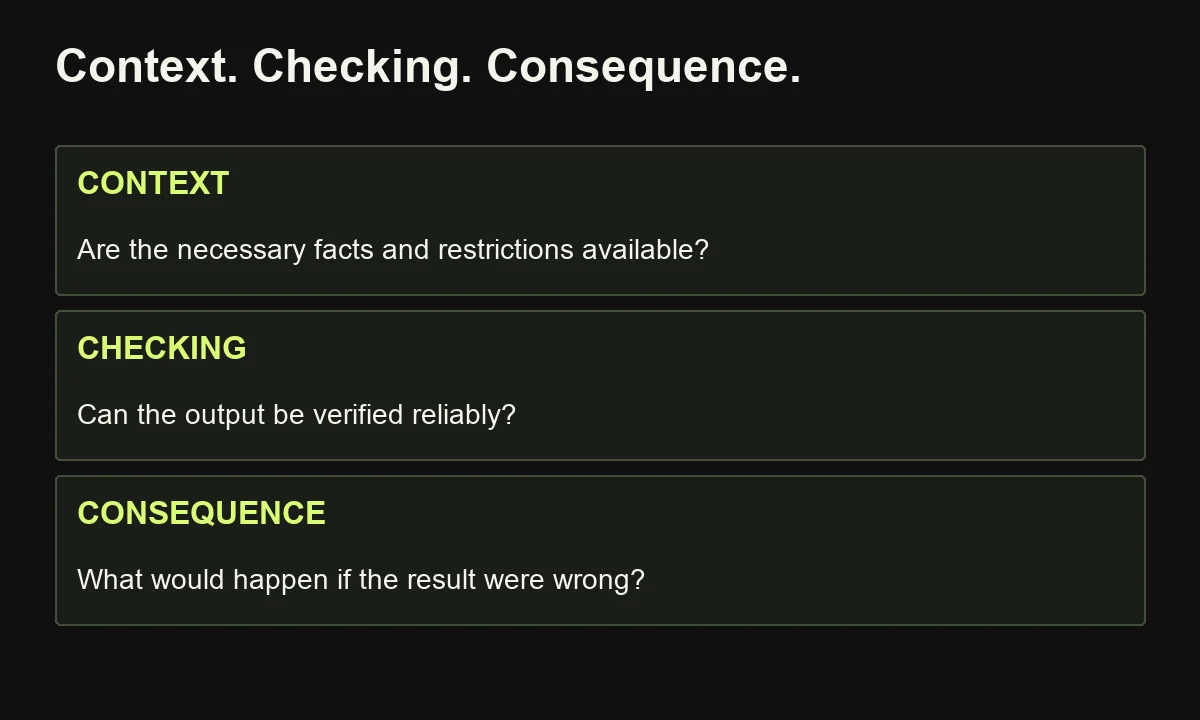
Use three questions to allocate a task: Is the necessary context available? Can the result be checked reliably? What happens if it is wrong? This is a proposed planning framework, not a validated prediction model. Its purpose is to make delegation decisions explicit and reviewable.
Context: Supply approved facts, audience needs, restrictions and examples. An instruction to “write something persuasive” leaves the system to fill important gaps. An instruction based on a verified product brief gives it a firmer foundation.
Checking: Specify what a reviewer will compare against. A source reference helps only if someone opens it and confirms that it supports the exact claim. Writing that sounds plausible has not passed that test.
Consequence: Consider customer harm, wasted spend, misleading claims and damage to trust. Increase review where a mistake would materially change someone's decision.
Choose an appropriate operating mode:
- Assist: AI proposes options; a person develops the argument and approves the result.
- Draft with verification: AI works from approved material; a named reviewer checks the output before release.
- Automate a bounded step: An established, low-consequence operation runs with monitoring and an exception path.
When context is missing, improve the brief or gather evidence first. When checking is unreliable or consequences are serious, narrow the task. Reassess after tool, product or policy changes. A workflow that worked last quarter is not automatically suitable for a different assignment today.
4. What makes content worth choosing when drafts are cheap?
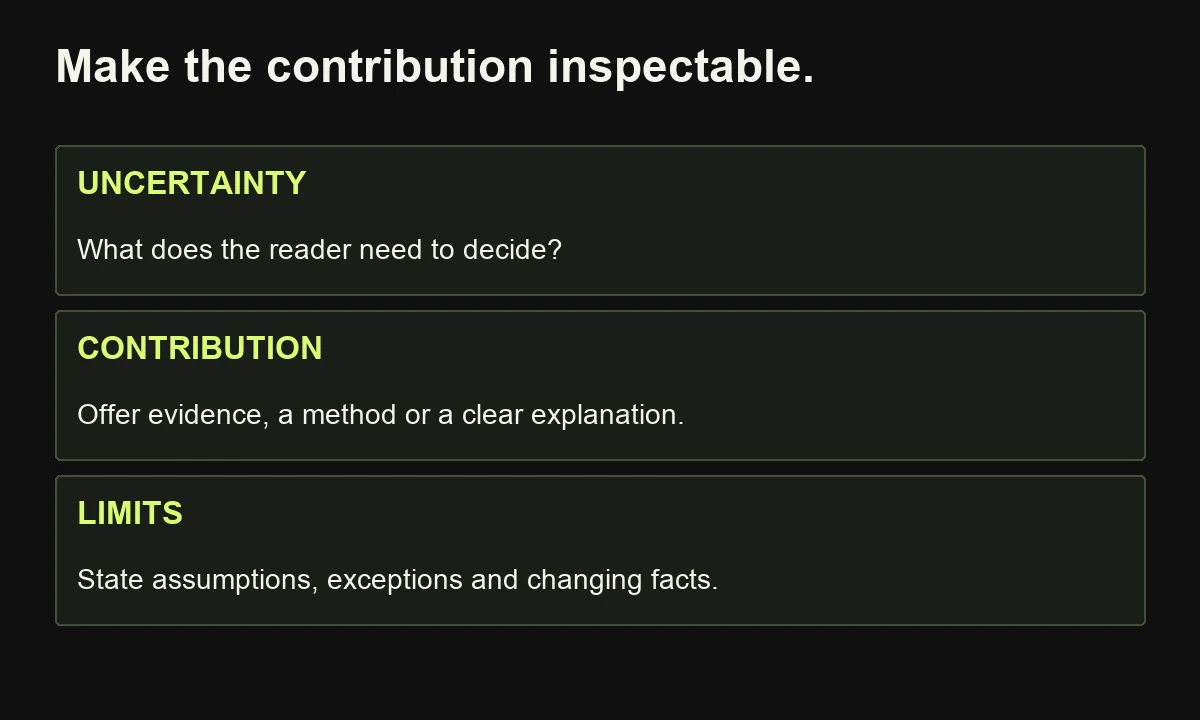
Content becomes valuable when it resolves uncertainty better than the alternatives. That may require original evidence, a useful comparison, an unusually clear explanation or a recommendation with explicit limits. Human authorship alone does not establish quality, and AI assistance alone does not disqualify an otherwise useful resource.
Ask a harder editorial question: what can the reader understand or do after this piece that they could not do before?
For a software buyer, that could mean understanding migration responsibilities. For a skincare shopper, it could mean identifying the relevant product information and knowing when a professional's advice is needed. For a marketing leader, it could mean estimating whether a workflow creates capacity or just moves effort elsewhere.
Originality does not require inventing a new concept every week. It can come from documenting an overlooked exception, explaining a real process, publishing a transparent calculation or showing why a common recommendation fails under particular conditions.
Give important contributions enough detail to inspect. Explain how a comparison was made, where examples are hypothetical and which facts could change. A downloadable template can help, provided the article also teaches people how to use it.
My six principles of successful B2B content develop this decision-focused approach. The relevant competitive advantage is the usefulness of the contribution, supported by evidence, rather than a label attached to the production method.
5. Can AI improve creativity without making brands sound alike?
Yes, AI can contribute useful creative options. The risk is that teams accept similar defaults, examples and arguments without investigating alternatives. Use it to expand the possibilities, then evaluate ideas against customer evidence, the brand's position and the purpose of the piece. Fluency and distinctiveness are separate editorial tests.
Doshi and Hauser's short-story research found that access to AI ideas improved evaluated creative output while making assisted stories more similar to one another. That finding concerns a specific experimental writing setting. It is not proof that every AI-assisted campaign will become generic.
It does provide a useful warning about accepting the first plausible direction.
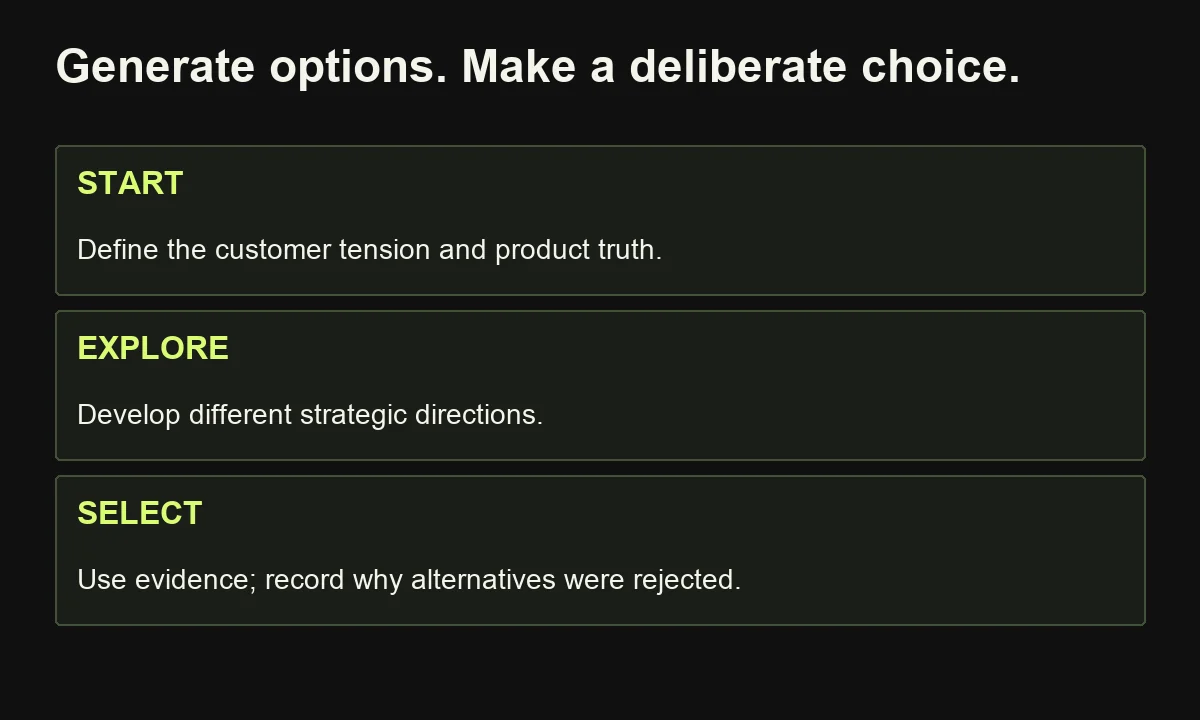
Before generating options, write down the real tension: what does the audience believe, what is incomplete about that belief and what evidence can the business contribute? Ask for competing approaches, including reasons each might fail.
For example, a consumer repair brand could explore convenience, maintenance confidence and repairability. Those are different strategic territories, not merely three versions of the same headline. Choose using product truth and audience research, then develop the execution.
Preserve a record of rejected directions and reasons. This makes future work more informed and helps reviewers distinguish a deliberate brand choice from a familiar model suggestion. The goal is a better creative decision, not a competition to demonstrate who can generate the longest list.
6. Worked B2B example: turn expertise into a useful buying guide
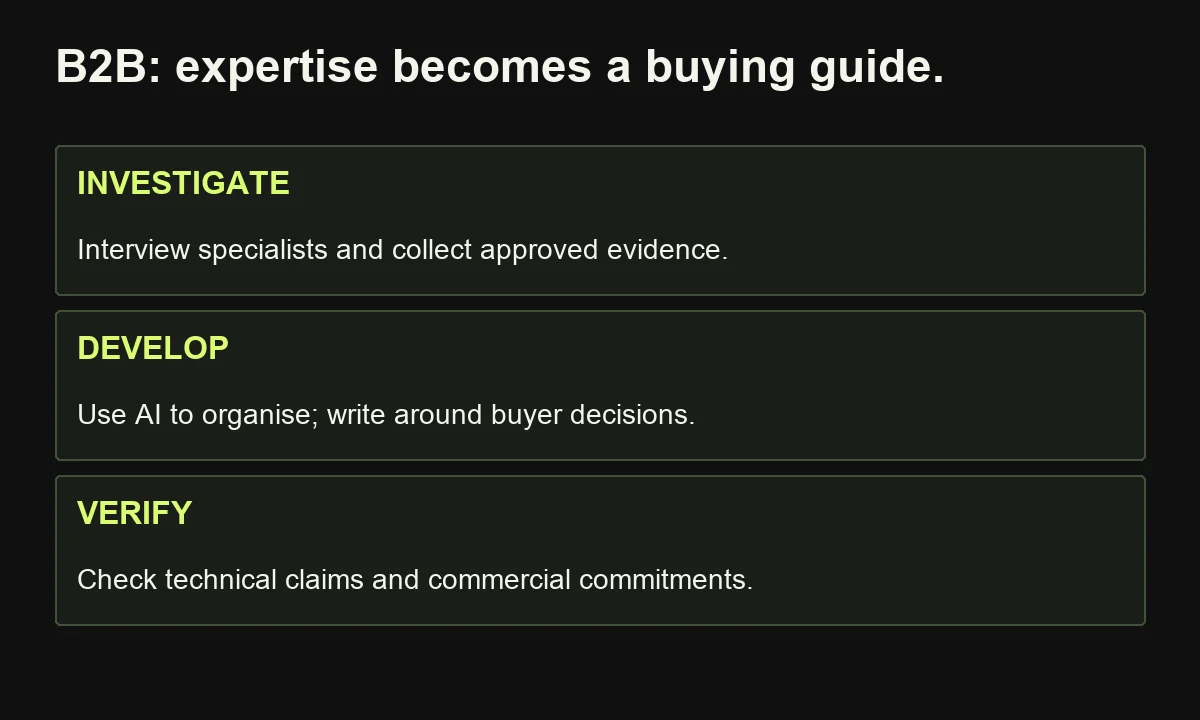
Suppose a cybersecurity consultancy wants a guide about preparing for an assessment. This is an illustrative workflow, not a client case study. Starting with a prompt for a comprehensive article risks producing confident generalities. Start with the buyer's decision and the consultancy's actual delivery process instead.
The strategist interviews a delivery specialist: what must clients prepare, which missing inputs cause delay, what varies by scope and which commitments should never be implied? Collect approved documents and separate public material from confidential client information.
AI can organise the notes into candidate questions, identify repeated themes and propose an outline. Require it to flag missing evidence rather than manufacture a confident answer.
The writer then builds the argument around useful decisions: readiness, responsibilities, scope and next steps. The specialist verifies technical statements. Someone authorised to discuss the service checks commercial commitments. One person may hold several responsibilities, but each approval should be explicit.
Before publication, ask a colleague unfamiliar with the engagement to explain what the buyer must do next. If they cannot, the draft may be accurate but still unhelpful.
Connect the guide to the relevant service and a genuine, permissioned case study where available. Track whether enquiries become better informed. Producing the article faster is useful; reducing avoidable confusion is the business reason for producing it at all.
7. Worked B2C example: help a shopper make a better choice
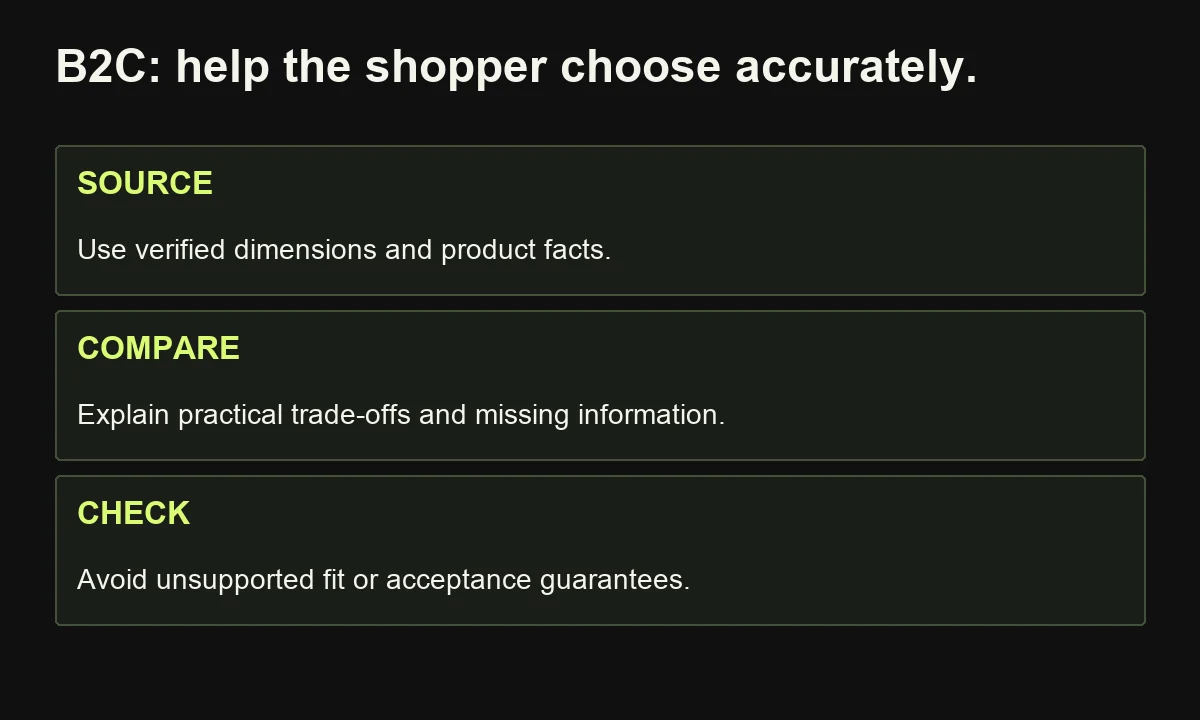
Imagine a luggage retailer preparing a comparison of cabin bags. The useful contribution is not an enthusiastic description of every model. It is helping a shopper understand dimensions, packing needs, weight and limitations. AI can assist the comparison, but unsupported travel or product claims can make the advice misleading.
Build a source sheet containing verified external dimensions, measurement method, weight, capacity information and relevant product restrictions. Date information that may change. Distinguish manufacturer specifications from any measurements the retailer actually performed.
Ask AI to prepare a comparison using only the approved fields and to mark missing values. Do not let a missing measurement turn into a convenient estimate.
A reviewer checks every number, whether wheels and handles are included, and whether the wording implies an airline acceptance guarantee. Any airline-specific advice needs a current authoritative source and its conditions; a general size label is insufficient.
The finished guide can explain trade-offs such as a lighter shell versus organisational features. Include real product images or clearly labelled diagrams that help the decision. Never generate a product feature or demonstration the item does not have.
Measure useful outcomes: qualified product visits, customer questions and recurring misunderstandings, alongside sales where attribution permits. If the guide produces more purchases but also creates avoidable expectation problems, the evaluation is incomplete. A customer-focused content strategy includes what happens after the click and after the sale.
8. How do you calculate the real value of AI-assisted content?
Compare equivalent completed work, including preparation, review and corrections. Faster drafting does not automatically mean lower total cost, cash savings or higher revenue. Measure the full workflow and define the quality standard first. Otherwise, a team can report impressive production gains while quietly transferring effort to editors or subject specialists.
Consider this hypothetical comparison for one article:
| Active work | Existing process | AI-assisted pilot |
|---|---|---|
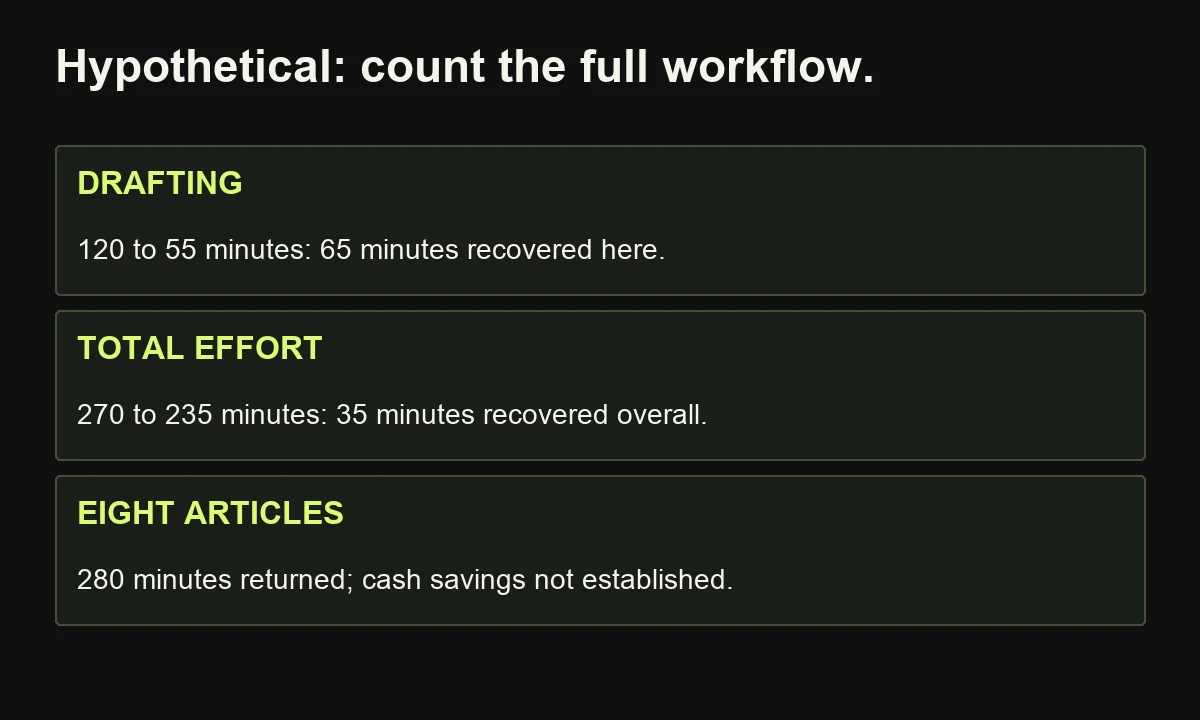
| Research and brief | 90 minutes | 100 minutes |
| Draft development | 120 minutes | 55 minutes |
| Verification and editing | 60 minutes | 80 minutes |
| Total | 270 minutes | 235 minutes |
The draft stage improves by 65 minutes, but net time recovered is 35 minutes per article. At eight equivalent articles, that is 280 minutes, or four hours and 40 minutes. These are invented planning inputs, not measured results or an industry benchmark.
Add subscriptions, setup, training and maintenance to the financial comparison. Recovered salaried time is capacity; it becomes cash savings only when expenditure actually falls. Define what the freed capacity will support, such as customer interviews or improving underperforming service pages.
Keep a record of major errors and rejected drafts. If quality declines, the comparison is not like-for-like. My guide to whether marketing automation is worth the money explains the distinction between useful capacity and a defensible financial return.
9. How should content adapt to SEO, AEO and GEO?
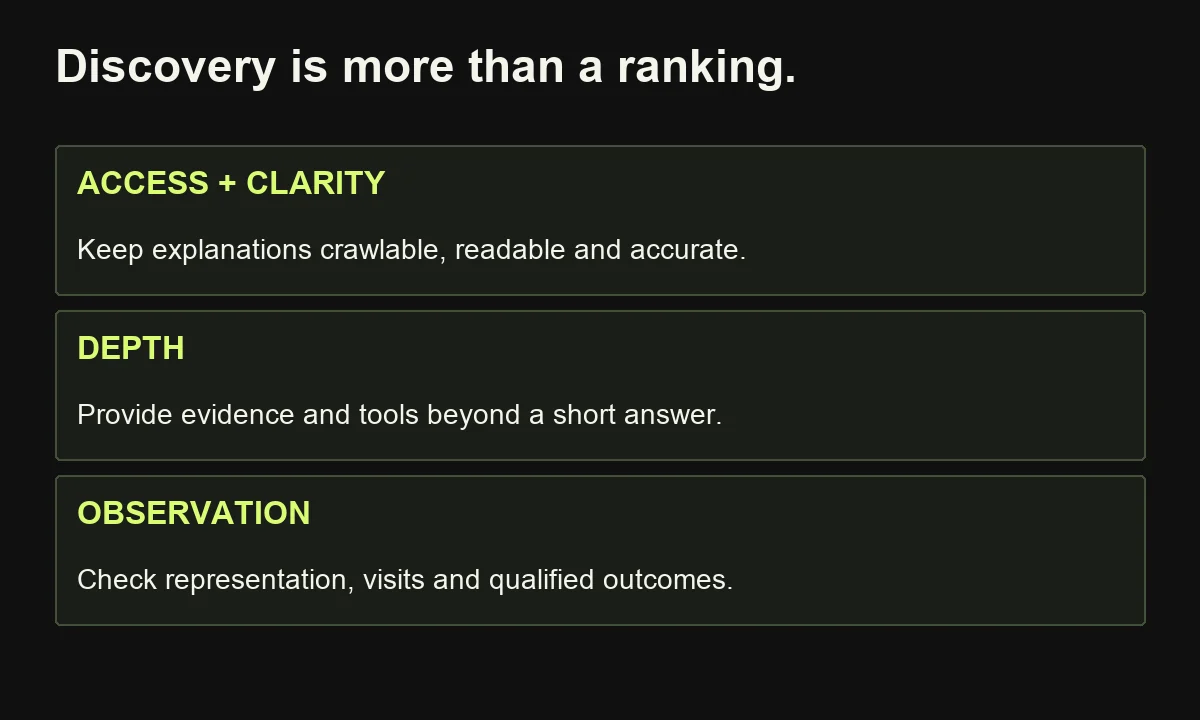
Make your content accessible, accurate and useful wherever people encounter it. Search rankings, generated answers and direct visits are different discovery outcomes. Support them with clear explanations and evidence, then measure them separately. No heading pattern, schema type or summary length guarantees that a search engine or AI assistant will select you.
Google's generative search guidance connects AI-search visibility with established SEO foundations and useful, distinctive content. It also rejects supposed requirements such as special AI text files and fixed content chunking. That guidance applies to Google; other platforms have their own access and display rules.
Practically, answer the main question early. Explain the conditions under which the answer changes. Use descriptive headings, readable tables and evidence close to the claim. These choices help readers assess the argument, whether or not a platform cites it.
Publish resources that justify a visit beyond a short answer: worked examples, comparison methods, credible evidence and tools people can adapt. Keep important facts in visible page text, not only inside an image.
Connect related resources where the reader needs them. A buying guide may need a case study, which may need a service description. The purpose of internal linking is to support that investigation. Monitor factual representation in generated answers as well as visits; a brand mention that misstates your service is not an uncomplicated success.
10. What should content marketers learn next?
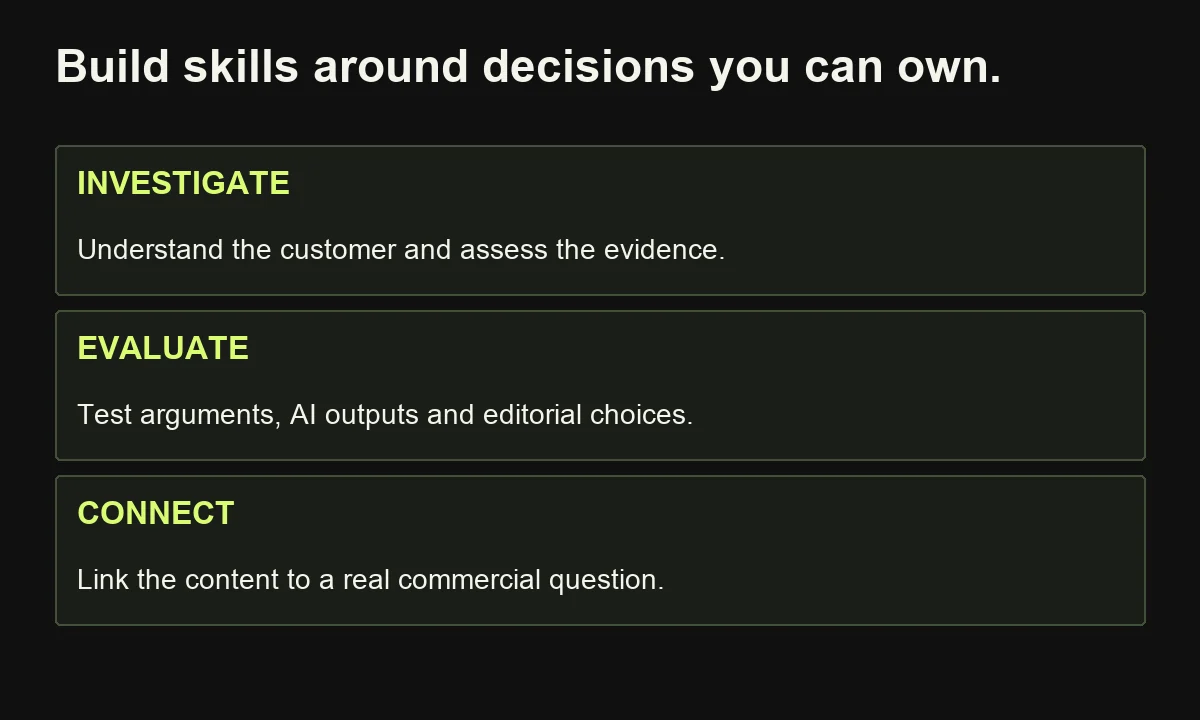
Learn to investigate a business problem, evaluate evidence and operate an assisted workflow. Prompting is useful, but it cannot compensate for an unclear audience or a weak offer. Your development plan should improve the quality of decisions you can own, alongside the efficiency of the work you can produce.
Prioritise four capabilities:
- Customer research: Conduct interviews, separate observations from interpretations and recognise what the sample cannot establish.
- Editorial judgment: Build an argument, test examples, remove unsupported claims and explain trade-offs clearly.
- AI evaluation: Test representative assignments, inspect failures and document when assistance is inappropriate.
- Commercial understanding: Connect content to a real buying question and an observable next step.
For junior marketers, protect opportunities to learn the underlying work. Ask them to explain why an outline works, verify sources and critique competing drafts. If software always supplies the answer before they attempt the problem, managers have less visibility into their reasoning.
For experienced practitioners, build portfolio evidence around decisions: the research question, the argument chosen, the sources used and the limitations. Only claim outcomes you can substantiate and share with permission.
No skill list offers permanent immunity from labour-market change. It does make your contribution easier to inspect. A client should be able to see why your involvement improves the work, rather than being asked to pay a premium solely because a person touched the draft.
11. Run a 30-day adaptation pilot before scaling
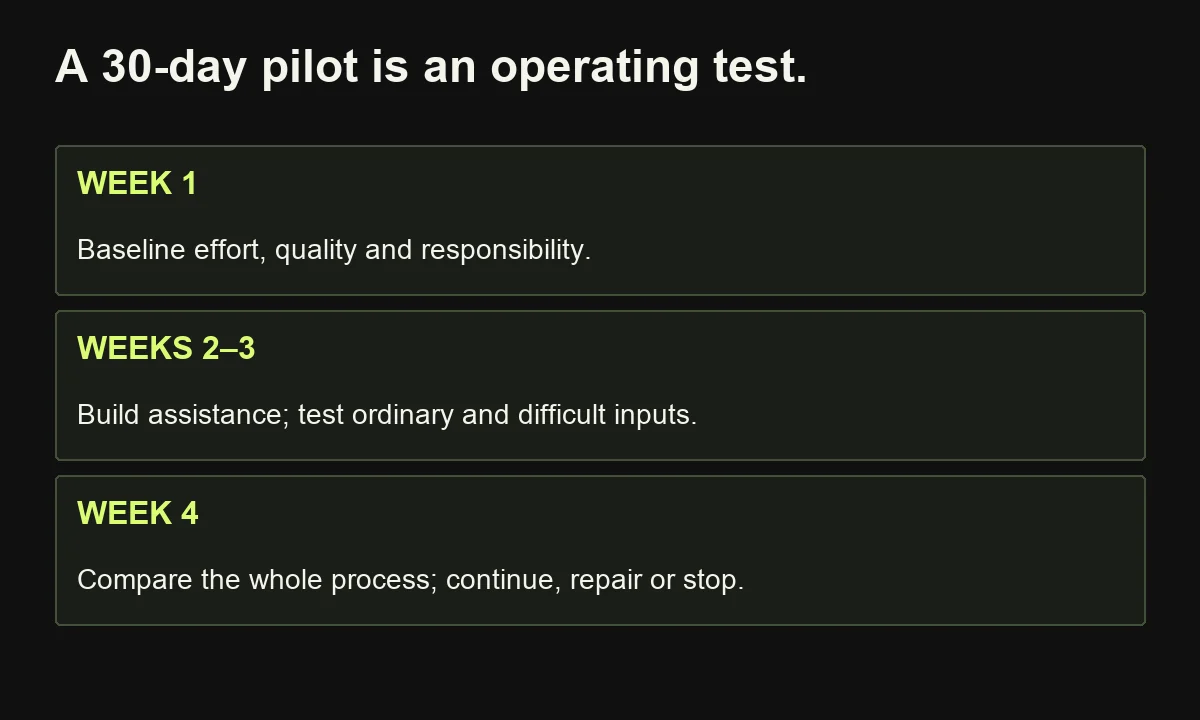
Start with one recurring, bounded workflow and compare it with a documented baseline. Thirty days can reveal operational problems and early efficiency signals; it usually cannot establish long-term revenue impact. Define success, stop conditions and responsibility before the pilot so that enthusiasm does not become the evaluation method.
Week one: establish the baseline. Choose a task with approved inputs and enough repetition to observe differences. Record staff time, review requirements and recurring errors. Agree what acceptable output means.
Week two: build the assisted version. Prepare the source material and instructions. Name the reviewer. Specify what happens when evidence is missing or the output contradicts a source. Use tools approved for the information involved; confirm applicable data handling and retention settings before supplying sensitive material.
Week three: test ordinary and difficult assignments. Include incomplete notes, changing product facts and an unsupported claim. Check whether uncertainty is flagged and whether the reviewer can catch mistakes without rebuilding the entire assignment.
Week four: decide. Compare full effort and quality. Continue if the improvement is useful, repair if the process shifts work elsewhere, or stop if the task is unsuitable. Keep a manual fallback.
Use the content task assessment worksheet to record context, checking, consequence, ownership and results. It is a planning aid, not a job-security score. Review the process again when its inputs, tools or business purpose change.
12. Frequently asked questions
Will AI replace content writers?
AI can perform parts of writing work, and some buyers may reduce spending on routine production. That does not predict every writer's future. Assess the assignments, their verification needs and the broader responsibilities involved. Research, writing, editing and commercial decisions can be combined differently as tools and budgets change.
Does Google penalise AI-written content?
Google's published guidance focuses on accuracy, quality, relevance and compliance with its policies. Generating many pages without adding value can violate scaled-content-abuse rules. Treat every draft and its metadata as material to verify; neither human authorship nor an AI tool guarantees acceptable content or search visibility.
Should a small business replace its content partner with AI?
First identify what the partner owns and where the actual constraint sits. If you need clearer positioning, customer research or a credible argument, faster drafts alone will not resolve that need. If the brief and evidence are complete, assistance may make a defined production task more efficient. Test before restructuring.
What is the best next step?
Audit one workflow and improve the weakest link. If you want help deciding what your content should say, what evidence it needs and where AI assistance belongs, tell me what you are trying to achieve. I can help with research, direction and writing. The useful question is what will make the content more valuable to your customers.