AI summary
The strongest case for B2B marketing automation is continuity: helping each interaction start with reliable context instead of making buyers and teams reconstruct the conversation. AI expands interpretation and preparation, but value depends on accurate information, useful content and accountable decisions.
- Connect decisions, not just channels: Preserve the current buyer question, its evidence and the next owner. Treat individual activity as limited evidence, rather than assuming one person’s engagement establishes the whole account’s readiness.
- Match assistance to responsibility: Use rules for defined actions and AI for appropriate interpretation or drafting. Keep source material accessible, review consequential commitments and stop pending actions when circumstances change.
- Prove the improvement before expanding: Pilot one interaction path using existing tools where possible. Measure context availability, response usefulness and full operating effort separately from revenue. Scale only when the evidence and maintenance capacity justify it.
B2B marketing automation matters to the future because it can connect buyer information, relevant content and timely action across teams and channels. Its strongest role is maintaining a useful conversation as circumstances change. AI expands what systems can interpret and prepare, while people remain responsible for strategy, evidence and consequential decisions.
A prospect reads your guide, attends a webinar and asks a detailed question. Two days later, they receive an introductory email explaining a problem they already understand.
The company has automated its communication. It has not maintained the conversation.
That distinction is the argument behind this guide. The future opportunity is continuity: helping the next interaction start with what the business reliably knows already. More messages, more tools and more generated content cannot provide that on their own.
Calling automation “the future” is a strategic judgment, not a promise that every business needs an enterprise platform or that adoption guarantees growth. The relevant question is which coordination problems it can solve, and under what conditions.
This article examines the evidence, the practical direction of change and two illustrative B2B situations. It also proposes a way to assess whether your own marketing preserves context or keeps making people start again.
For the execution sequence, use how to start with B2B marketing automation. Here, the focus is why the capability matters and how to prepare for a more connected, AI-assisted way of working.
1. What is changing in B2B buying?
B2B buyers can investigate independently, switch channels and involve colleagues before speaking with a supplier. That creates a coordination challenge: the business needs to support different tasks without treating every interaction as a fresh lead. Automation can help maintain relevant context, but it cannot observe every conversation or establish every buyer's intentions.
Gartner's June 2025 release reports that 61% of surveyed B2B buyers preferred an overall rep-free experience. The survey covered 632 buyers in August–September 2024. Importantly, preferences changed by task: buyers favoured seller input when assessing fit for their company's situation.
This is reported preference, not evidence that buyers never want people involved.
McKinsey's 2024 B2B Pulse surveyed nearly 4,000 decision-makers across 13 countries. Respondents used an average of ten interaction channels during their buying journey. That is a dated survey finding, not a requirement for a small business to launch ten channels.
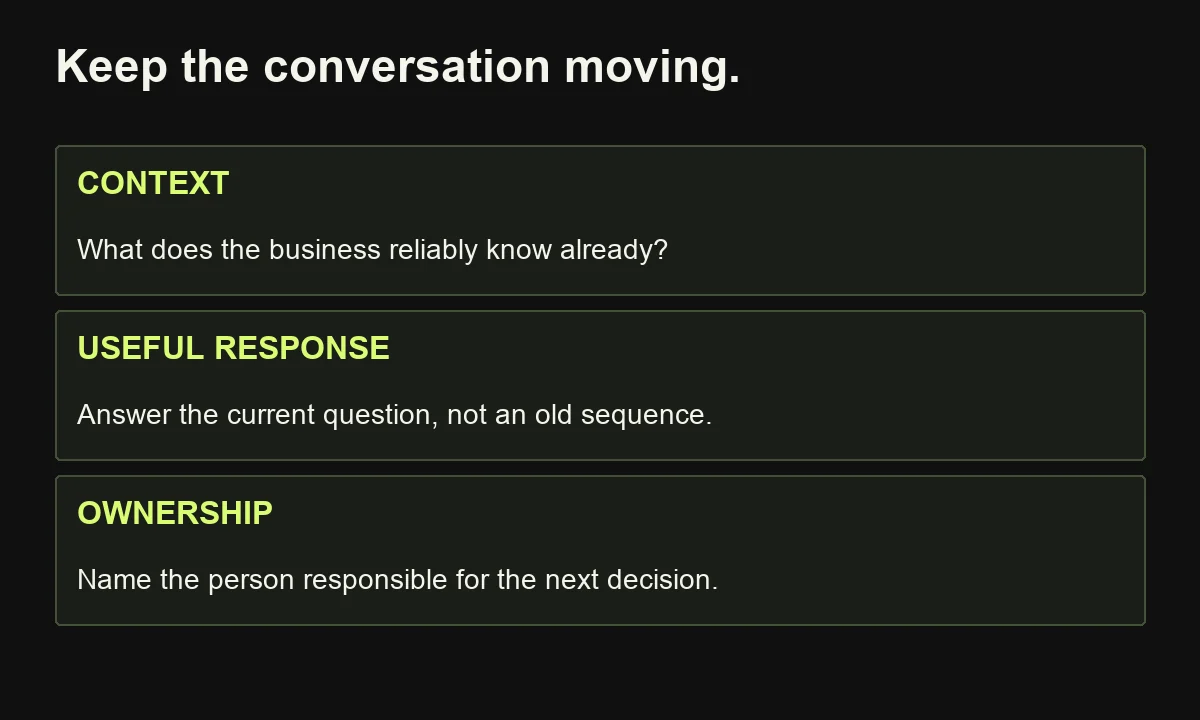
Together, these findings support a practical planning question: can someone move from an independent explanation to a useful human conversation without losing the relevant context?
Keep source limitations beside the finding. Neither survey proves that your particular workflow will increase sales. They explain why coordinated experiences deserve investigation, while your own customer research determines which interactions need attention first.

2. The shift is from completing tasks to maintaining continuity
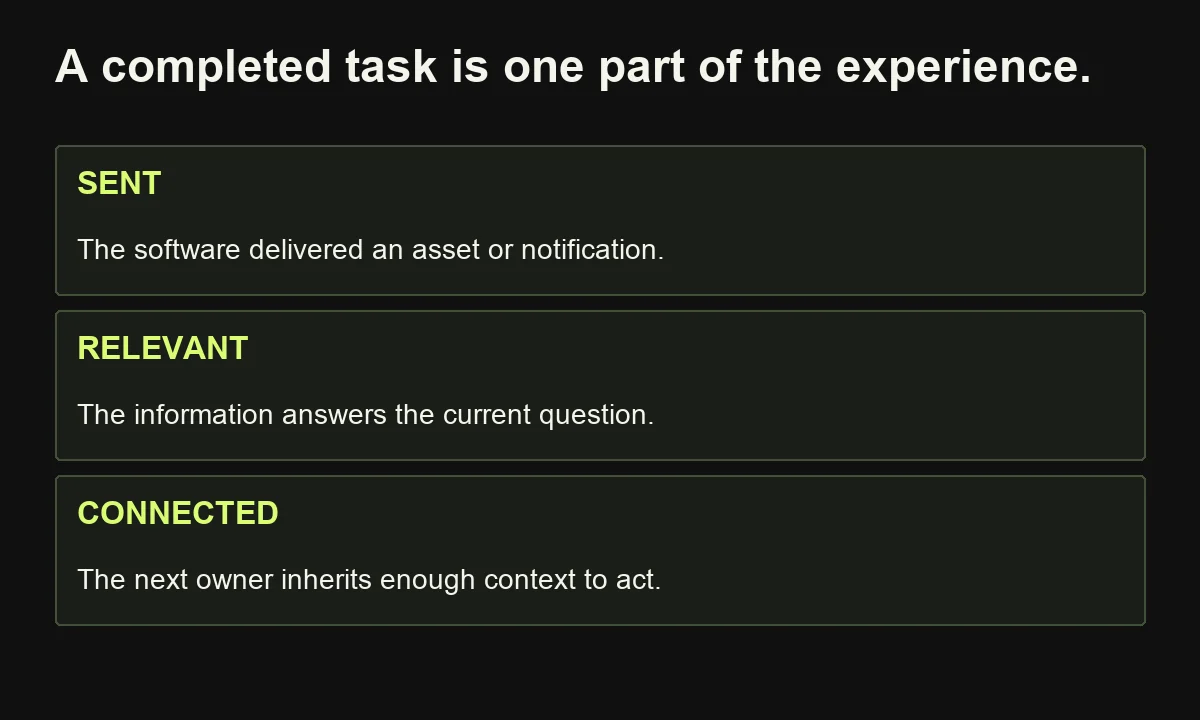
Task automation performs a defined action, such as sending a resource or updating a record. Coordinated automation considers how that action affects the next interaction. The useful difference is not simply more advanced software. It is whether the process preserves the request, respects changed circumstances and helps the next person act appropriately.
Consider the difference:
| Task completed | Continuity question |
|---|---|
| A guide was delivered | Which question did it help the reader investigate? |
| A lead score increased | What evidence supports the proposed next action? |
| Sales received a notification | Does the owner have enough context to respond? |
| A follow-up was scheduled | Is it still relevant when the send time arrives? |
I use context debt here to describe the repeated reconstruction work created when useful information is lost, contradictory or inaccessible. It is a practical label, not a validated economic measure or an original research finding.
Context debt appears when buyers repeat requests, sales reconstructs conversations or different messages make incompatible promises. Automation is valuable when it reduces that unnecessary work without making unsupported assumptions.
The appropriate response might be a shared field, a clearer content asset or a connection between existing tools. AI may help interpret unstructured notes, but it is not required for every improvement.
Ask what the next interaction needs to inherit. That question produces a more useful requirement than “we should automate more of the funnel.”
3. Buying groups make individual lead journeys incomplete
A B2B purchase can involve several people investigating different questions. An individual's activity provides useful evidence about that person, but it does not automatically describe the company's decision. Automation should connect relevant relationships while keeping uncertainty visible, rather than promoting an entire account to “ready to buy” because one contact clicked.
Adobe's buying-group documentation distinguishes accounts, participating people and groups associated with particular offerings. That is a useful capability model, not proof that every company needs an enterprise buying-group platform.
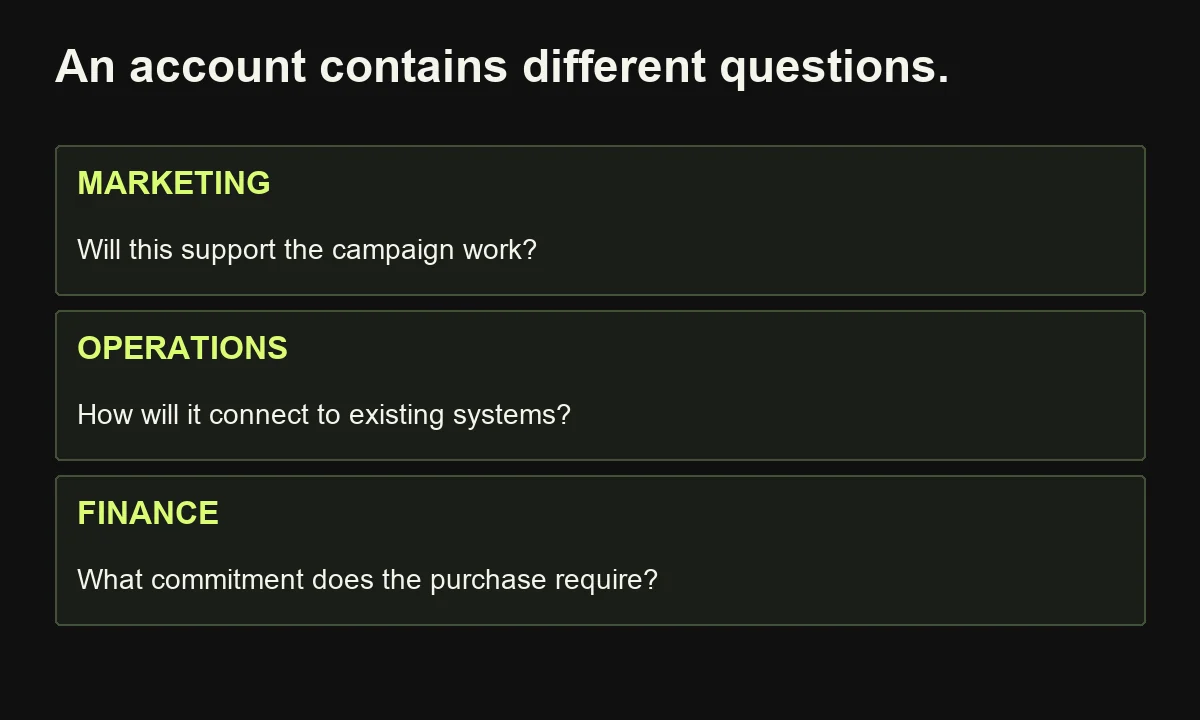
For a software purchase, marketing may investigate campaign execution, operations may inspect integration and finance may assess commitment. These are related questions with different evidence needs.
Record the relationship and the unresolved decision where it is known:
- Which company or relevant business unit is involved?
- What has this person actually requested or confirmed?
- Which concern remains unresolved?
- Who owns the next useful response?
Do not infer a colleague's identity or buying role solely from a company domain. Shared employers do not establish participation in the same purchase.
Use ICP and buyer-persona research to distinguish account suitability from individual needs. Then coordinate messages around verified context. A useful system can preserve “unknown” until a conversation supplies the answer.
This is why B2B marketing automation has a role beyond delivering a fixed series of emails: it can help teams work from a consistent, qualified understanding of an evolving evaluation.
4. AI makes more information usable, but does not make it true
AI can help interpret requests, organise research, summarise conversations and prepare relevant content. Those capabilities can reduce the effort involved in maintaining context across a larger volume of interactions. They also introduce interpretation errors, so the system must distinguish original evidence, generated suggestions and decisions approved by the responsible person.
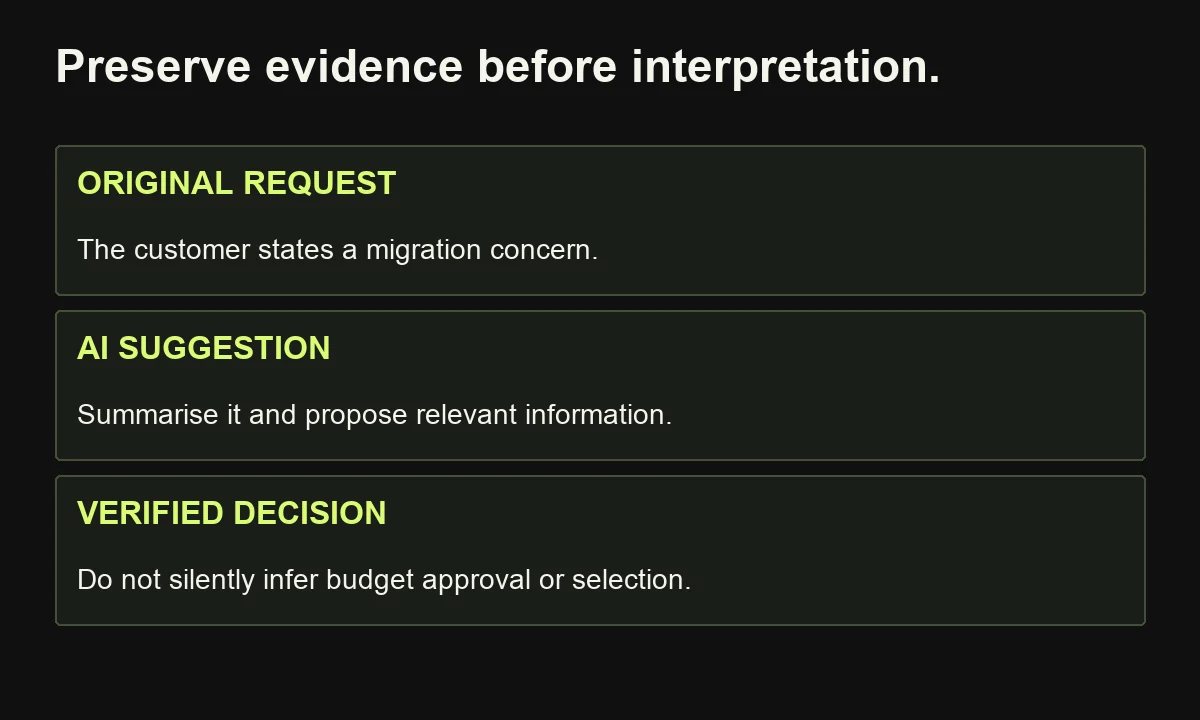
A hypothetical example: a prospect writes, “We are comparing two approaches, but our operations team is concerned about the migration.”
AI can propose a summary, identify the migration question and suggest an appropriate preparation guide. It should not quietly change the record to “budget approved” or assume the buyer has selected a vendor.
Salesforce's 2026 State of Marketing summary reports widespread AI adoption alongside continued problems accessing usable customer data. Its methodology describes 4,450 marketing decision-makers surveyed in October–November 2025 across several regions. This is vendor-sponsored, self-reported marketing research, not a B2B-only experiment proving that agents improve revenue.
The implication is straightforward: access to AI and the ability to use relevant information are different achievements.
Build a reviewable path from source material to interpretation to action. Keep the original request available, state what remains uncertain and verify important claims. A model-generated explanation can be useful without becoming an authoritative statement of the customer's situation.
For practical applications, see my guide to using AI in marketing.
5. Rules, AI assistance and agents have different jobs
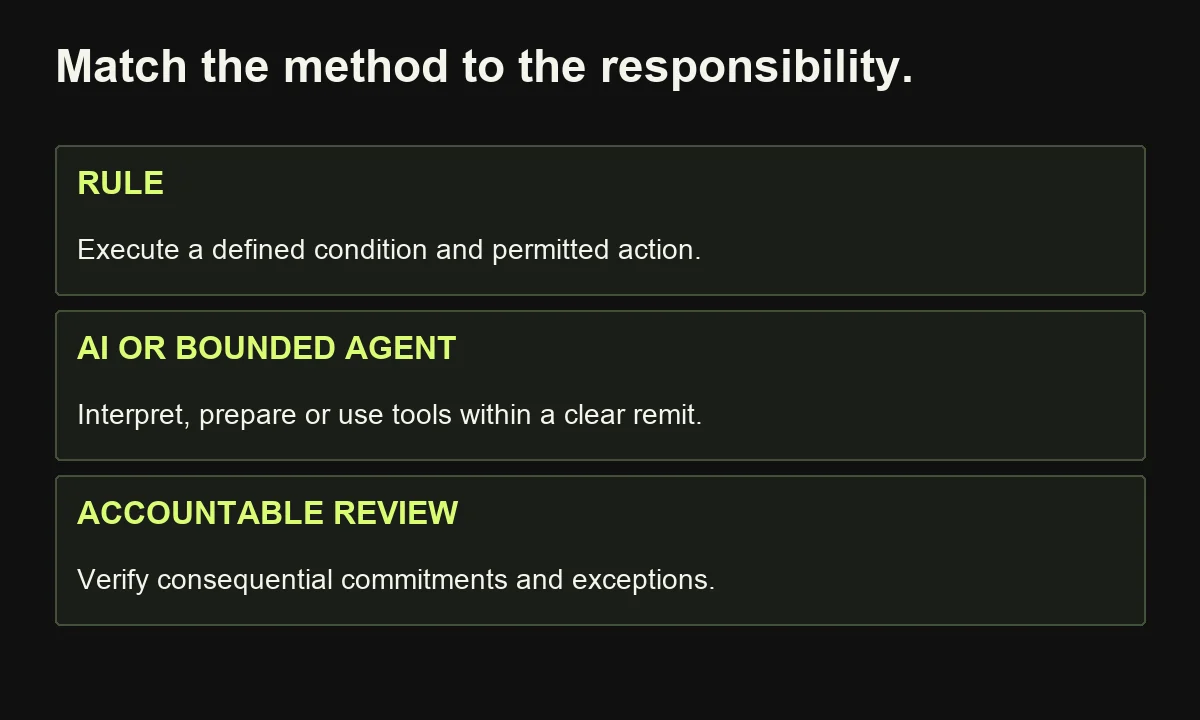
Rules are useful when the condition and permitted response are explicit. AI assistance helps when interpretation or drafting is needed. An agent can select and use tools within a defined remit. These approaches can coexist; the most capable system is not necessarily the one with the greatest freedom to act.
For example:
| Need | Suitable starting approach |
|---|---|
| Apply a known service-category routing rule | Deterministic rule |
| Summarise a customer's free-text concern | AI assistance with verification |
| Gather approved information from several tools | Bounded agent with access limits |
| Promise a bespoke delivery date | Accountable human decision |
n8n's human-review documentation illustrates selective approval before particular agent tool calls. It is an implementation example, not a guarantee that any configured workflow is safe or commercially useful.
Define the permitted actions, information sources and escalation path. Require review where an action could make an important commitment, misrepresent the offer or materially affect a relationship.
A person should approve the actual message or action proposed, not an earlier version whose meaning changed afterward. Keep an appropriate record of the decision and the resulting outcome.
This is augmentation in practical terms: software handles suitable work, while people supply direction and remain accountable. Human involvement should have a defined job, rather than serving as a vague reassurance added to an otherwise unexamined process.
6. A continuity record is more useful than a bigger contact profile
Maintain the smallest trustworthy record that helps the next interaction. More fields do not automatically create better personalisation. The useful information explains what is being investigated, where the evidence came from, what changed and which next action is appropriate. Data that lacks purpose or cannot be verified can increase confusion.
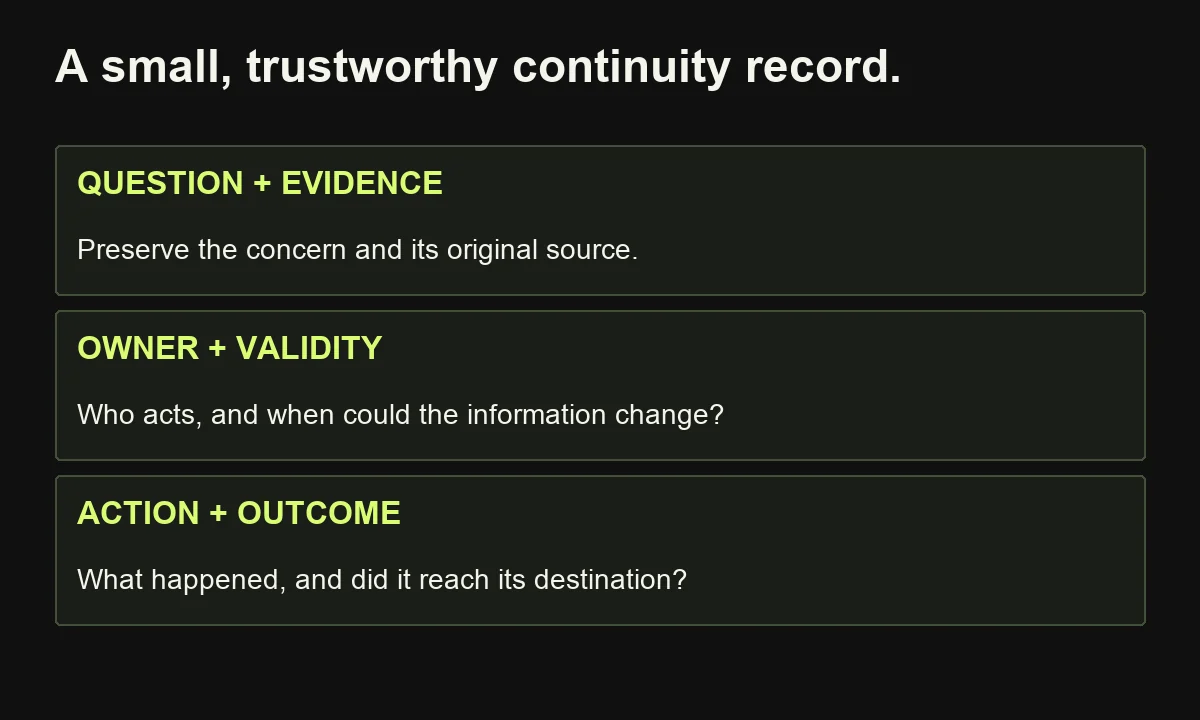
Here is a proposed continuity record for a B2B evaluation:
| Element | What to preserve |
|---|---|
| Current question | The buyer's actual unresolved concern |
| Evidence | Original request, conversation note or approved fact |
| Interpretation | What the team thinks it means, labelled as such |
| Responsibility | Named owner and next decision |
| Validity | When the information was confirmed and what could change it |
| Action and outcome | What happened, and whether it reached its destination |
This is an editorial and operating template, not a universal database design. Adapt it to the sensitivity of the information and the task.
Keep observed activity separate from inferred intent. “Downloaded a migration checklist” is an observation. “Ready to migrate this quarter” requires additional evidence.
Do not collect every possible signal. Use information appropriate to the relationship and applicable requirements, with access limited to people who need it. A qualified, current answer is more helpful than a large profile that confidently repeats an old assumption.
The competitive opportunity is applying useful context consistently, not accumulating the largest possible record about each person.
7. Worked example: a professional-services evaluation
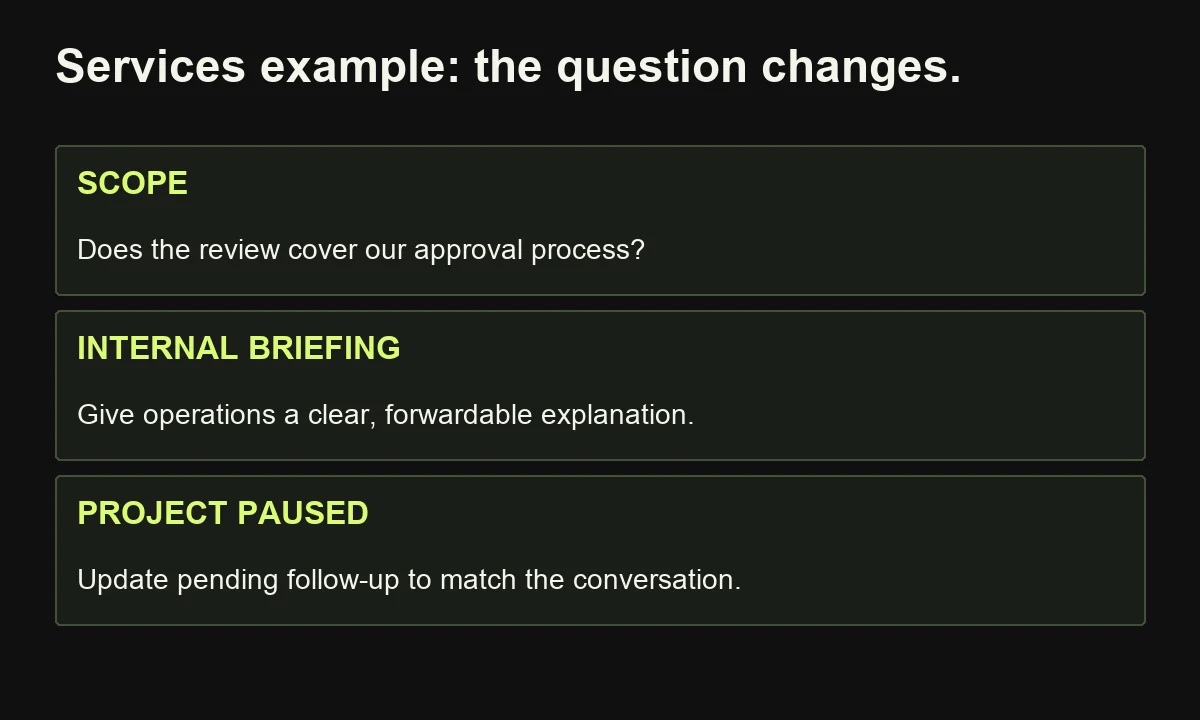
Imagine a B2B consultancy selling a workflow review. A marketing manager reads an educational guide, then asks whether the engagement includes reviewing existing approval processes. This is a hypothetical scenario, not a client case study. The immediate task is to answer the scope question accurately, not force the person into a generic sales sequence.
A connected process could work like this:
- Preserve the question and its source in the enquiry record.
- Match it to the current, approved scope explanation.
- Give the responsible person the question, relevant history and factual source.
- Prepare a reply explaining what is included and what needs clarification.
- Review the reply before making a bespoke commitment.
- Record the response and any agreed next step.
Suppose the prospect then asks for a short summary they can forward to operations. The next asset should explain the engagement's purpose, responsibilities and boundaries. Repeating the awareness article would not resolve the new question.
If the prospect says the project is paused, update the pending follow-up. Do not let an earlier schedule override the current conversation.
The useful automation connects a known question with reliable evidence and responsible action. The strategic work remains deciding what the buyer needs to understand. Research, content direction and clear writing make the automated step worth performing in the first place.
Evaluate whether the next conversation starts better informed, alongside the time required to maintain the process.
8. Worked example: a software buying group changes direction
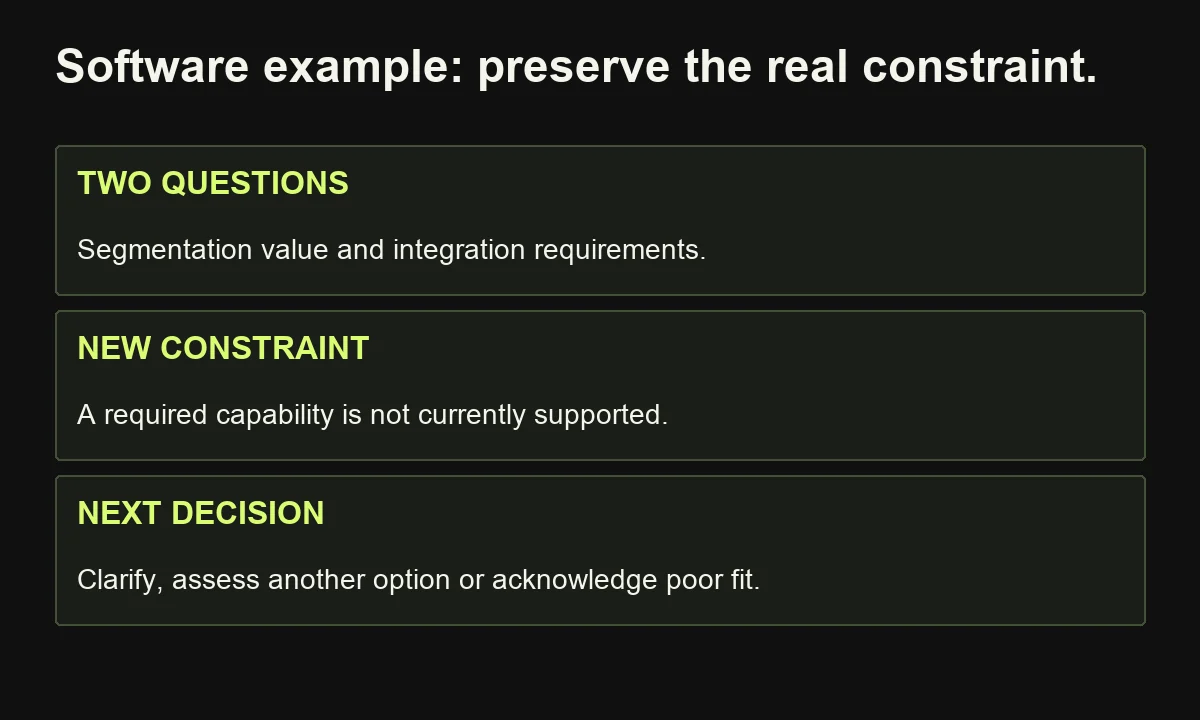
Consider a software company supporting an evaluation involving marketing and operations. Marketing wants better segmentation; operations needs to understand how customer records move between systems. Treating both people as a single lead score can obscure the practical questions that determine whether the evaluation can progress.
The marketing contact receives an explanation of campaign use cases. The operations contact receives a verified integration overview, including dependencies and limits. Link the relevant questions to the same evaluation only when that relationship is established.
Now suppose operations discovers a requirement the product cannot currently support. The system should preserve that constraint and inform the responsible people. Continuing to send generic “ready to get started?” messages would create activity without addressing the obstacle.
AI could summarise the technical discussion and draft a comparison of the approved options. A product or technical owner should verify the capability statements. Sales should not inherit a confident promise generated from an outdated knowledge source.
The next action might be clarification, a different configuration or an honest decision that the current offer does not fit. Automation can help coordinate each outcome; success is not always moving the account to the next sales stage.
Connect marketing, sales and delivery carefully. Share the context needed for the decision, with explicit ownership and qualifications. Apply the same principle after purchase: preserve onboarding commitments, unresolved issues and renewal questions instead of restarting a generic campaign.
9. Content becomes part of the operating system
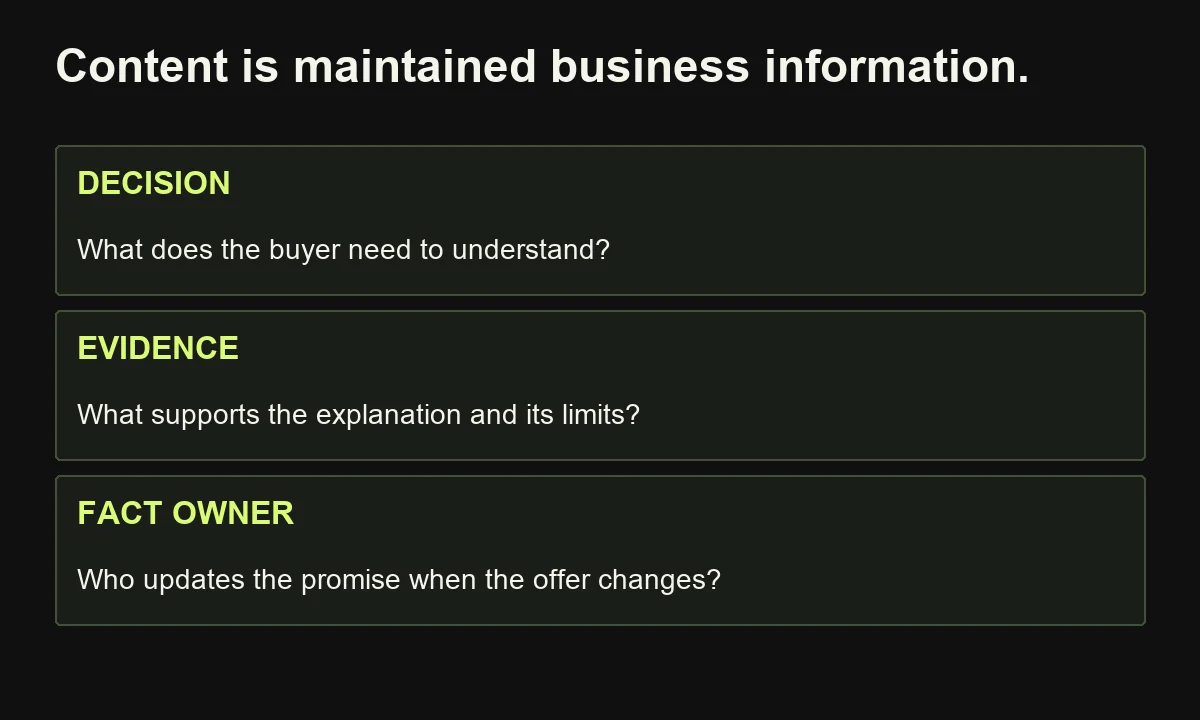
When a workflow selects information for a particular question, the quality of that information becomes an operating requirement. Content needs clear scope, inspectable evidence and a maintenance owner. An elegant automation can distribute a weak or outdated answer efficiently; it cannot make that answer reliable merely by personalising the greeting.
Build content around recurring decisions:
- What problem is this approach suitable for?
- What must be prepared before work begins?
- Which responsibilities belong to the customer?
- What does a relevant case demonstrate, and what does it not prove?
- When should another option be considered?
Connect the resources so someone can investigate further. A guide may lead to a case study and then a service explanation, with each link serving a real question. Avoid creating near-identical pages for every wording variation.
AI search makes consistency another practical concern. A prospect may arrive with an explanation assembled outside your website. Ask what they understand and supply a clear correction where necessary; do not assume the generated answer represented your offer accurately.
Google's AI-search guidance emphasises useful, distinctive content and established SEO foundations. Clear answers and credible examples help readers, but no special formatting guarantees a citation or recommendation.
My recommendation is to assign ownership to changing facts wherever they appear. An outdated service promise can create problems across a page, a sales reply and an automated message at the same time.
10. Measure whether the experience stays coherent
Measure operation, reader usefulness and commercial results as different outcomes. A successful software run does not prove that the response was appropriate. A helpful conversation does not prove that automation caused the sale. Define what improvement you expect, collect comparable evidence and preserve the uncertainty in your conclusions.
For a continuity pilot, inspect:
| Question | Evidence to review |
|---|---|
| Did the next owner receive the necessary context? | Request, evidence and ownership record |
| Did the response answer the current question? | Reviewer assessment and buyer clarification |
| Did changed circumstances stop inappropriate action? | Exit records and pending-message checks |
| Did fewer people reconstruct the same information? | Recorded staff effort and repeated questions |
| Did useful commercial progress follow? | Qualified next steps with consistent definitions |
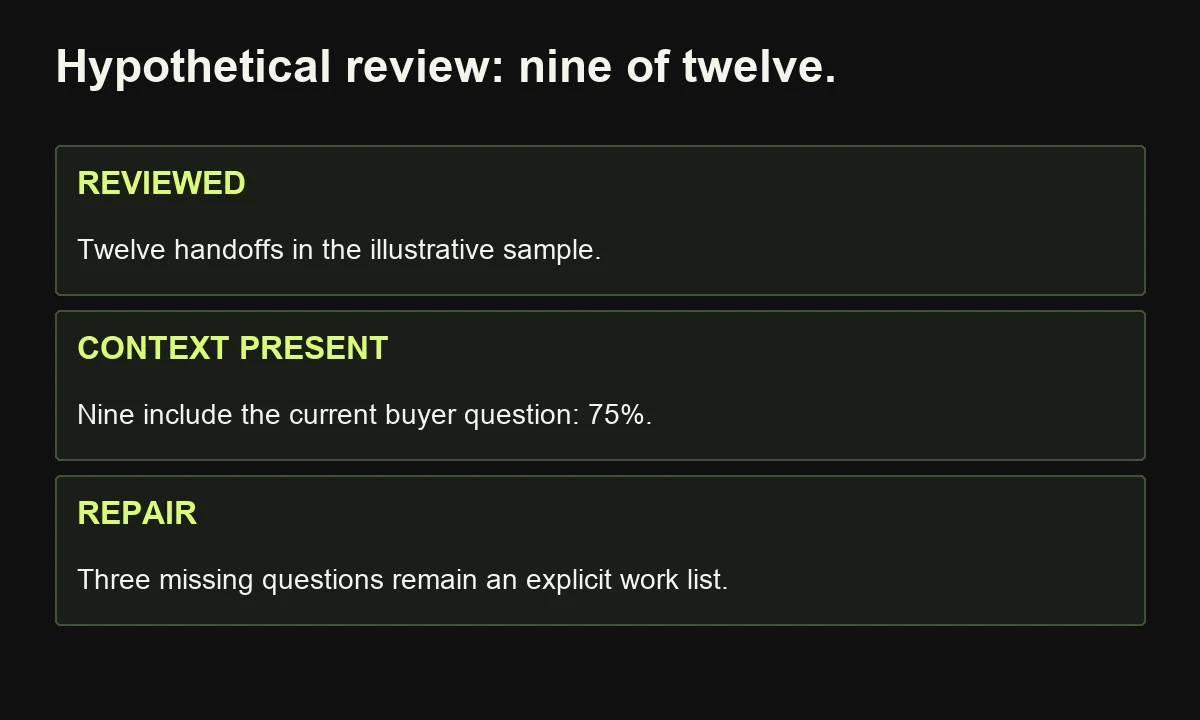
Keep denominators visible. If twelve hypothetical handoffs are reviewed and three lack the buyer's current question, nine of twelve contain it. That is 75% coverage in that sample, not a market benchmark or a sufficient quality standard.
The missing context is a repair list, not a reason to celebrate the nine records alone.
Compare similar types of request and follow-up periods. Record changes in staffing, offers and campaigns that could explain results. For a small pilot, qualitative findings may be more useful than claiming a statistically established revenue uplift.
The aim is to learn which part of the experience improves and what still requires attention.
11. How should a business prepare over the next 90 days?
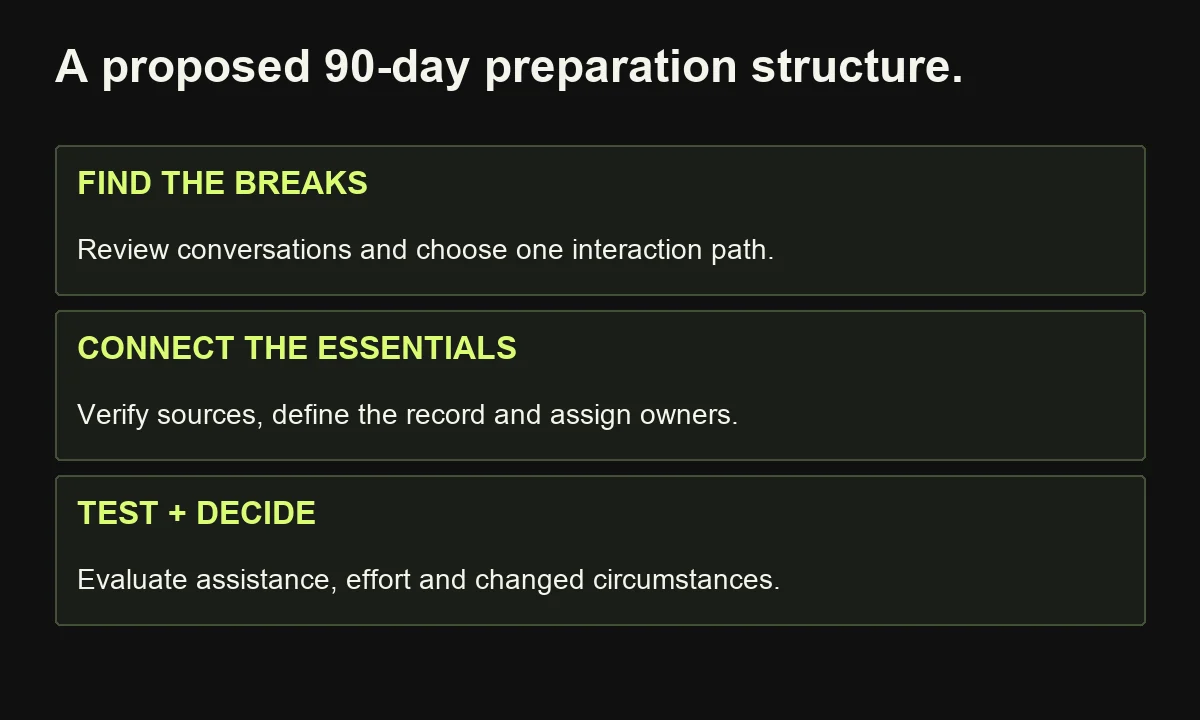
Prepare by strengthening one real interaction path, then expand only after its value and operating requirements are understood. A ninety-day plan is a proposed review structure, not a promised implementation timeline or a claim that commercial returns will appear within that period. Let the evidence determine the next commitment.
First phase: find the breaks. Review recent conversations and identify where information was lost, contradicted or repeatedly requested. Interview the people handling those moments. Choose one path where an improvement would help a buyer or the next responsible colleague.
Second phase: connect the essentials. Define the continuity record, verify the source material and assign an owner. Use existing tools where they meet the need. Test whether another person can understand the next action without reconstructing the whole history.
Third phase: test assistance and review. Add rules or AI only to a defined task. Compare full effort, check difficult examples and verify changed-circumstance handling. Decide whether to continue, repair or defer expansion.
Budget for research, content and maintenance alongside software. The B2B automation cost guide separates cash spending from internal effort so a promising idea does not hide an unowned workload.
Use the continuity planning worksheet to capture the buyer question, evidence, next owner, validity conditions and observed outcome. Keep assumptions visible and revisit them when the offer, source information or relationship changes.
12. Frequently asked questions
Why is B2B marketing automation considered the future?
It can coordinate information and appropriate action across increasingly varied interactions and buying groups. AI adds interpretation and preparation capabilities. The strategic case is stronger continuity and useful response, not a guarantee that every organisation should buy more technology or that all marketing decisions should become autonomous.
Will AI replace marketing strategists?
AI can perform parts of research, drafting and analysis, and roles can change. Businesses still need accountable decisions about audience, positioning, evidence and the relationship. Evaluate specific tasks and results rather than assuming either permanent job protection or universal replacement. A human label alone does not establish the quality of the work.
Does every small business need an advanced platform?
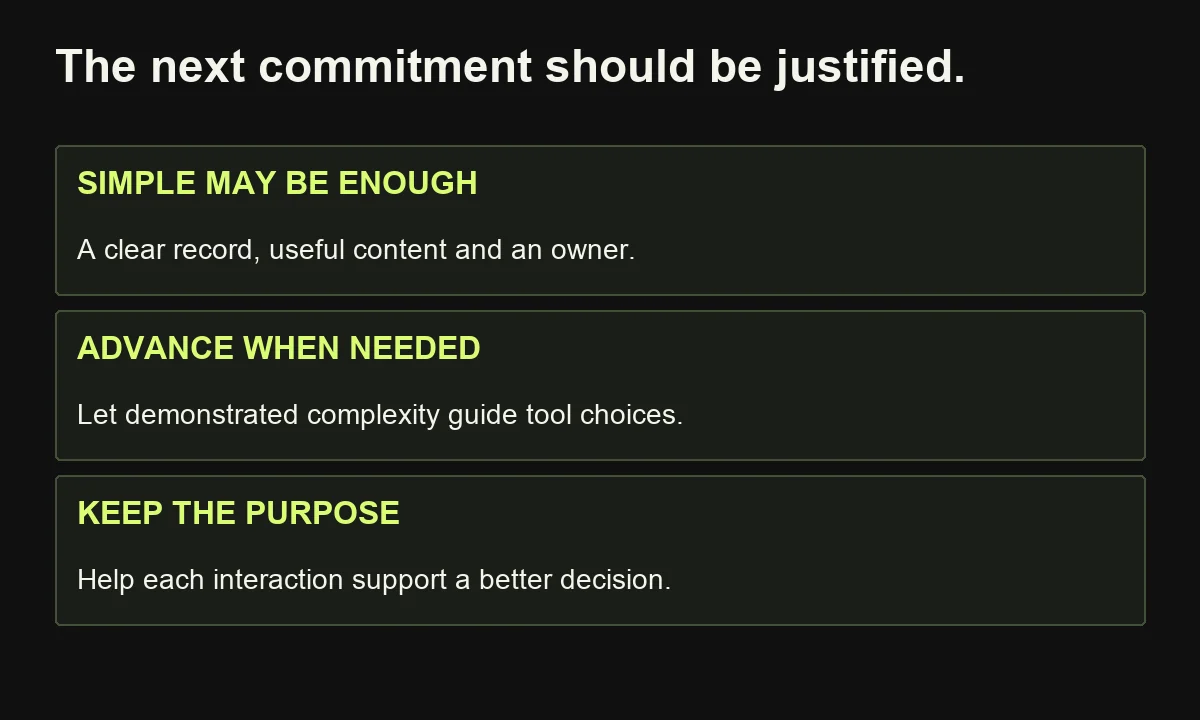
No. A shared record, clearer content and an agreed owner may solve the immediate problem. Consider more advanced tools when demonstrated volume or complexity justifies them. A simpler process that people maintain is preferable to capabilities nobody can operate or evaluate responsibly.
Where does expert content support make a difference?
It connects the buyer's uncertainty with a clear, credible explanation and a useful next step. If that part is weak, automating distribution will not fix it. Tell me where your content or handoffs are getting stuck; I can help with research, content direction and writing. The future worth building is one where each interaction helps people make a better decision.