AI summary
Budget for a working marketing process, not just a subscription. Compare a defined scope over the same period and separate external payments from internal capacity. Published vendor prices explain particular commitments; they do not establish what your complete programme should cost.
- Make the full scope visible: Include implementation, content, integrations, usage, maintenance and change or exit work. Check what onboarding actually supplies, and avoid paying twice for overlapping tasks.
- Model the billing triggers: Translate your workflow into the vendor’s actual unit: contacts, actions, credits or executions. Test growth, peaks, feature upgrades and renewal terms. Monthly equivalents do not always describe payment timing.
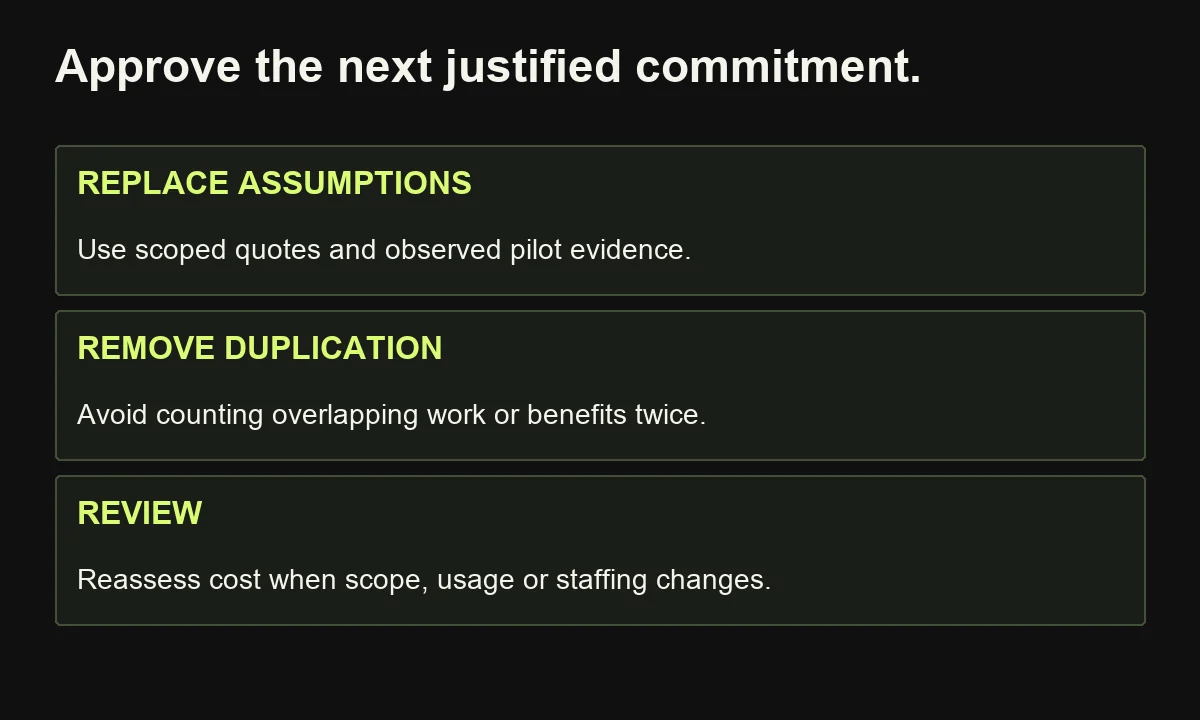
- Fund evidence before expansion: Use scoped quotes and a limited pilot to replace assumptions. Keep hypothetical scenarios separate from market rates, and distinguish capacity gains from cash savings or genuinely additional contribution. Retain accountable human ownership of consequential decisions.
The cost of B2B marketing automation includes software, implementation, content, integrations and ongoing operation. Your budget depends on the workflow, billable contacts or usage, required features and the people maintaining it. Compare first-year cash spending, recurring commitments and internal effort separately; a subscription price cannot describe the full cost.
A platform costs €20 a month. Another requires thousands of dollars for onboarding. Both prices can be accurate, yet neither tells you what your business will spend to operate a useful marketing process.
An integration service and a complete marketing platform are different purchases. So are a single enquiry-routing workflow and an account-based nurture programme connected to several systems.
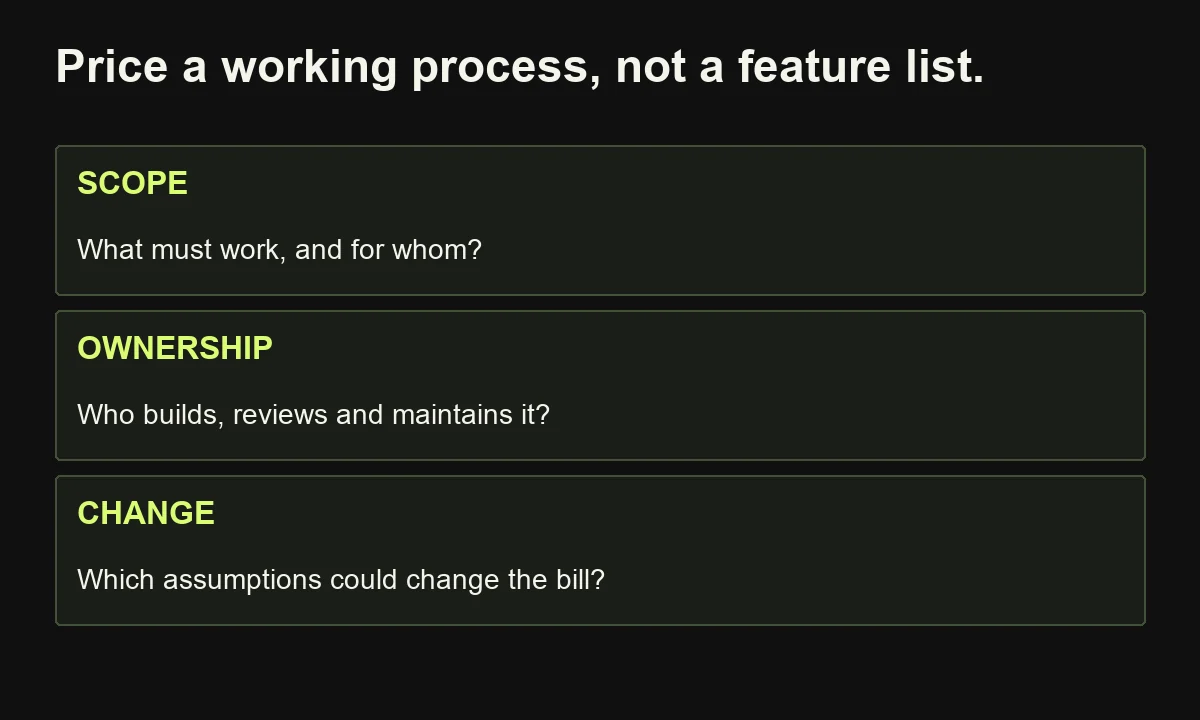
My recommendation is to price a defined business process with an owner, rather than a collection of features. Ask what must work, who will maintain it and which assumptions could change the bill.
This guide combines dated vendor examples with transparent planning scenarios. The scenarios are hypothetical, not market averages, client outcomes or a quotation for my services. Published prices remain in their original currencies; obtain your own regional quote before committing.
You will learn how to build a full budget, compare proposals and identify the costs worth reducing. If you need the implementation sequence first, see how to start with B2B marketing automation. Here, the focus is what that process costs to establish, operate and change.
1. What belongs in the total cost of ownership?
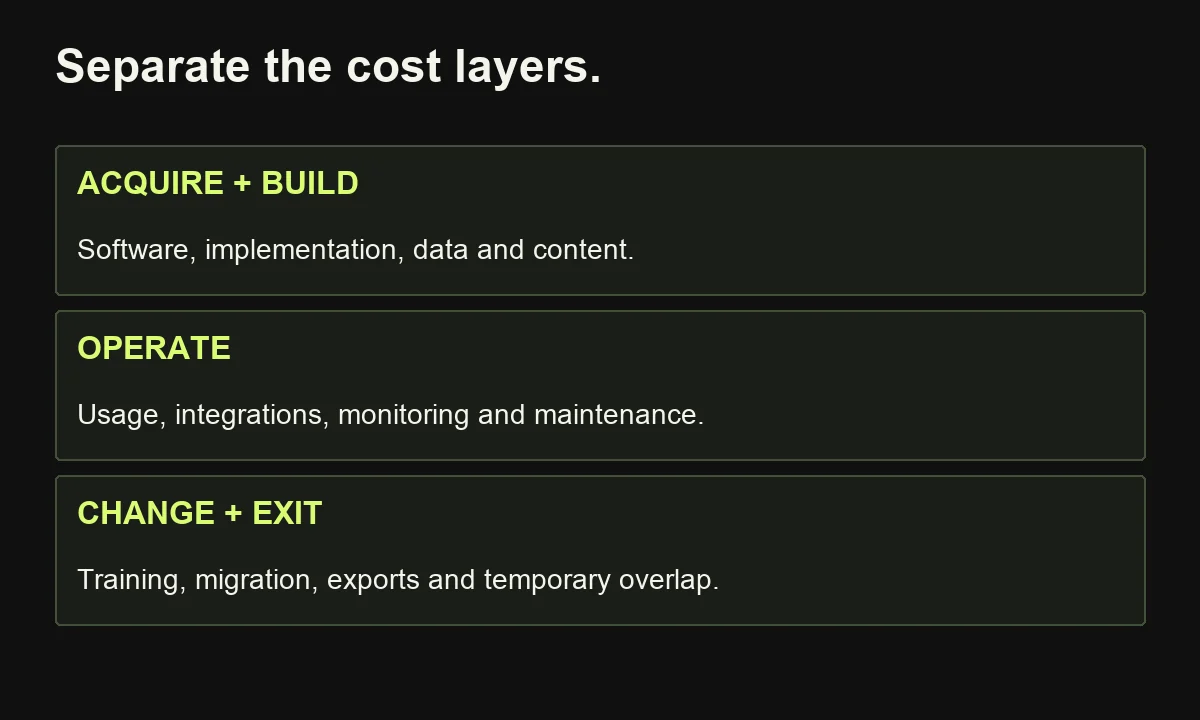
Total cost of ownership, or TCO, combines the resources needed to acquire, implement, operate and eventually change or leave a system over a stated period. For a useful comparison, include the same activities for each option. Keep external payments distinct from allocated staff time so the budget does not disguise either obligation.
Use these categories:
| Cost category | What to investigate |
|---|---|
| Software | Platform, seats, contact tiers and add-ons |
| Implementation | Process design, migration, configuration and testing |
| Content | Research, messages, assets, landing pages and revisions |
| Integration and usage | Connectors, transactions, sends and AI consumption |
| Operation | Monitoring, exceptions, maintenance and reporting |
| Change and exit | Training, exports, overlap and rebuilding |
For a twelve-month comparison, a practical starting formula is:
First-year external cost = one-time external work + twelve months of recurring external costs + other external charges.
Then add allocated internal effort to understand the fuller resource commitment. If subscriptions begin at different times or charges vary monthly, model the actual schedule instead of multiplying every item by twelve.
Do not count a consultant's implementation fee twice because the proposal also lists its component tasks. Conversely, do not assume a platform's onboarding fee includes data cleanup, content creation or bespoke integrations.
The first budget question is therefore about scope: which work is included, which is excluded and who supplies the missing pieces?
2. What do current vendor prices actually tell you?
Vendor prices describe particular products, allowances and billing terms, not the cost of an entire programme. Use published figures to understand the starting commitment, then verify the exact configuration you require. A lower-priced integration service does not automatically replace a CRM, an email platform or the people operating them.
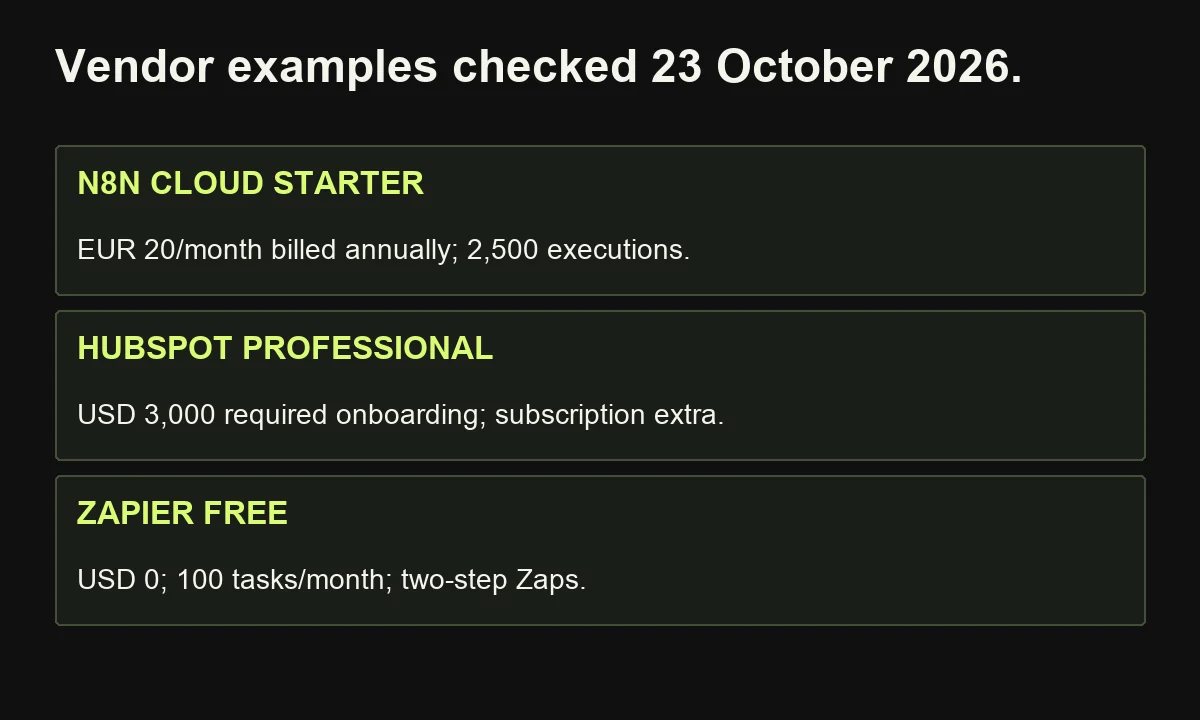
Examples checked on 23 October 2026:
| Official example | Published detail | Budget implication |
|---|---|---|
| n8n Cloud Starter | €20/month billed annually; 2,500 workflow executions with unlimited steps | €240 annual subscription equivalent; connected services remain separate |
| HubSpot Marketing Hub Professional | Required one-time Professional onboarding listed at US$3,000, additional to subscription | Include onboarding and establish what delivery work it covers |
| Zapier Free | US$0 with 100 tasks/month and two-step Zaps | A free plan has capacity and functionality boundaries |
These are different product categories and scopes, not equivalent packages or a cheapest-to-best ranking. The HubSpot onboarding figure is not its subscription price. The n8n figure is an annually billed rate, not a promise of month-to-month cancellation at that price.
Pricing can change with region, term, promotions, product updates and negotiated scope. Confirm taxes, currency, extra services and actual payment timing in writing.
A proposal should make the required plan explicit. “Uses a free CRM” does not establish that its advanced workflows, reporting or permissions are free.
For a wider shortlist, use the marketing automation tools guide, then confirm the cost of the configuration you actually need.
3. Normalise contacts, tasks, credits and executions
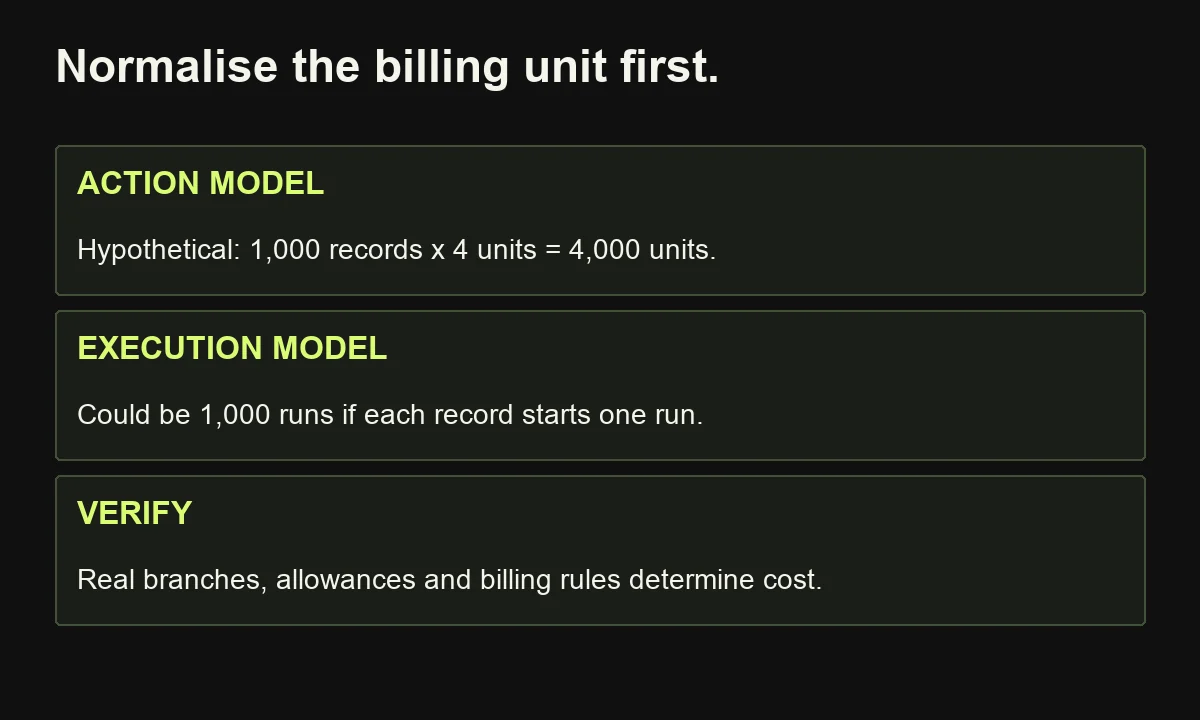
Different billing units measure different things. A contact is not a workflow execution, and an execution is not necessarily one billable action. Estimate the actual process at realistic volume before comparing allowances. Otherwise, two plans with similar headline limits can support very different amounts of useful work.
Consider 1,000 hypothetical enquiries, each requiring four billable actions. In an action-metered design, that could mean 4,000 billable units before other activity. In an execution-metered design, it could mean 1,000 executions if each enquiry produces one complete run. Neither is a universal conversion rule.
Zapier's pricing explanation distinguishes triggers from successful actions and notes that some actions can consume more than one task. Its exceptions and current usage rates matter.
Make's credit documentation distinguishes ordinary operations from AI-related charging. With a custom AI provider connection, provider token charges can sit outside Make's own operation credits. n8n's pricing uses workflow executions rather than charging each step in the same way.
Build an activity estimate: incoming records, actions per record, scheduled checks, branches, loops, retries and external service calls. Verify what each vendor bills; do not assume all of those consume units identically.
Run a small representative test and inspect the usage record. Forecast from observed consumption where possible. “One lead equals one credit” is not a reliable budgeting assumption unless that exact workflow and billing definition support it.
4. What makes implementation expensive?
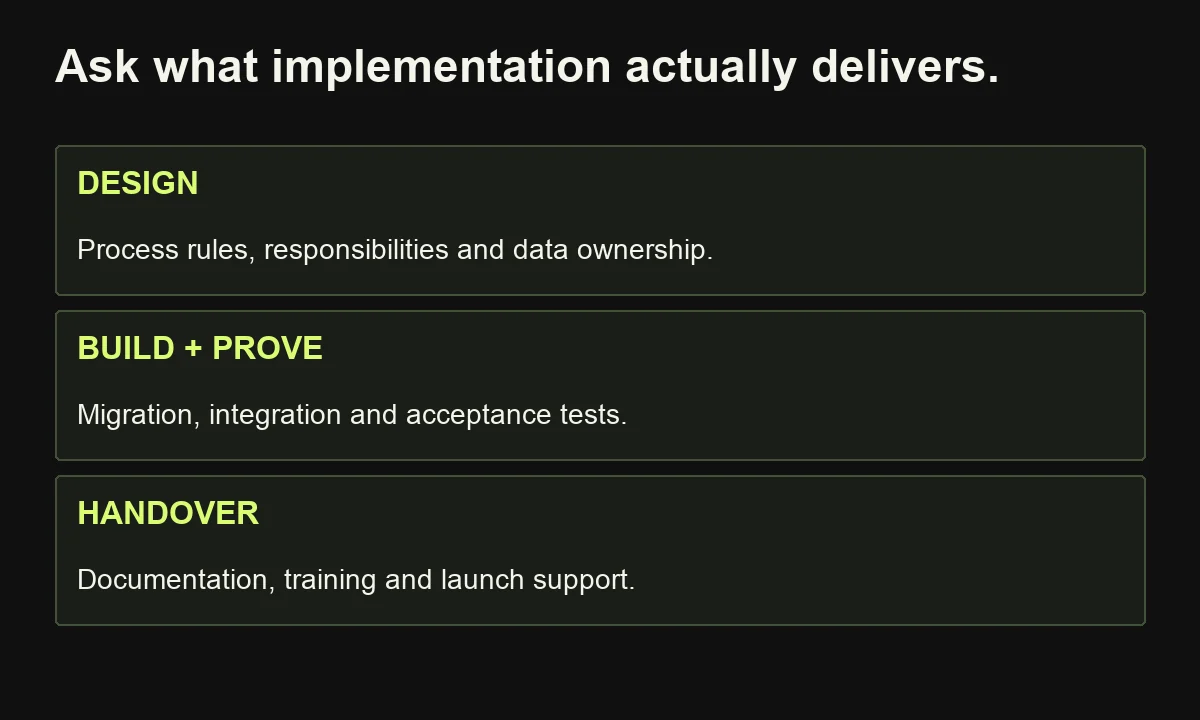
Implementation becomes more demanding when the team must resolve unclear processes, inconsistent data or difficult system boundaries. Price the deliverables and acceptance tests, not merely the number of workflows. One simple-looking sync can require more work than several straightforward message sequences if ownership and conflict rules are unresolved.
Ask for a breakdown covering:
- Process discovery and agreement on entry, exit and ownership.
- Data mapping, cleanup, migration and reconciliation.
- Configuration, integrations and access setup.
- Testing, documentation, training and launch support.
For a CRM integration, define which system owns each field, whether updates move in one or both directions, and what happens when values conflict. Include duplicate handling, changed preferences and interrupted transfers in the test scope.
A useful deliverable is specific: “An eligible consultation request creates one enquiry, reaches an owner and retains a verified destination status.” “CRM integration completed” is harder to assess without those details.
Separate vendor onboarding from implementation delivery. One may provide guidance while another party performs the build. Ask who actually migrates records, writes messages, tests failures and fixes issues found after launch.
Use a paid discovery phase when requirements are genuinely uncertain, with a concrete output such as a process map and scoped estimate. That can make later pricing more credible. It should not become an open-ended fee without review points or leave you unable to use the documentation independently.
5. Content is an operating requirement, not decoration
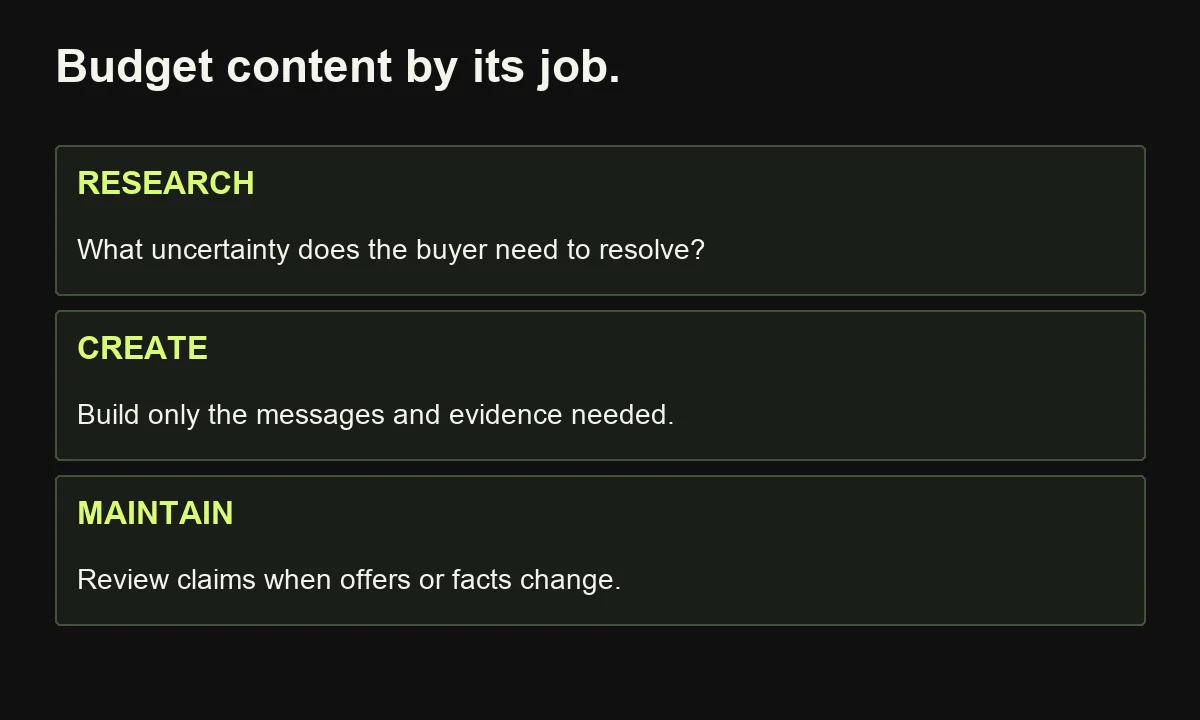
Automation needs useful information to deliver. Budget for the research, writing and review required to answer the buyer's actual questions, alongside the technical build. Reusing suitable material can reduce work, but a template cannot establish your positioning, substantiate a claim or decide which evidence matters to a particular buying situation.
For a B2B nurture path, the work might include a preparation checklist, a relevant case study, a scope explanation and messages that connect them. Each asset has a purpose; creating ten emails is not automatically more valuable than creating three useful ones.
Estimate content work through deliverables:
| Deliverable | What changes the effort |
|---|---|
| Buyer research | Access to customers, specialists and usable evidence |
| Message plan | Audience differences, decisions and exit conditions |
| Writing | Technical depth, examples and factual commitments |
| Review | Approvers, evidence checks and revision boundaries |
| Maintenance | Offer changes, outdated claims and broken links |
Agree who supplies subject knowledge and approves service promises. Slow or contradictory reviews can consume capacity even when the writing fee is fixed.
AI can assist outlines, variants and adapting approved material. Include preparation, verification and editing when estimating the resulting efficiency. Faster drafting does not prove that the whole content process became cheaper.
This is where senior content direction can prevent avoidable spend: decide what buyers need before commissioning assets. My B2B content strategy audit guide explains how to identify gaps without treating every missing asset as a new production requirement.
6. What recurring costs appear after launch?
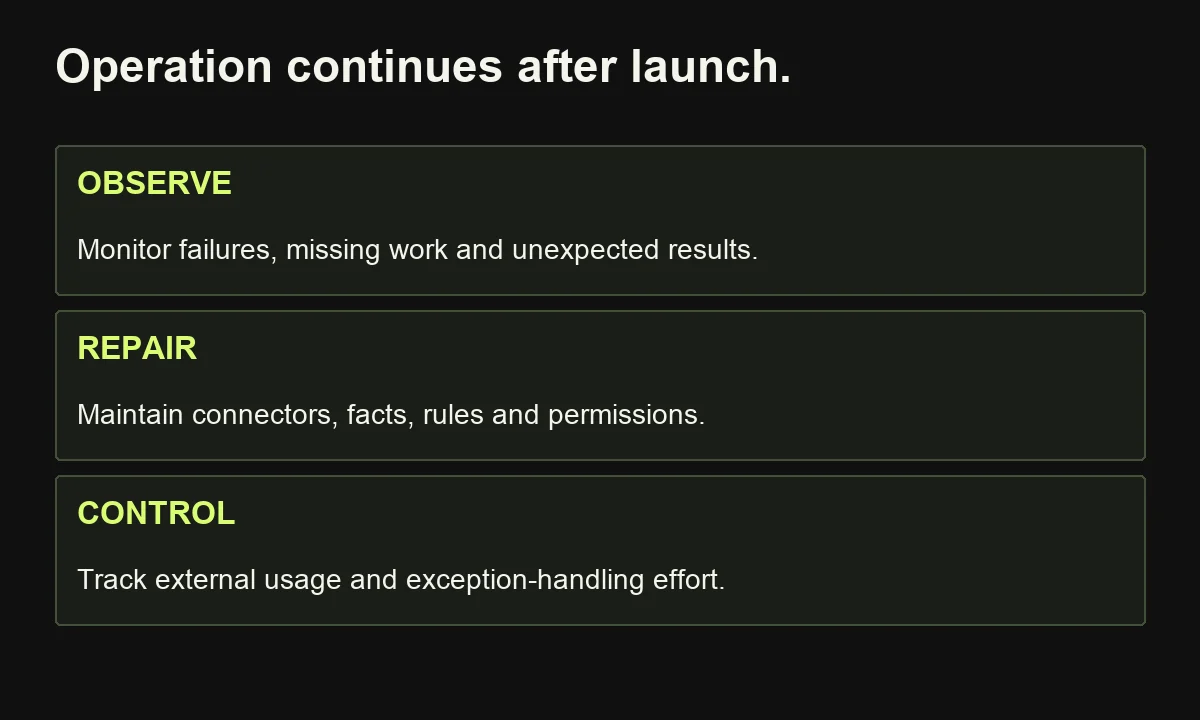
Recurring cost includes more than subscription renewals. Someone must monitor the workflow, investigate exceptions, maintain source information and adapt it when the business changes. Define that responsibility and its expected workload. A process that nobody maintains can become expensive through missed work and repairs, even while its software bill stays unchanged.
Include these recurring responsibilities:
Operations: investigate failed runs, duplicate records, unresolved handoffs and unexpected outcomes. Reconcile inputs against destination records; a green execution log does not prove that every enquiry arrived.
Maintenance: update connectors, credentials, field mappings, content and business rules. Clarify whether a retainer includes only repairs or also new development.
Measurement: review usage, lead quality, owner acceptance and commercial progress. Report denominators and observation periods, rather than only activity totals.
External consumption: account for messaging, enrichment, storage and AI services when charged separately. Ask which charges are included in the platform and which arrive on another invoice.
AI usage needs its own control: identify the model or service, charging basis, typical input and output size, retry policy and spending limit. There is no universal fixed AI cost per lead.
Estimate exception work explicitly. If 500 hypothetical requests produce a 4% exception rate, 20 need attention. At ten minutes each, that is 200 minutes of work. Those are planning assumptions, not expected failure rates. Replace them with observed evidence as the process runs.
7. Is DIY or self-hosting cheaper than external help?
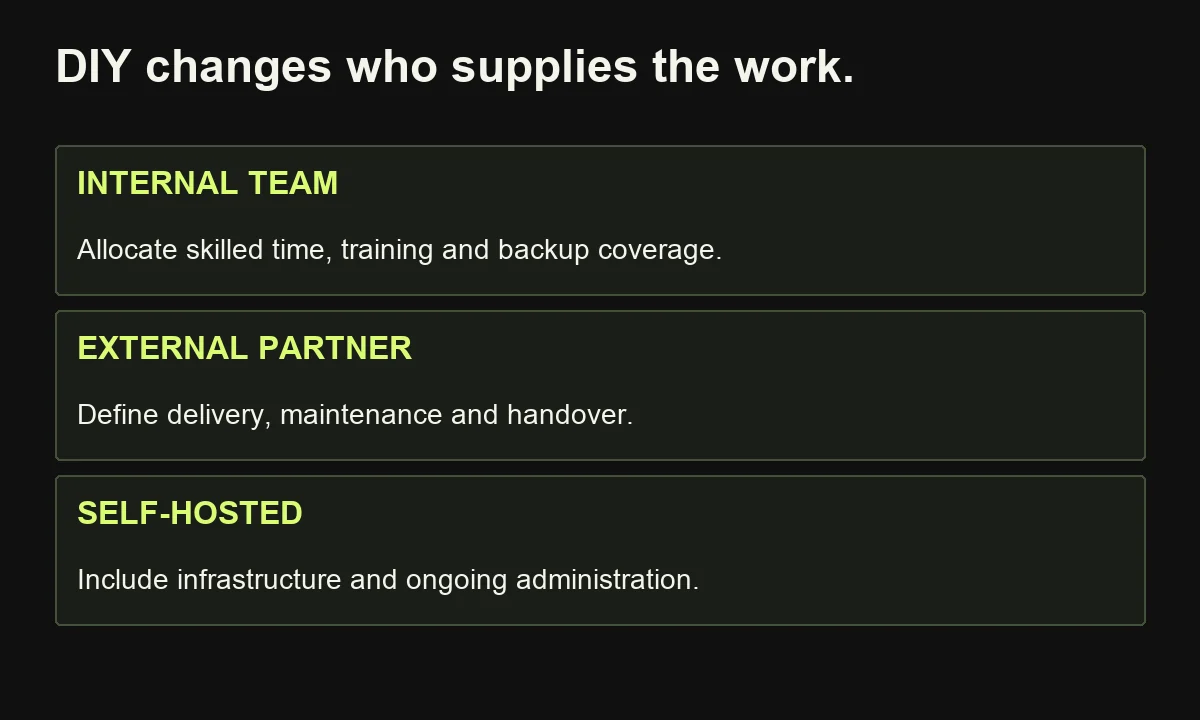
DIY can reduce external fees when the team has relevant skills, available time and a bounded requirement. It does not remove implementation or operating work. Compare complete delivery options, including maintenance and cover when the builder is unavailable. Self-hosting changes who supplies the infrastructure and administration; it does not make them disappear.
n8n's hosting documentation describes deploying on your own infrastructure. Budget for the environment you actually need: hosting, backups, updates, access controls, monitoring and recovery work. Check the edition and licensing terms for required features rather than assuming every self-hosted capability is free.
Compare responsibilities rather than labels:
| Route | Potential advantage | Cost to include |
|---|---|---|
| Internal owner | Existing business context | Training, allocated time and backup coverage |
| Specialist freelancer | Direct delivery ownership | Defined scope, handover and ongoing support |
| Agency or consultancy | Several disciplines and capacity | Coordination, commercial scope and change requests |
None is always cheaper or more attentive. Inspect who will do the work, what they will deliver and what remains with your team.
Existing salaried time is not necessarily new cash spending, but it is still capacity committed to this project. If a contractor performs a task already covered by a retainer, do not add the same work again as a separate hypothetical fee. Consistent boundaries make the comparison useful.
8. Three transparent first-year budget scenarios
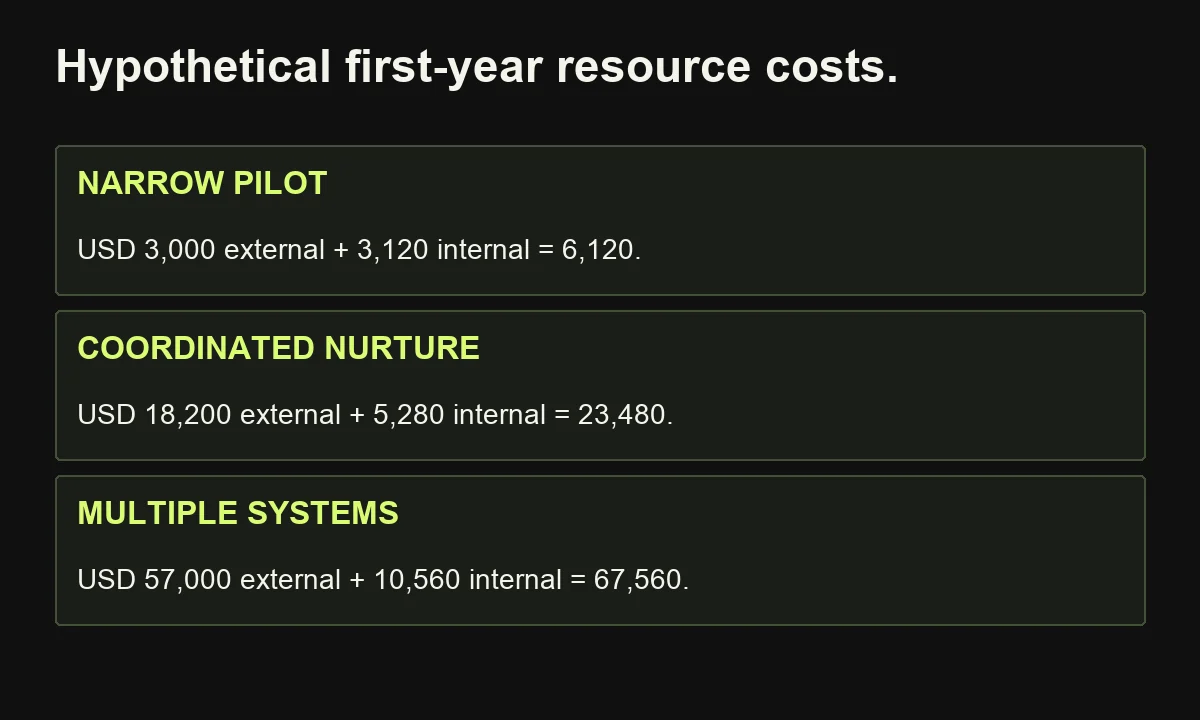
Build your estimate from scope and explicit assumptions. The following scenarios are invented planning examples, not vendor packages, market averages or recommended spending levels. All amounts are US dollars, before tax and foreign-exchange effects. Recurring charges are assumed constant for twelve months, with no unlisted additions.
| Assumption | Narrow pilot | Coordinated nurture | Multiple systems |
|---|---|---|---|
| One-time external work | $600 | $5,000 | $15,000 |
| Monthly external costs, combined | $200 | $1,100 | $3,500 |
| First-year external cost | $3,000 | $18,200 | $57,000 |
| Internal setup hours | 30 | 60 | 120 |
| Internal hours per month | 4 | 6 | 12 |
| Internal effort at $40/hour | $3,120 | $5,280 | $10,560 |
| Combined resource cost | $6,120 | $23,480 | $67,560 |
For the narrow pilot, the assumed $200 monthly combines $50 software, $50 usage and $100 external maintenance. The other scenarios also combine software, usage and external operation; replace these totals with separate quoted lines in your budget.
Internal effort includes setup plus twelve months of operation. For the pilot: (30 + 12 × 4) × $40 = $3,120. The hourly rate is an assumed allocation value, not a salary benchmark or an external bill.
These totals illustrate the method. They cannot establish what your project should cost. Obtain scoped estimates and remove work already included elsewhere before comparing the options.
9. Stress-test growth, renewals and payment timing
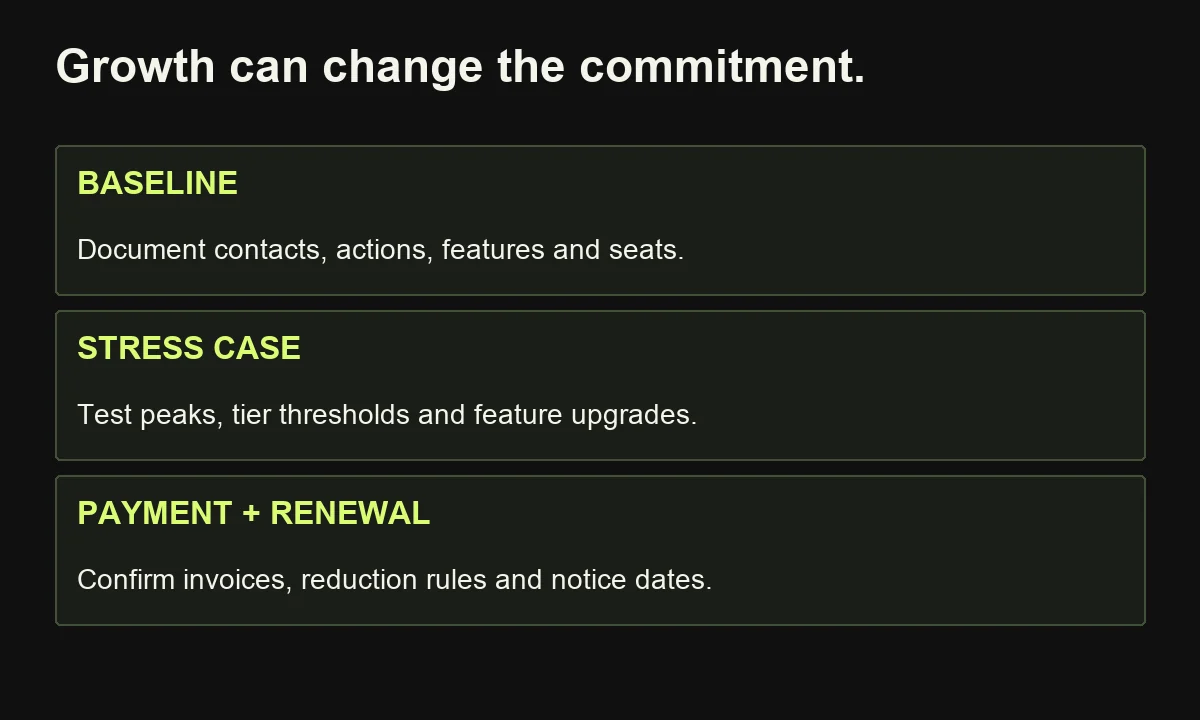
A budget should show what changes the bill, when the change occurs and whether the commitment can be reduced later. Model realistic growth and a demanding month as well as the baseline. Low average usage can conceal a peak that crosses a tier, triggers overages or pauses a workflow.
HubSpot's marketing-contact billing guidance explains that exceeding the applicable contact tier can cause an automatic upgrade. The higher tier can remain billable until renewal even if the count later falls. Status-change timing and account controls therefore belong in the operating plan.
For any platform, investigate:
- What exactly becomes billable, and who can create it?
- What happens at the limit: upgrade, overage, stop or delayed processing?
- Which features require a higher plan even without more volume?
- When can contacts, seats or commitments be reduced?
- Are annual fees paid upfront, and when is notice required?
Use arithmetic to expose a growth assumption. If one quoted recurring cost rises from $200 to $400 after month six, the year's recurring total is $3,600, not $2,400. Add setup separately. This is a hypothetical price change, not a vendor prediction.
Keep original currencies visible and apply one explicit exchange-rate assumption when consolidating the budget. Ask the relevant finance owner about taxes and recoverability. A monthly-equivalent price, an invoice schedule and an accounting allocation are different views of the commitment.
10. How do you judge whether the cost is justified?
Compare the full incremental cost with defensible incremental benefits over the same period. Recovered hours represent capacity; avoided expenditure and additional realised contribution can support a financial return. Revenue attributed to a workflow is not automatically revenue caused by it, and pipeline value is not cash available to repay setup.
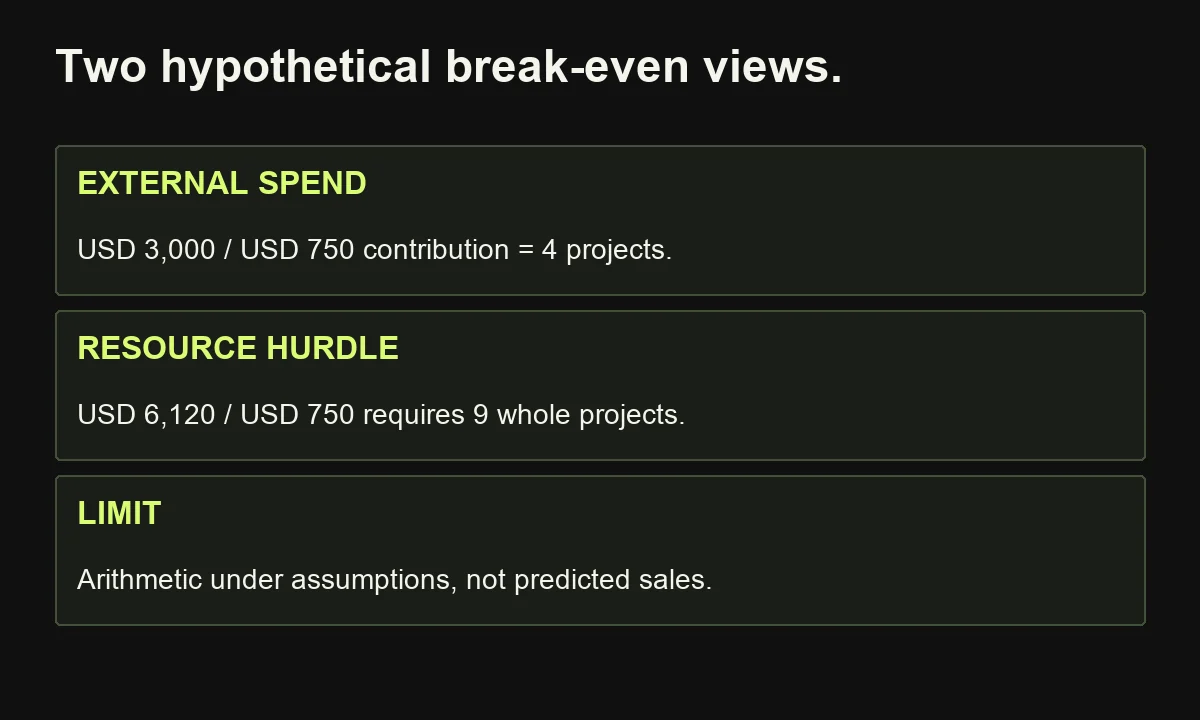
Use the hypothetical narrow pilot's $3,000 first-year external cost. Suppose there is no new payroll spending and each genuinely additional completed project provides $750 contribution after its variable delivery costs. Covering that external cost would require four additional projects, before any other incremental costs or benefits.
This is a break-even calculation under stated assumptions, not a forecast that four projects will happen. If the internal allocation is also a relevant economic hurdle, comparing the $6,120 combined resource cost with $750 would require nine whole projects. Keep those two decision views separate.
Record what benefit the process is intended to create: fewer lost enquiries, faster ownership, better-informed conversations or less repeated administration. Then collect evidence.
For long sales cycles, early operational improvement may be observable before financial results. Compare records with similar follow-up periods and note other changes in offer, staffing or campaigns. Small samples may remain inconclusive.
For the broader investment decision, see whether B2B marketing automation is worth the money. Cost modelling clarifies the hurdle; it cannot supply missing evidence that the programme will clear it.
11. Compare proposals and reduce the right costs
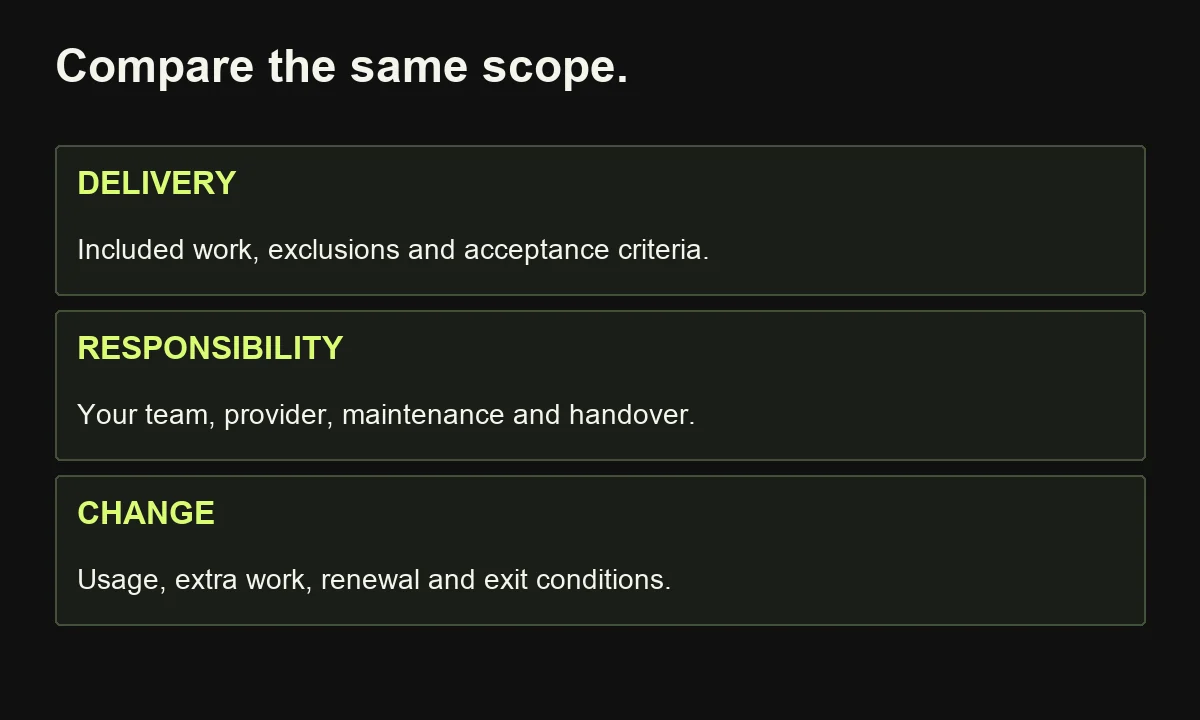
Give providers the same workflow brief, data assumptions and acceptance conditions before comparing prices. A cheaper proposal may omit work the more expensive one includes. Equally, a larger package may include capabilities you do not need. Evaluate the required outcome, responsibilities and change rules rather than choosing by the lowest monthly figure.
Ask each provider to identify:
- Included deliverables and explicit exclusions.
- Named delivery and maintenance responsibilities.
- Your required inputs and internal effort.
- One-time, recurring, usage and optional charges.
- Acceptance tests, documentation and handover.
- Change-request pricing and support boundaries.
- Renewal, export and exit arrangements.
Reduce cost by narrowing the first workflow, reusing verified content and resolving data ownership before building. Retire duplicate tools only after confirming the replacement covers their actual work.
Do not remove essential testing, exception handling or accountable review merely to lower the quote. Those cuts can transfer spending into later repairs and customer confusion.
Include exit work in the comparison: usable exports, field definitions, suppression history, workflow documentation and temporary overlap during a move. A cheap first year is not necessarily a cheap transition later.
Set aside a risk allowance tied to identified uncertainties, not an unexplained universal percentage. Keep it separate from committed spending. Release more budget when discovery or a pilot resolves the uncertainty, rather than treating the entire allowance as permission to expand scope automatically.
12. Budget worksheet and frequently asked questions
Use the B2B automation cost worksheet to record scope, payment timing, recurring charges and internal effort. Its worked numbers are hypothetical. Replace them with your own quotes, document uncertainty and review the estimate when usage, requirements or staffing change.
What is a realistic small-business budget?
There is no reliable universal total without the workflow and scope. A narrow pilot can require far less than a complex migration, but a low subscription price excludes substantial possible work. Use the scenarios to structure your estimate, not as evidence of prevailing market rates.
Is platform onboarding the same as implementation?
Not necessarily. Confirm who performs migration, integrations, content preparation, testing and training. Ask for deliverables in writing. An onboarding requirement can exist alongside a separate implementation fee, but overlapping work should not be counted twice.
Can AI reduce the cost?
It can reduce effort on suitable tasks. Include source preparation, review, corrections and usage charges before claiming net savings. People still need to own the message, the evidence and consequential decisions; those responsibilities do not disappear because drafting becomes faster.
How can I avoid paying for the wrong content?
Start with the buyer questions and handoffs the workflow must support. Define the necessary assets before commissioning a sequence. If you need help with research, content direction or writing, tell me what you are planning. I can help establish what the communication needs to achieve before you spend on producing and distributing it.