AI summary
AI answers can explain a problem, compare options and introduce a business before someone visits its website. Adapt your content to help that research while giving people a meaningful reason to engage directly.
- Give content a clear job: Build answer value, evidence value and interaction value. Improve the resources that support real purchase decisions before commissioning more articles or pages for minor query variations.
- Preserve accuracy and access: Clarify offer details, substantiate claims and review relevant external descriptions. Keep technical discovery working, and distinguish search inclusion from model-training permissions.
- Measure the whole handoff: Track visibility, factual accuracy, useful visits and qualified outcomes separately. Use platform definitions and comparable observations; neither citations nor declining traffic establish commercial impact. Begin with a focused 30-day improvement programme and retain human responsibility for editorial decisions.
GEO is changing content strategy by expanding the goal from earning a search click to helping a business be discovered, accurately understood and considered inside AI-generated answers. Adapt by creating useful decision content, publishing credible evidence, keeping offer information consistent, and measuring visibility, visits and business outcomes separately.
Strictly speaking, generative search is changing discovery; generative engine optimization, or GEO, is how marketers respond. That distinction matters. A new acronym does not create demand, and adding it to a content calendar does not make a business easier to choose.
A buyer can ask an assistant to explain a problem, compare approaches and suggest providers before visiting a single company website. Your content may contribute to that research without receiving a visit. When a visit happens, the buyer may arrive with assumptions your homepage did not create.
My recommendation is to plan for both situations: be useful before the click and worth visiting afterwards.
This article focuses on the commercial consequences of that change and a practical adaptation plan for service businesses, B2B teams and consumer brands. For definitions and the underlying discipline, start with the GEO fundamentals guide.
The opportunity is not to write for machines at the expense of people. It is to make your expertise easier for people to discover through the interfaces they use, while giving them a meaningful reason to continue the relationship on your own site.
1. Discovery now includes an explanation before the visit
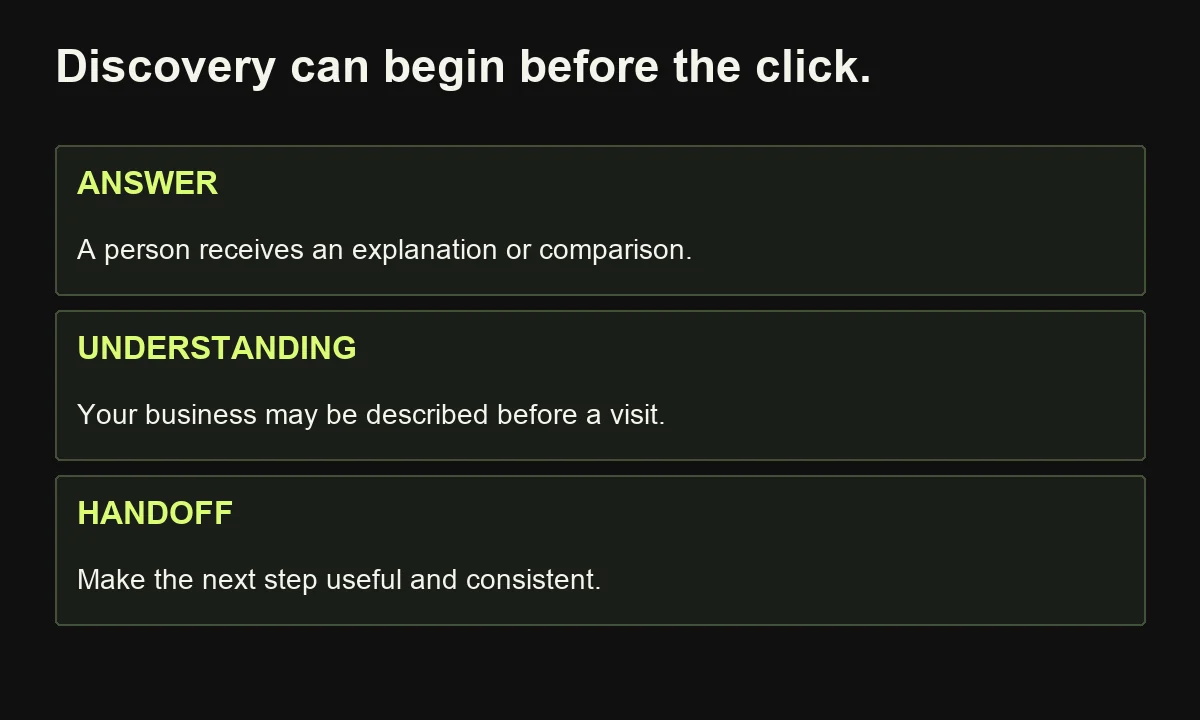
In a conventional search journey, someone sees a result, opens a page and forms an impression. A generated answer can introduce an additional step: it interprets several sources and presents an explanation, comparison or recommendation before the person chooses a destination. That changes where understanding begins.
Consider a business buyer asking, “Should we hire a content strategist or build an internal team?” They may first receive a comparison of ownership, capabilities and trade-offs. Your company could enter the conversation through an explanation of a relevant decision, rather than through a search for your name.
A consumer might ask, “Which lunch container fits a small work bag and is easy to clean?” Here, dimensions and care instructions can matter more than an atmospheric product description.
Neither journey eliminates websites. It changes the work a website needs to do when a person arrives.
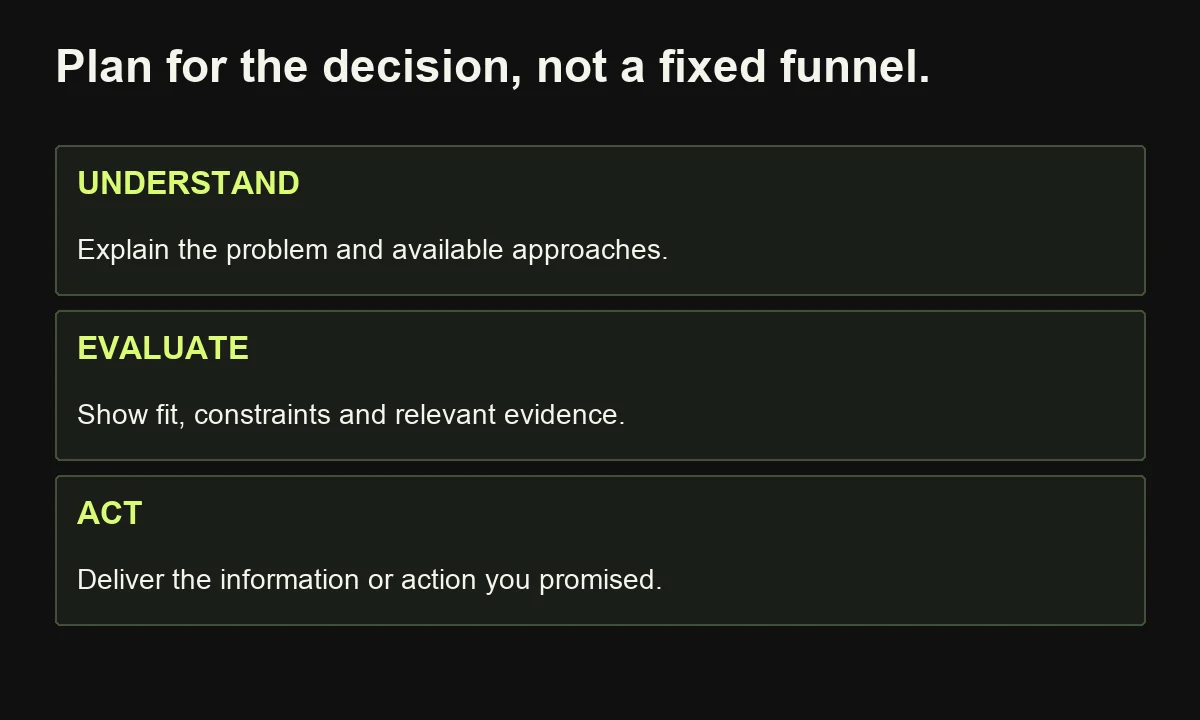
| Discovery moment | Content responsibility |
|---|---|
| Understanding the problem | Explain choices and consequences |
| Comparing approaches | Show criteria, suitability and limitations |
| Assessing a provider or product | Supply specific, verifiable evidence |
| Taking the next step | Deliver the promised information or action |
These moments may happen across search, assistants, social channels, marketplaces and direct recommendations. Avoid treating them as a tidy sequence everyone follows.
The strategic implication is to connect your content to these decisions, rather than assuming every educational article must immediately generate a sales enquiry.
2. One question can create several discovery opportunities
Conversational research lets someone describe constraints that a short keyword query may leave unstated. A request can include budget, experience, geography, compatibility and an unwanted outcome. Your content should explain the relationships between those constraints, rather than repeat a broad topic more frequently.
Google describes query fan-out as generating related searches to gather additional information for a question. Its current generative search guidance also warns against creating separate pages for every wording variation primarily to manipulate responses.
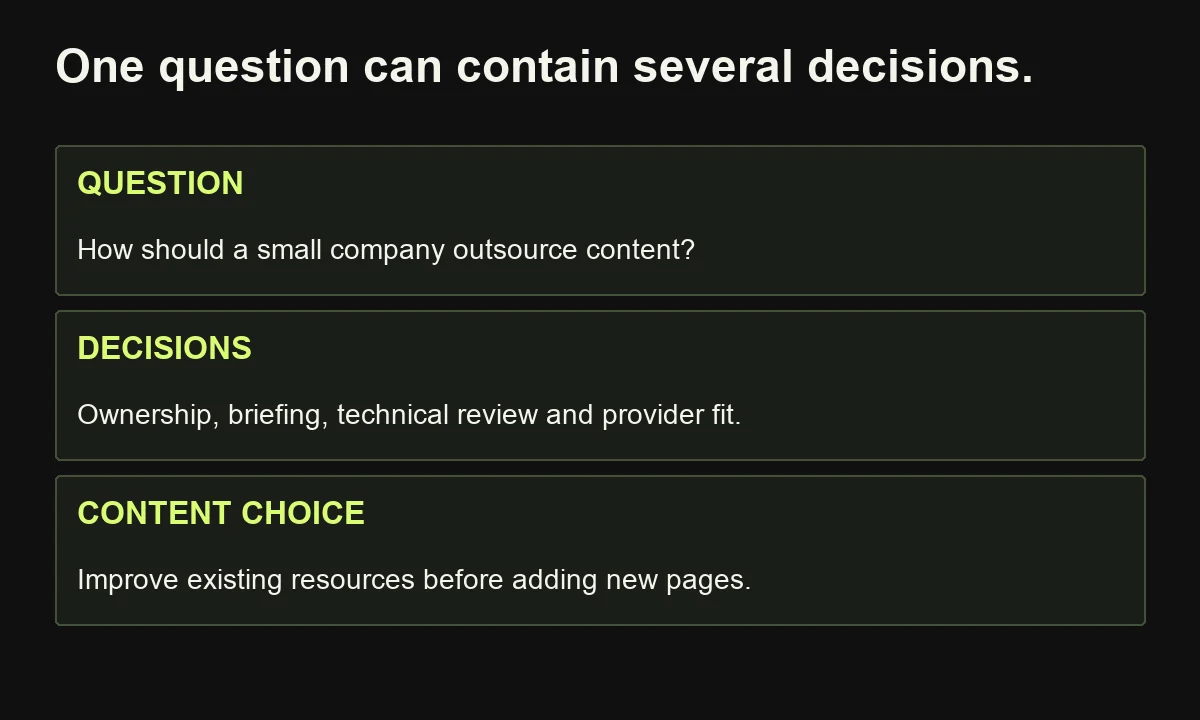
For example, “How should a small software company outsource content?” might involve several underlying decisions:
- What should remain with the internal team?
- What does a useful writer brief contain?
- How should technical review work?
- When is a freelancer suitable, and when is a wider team needed?
These can justify useful coverage, but not necessarily four new pages. An existing guide may already answer two of them well. Another may need an example or clearer navigation.
Build a decision inventory from sales questions, support conversations and actual customer research. Record the decision, audience, constraints and best existing resource. Only commission a new page when it serves a distinct task.
That is a content strategy decision, not a prompt-volume exercise. The benefit is a coherent collection of resources a person can use across several questions, supported by internal links that connect relevant explanations, evidence and services.
3. What does the evidence say about clicks?
AI visibility and website traffic are different outcomes. A source can contribute to an answer without receiving a visit, and a visit does not establish a purchase. Research can help frame that risk, but its population, observation period and methodology determine how far the finding can travel.
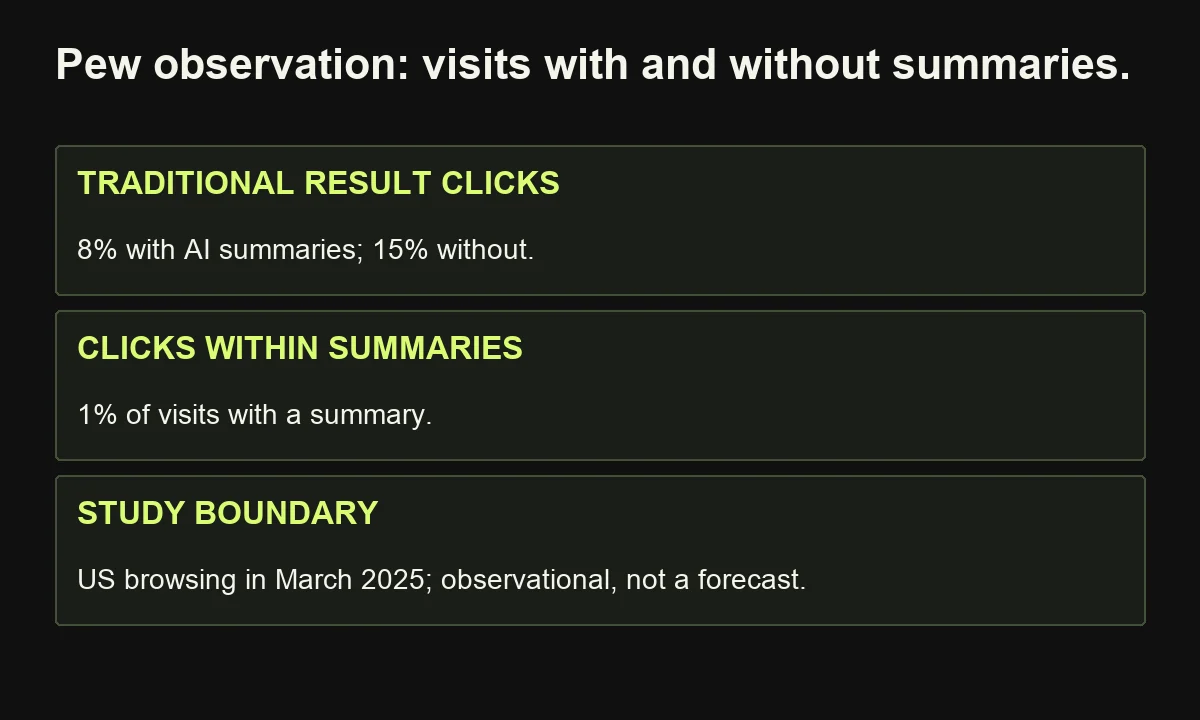
In Pew Research Center's July 2025 analysis, users clicked a traditional result in 8% of visits with an AI summary, compared with 15% without one. Links within summaries were clicked in 1% of visits with a summary.
The analysis used browsing data from 900 US adults during March 2025 and search results collected in April. It covered 68,879 unique Google searches. The results were reconstructed after the browsing period, and the study was observational.
These are not universal 2026 click rates, an experiment establishing causation, or a forecast for your market. Different queries, industries and interfaces can behave differently.
The appropriate business response is to investigate exposure, not declare the end of search traffic.
Look for declining visits to informational pages alongside stable or changing visibility. Check seasonality, technical issues, competitors and query mix before attributing the change to AI. Then examine whether those pages ever supported a meaningful customer decision.
A page that loses low-value visits needs a different response from a product comparison that loses qualified prospects. Sitewide averages can hide that distinction.
4. Give each content asset a clear commercial job
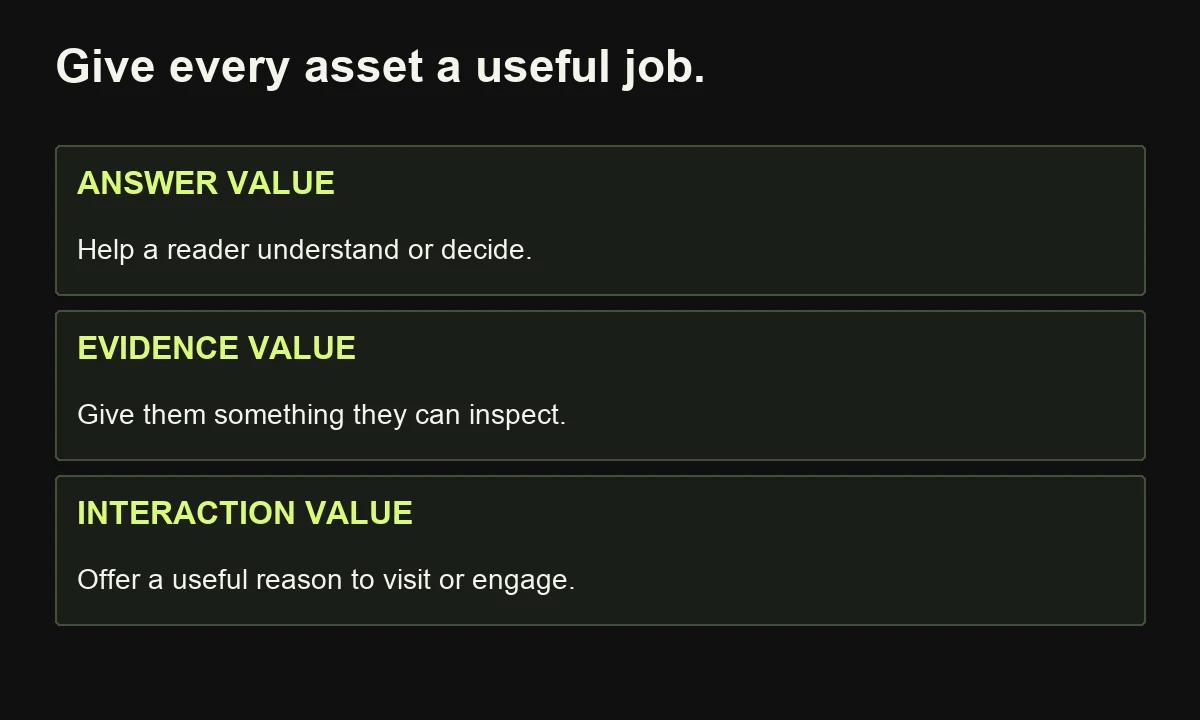
I recommend organising the adaptation around three kinds of value: answer value, evidence value and interaction value. This is a planning framework proposed here, not a ranking formula. It helps decide what to create and what to improve when information can be summarised before a visit.
Answer value helps someone understand or choose. Examples include an explanation of implementation options, a compatibility guide or a comparison that describes who each option suits.
Evidence value gives the explanation substance. Examples include a permission-cleared work sample, a documented method, a test with disclosed conditions or a customer account that separates observed results from assumptions.
Interaction value gives someone a reason to visit or engage. Examples include a useful calculator, a configuration tool, an editable brief, a detailed sample scope or a conversation about their situation.
A single page can provide all three. They are jobs, not mandatory content formats.
Audit your most commercially important resources with three questions:
- What decision does this help someone make?
- What can they inspect rather than simply believe?
- What useful thing can they do next?
Do not hide basic answers merely to force a click. Make the public explanation worthwhile, then offer something additional that genuinely needs the website or your involvement.
A practical asset often combines a clear recommendation, a worked example and a reusable tool. It gives an answer substance and gives the next step a purpose beyond “learn more.”
5. Adapt a service page to a buyer's actual decision
For a service business, explain the problem you address, the work you undertake, the evidence behind your approach and the client's responsibilities. A buyer needs enough context to assess fit. Broad claims about growth or innovation leave both people and systems with little concrete information to use.
Consider this hypothetical starting point:
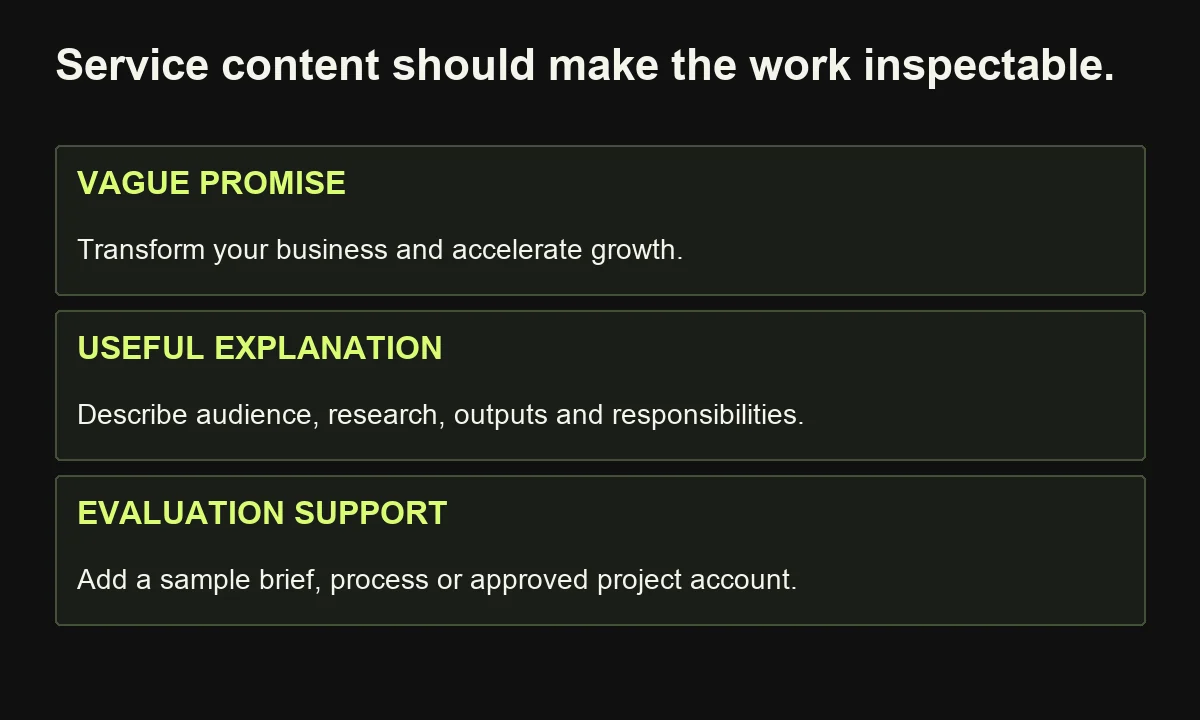
We create powerful content strategies that transform your business and accelerate growth.
It names a desirable outcome without explaining the engagement. A more useful version might be:
I help B2B teams decide which buyer questions their content should answer. A strategy engagement can include customer research, an audit of existing resources, priority topics and editorial briefs. Your team provides access to relevant customers, sales questions and subject-matter reviewers. Scope depends on the problem and available evidence.
This is an illustrative service description, not a fixed package or a claim about a completed client project.
Now add material that supports evaluation: an annotated brief, a sample decision map, the review process and a relevant, approved project account. Link the deliverable to the question it resolves.
The objective is not to make every provider sound identical in an AI comparison. It is to explain the choices that distinguish the work: who researches, who writes, who verifies, and what happens when evidence is missing.
That is where a senior independent strategist can make their involvement tangible. Buyers can evaluate direct responsibility instead of inferring quality from the size of a team.
6. Adapt consumer content to real constraints
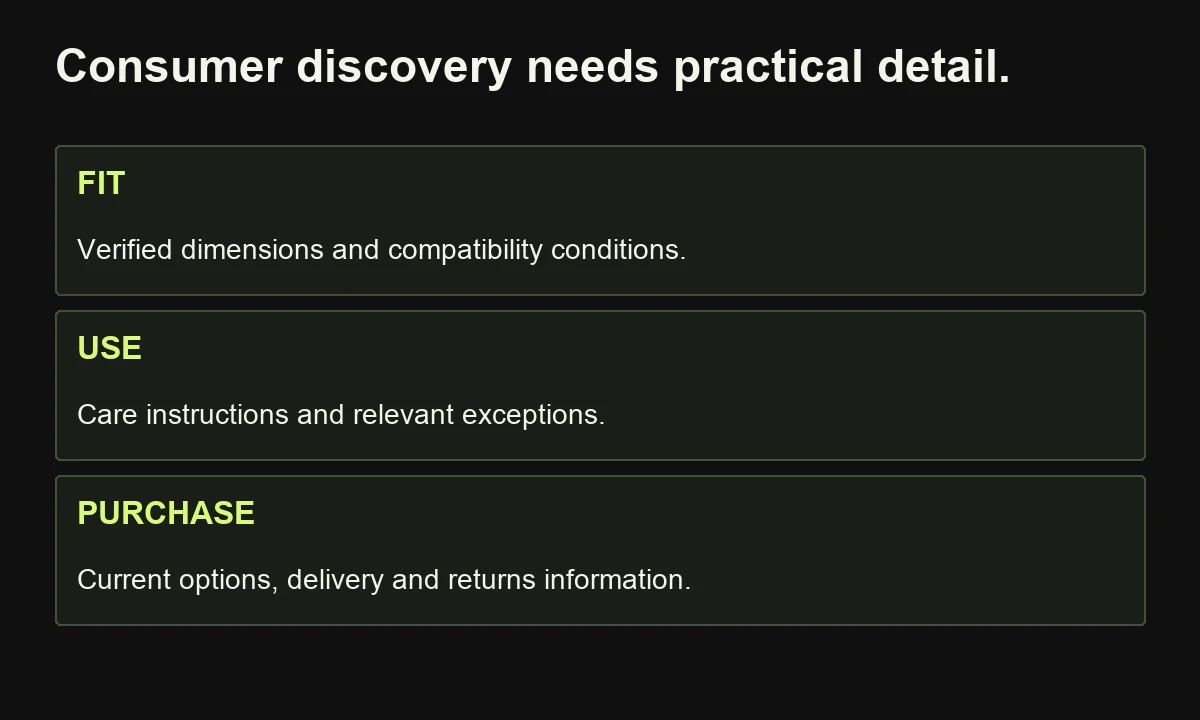
Consumer discovery often involves practical constraints: dimensions, materials, compatibility, availability, care, delivery or returns. Address these in useful product and comparison content. A visual brand story can create interest, but it should sit alongside the information a shopper needs to decide whether the product fits their situation.
For a hypothetical lunch-container brand, replace “The perfect companion for every adventure” with specific, verified details. Explain external dimensions, compartment capacity, closure operation and care instructions. Distinguish manufacturer specifications from independent testing and customer opinion.
A comparison can answer a real question: “Which model fits this bag?” Show the bag dimensions, the container dimensions and how the comparison was made. Do not imply that a demonstration with one bag establishes universal compatibility.
| Shopper question | Useful response |
|---|---|
| Will it fit? | Dimensions, measurement guidance and a representative image |
| How do I clean it? | Verified instructions and exceptions |
| Which option suits me? | Comparison criteria and differences |
| What happens after purchase? | Current delivery, care and returns information |
Keep product details consistent across the website and distribution channels you control. If a specification changes, identify the other pages or listings that need review.
For local services, the equivalent may be service area, opening hours and booking requirements. For complex purchases, it may be prerequisites and implementation. The principle travels across categories: replace an unspecified promise with information that resolves a purchase constraint, without overwhelming the reader with irrelevant detail.
7. Build useful evidence beyond your own website
Generated answers can draw on information outside your site. That makes accurate external descriptions and credible participation worth reviewing. It does not mean buying mentions everywhere or assuming a particular publication has a permanent influence over every engine. Start with sources that matter to the audience and question.
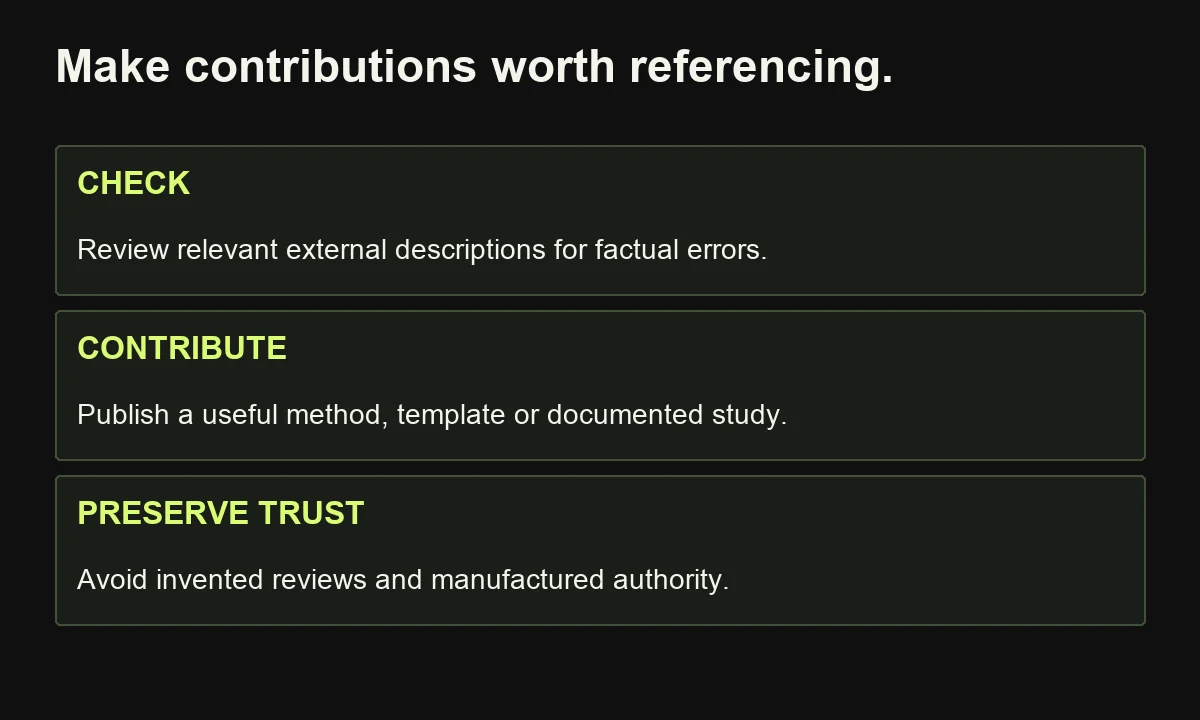
Search for how your business is described in relevant directories, partner pages, interviews and reviews. Correct factual errors through the appropriate channel. Distinguish a missing description from an unfavourable but legitimate opinion; these require different responses.
Then ask what you can contribute that someone else would reasonably reference:
- A clear comparison method with its assumptions disclosed.
- Original research with a described sample and limitations.
- A practical template that solves a recurring problem.
- A documented project account explaining decisions and constraints.
None requires manufacturing an impressive statistic. A carefully explained method can be useful because readers can apply it.
For a consumer brand, a genuine product demonstration may answer a practical question. For a business service, a worked brief or project account may explain the judgment behind the work. Use the case study writing guide to document that evidence responsibly.
Participate in communities because you have something relevant to contribute. Do not turn every discussion into a brand-placement exercise. Avoid invented reviews, undisclosed promotional participation or pages created solely to manufacture apparent authority.
The test is whether the contribution remains useful even if no AI system cites it.
8. Preserve access without confusing discovery and training
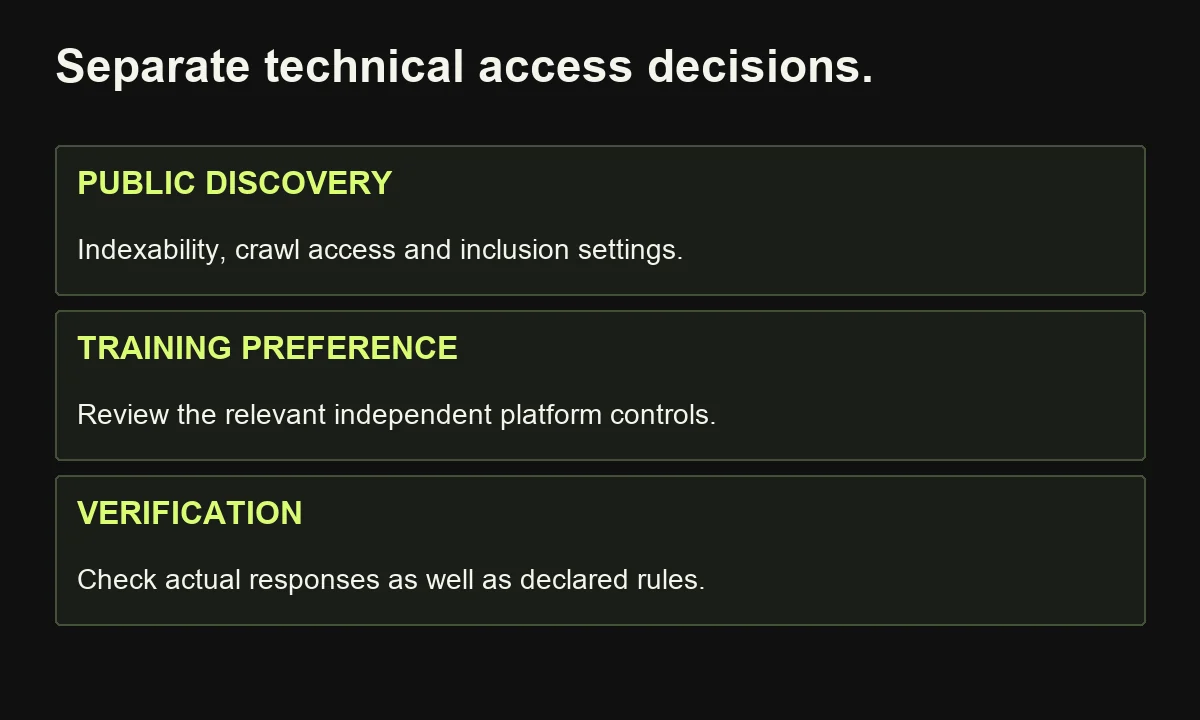
A technically inaccessible page cannot reliably serve as a useful public resource. Check indexability, crawl access, clear navigation, readable content and functioning links before commissioning more articles. Review platform-specific controls separately; “allow AI” is too vague to be an informed publishing decision.
Google's guidance requires indexed, snippet-eligible pages and inclusion in Search generative AI features through Search Console. Eligibility does not guarantee appearance. Google's owner-controls announcement explains its separate generative search inclusion control.
OpenAI's crawler documentation distinguishes OAI-SearchBot, used for search, from GPTBot, associated with potential model-training use. Their settings are independent. Do not copy a blanket crawler block without understanding which objective it affects.
Have a developer check both declared rules and actual responses. A page can look accessible in a browser while a firewall challenges a legitimate crawler. Conversely, a request bearing a crawler's name is not sufficient proof of identity.
Give the technical review a focused brief:
- Identify the public pages that should be discoverable.
- Inspect indexing and relevant platform inclusion settings.
- Check crawl rules, canonical URLs, responses and internal discovery.
- Confirm important information is present as readable page content.
- Record the finding, owner and verification method.
Do not trade away security controls indiscriminately. Resolve the specific access problem. Technical availability supports the content strategy; it cannot compensate for an unclear offer or evidence that does not exist.
9. Measure visibility, understanding and commercial response
A useful measurement plan separates exposure from interpretation and business action. Platform reports, repeated observations, website analytics and customer conversations answer different questions. Combining them can reveal a pattern, but adding their numbers together can create a metric that has no defensible meaning.
As checked on 17 October 2026, Google's Generative AI performance report for Search reports impressions for supported AI features, including AI Overviews and AI Mode. It includes page, country, date and device views. Google notes that insufficient impressions can explain a missing report. It is not a report of every AI conversation or a complete conversion record.
Microsoft's AI Performance documentation describes citations, cited pages and grounding queries. Read the definitions before comparing those figures with Google's impressions.
Alongside platform data, keep a small, stable question set. Record the engine, date, search mode, relevant context, answer, visible sources and factual errors. Repeated checks are observations under those conditions, not a census of customer demand.
In analytics, inspect identifiable AI referrals and what those visitors do. Some journeys will not preserve an identifiable referral. An optional enquiry question about discovery can add context, but human recall is imperfect too.
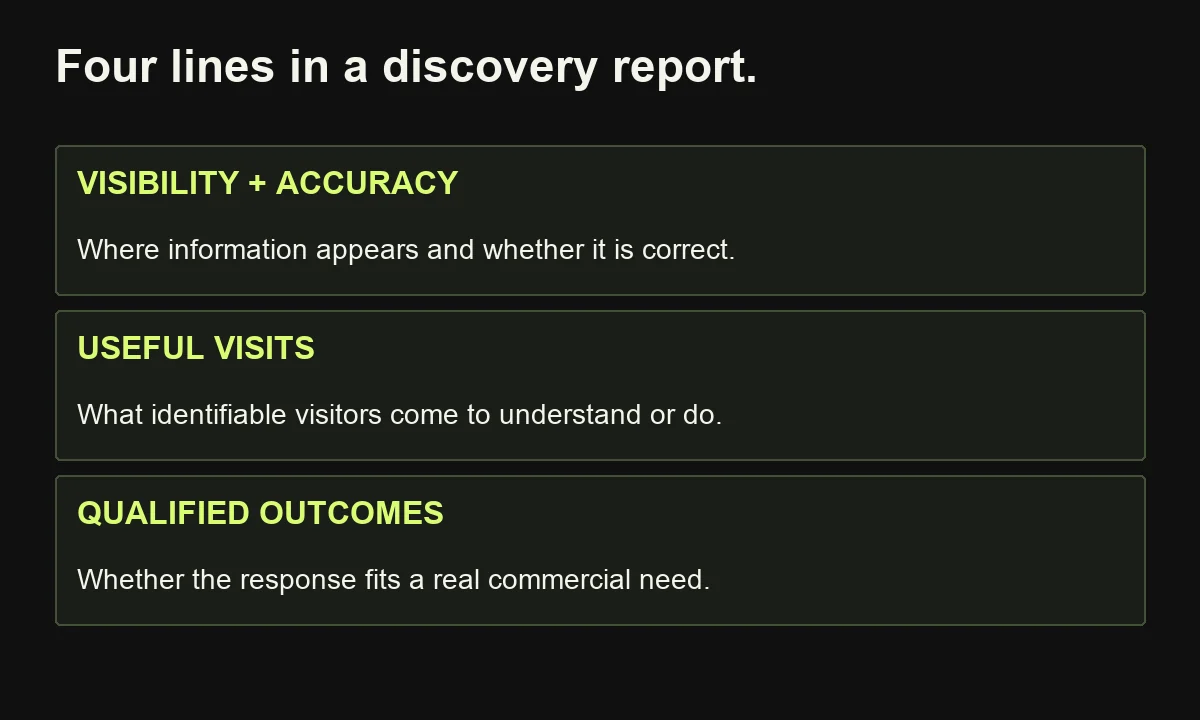
Report four separate lines: visibility, accuracy, useful visits and qualified outcomes. A correct description without a citation, a citation without a visit and a visit without an enquiry are different findings requiring different decisions.
10. Reassess content economics without inventing AI revenue
Losing traffic does not automatically make a resource worthless, and gaining citations does not automatically make it profitable. Assess its role in customer decisions, the quality of visits it still receives and the cost of maintaining it. Use financial measures with explicit boundaries and comparable definitions.
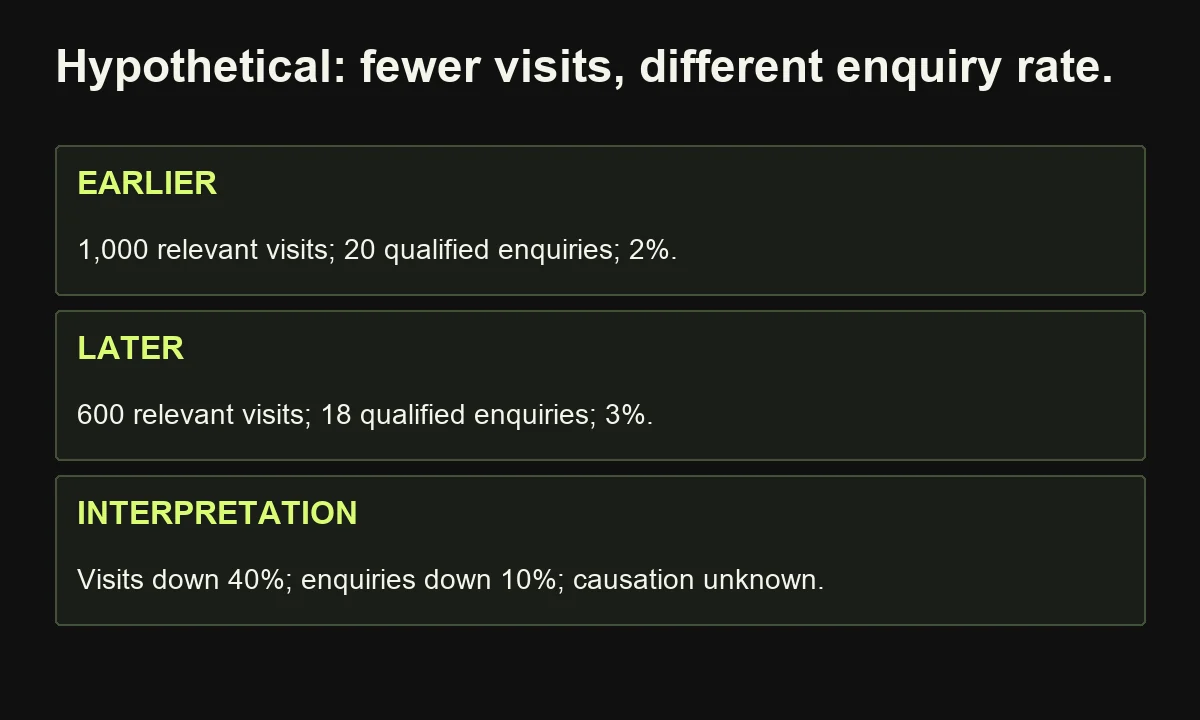
Consider this hypothetical planning example, not a forecast or client result:
| Period | Relevant visits | Qualified enquiries | Enquiries per visit |
|---|---|---|---|
| Earlier | 1,000 | 20 | 2% |
| Later | 600 | 18 | 3% |
Visits fell 40%, while qualified enquiries fell 10%. The enquiry rate rose by one percentage point. That does not establish that AI improved visitor quality or that the content became more profitable. Acquisition mix, qualification rules, demand and other changes could explain the pattern.
The appropriate next step is to inspect comparable segments and downstream outcomes, including whether enquiries became suitable customers. If comparing financial returns, use attributable contribution and relevant costs rather than treating enquiry volume as revenue.
This also changes editorial prioritisation. A generic definition may need consolidation. A useful comparison may deserve better evidence. A tool that helps a buyer make a difficult decision may deserve maintenance even if it attracts fewer visits than a broad informational post.
Do not remove a resource solely because a dashboard has fewer clicks. Identify what work it does, what evidence supports that judgment and what you would lose by withdrawing it.
11. A practical 30-day adaptation plan
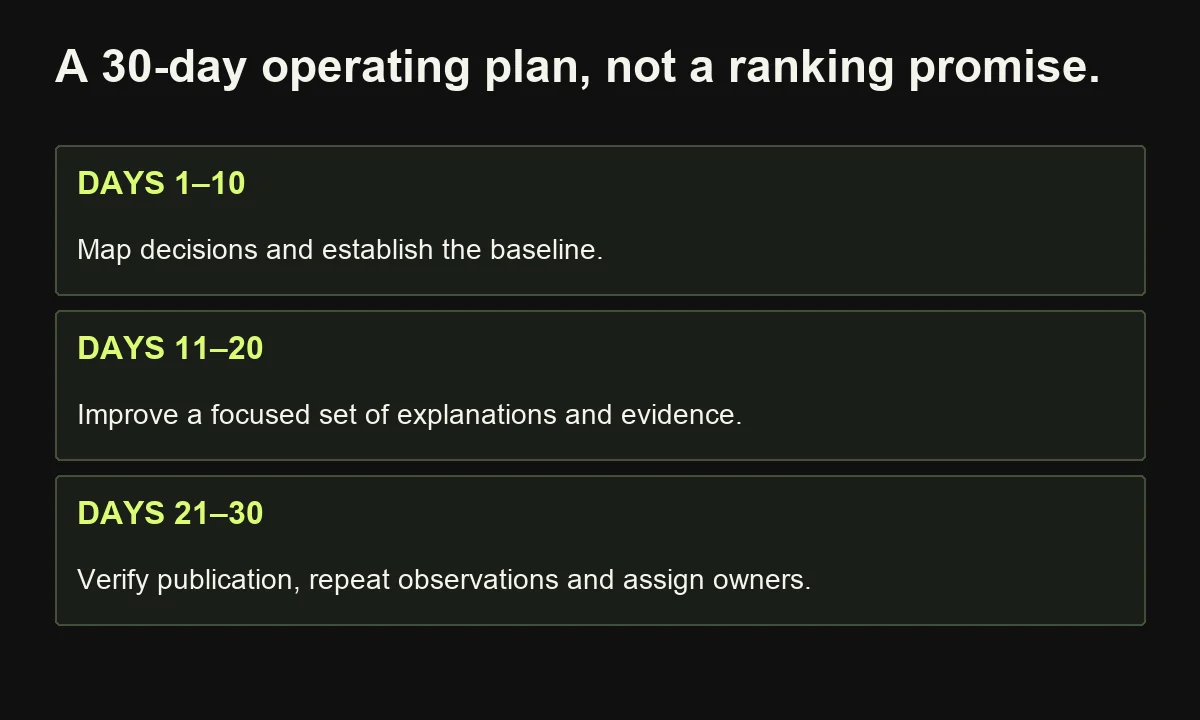
Start with a manageable group of commercially relevant resources, not the entire website. A short programme should establish a baseline, make specific improvements and identify what to observe next. Thirty days is an operating schedule proposed here, not a promise of rankings, citations or sales.
Days 1–5: Map discovery and decisions. Choose one audience and offer. Review actual sales or support questions. Identify the pages that explain the problem, comparison, evidence and next step. Record known gaps and a small question set.
Days 6–10: Establish the baseline. Inspect available platform reports, relevant referral traffic and a few comparable answer observations. Check the cited pages themselves. Record inaccurate descriptions and technical concerns before deciding that more content is the answer.
Days 11–20: Improve a focused collection. Clarify one important service or product page. Strengthen one comparison or implementation explanation. Add one genuinely useful evidence asset or tool. Connect them with contextual links and verify necessary technical corrections.
Days 21–30: Review and operationalise. Check the published versions, account for reporting delays and repeat the same observations. Document what changed and what remains uncertain. Assign review owners for changing facts and choose the next improvement based on the evidence.
Download the discovery adaptation worksheet to record the audience, content job, evidence, next step, owner and measure.
A useful outcome is a better-connected decision journey and a repeatable review process, even before performance changes can be interpreted confidently.
12. Keep human judgment close to the work
Adapting to AI discovery needs editorial judgment, subject knowledge and technical support. Someone must decide which questions matter, verify the claims and make the content useful. Software can assist research organisation, drafting and monitoring, but it cannot take responsibility for whether your public explanation is accurate.
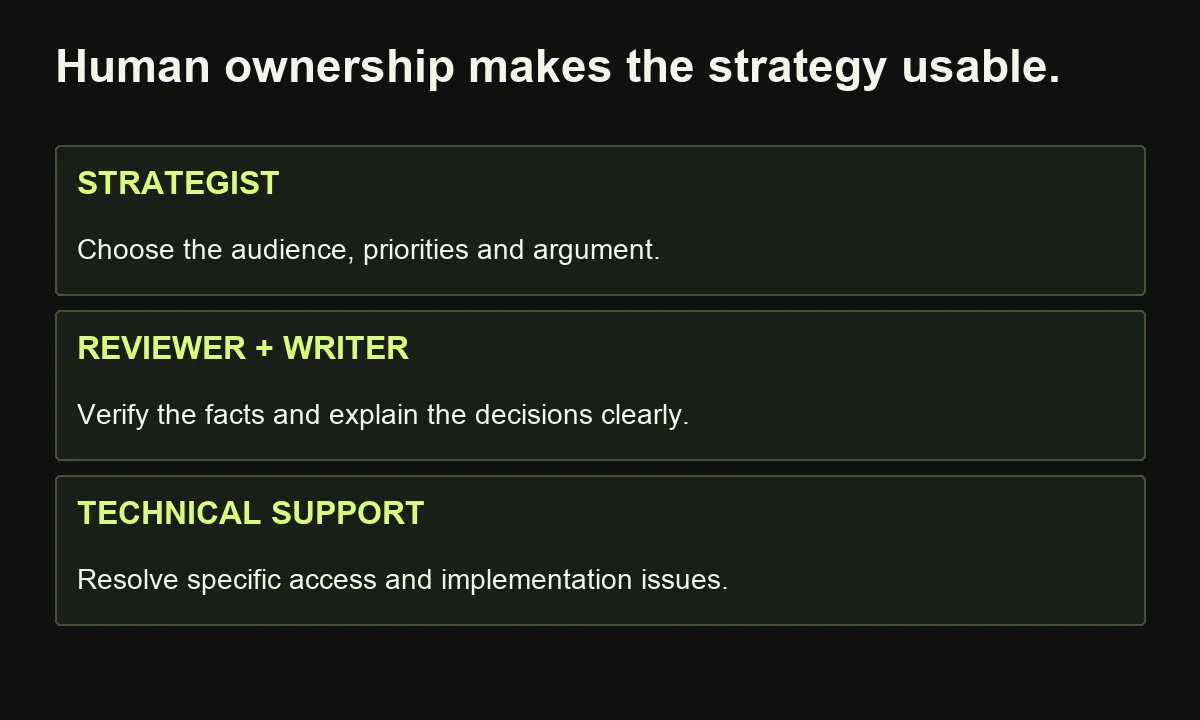
Give the work clear owners. A strategist chooses the audience, content priorities and argument. Subject-matter reviewers verify important facts. A writer turns the material into a clear explanation. A developer checks access. One person can hold several roles; make responsibilities explicit.
This is the part of content work I focus on: connecting buyer research, content direction and writing so the published material helps a prospect make a decision. The aim is a coherent explanation of your value, supported by material someone can inspect.
If your calendar is full but your positioning remains unclear, another batch of articles may not address the constraint. Review the decisions your existing content supports before increasing production.
Frequently asked questions
Does GEO replace SEO?
No. GEO extends the visibility and representation questions marketers ask. Maintain search fundamentals while investigating how relevant AI experiences describe your business and use its information.
What should a small business change first?
Start with an important offer page and a real customer decision it does not answer well. Improve clarity, evidence and the next step, then measure the response. If you want help choosing that starting point, tell me where discovery is breaking down.