AI summary
Direct answers can shape a purchase decision before someone reads your whole page. Adapt by resolving genuine customer uncertainty, keeping the conditions that make an answer accurate, and connecting it to evidence and a sensible next step.
- Choose consequential questions: Use sales, support and research evidence to identify uncertainty. Improve the most appropriate existing resource instead of creating a separate page for every wording variation.
- Make the answer complete: State the response directly, explain when it applies, support important claims and help the reader act. Maintain changing facts across relevant pages; formatting cannot repair contradictory information.
- Test usefulness and visibility separately: Review comprehension, factual accuracy, platform observations and qualified outcomes. Run a focused improvement pilot with clear ownership. Fixed answer lengths, FAQ blocks and schema do not guarantee selection, citations or business results.
AEO is changing content planning by making the customer's question a more important starting point. To adapt, publish direct answers that retain essential conditions, support them with evidence, and connect them to useful next steps. Keep your website accessible and measure answer visibility separately from visits and commercial results.
Answer engine optimization, or AEO, describes work intended to improve discovery through direct answers. The interfaces are changing discovery; AEO is the response, not the cause of the change.
A prospect may ask whether they need a content strategist before hiring a writer. A shopper may ask whether a backpack fits their laptop. In both situations, an answer can shape the decision before either person studies your homepage.
The writing challenge is more demanding than “put a short paragraph at the top.” An answer must be clear enough to help immediately and careful enough not to mislead when encountered outside its original page.
My recommendation is to treat the quality of the answer as an editorial responsibility, not a formatting trick.
This guide explains how to adapt existing content, with worked B2B and consumer examples, a reusable worksheet and a practical publishing pilot. For the terminology and foundations, see what answer engine optimization means. For the broader business implications of AI-mediated research, read how GEO is changing content discovery.
1. What changes when discovery starts with an answer?
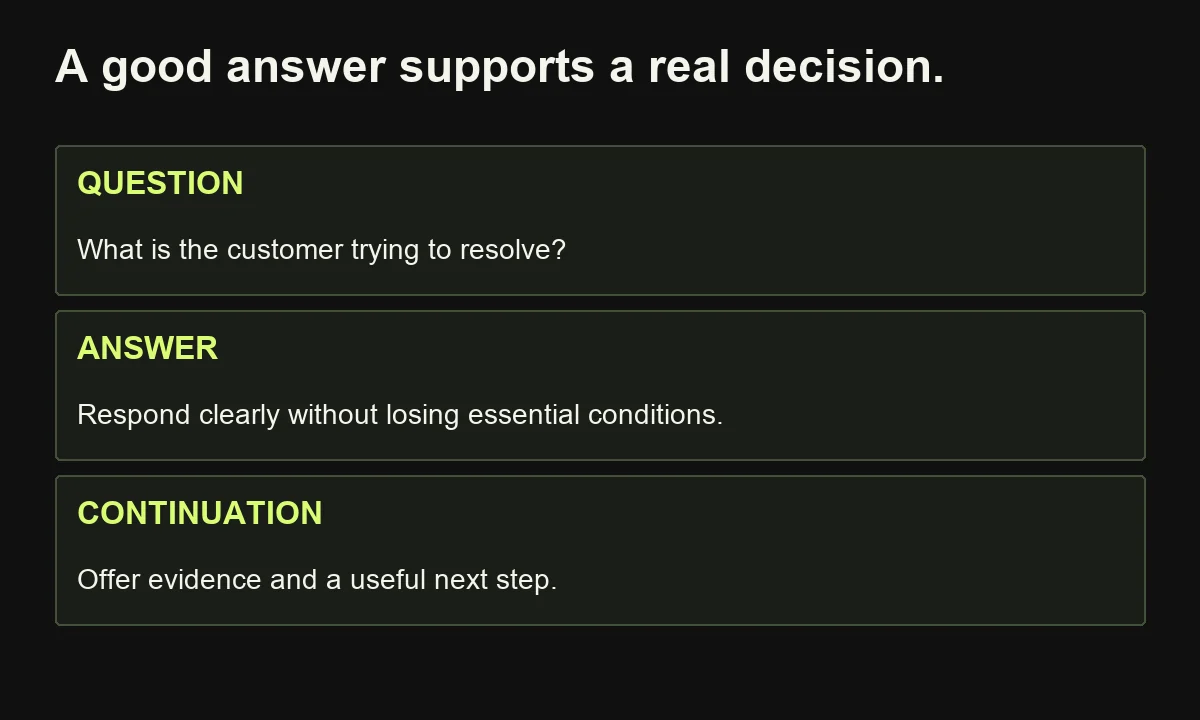
Direct answers let someone form an understanding without first reading an entire page. The answer may explain a concept, narrow a comparison or resolve a practical concern. Content therefore needs to help at the question level while still offering the context, evidence and navigation that make the full page useful.
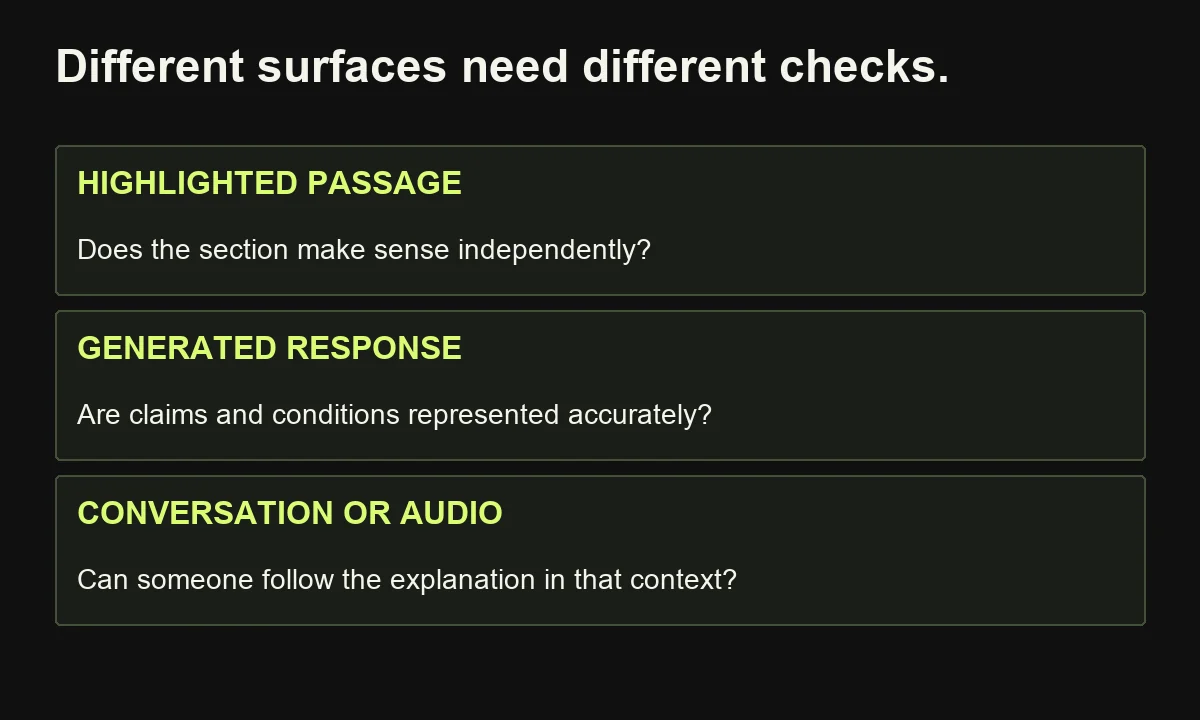
Different surfaces do different things:
| Surface | What the person encounters | Editorial implication |
|---|---|---|
| Featured snippet | A highlighted passage associated with a source | Make the passage meaningful and accurate |
| Generated answer | A response that may combine information from several sources | Explain claims and their conditions clearly |
| Conversational follow-up | A further question informed by the discussion | Anticipate constraints and adjacent decisions |
| Spoken response | Information heard rather than scanned | Use understandable names, units and phrasing |
These are viewing and interaction patterns, not a claim that every service uses the same selection system. A spoken response can itself contain generated or retrieved information.
Google's featured-snippet documentation explains that its systems select suitable passages; publishers cannot mark a page to guarantee selection. The documentation also notes that a click can take the reader directly to the relevant section.
That creates a practical design question: if someone lands halfway down your page, can they understand the subject, the qualifications and the next useful resource? A strong introduction cannot repair an ambiguous section the reader encounters independently.
2. Choose questions that change a decision
Prioritise questions where a useful answer helps someone assess fit, avoid a mistake or take a sensible next step. AEO does not require an article for every question a tool produces. Start with evidence of customer uncertainty and the contribution your business can responsibly make.
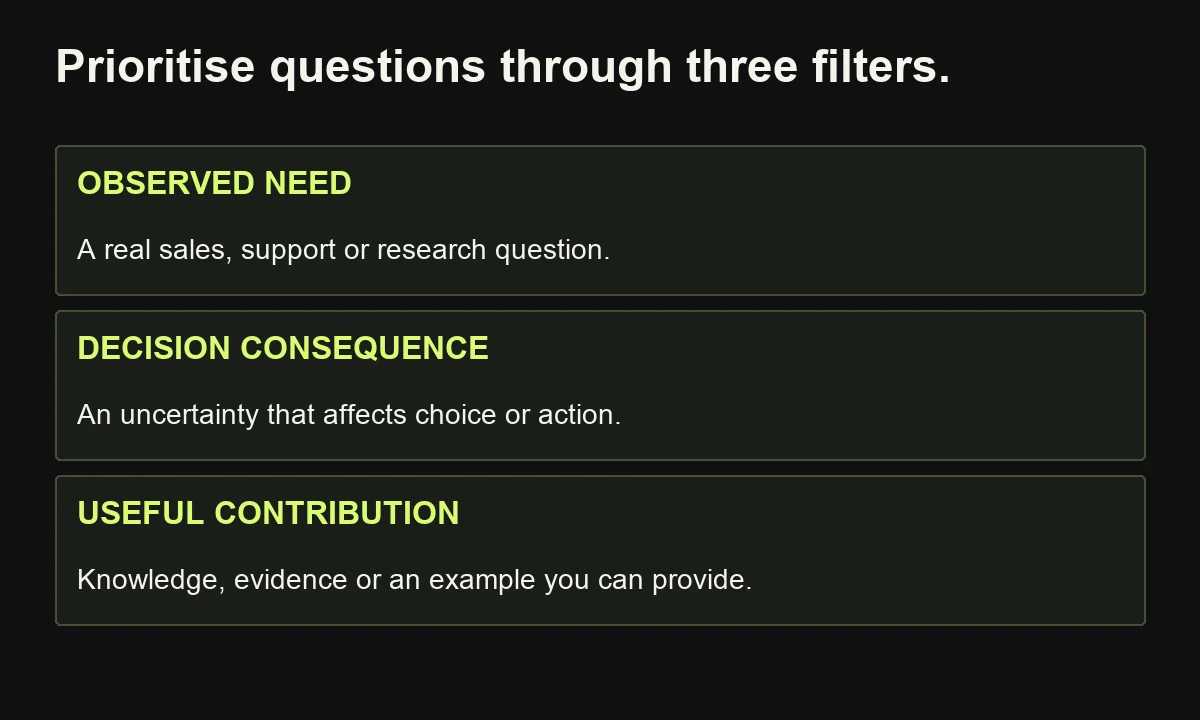
Use three filters:
- Observed need: Does this appear in sales conversations, customer interviews, support messages or relevant search data?
- Decision consequence: What might someone choose or misunderstand because of the answer?
- Useful contribution: Do you have the knowledge, evidence or example needed to improve the explanation?
A question such as “What is content marketing?” may attract attention, but it is not automatically the right priority for a consultant. “What should be ready before a content writer starts?” may expose a more immediate buying problem.
For a backpack seller, “What is a backpack?” offers little distinction. “Does the laptop compartment measurement include room for a sleeve?” addresses a concrete uncertainty if customers actually ask it.
Record where the question came from and preserve its intended meaning. Do not manufacture customer demand from a generated keyword list. Tool suggestions are leads to investigate, not proof of frequency or commercial value.
Group questions that belong to the same decision. “What does the writer need?” and “What belongs in the brief?” may share one resource. A request about ongoing editorial ownership may deserve a different explanation. Let the reader's task determine the boundary.
3. Put the answer where people need it
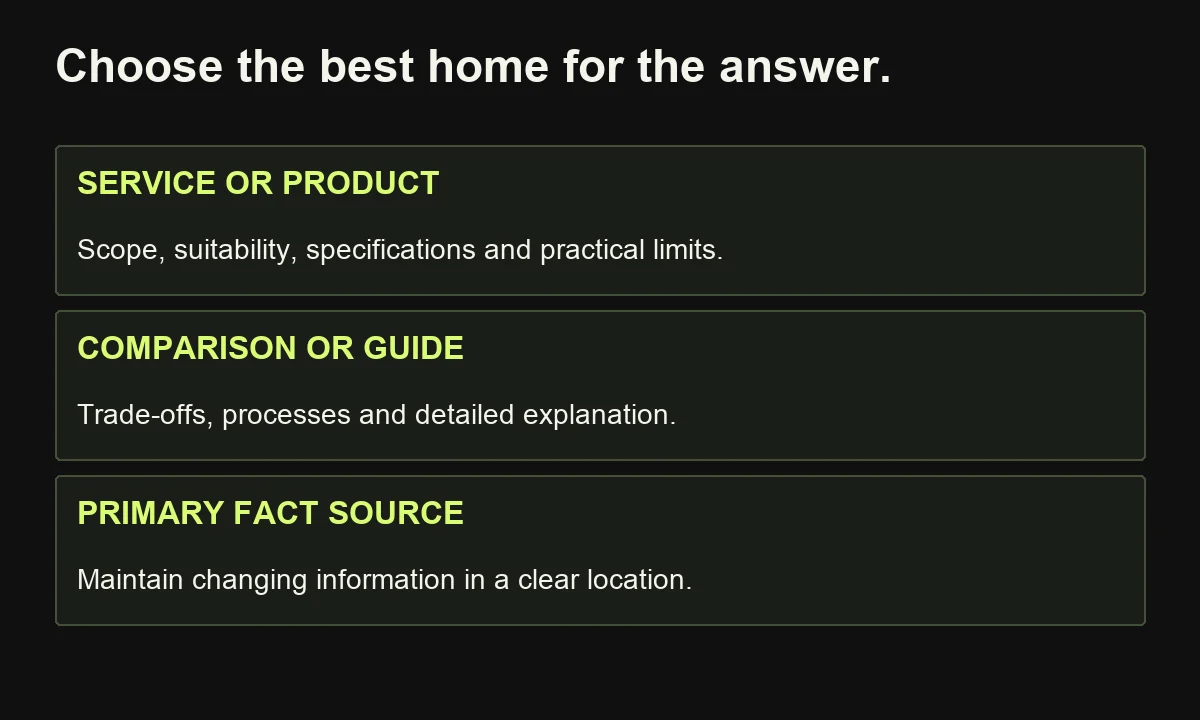
Place an answer on the page that best supports the task. Some questions belong inside a product description, service page, comparison or implementation guide. Others justify a standalone resource. A separate FAQ page is useful only when it improves navigation and maintenance, not because the label itself creates authority.
Create a simple map:
| Question | Best home | Supporting material |
|---|---|---|
| What does this service include? | Service page | Sample scope and responsibilities |
| Which approach suits our team? | Comparison or strategy guide | Criteria, examples and trade-offs |
| Will this product fit? | Relevant product page | Measurements and verified specifications |
| How do we use it? | Instructions or support resource | Demonstration and exceptions |
Choose a primary place to maintain changing facts. Other pages can summarise them and link to the fuller explanation. This reduces the risk of five slightly different answers surviving after a policy or specification changes.
Do not remove useful detail merely to make an answer look compact. Give the immediate answer first, then supply the explanation the decision requires.
Use contextual links that describe the next resource. “See the review responsibilities in the sample brief” is more helpful than an unexplained “click here.” The aim is continuity: a person should be able to move from question to explanation to evidence without starting their research again.
The internal linking guide explains how to connect these resources around the buyer's task.
4. Review answers for four kinds of completeness
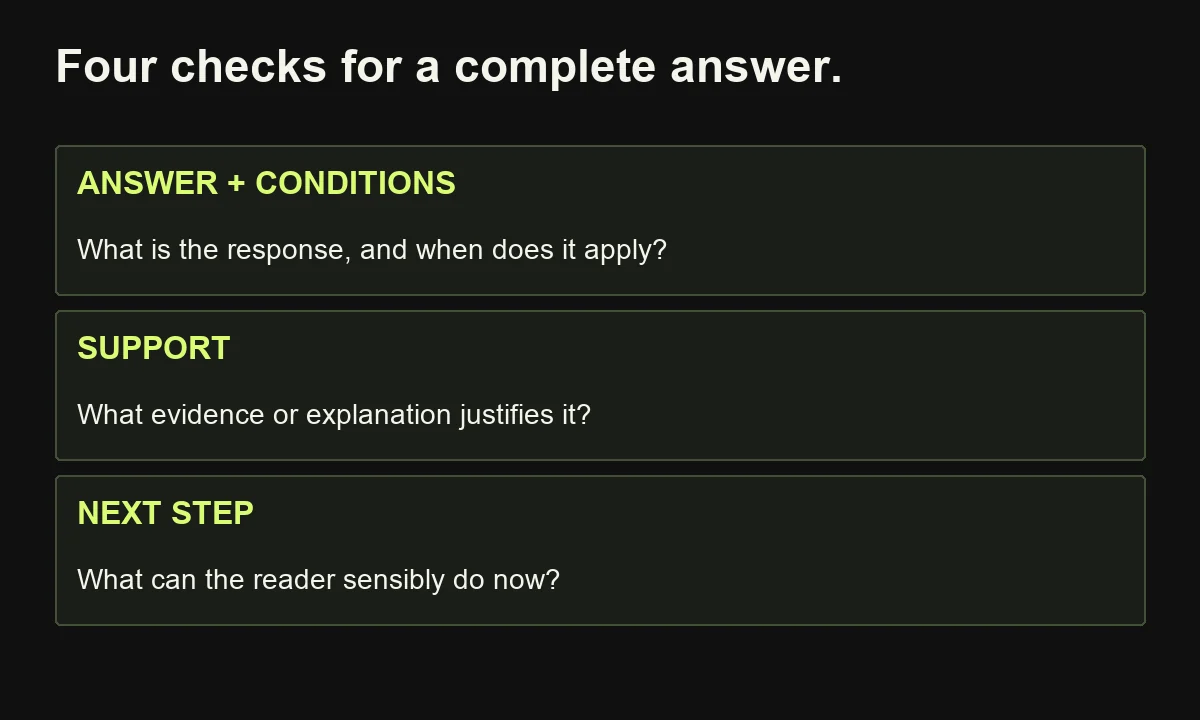
I recommend reviewing an important answer through four questions: Did we answer it? When does the answer apply? What supports it? What should the reader do next? This is an editorial review method proposed here, not a formula that controls what a platform selects or cites.
Answer: State the recommendation, definition or result without a long promotional warm-up. If the correct response is conditional, name the condition rather than hiding behind “it depends.”
Conditions: Preserve the details that could change the decision: audience, product model, prerequisites, geography, timeframe or exceptions. The necessary conditions depend on the subject; do not add an irrelevant disclaimer to every paragraph.
Support: Explain the basis. That may be an official specification, an observable process, a relevant source or a documented example. Distinguish an illustrative example from a measured result.
Next step: Help the reader apply the answer. They may need to measure something, inspect a sample, compare options or ask for help. A sales call is not the appropriate next step for every question.
Use the review before polishing the wording. A beautifully concise answer can still omit the condition that determines whether it is true.
A useful final test is to read the answer without the page title and adjacent paragraphs. Does it still identify the subject and communicate its limits? Improve clarity where necessary, while keeping enough surrounding explanation for readers who want to understand the reasoning.
5. Worked B2B example: strategy before writing
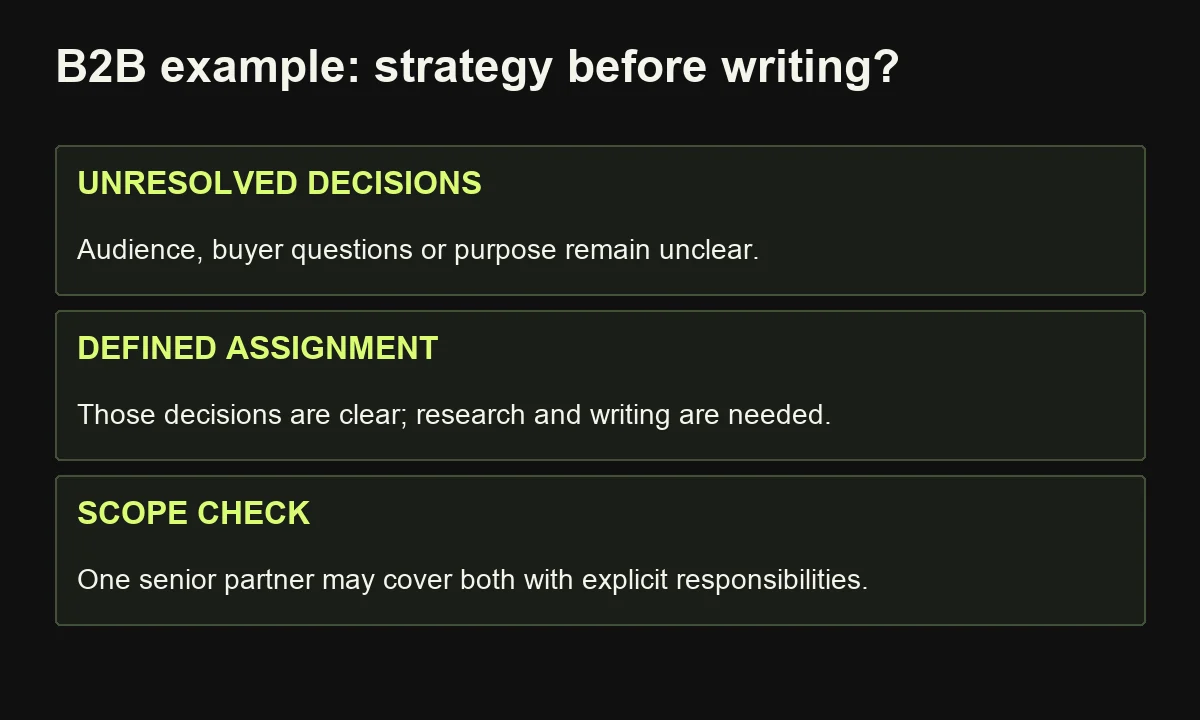
Suppose a marketing lead asks, “Should we hire a content strategist before a writer?” A useful answer should distinguish an unresolved strategic decision from a production gap. It should not imply that every team needs a separate strategy engagement or that writing requires no strategic judgment.
A weak answer might say:
Every successful business needs a comprehensive strategy to unlock the full potential of its content and maximise growth.
That does not answer the hiring question. Here is an original illustrative rewrite:
Start with strategy work if your team cannot agree on the audience, priority buyer questions or purpose of the content. Hire for writing when those decisions are clear and you need help researching and explaining the subject. A senior independent content partner can sometimes handle both, provided the scope and responsibilities are explicit.
The answer creates a decision rather than an obligation to buy. Follow it with a short diagnostic:
- Can we identify the reader and the decision the article should support?
- Do we know which evidence and subject-matter access the writer needs?
- Who will resolve conflicting feedback and approve the final work?
If those questions remain unresolved, the brief needs work. If they are settled, a large strategy exercise may add little value to the immediate assignment.
Support the explanation with an annotated brief or an appropriate work sample. These are practical ways to show judgment without inventing a financial result or promising that one hiring model always performs better.
6. Worked B2C example: a laptop and a backpack
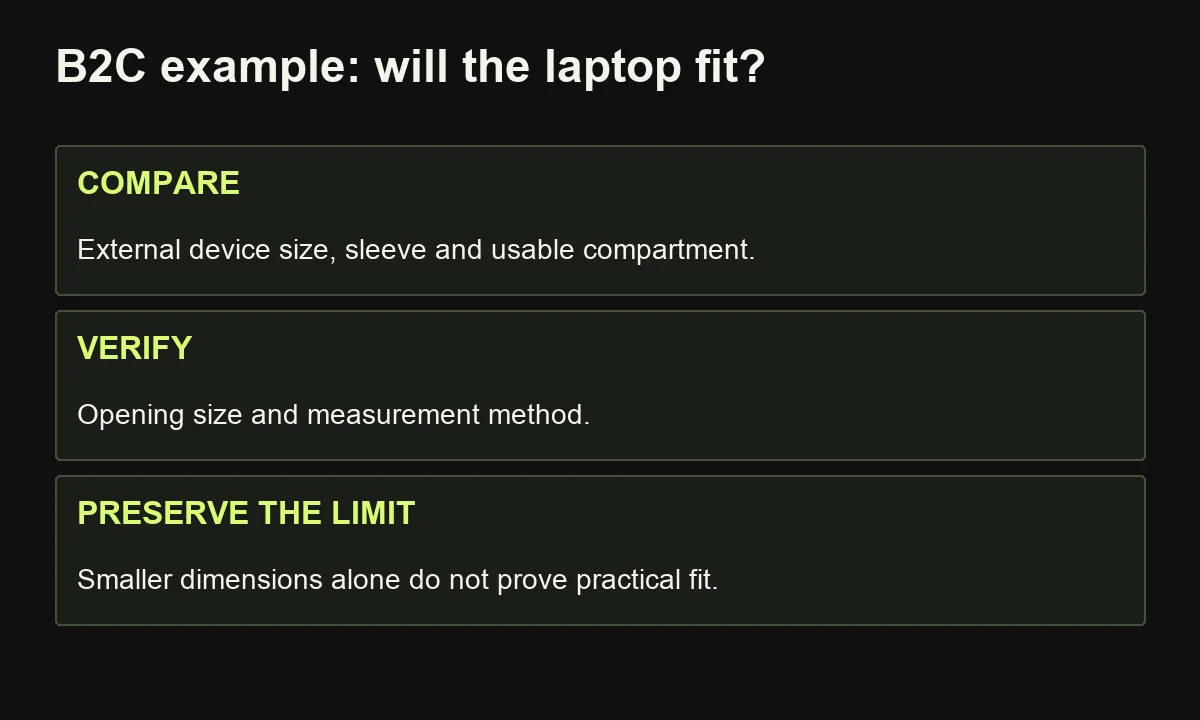
A product answer should resolve the shopper's actual constraint, not merely repeat a category label. “Fits a 14-inch laptop” can leave uncertainty because the label describes screen size rather than the complete device dimensions. The useful answer explains what to compare and which information has been verified.
Consider a fictional product page. All measurements below are assumed for teaching, not specifications for a real product.
Question: Will my laptop fit this backpack?
Weak answer: Yes, it is perfect for modern laptops and everyday adventures.
Useful answer: Compare your laptop's external width, height and thickness with the usable compartment dimensions, including any sleeve you intend to carry. In this illustrative example, the compartment is listed as 32 × 23 × 3 cm. Also check the opening and how the dimensions were measured before relying on the comparison.
A laptop listed as 31 × 22 × 2 cm is smaller on those three measurements, but the figures alone do not establish effortless insertion, suitable padding or compatibility with an added sleeve. That boundary belongs beside the answer.
Then provide a labelled measurement image and a clear route to ask about an unlisted model. Avoid making the customer supply unnecessary personal information.
The broader lesson applies to products and services alike: identify the deciding variable, publish the relevant facts and explain any uncertainty. Specificity earns its value by resolving the question, not by making the answer sound more confident.
7. Choose a format that matches the question
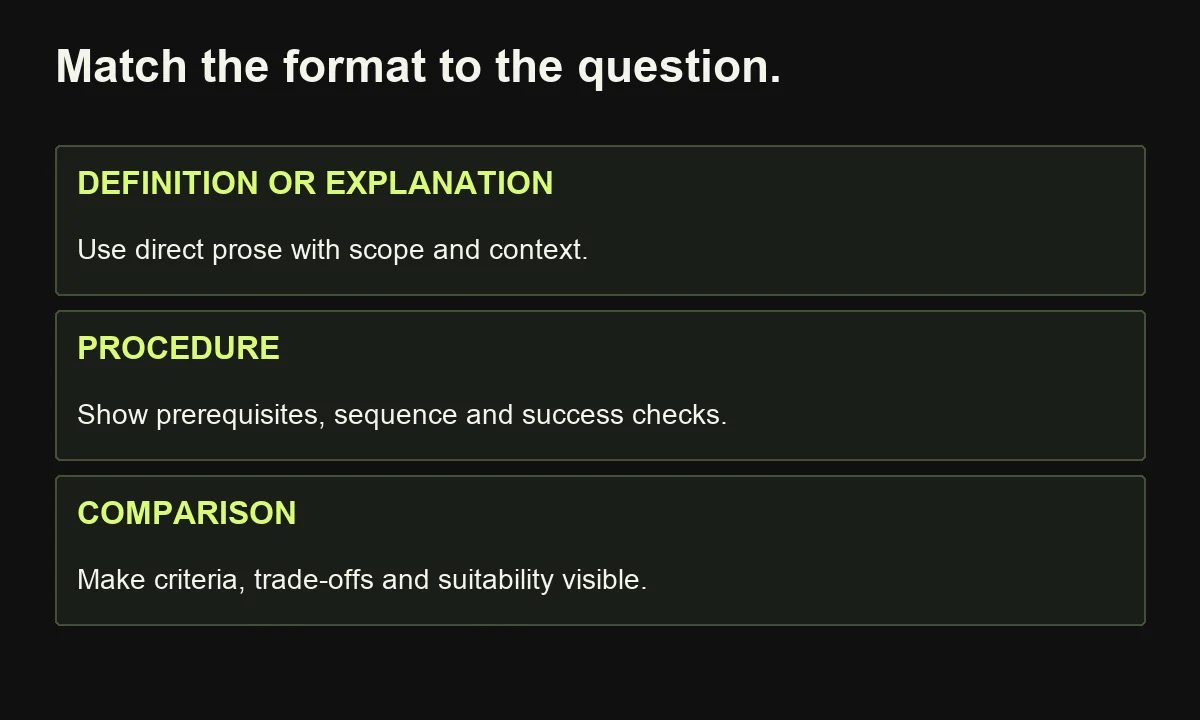
Use prose for an explanation, a list for an ordered process and a table when a comparison genuinely helps. An answer should be easy to understand because its structure fits the task. Converting every paragraph into a question or table can make a page harder to read.
Match the format to the decision:
| Question type | Useful format | What must remain visible |
|---|---|---|
| What is it? | Direct definition and example | Meaning and scope |
| How do I do it? | Steps with prerequisites | Sequence, inputs and checks |
| Which should I choose? | Criteria-based comparison | Trade-offs and suitability |
| Does it work for me? | Conditional explanation | Requirements and exceptions |
For a procedure, include the point where someone checks whether the step succeeded. “Connect the tools” is not an actionable instruction if the reader cannot identify the required permission, destination or confirmation.
For a comparison, explain the criteria before announcing a winner. Two options may suit different constraints. A table can make the distinction visible without implying an objective universal ranking.
Use descriptive headings and logical heading levels. W3C's headings guidance explains how headings communicate organisation and support navigation, including with assistive technologies.
Write meaningful visual information into accompanying text too. An image should help someone understand the answer, not become the only place where essential conditions, steps or measurements appear. Clear structure serves the reader before it serves any optimisation goal.
8. Resolve conflicting answers before publishing more
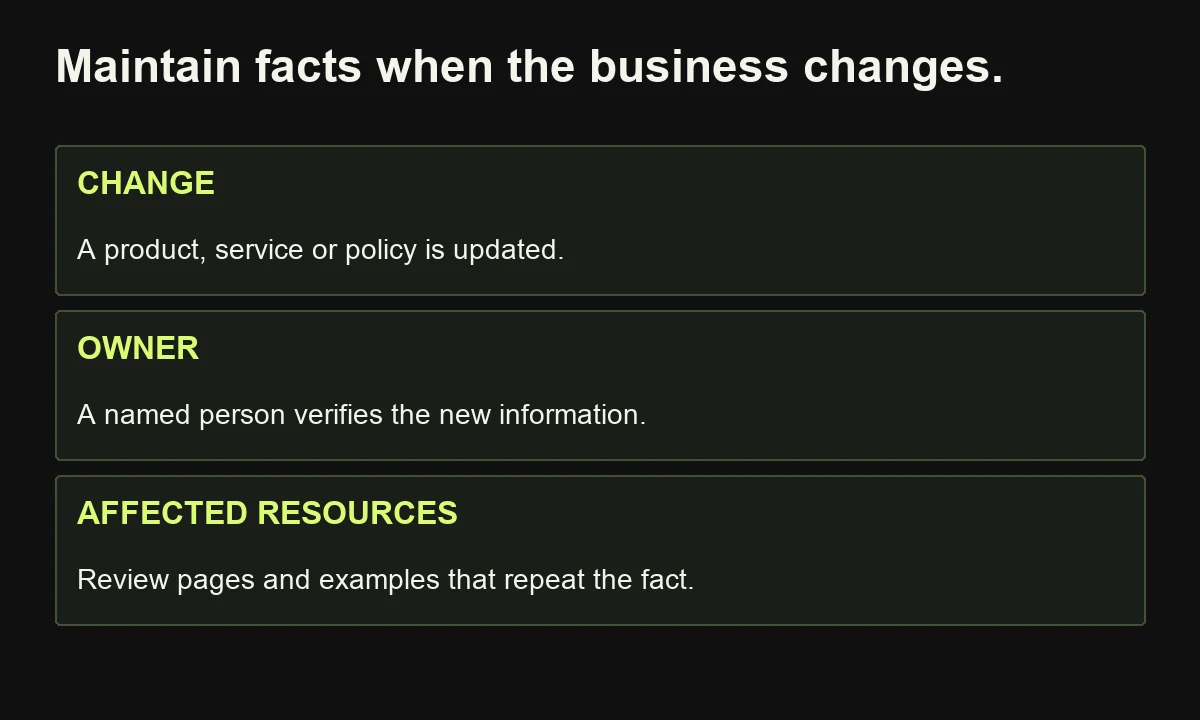
Answer quality is also an information-management problem. A clear paragraph on one page cannot resolve a different price, specification or process elsewhere. Before adding more question-led content, identify where important facts live and who is responsible for reviewing them when the business changes.
Build a small register for consequential information:
| Information | Primary source | Review trigger |
|---|---|---|
| Service scope | Approved service description | Offer or responsibility changes |
| Product dimensions | Verified product record | Model or packaging changes |
| Delivery policy | Current fulfilment policy | Operational or regional changes |
| Project result | Approved evidence record | Correction or new context |
Assign an owner and review the affected pages when a trigger occurs. Calendar reviews help, but they do not replace a check when a known change happens.
For example, if a service stops including interviews, review the service page, relevant examples, proposal materials and any comparison that describes interviews as standard. Do not simply update the latest article and assume the public explanation is consistent.
This is also where marketing, sales and support can help one another. Repeated clarification requests may reveal a missing or contradictory answer. Share the verified response and record the unresolved exception.
A proposed maintenance process does not guarantee that an engine will refresh its answer immediately. It improves the information available for readers and future retrieval. Record corrections and observe whether the public description changes rather than assuming that a publication timestamp has fixed the issue.
9. Which AEO shortcuts should you avoid?
Do not confuse helpful writing practices with guaranteed selection rules. A short answer, visible FAQ or technically valid markup can still be inaccurate, irrelevant or unhelpful. Evaluate a tactic by the reader problem it solves and the platform documentation supporting the claim made for it.
Google's current AI search guidance says there is no requirement to break content into tiny pieces and no ideal page length for its generative search features. It also cautions against unnecessary AI text files and inauthentic mentions. Those statements apply to Google; other services should be assessed against their own guidance.
The same distinction matters for FAQs. A visible FAQ can answer genuine questions, but Google's documentation changelog records that FAQ rich results stopped appearing from 7 May 2026. Do not buy an implementation on the promise that adding FAQ markup will restore that retired display.
Technical foundations still matter. Have the appropriate person check indexing, relevant search inclusion settings, crawl access, canonical URLs and readable content. Check actual responses as well as declared permissions; a browser view alone does not establish crawler access.
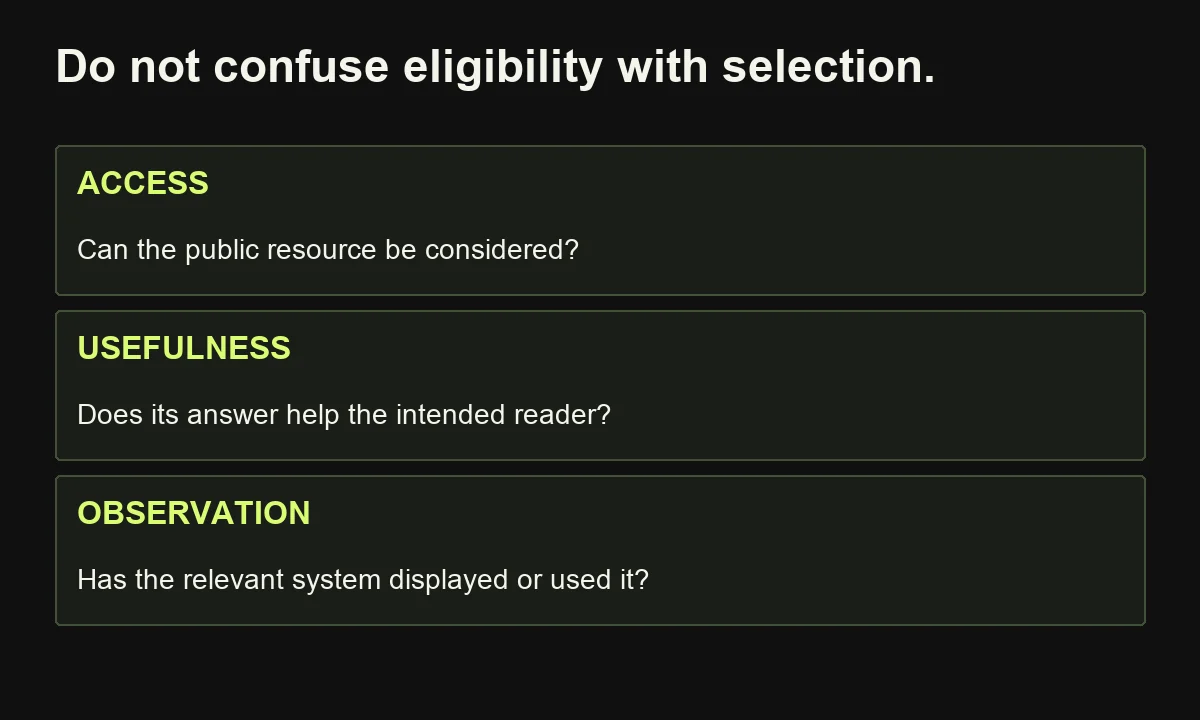
Keep these questions separate:
- Can the resource be accessed and considered?
- Does the answer actually help the intended reader?
- Has the relevant system displayed or used it?
Eligibility, usefulness and observed appearance are different findings. None should be reported as a guarantee of the others.
10. Measure whether the answer is helping
Evaluate AEO at the level of the question and intended decision, then connect it to broader website performance. An answer can be visible but wrong, useful but unclicked, or visited without producing a relevant enquiry. Your reporting should preserve those distinctions instead of reducing everything to one visibility score.
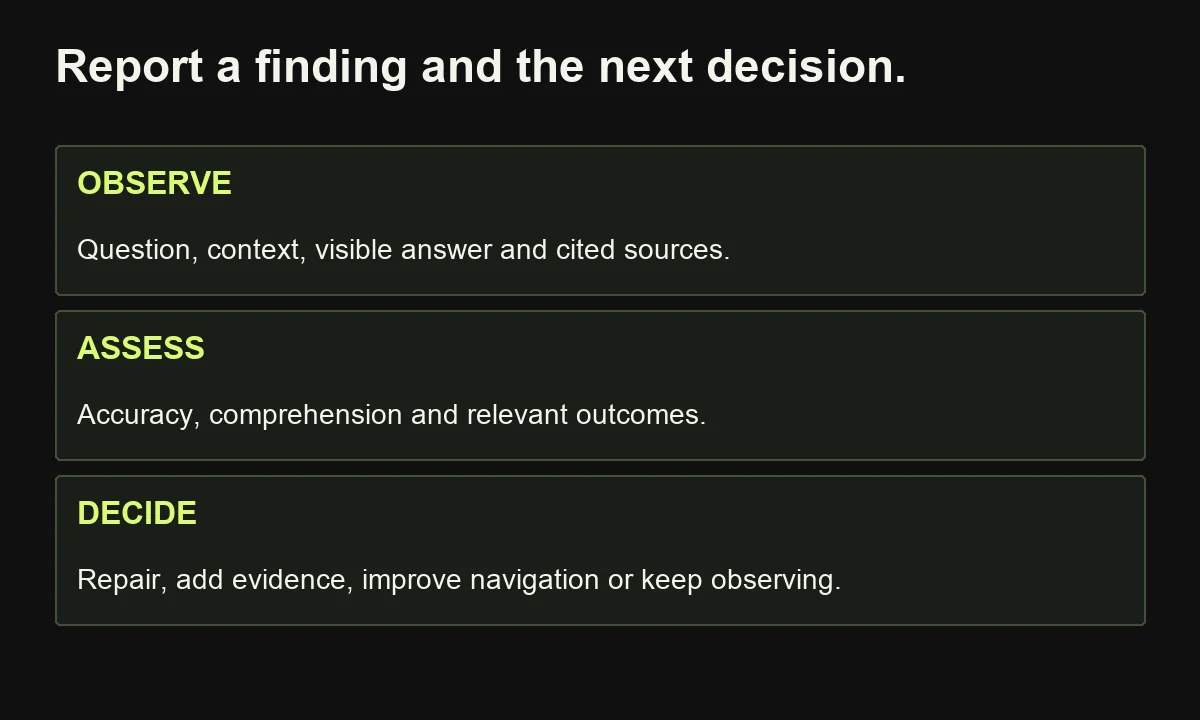
Create an observation record containing the question, platform, date, relevant mode or context, visible response, cited sources and any error. Repeat a small, stable set under comparable conditions. Treat it as a sample, not a census of every user's experience.
As checked on 17 October 2026, Google's Generative AI performance report for Search reports impressions for supported features including AI Overviews and AI Mode. It offers views by page, country, date and device; insufficient impressions can explain a missing report. Those figures are not a complete record of enquiries or all answer engines.
Add website behaviour and business feedback. For a product-fit answer, inspect whether visitors reach the relevant specifications and whether fit-related questions remain unresolved. For a service comparison, review the relevance of subsequent enquiries and the assumptions prospects bring to a conversation.
Do not infer causation from one improved answer followed by one good lead. Changes in demand, distribution and the offer may contribute too.
End the report with a decision: repair an error, add missing evidence, improve navigation, continue observing or leave a useful answer alone. Measurement should guide the next action.
11. Run a focused answer-improvement pilot
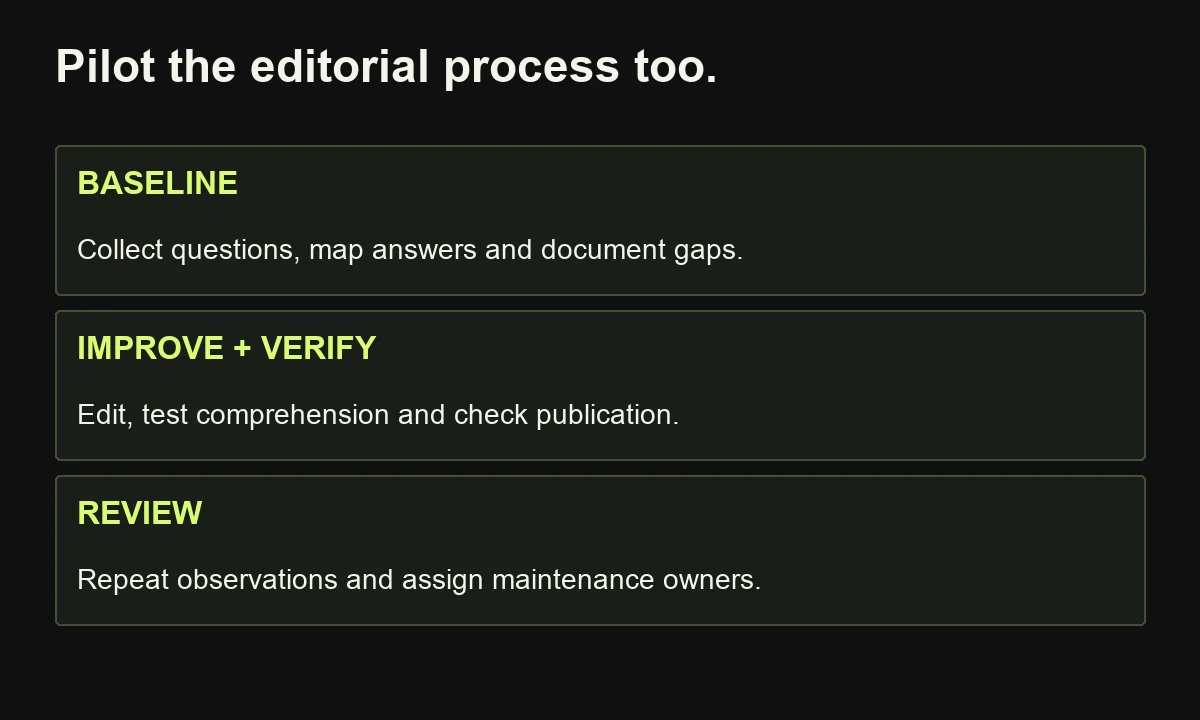
Choose a small group of related customer questions and improve the resources that should answer them. A useful pilot tests your editorial process as well as the content. It should establish what changed, who verified it and what evidence would justify expanding the work.
For example, a service business might select five recurring pre-enquiry questions: suitability, scope, preparation, review and the first step. This is an illustrative planning choice, not a validated optimum number.
Before editing: Collect the exact questions from real conversations. Map their current answers and record a baseline using available reports and comparable observations. Identify conflicting facts and missing subject-matter input.
During editing: Write the immediate answer, preserve relevant conditions, add evidence and connect the next step. Ask someone unfamiliar with the draft to explain what they would do after reading it. Fix misunderstandings before publication.
Before release: Confirm the factual reviewer, links, metadata, visual explanations, mobile readability and technical eligibility. Keep a record of the approved version and an owner for changing information.
After release: Verify the public page and allow for discovery and reporting delays. Repeat the same observations, review customer questions and document uncertainties. Set the review schedule to suit how often the facts change rather than inventing a universal waiting period.
Download the answer-improvement worksheet to capture the question, destination, answer, conditions, evidence, owner, next step and observation. Expand only when the process produces useful, maintainable resources.
Frequently asked questions about adapting to AEO
Does AEO replace SEO or GEO?
No. These terms overlap and are used differently across the industry. This guide uses AEO to focus on answering a customer's question accurately and usefully. Maintain search fundamentals and connect the answer to the broader discovery journey.
How long should an AEO answer be?
Long enough to answer the question with the conditions that matter. Start directly and add the necessary explanation. Google's featured-snippet documentation does not give an exact minimum length, so avoid treating a universal word count as a selection rule.
Should every page have an FAQ?
Only when the questions help the reader and are not answered more naturally elsewhere. A strong comparison, product description or procedure can be useful without a separate FAQ block. Do not add repeated questions simply to increase the apparent amount of optimised content.
What help should I look for?
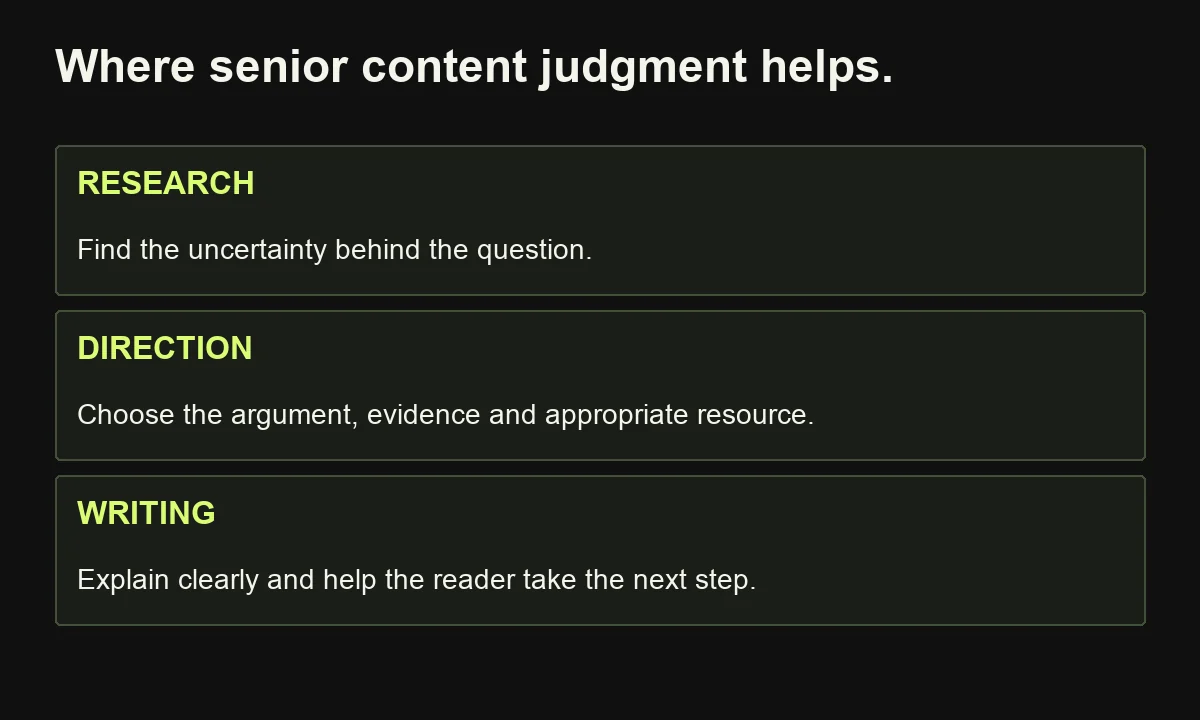
Look for someone who can research the reader's uncertainty, challenge weak claims and write an explanation that supports a decision. Formatting a page is only one part of that work.
This is where I focus my content strategy and writing: turning buyer research and subject knowledge into clear, useful resources. If your content gets attention but prospects still misunderstand the offer, tell me which questions keep coming back. We can discuss whether the starting point is research, a clearer content direction or a focused rewrite.