
AI summary
A useful B2B content workflow makes the next decision clear. It connects an agreed buyer question with reliable evidence, a reviewable draft and recorded approval, so work can progress.
- Agree the work before drafting: Define the reader, intended answer, scope and evidence owner. Ask experts focused questions early. An unresolved brief or unsupported capability claim should remain visible rather than becoming somebody else's revision problem.
- Give review a clear purpose: Separate strategic, factual, editorial and release decisions. Request specific feedback, consolidate conflicting instructions and approve a named version. Material changes may need another check; missed deadlines do not silently create approval.
- Improve flow without losing usefulness: Track waiting, blockers, rework and unfinished assets alongside reader responses. Start with one workflow, inspect the published page and assign distribution. Add software or AI assistance only where the task and review standard are clear.
A B2B content workflow defines how an idea becomes a researched, reviewed, approved and published asset. It gives each handoff an owner, a clear input and a condition for moving forward. Start with the buyer's question, involve experts before drafting, separate different review decisions and verify the actual published result.
An article can be beautifully written and still spend weeks waiting for someone to decide whether it is ready.
The writer thinks the subject expert is checking accuracy. The expert assumes marketing wants a rewrite. A senior stakeholder changes the audience after design has started. Everyone has contributed, but nobody knows which decision permits publication.
The problem is often visible in the calendar as a missed date. Its cause sits earlier: an unresolved question, unclear authority or a handoff that arrived without the information needed to act.
This guide proposes a practical B2B content workflow for a lean team. It covers the brief, subject-matter input, drafting, review, approval, publication and learning. The central recommendation is simple: define what the next person must receive before asking them to take responsibility.
You will find a completed hypothetical example, review instructions and an editable workflow template. These are operating recommendations, not a promise of a particular publishing speed. Use them to expose the decisions slowing your work, then simplify the process around those decisions.
1. What should a content workflow control?
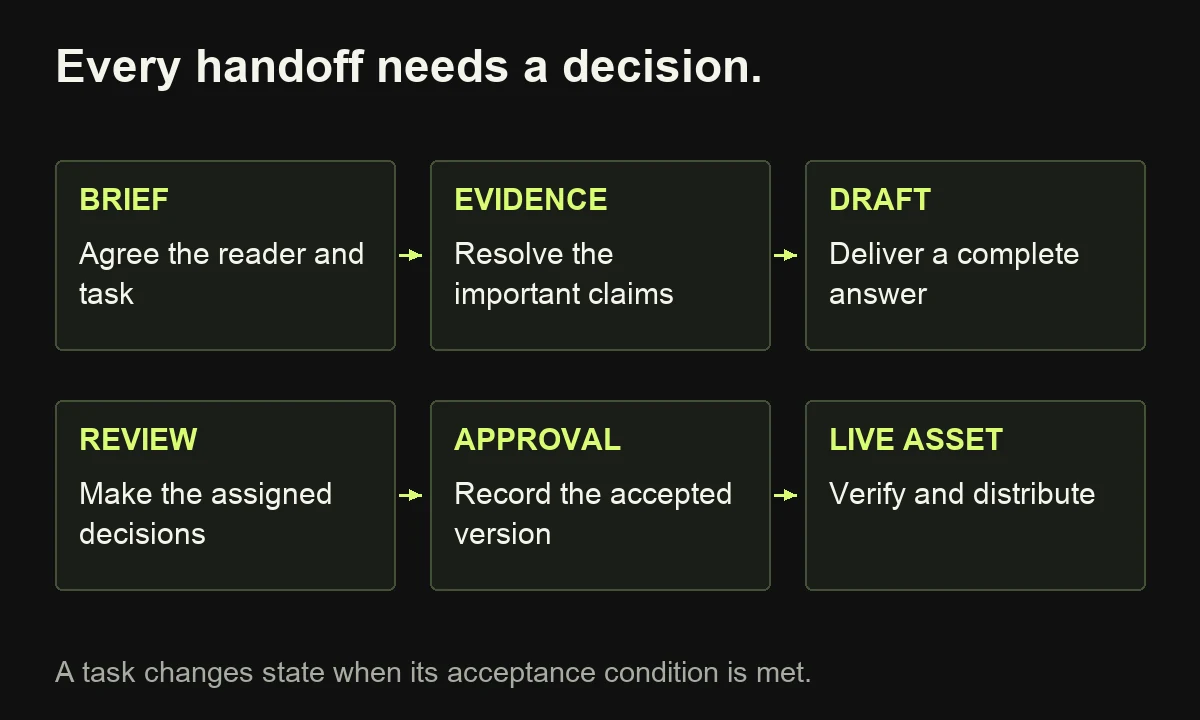
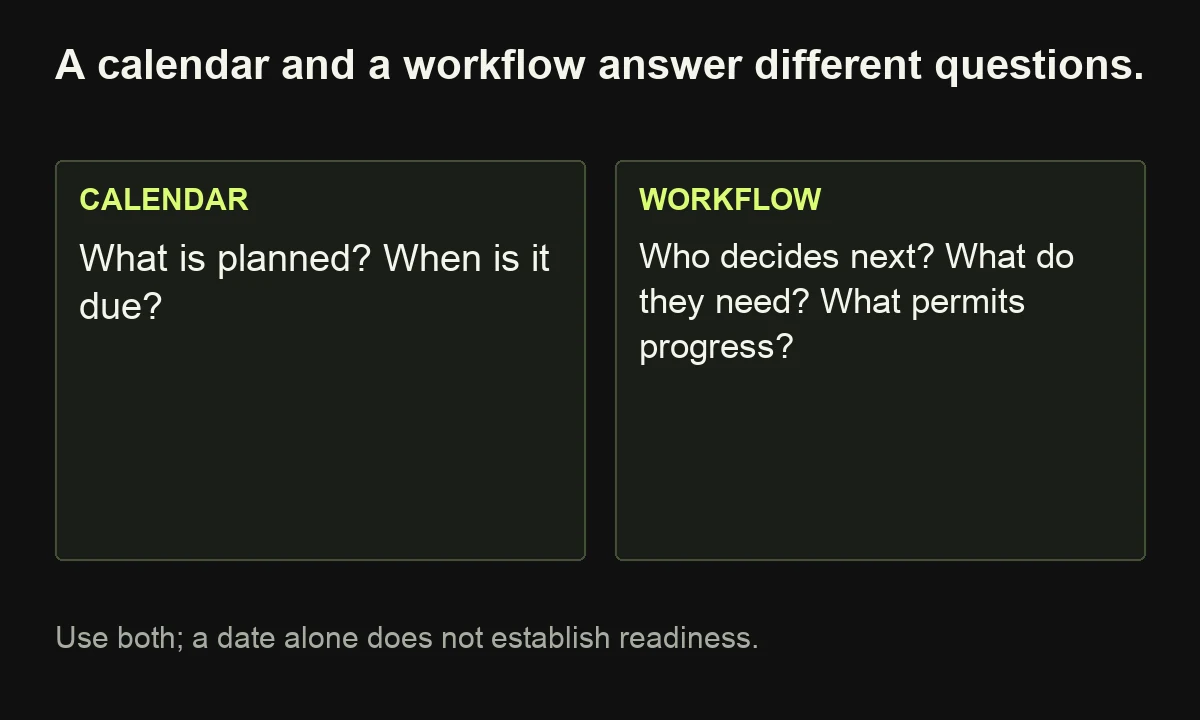
A workflow should control the movement of decisions and evidence, not merely list production tasks. A calendar tells you what is planned and when it is due. A workflow explains who can advance the work, what they need to inspect and what happens when the required condition is not met.
The Content Marketing Institute's workflow documentation guide describes connected stages covering requests, prioritisation, creation, publication and storage. The useful lesson is that writing is only one part of the process.
For a small team, begin with these working states:
| State | Evidence needed to move forward |
|---|---|
| Proposed | Relevant reader question and business purpose |
| Brief agreed | Scope, intended answer and research requirements |
| Evidence ready | Usable sources and resolved expert questions |
| Draft ready | Complete argument and inspectable claims |
| Approved | Required decisions recorded against a version |
| Published | Correct live asset and distribution owner |
Keep the labels understandable to the people using them. A status such as “in progress” tells the next person very little.
For each handoff, record the next decision, its owner and the accepted output. If the evidence is missing, return the task with a specific reason. That is more useful than moving a card into review and hoping someone will work out what it needs.
2. Agree the brief before assigning the draft
A useful brief settles the reader, the task and the article's intended contribution before the writer starts. It should also identify which claims need evidence and who can supply it. Keywords and a list of headings are insufficient when the business has not decided what the reader needs to understand.
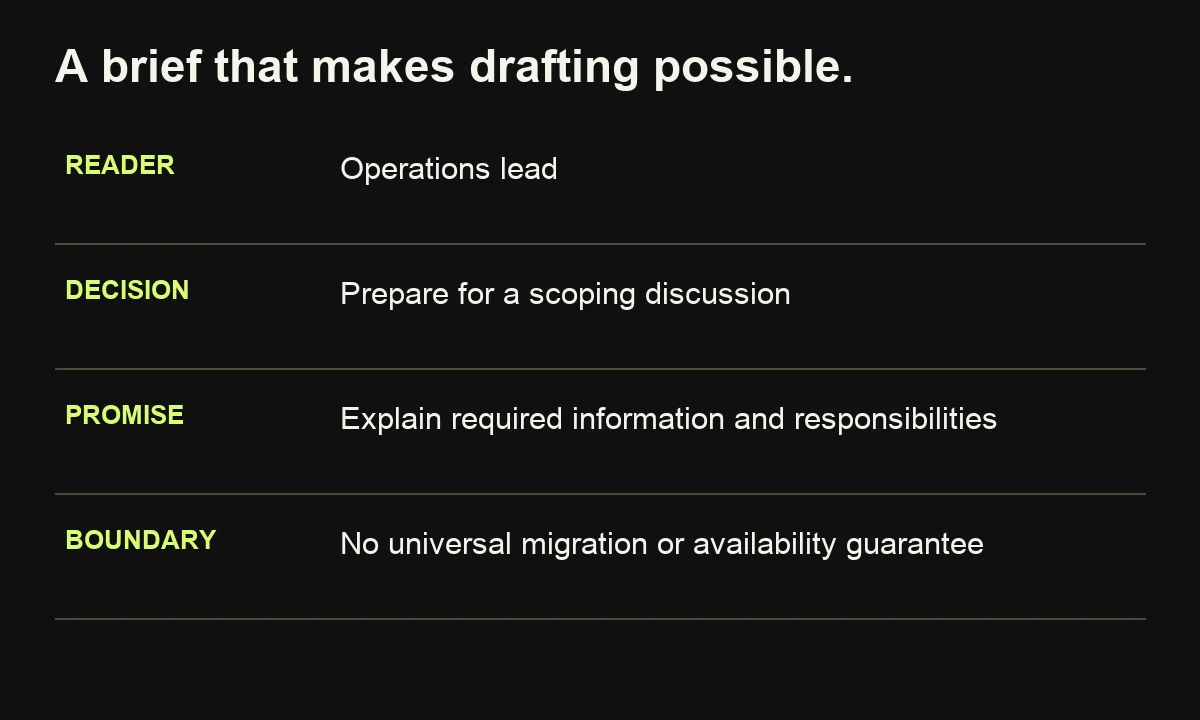
Consider a hypothetical software vendor commissioning an article about preparing customer data for a migration discussion. The reader is an operations lead, not a database specialist performing the migration itself.
A workable brief might include:
- Reader decision: Can we begin a productive scoping conversation?
- Article promise: Explain the information and responsibilities to prepare.
- Boundary: Do not provide a universal migration procedure or promise uninterrupted service.
- Evidence owner: The implementation lead verifies preparation requirements.
- Next step: Use a readiness checklist or request a scoping discussion.
The content lead approves that direction before commissioning a full draft. If sales wants a vendor-comparison article instead, resolve the difference now.
Include proposed internal links, a realistic length and the person who can decide whether the finished article meets the brief. Let the writer improve the outline when research reveals a better structure.
For the editorial work inside this stage, see my guide to writing a high-ranking blog. The workflow's job is to make that work possible without repeatedly reopening the assignment.
3. Make expert input a bounded assignment
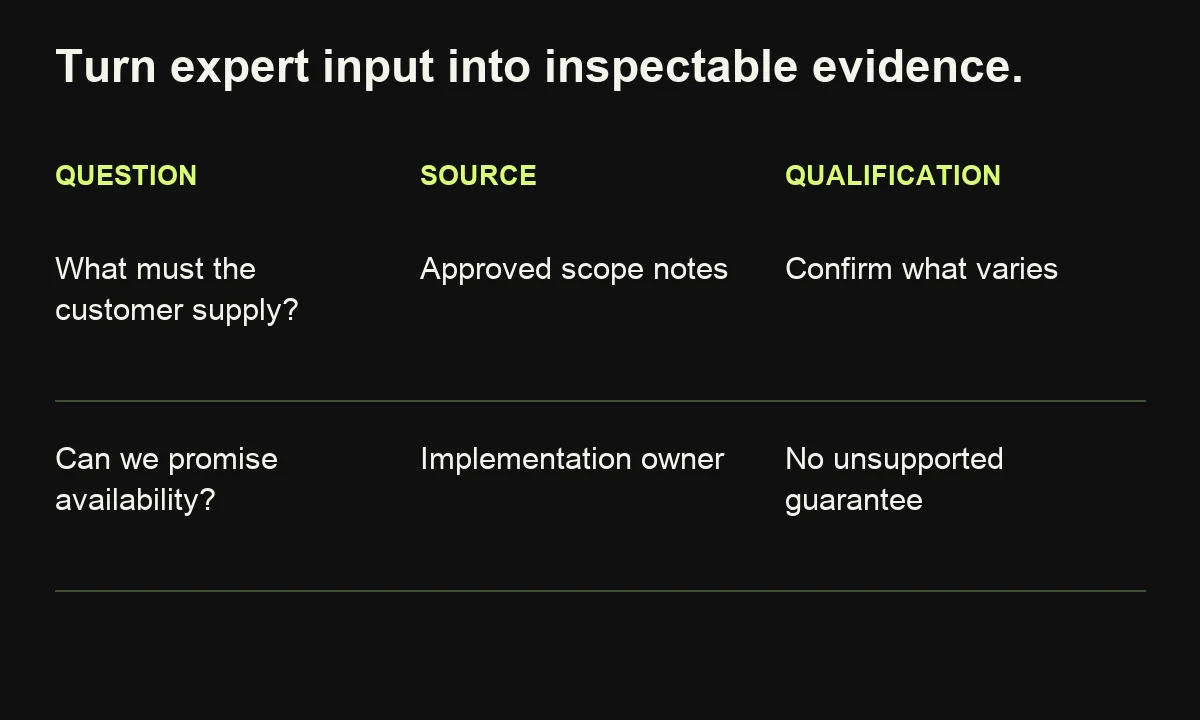
Ask subject-matter experts for the knowledge only they can supply, rather than asking them to write or approve everything. Send a short question pack with the article's audience, the uncertain claims and the decision needed. The output should be usable evidence and qualifications, not an unstructured recording nobody has time to interpret.
For the migration example, useful questions include:
- What information must a customer supply before the team can assess the work?
- Which preparation steps vary by source system or customer situation?
- What do prospects routinely misunderstand?
- Which promises would be inaccurate without further investigation?
- What example can we explain publicly, with permission?
Share these before a short interview or written response. Choose the format around the expert's availability and the complexity of the question; a meeting is not automatically the best answer.
Afterward, the writer turns the input into a claim record: proposed statement, supporting source, important limitation and person responsible for confirmation. Return specific uncertainties to the expert instead of asking them to repeat the entire discussion.
If a customer story is involved, verify permission and the exact scope of the result. My case-study writing guide explains how to gather that evidence. An internal anecdote does not become publishable proof simply because somebody recalls it confidently.
4. Define what “ready for review” means
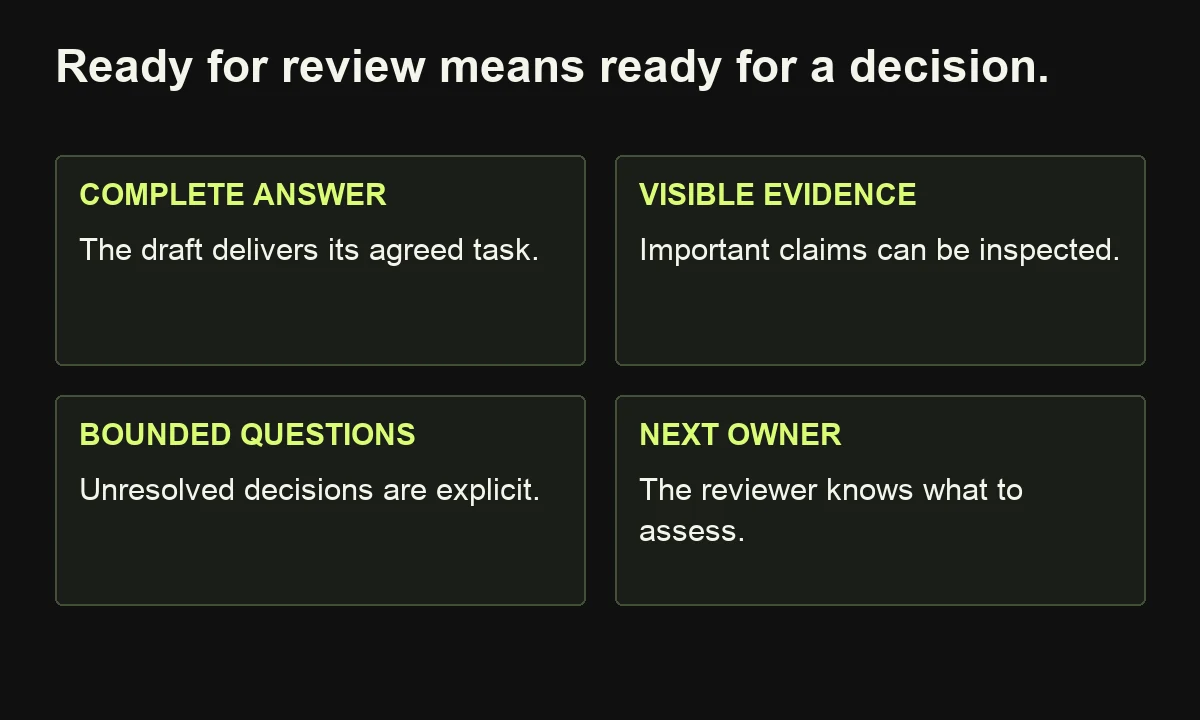
A review-ready draft is complete enough for the reviewer to make the assigned decision without rebuilding the writer's research. It should deliver the agreed answer, expose material claims and identify any decision that remains open. Sending an unfinished draft to a large group often transfers unresolved writing work into the review stage.
Before handing it over, the writer should check:
- The opening answers the main question accurately.
- Each section delivers the promise in its heading.
- Examples show how the recommendation works.
- Material claims have an inspectable source or named owner.
- Links, visual instructions and intended next steps are present.
- Unresolved issues are explicit rather than hidden in polished prose.
Use a short handoff note: “Please verify the preparation requirements in sections two and four. The audience and structure have already been agreed. Two capability questions are listed below.”
This gives an expert a bounded job. It also makes a blocked draft visible: if the answer depends on a product capability nobody can confirm, it is not ready for factual approval.
Do not turn this checklist into a demand for a perfect first draft. Editorial revision is normal. The point is to distinguish work that needs useful review from work that still needs basic research, direction or completion. That distinction protects both the reviewer and the writer.
5. Separate review responsibilities
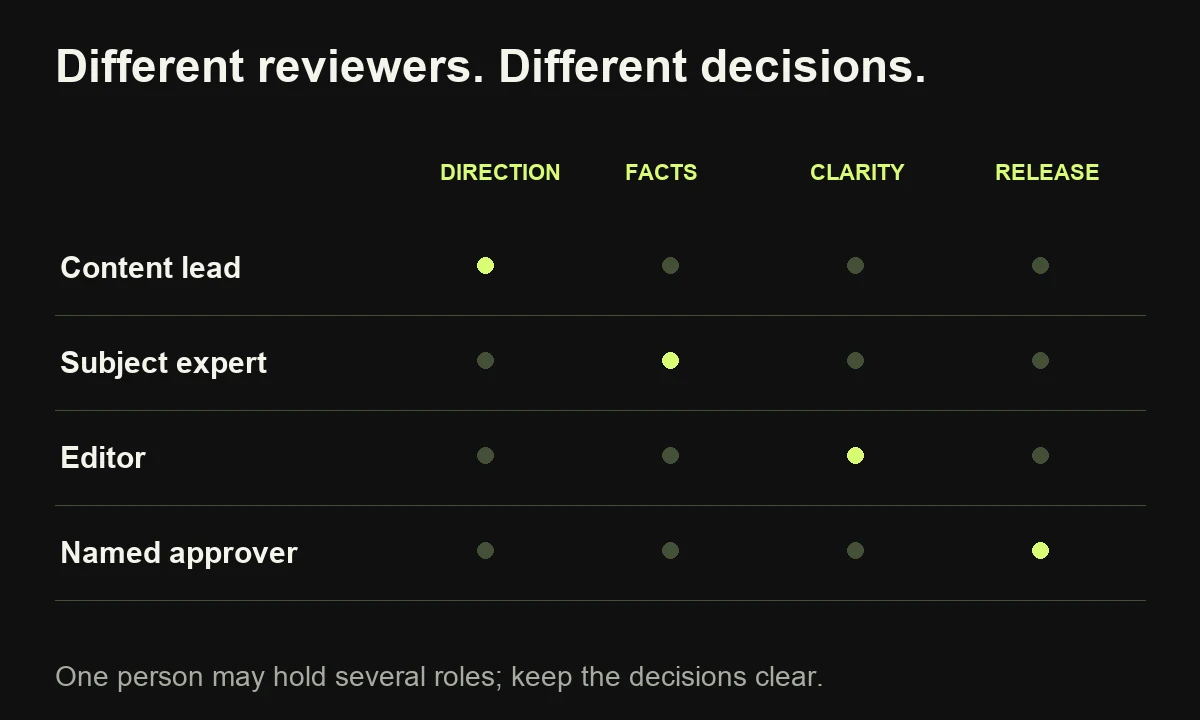
Different reviewers should answer different questions. An editor checks whether the article makes sense for the reader. A subject expert checks technical accuracy. A business owner checks whether the offer and commitments are represented correctly. Where additional specialist approval is required, define its scope and the responsible person before work reaches that stage.
A lean responsibility map can look like this:
| Decision | Responsible reviewer | Expected output |
|---|---|---|
| Does the answer serve the agreed reader? | Content lead | Accept direction or explain the gap |
| Are the material statements accurate? | Subject expert | Corrections with evidence or conditions |
| Is the writing clear and coherent? | Editor | Consolidated editorial revision |
| Can this version be released? | Named approver | Recorded approval or specific blockers |
One person can hold several roles. The decisions should still remain distinguishable.
Decide which checks can happen together and which depend on earlier answers. Technical claims may be reviewed alongside language, but a substantial change to the audience can invalidate both rounds.
The CMI's review and approval article recommends being selective about reviewers and agreeing expectations. Use that principle without adopting its older example timelines as a universal standard.
Choose a person to consolidate feedback and resolve conflicting instructions. A writer should not have to guess which of two incompatible requests carries authority.
6. Ask for decisions, not general reactions
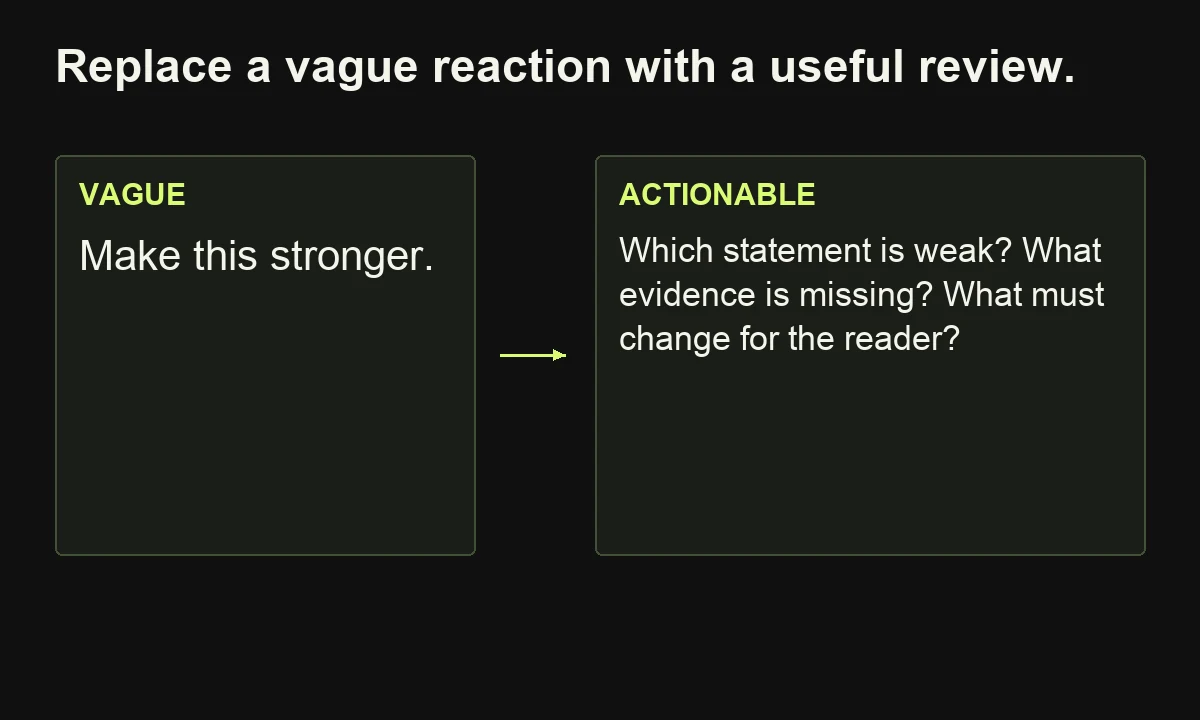
Useful feedback identifies the problem, its consequence for the reader and the change or evidence needed. “Make this stronger” is difficult to act on because it does not explain what is missing. Give reviewers a simple way to distinguish factual corrections, strategic objections, clarity issues and optional preferences before requesting revisions.
Compare these comments:
| Vague reaction | Actionable review |
|---|---|
| This is too basic | The reader already knows the definition; explain the preparation decision next |
| Make the claim stronger | Show the supporting evidence or narrow the claim |
| Add more detail | Give an example of the information the customer must supply |
| I prefer the earlier version | Identify which reader need the earlier wording served better |
Review the recommendation behind a requested edit. A suggested sentence may be inaccurate even when the reviewer's underlying concern is valid.
Google Docs supports suggested edits that can be accepted or rejected without immediately replacing the original text. That is useful review functionality, but resolving a suggestion is not the same as recording business approval.
Keep the final decision somewhere the team can find it. When a requested change affects scope or a previously verified claim, record who must recheck it. A comment marked resolved should mean the issue was addressed, not simply that the discussion disappeared.
7. Approve a specific version
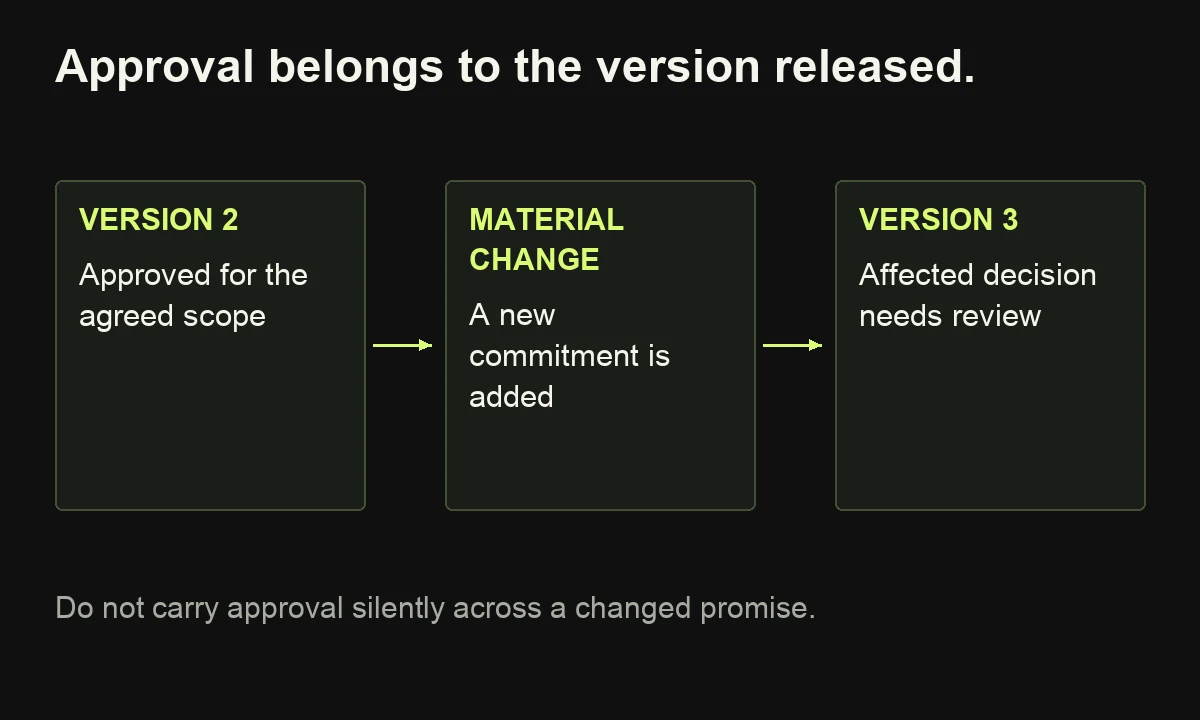
Approval should identify the version, the reviewer, the decision and any conditions. A message saying “looks good” becomes ambiguous after somebody changes the offer, adds a claim or replaces a graphic. Define which changes require another check and which minor corrections the editor can make within the agreed authority.
A proposed approval note is straightforward:
“Version three approved for the agreed audience and scope. Preparation requirements verified by the implementation lead. No unconditional service-availability claim. Recheck if those requirements or commitments change.”
This is an example of an internal record, not a contractual document or a substitute for your organisation's approval policies.
Adobe's document-version guidance illustrates why version identity matters: adding a new version can withdraw outstanding approvals on the previous version. Exact functionality depends on the applicable Workfront experience and availability.
You do not need that platform to adopt the underlying discipline. A versioned document and a clearly recorded decision may be enough for a small team.
After approval, make material changes visible. If a designer shortens a qualified statement into an absolute promise, return that statement to the appropriate reviewer. Approval belongs to the meaning released, not merely the file that happened to pass through the process earlier.
8. Plan around the bottleneck
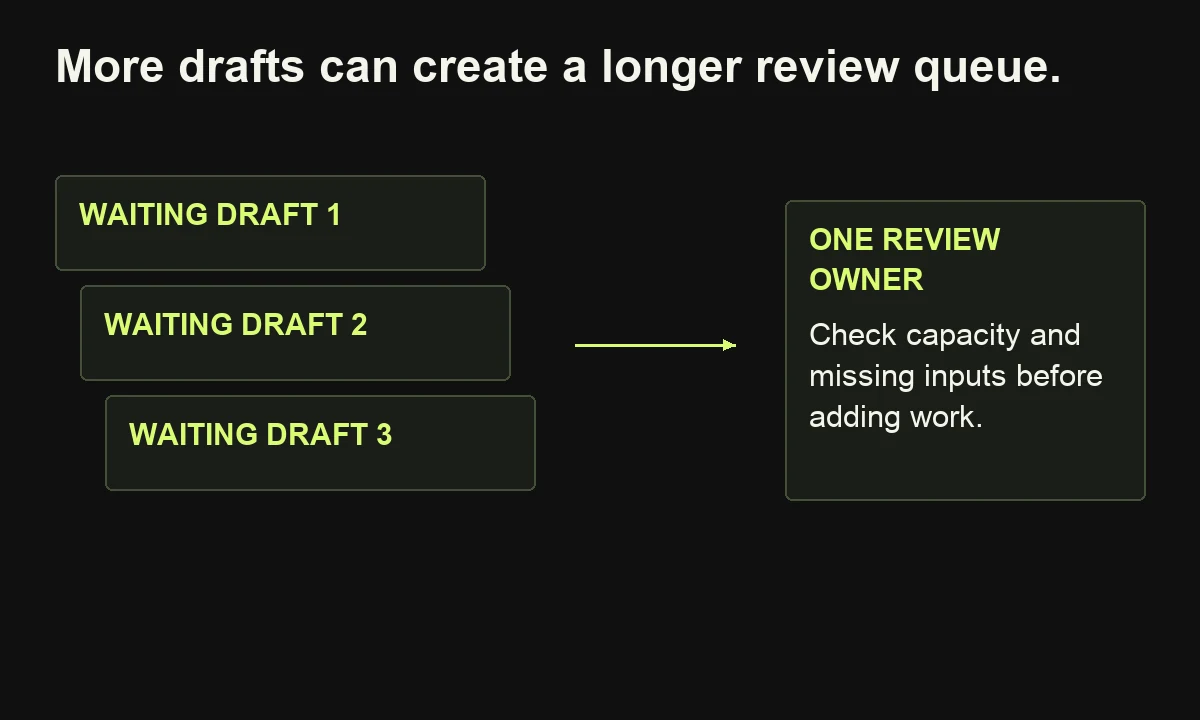
Set the publishing commitment around the capacity of the people making essential decisions, not just the availability of writers. If expert review is the constraint, adding more drafts can increase the waiting queue. First establish what is waiting, why it is waiting and which owner can make the next decision.
Separate three situations:
- Working: Someone is actively completing the assigned task.
- Waiting: The next owner has usable inputs but has not started.
- Blocked: A required answer, source, permission or decision is missing.
Each needs a different response. Waiting work may need scheduling. Blocked work may need a narrower claim, another source or a different publication date. A reminder alone will not supply missing evidence.
In its account of its own content operations, Asana describes templates, responsibilities and shared visibility. That is an example of one team's practice, not evidence that buying a particular platform will resolve your bottleneck.
Agree review windows with the actual reviewers. Record what happens when a deadline is missed: escalate to the named owner, reschedule or remove a nonessential section when appropriate. Do not silently convert an overdue factual or required approval into consent.
Keep work in progress visible. Finishing one reviewable asset can be more useful than announcing several new drafts that the same constrained reviewer cannot assess.
9. A worked B2B content workflow
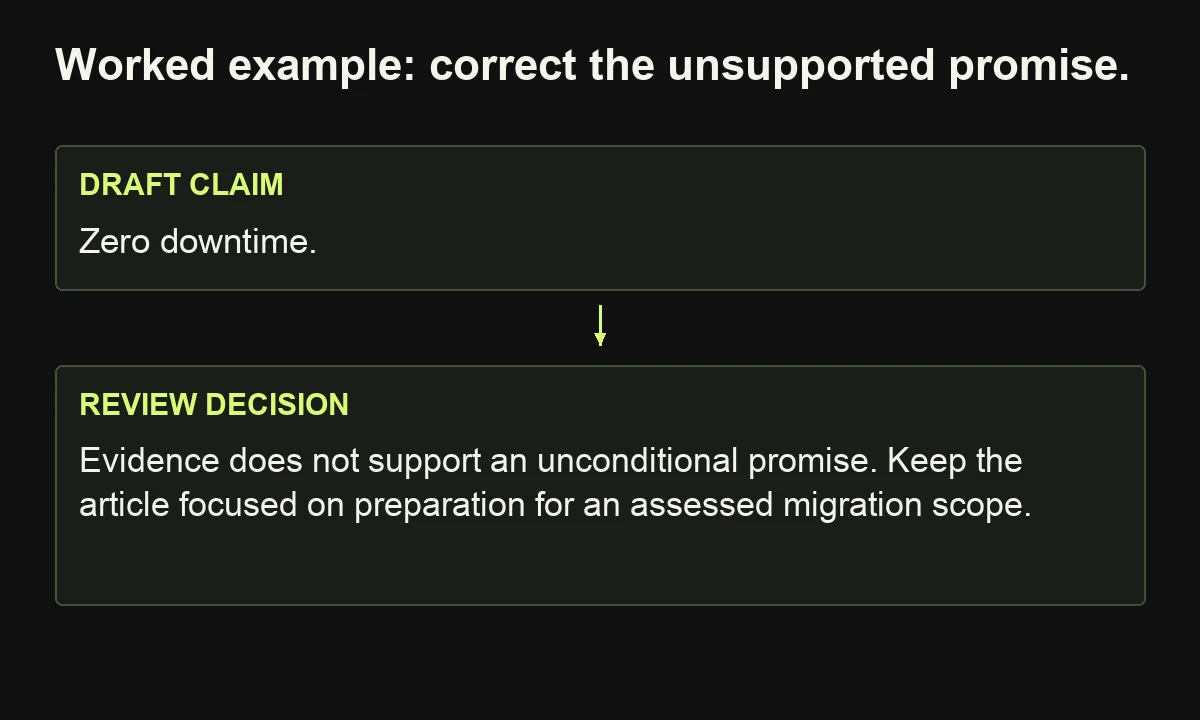
Return to the hypothetical migration-preparation article. The content lead agrees that it should help an operations buyer prepare for a scoping discussion. The writer gathers the implementation team's approved requirements and drafts a practical checklist. An unsupported “zero downtime” promise appears during revision, so the expert flags it before approval.
The team records the decisions:
| Handoff | Decision and accepted output |
|---|---|
| Content lead → writer | Brief agrees reader, preparation task and exclusions |
| Expert → writer | Requirements supplied with limits and unresolved questions |
| Writer → reviewers | Complete draft identifies the statements to verify |
| Reviewers → editor | Unconditional promise rejected; wording narrowed |
| Approver → publisher | Specific corrected version approved for release |
The correction does more than remove risky wording. It helps the reader understand that the migration plan follows investigation of the source systems and requirements. In this illustration, the article promises a useful preparation conversation, not a universal technical outcome.
If sales later asks for a guarantee in the introduction, that is a new substantive decision. The publisher should not treat the approved version as permission to insert it.
This example shows the workflow's value without inventing a speed or revenue result. Each handoff makes the next decision possible, and each important statement has someone responsible for its accuracy and use.
10. Where AI can support the workflow
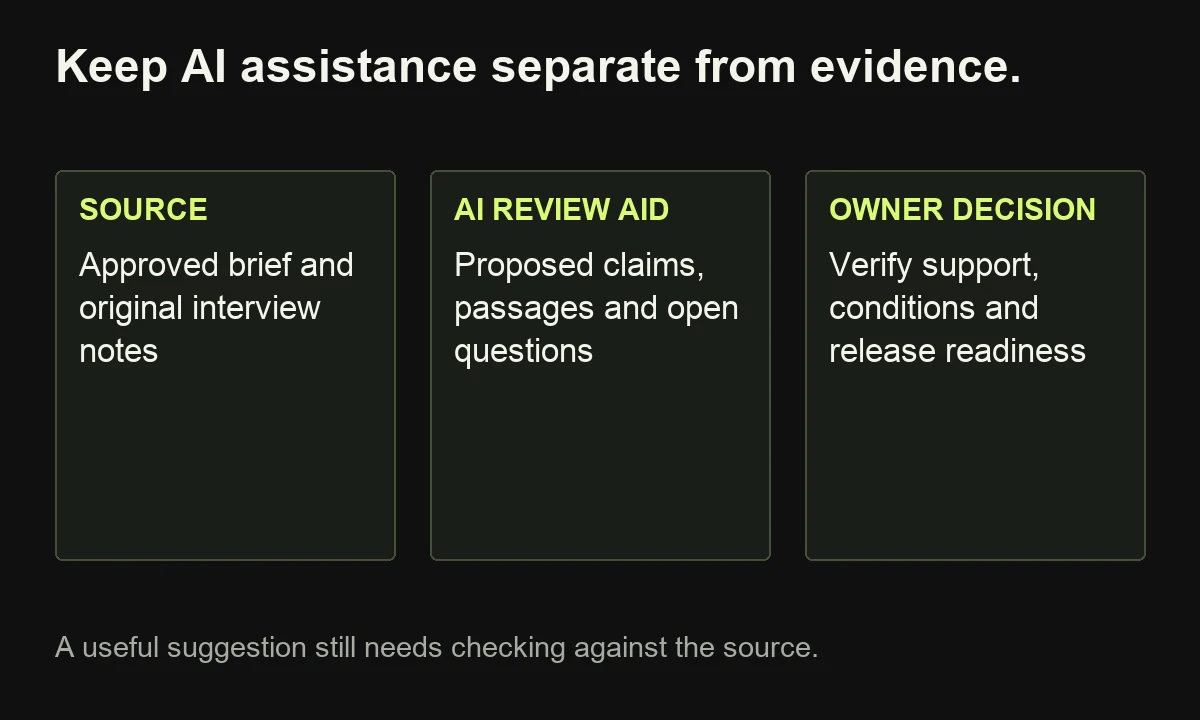
AI can prepare material for a defined review: organise approved notes, suggest questions, compare a draft with a brief or identify statements that appear unsupported. Its output should remain distinguishable from the underlying evidence. The accountable owner still decides what is accurate, appropriate for the reader and ready to release.
A practical assignment might read:
“Using this approved brief and these interview notes, list the article's material claims. For each, show the supporting passage, any qualification and the question that still needs an expert answer. If the notes do not support a statement, mark it unsupported. Do not invent a source or fill the gap.”
Treat the resulting list as a review aid. Check quoted passages against the original material, because a plausible summary can lose a condition or misattribute a statement.
AI can also prepare a focused handoff note: what changed, which claims were affected and who needs to inspect them. That is more useful than circulating a newly generated full draft without explaining its differences.
Use only information and tools approved for the work. An external model should not receive confidential client material merely because the task is convenient.
For broader applications, see how to use AI in marketing. Introduce assistance after the decision and review standard are clear; faster generation cannot resolve an unsettled brief.
11. Close the publication and distribution handoff
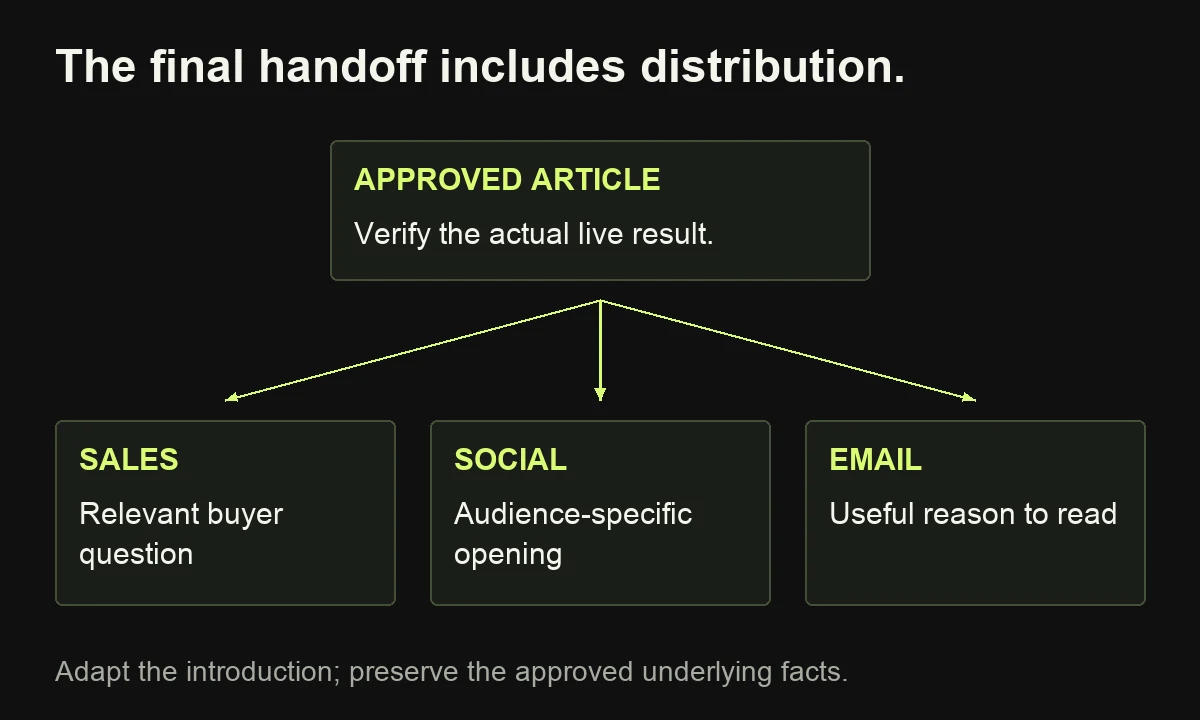
Publishing is complete when the correct approved asset is available and usable, not when someone clicks a button in the CMS. Assign an owner to inspect the live page and another clear responsibility for distribution. A technically published article can still fail its reader if the content, links or next step are wrong.
The release check should cover the actual result:
- Correct approved text, images and author information.
- Readable layout and useful image labels on mobile.
- Working links, appropriate metadata and the intended canonical URL.
- A functioning next step, such as a relevant enquiry page.
- Indexing settings appropriate to the public article.
Google's people-first content guidance asks whether content helps its intended audience achieve a goal and provides substantial value. Build that question into the release review; a completed checklist should not excuse an unclear answer.
Give the distribution owner the article's audience, central recommendation, approved promotional claims and useful channels. A sales email, social post and newsletter may need different introductions while preserving the same underlying facts.
Connect the article to relevant resources through purposeful internal links, then record where the finished asset lives and who maintains it. Scheduling publication without this final handoff leaves discovery and maintenance to chance, even when production itself ran smoothly.
12. Measure waiting, rework and usefulness separately
Track production flow and content performance as different outcomes. A shorter review cycle does not establish that an article helped buyers, and a successful enquiry does not prove that the workflow caused it. Use measures that reveal the next operational decision instead of combining everything into a single productivity score.
For a small pilot, record:
| Measure | What it helps diagnose |
|---|---|
| Time waiting at each handoff | Scheduling or ownership constraints |
| Reason for each return | Missing evidence, scope changes or editorial gaps |
| First-review acceptance | Whether the agreed handoff standard was met |
| Age of unfinished work | Backlog hidden by completed-project averages |
| Relevant reader responses | Whether the content answers a useful question |
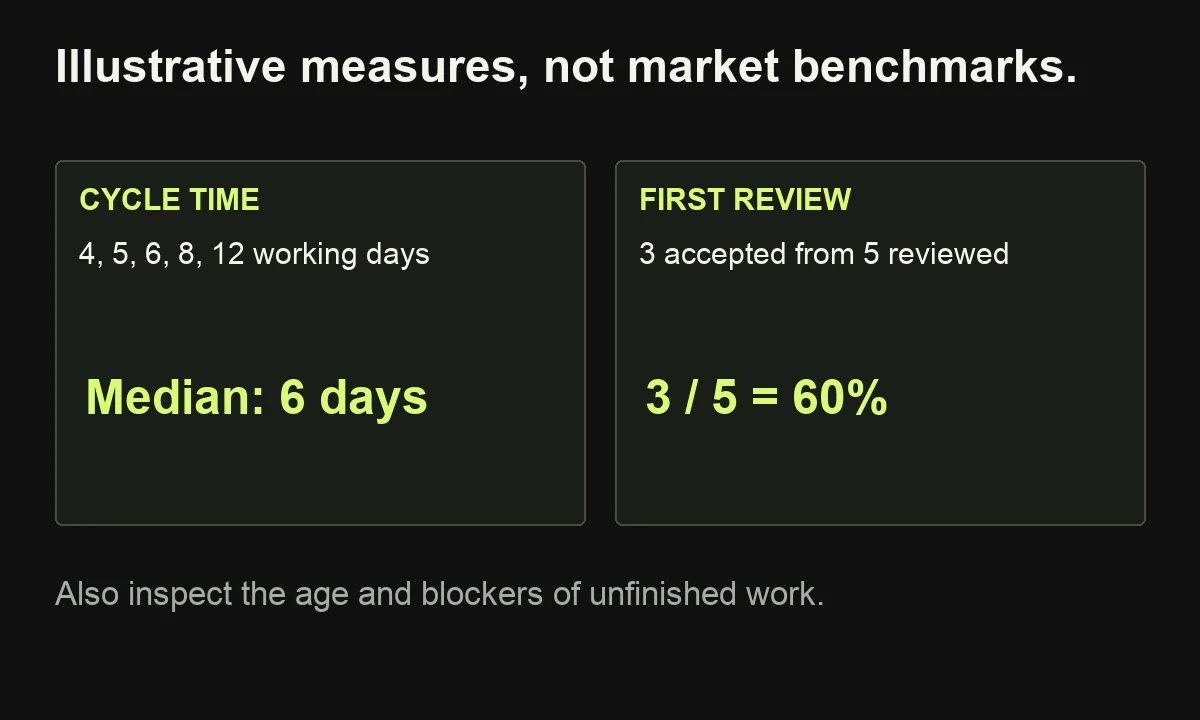
In an illustrative set of five completed assets, cycle times of four, five, six, eight and twelve working days have a median of six days. If three pass the first review, first-review acceptance is three out of five, or 60%. These are examples, not targets or market benchmarks.
Also inspect unfinished assets; excluding stalled work can make completion statistics look healthier than the queue actually is.
Use the editable B2B content workflow template to record owners, entry requirements, acceptance decisions and blockers. Start with one article, review where it stalled and revise the process before expanding it across the calendar.
Frequently asked questions
Can a spreadsheet support a B2B content workflow?
Yes. A shared spreadsheet and versioned documents can support a lean team if owners, links, review decisions and blockers are clear. Consider additional software when coordination needs justify it, rather than expecting a platform to define the process for you.
Should every article have the same reviewers?
No. Match the reviewers to the claims, audience and approval requirements. A technical explanation may need different expertise from a short opinion piece. Keep required checks explicit and avoid adding reviewers without a decision for them to make.
When should you bring in a content strategist?
When the recurring problem is deciding what the content should say, which evidence matters or how to resolve conflicting feedback. That work connects buyer research, direction and writing. If your articles keep stalling between those decisions, tell me where the workflow gets stuck. We can start with the bottleneck rather than commissioning more drafts.