

AI summary
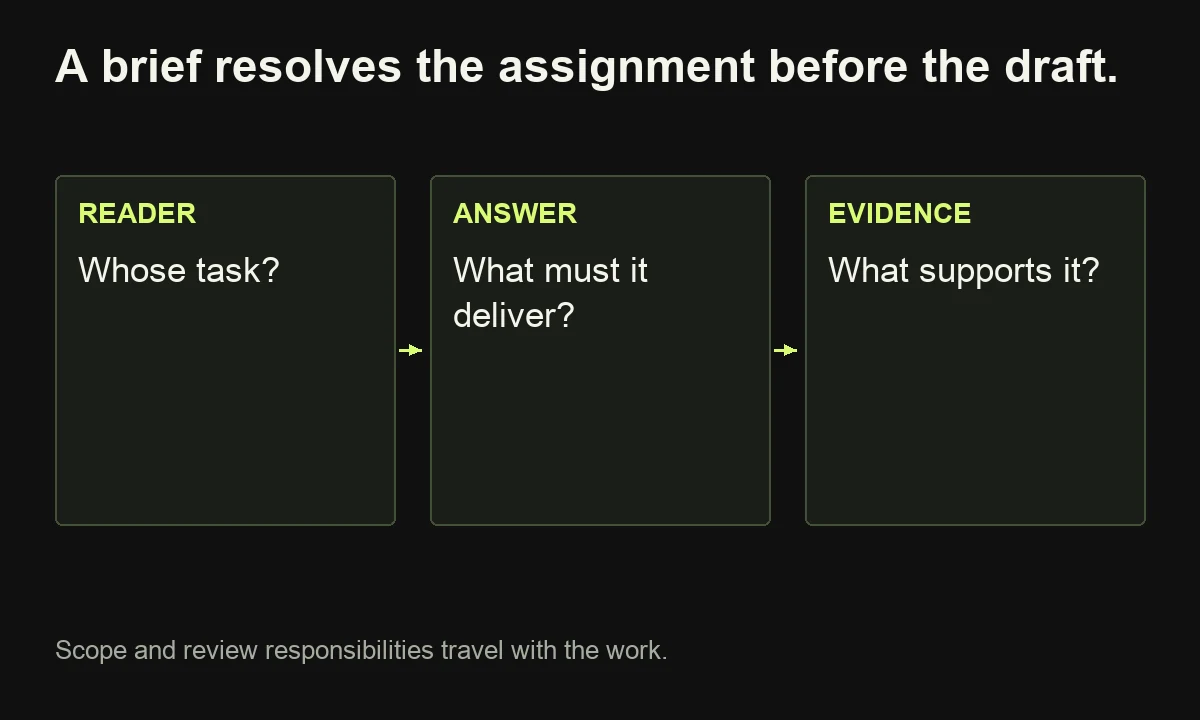
A strong content brief resolves the decisions that shape research, writing and review. Begin with the reader’s task, define the useful contribution and identify the evidence needed before assigning the draft.
- Define the assignment: Record audience, search intent, scope and the promised example. Use current result observations and business knowledge together. Keep unsupported keyword measurements and company claims visibly unresolved until someone can verify them.
- Give the writer useful freedom: Specify essential questions, boundaries and acceptance criteria without scripting every sentence. Assign factual decisions to an appropriate expert and give reviewers a clear purpose so feedback addresses the agreed task.
- Inspect the finished outcome: Use clear answers, natural language and attributable evidence for readers and discovery systems. After publication, check whether the asset delivers its promise and use recurring misunderstandings to improve the next brief.
An SEO content brief is a working document that tells a writer who the article serves, what question it must answer, which evidence supports it and how it fits the business. A useful template also records search intent, the original contribution, internal links and review responsibilities. Its purpose is to resolve important decisions before drafting begins.
A keyword, a word count and five competitor links leave too much unexplained. The writer still has to guess what the reader already knows, which claims the company can defend and what should happen after someone reads the page.
My preferred approach is to make the brief a set of decisions with evidence attached. Keep instructions that change the work. Remove fields nobody will use.
Ahrefs' practitioner guide similarly separates the goal, audience, useful subtopics and product relevance from practical delivery details. The implication for your team is straightforward: an outline alone is not a complete assignment.
This guide provides a compact SEO content brief template, a completed hypothetical example and a readiness check. Download the editable brief worksheet, then adapt it to one article before adding it to your entire process. A resolved short brief is easier to act on than an elaborate document full of unanswered questions.
What should an SEO content brief template contain?
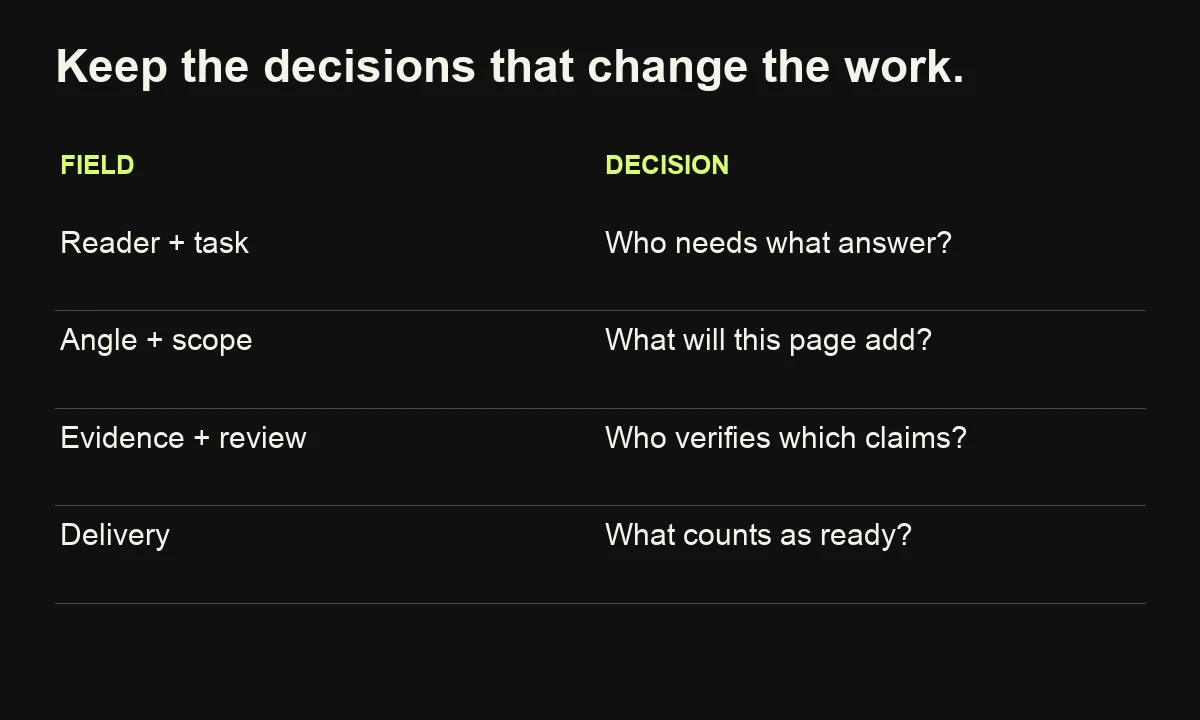
Include the information that changes research, writing or review. Start with these fields, then add specialist instructions only when the subject needs them. A technical tutorial may require a tested environment; a customer story may require approved quotations and publication permission.
| Field | Decision to record |
|---|---|
| Reader | Role, current situation and existing knowledge |
| Reader task | What the article should help them decide or do |
| Primary query | The main search need being addressed |
| Intent evidence | What people appear to want from current results |
| Angle | The useful argument this article will defend |
| Original contribution | Example, analysis, template or expert explanation |
| Evidence | Sources and people needed for important claims |
| Scope | Essential coverage and explicit exclusions |
| Structure | Questions in a helpful reading order |
| Links | Relevant explanations, proof and next steps |
| Review | Who checks facts, clarity and release readiness |
| Delivery | Owner, deadline and acceptance criteria |
Treat the template as a conversation aid. If an evidence source is unavailable, record the consequence: narrow the claim, find another source or postpone that part of the assignment.
The B2B content workflow guide explains how this brief moves into expert input, drafting and approval. Here, the priority is making the assignment clear enough for that handoff to succeed.
Research the search need before choosing the outline
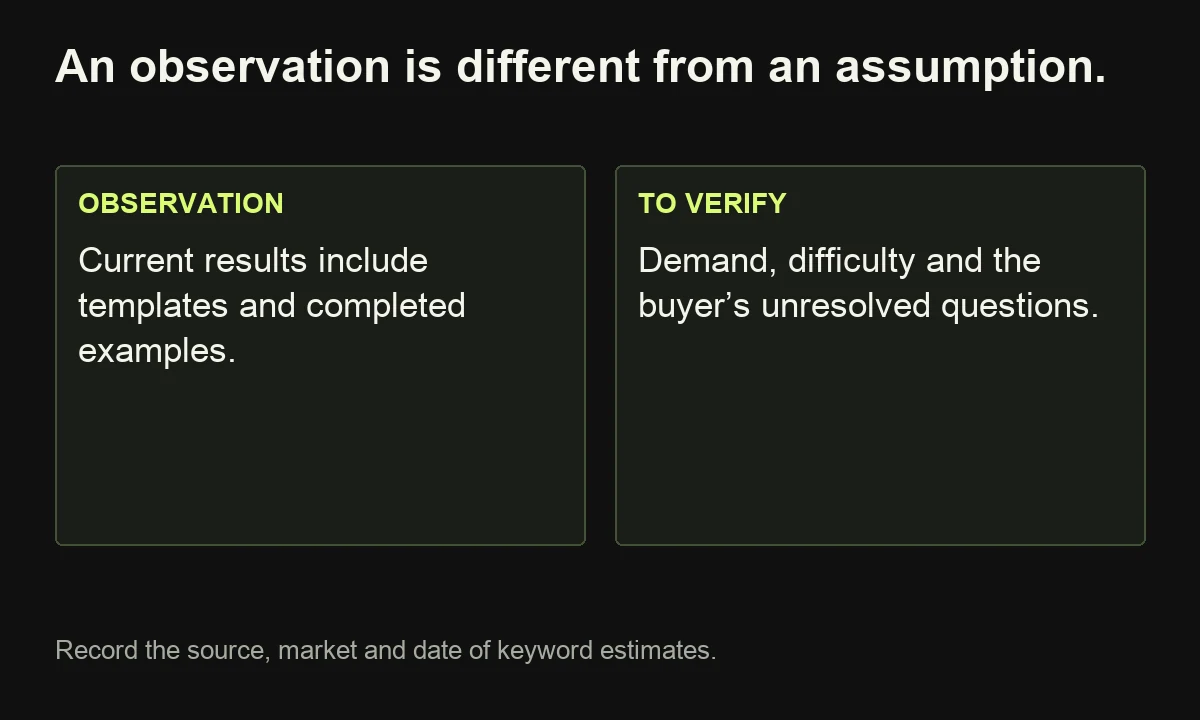
Search the main query and a few meaningful variations. Open relevant results and identify the task each page serves: explanation, comparison, purchase, template or troubleshooting. Record observations separately from assumptions about why those pages rank.
Next, inspect your own library. If an existing article already answers the same question, consider updating it. A different keyword spelling does not automatically justify another URL.
Ask a customer-facing colleague what readers struggle to understand. Compare that evidence with the search results. A query can reveal a topic without revealing the buyer's full situation.
For keyword metrics, record the provider, country and retrieval date. Keep estimated monthly searches separate from traffic potential and expected enquiries. If a measurement is unavailable, write “not verified” in the private planning record instead of manufacturing a plausible number.
Then choose an original contribution the team can actually deliver. “More comprehensive” is an aspiration. “A completed preparation checklist with decision owners and examples” is an assignment.
Finally, propose the outline around the reader's sequence of questions. Borrow useful topic awareness from competitors, but do not copy their headings mechanically. Your business may have different evidence, boundaries or expertise. Before drafting, ask whether the planned article still helps its intended reader if they arrive directly, without a search engine.
A completed B2B content brief example
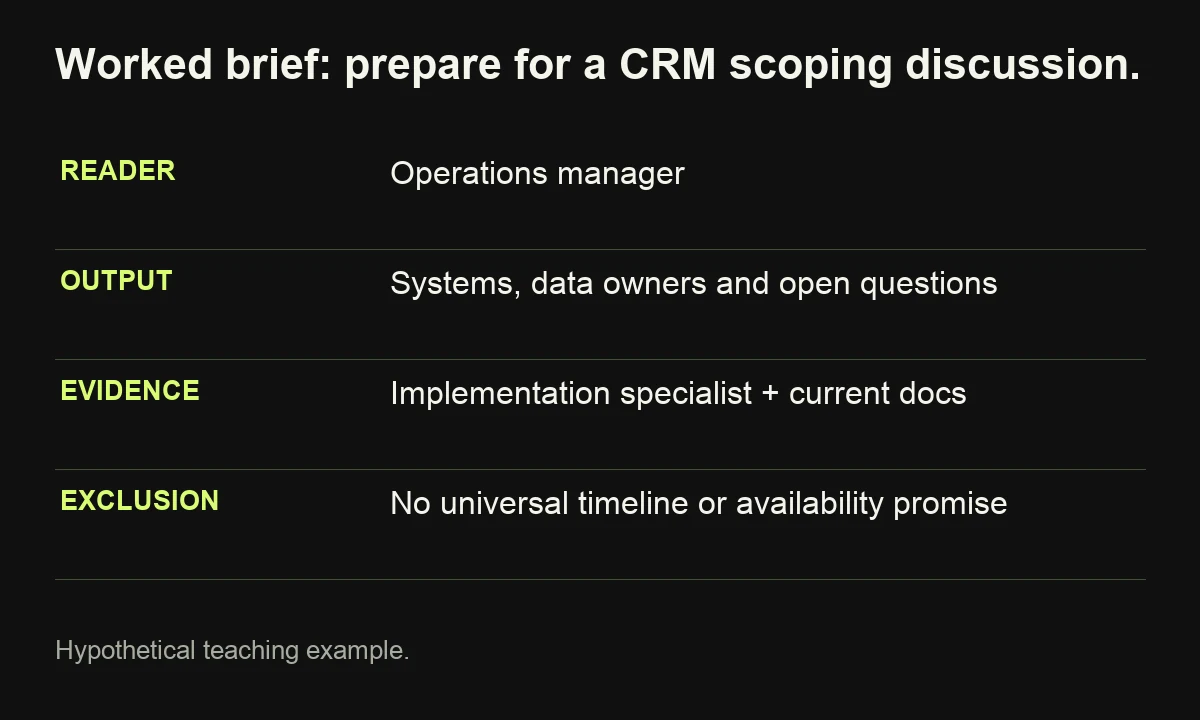
Consider this hypothetical assignment for a company offering CRM implementation support. The article helps an operations manager prepare for a scoping conversation; it does not promise that every migration will follow the same procedure.
| Brief field | Completed example |
|---|---|
| Working title | CRM Migration Preparation: What to Gather First |
| Reader | Operations manager comparing implementation support |
| Reader task | Assemble information needed for an initial scope |
| Primary query | CRM migration preparation checklist |
| Angle | Good preparation exposes dependencies before a timeline is promised |
| Contribution | A filled inventory showing systems, data owners and open questions |
| Evidence | Implementation specialist and current product documentation |
| Essential sections | Inventory, ownership, data condition, integrations and questions for scoping |
| Exclusions | Universal timelines, guaranteed availability and unsupported savings |
| Next step | Discuss the inventory with a qualified implementation contact |
The brief should also assign decisions. Ask the specialist to verify preparation requirements and identify conditions that vary. Ask the editor to check whether a nontechnical manager can complete the inventory.
An acceptance criterion could read: “The reader can list the relevant systems, name an owner for each dataset and identify unresolved integration questions.”
That makes usefulness inspectable. It also gives the writer room to explain the material clearly, rather than prescribing every sentence or assuming that a specific word count proves the task is complete.
How should the brief address SEO, AEO and GEO?
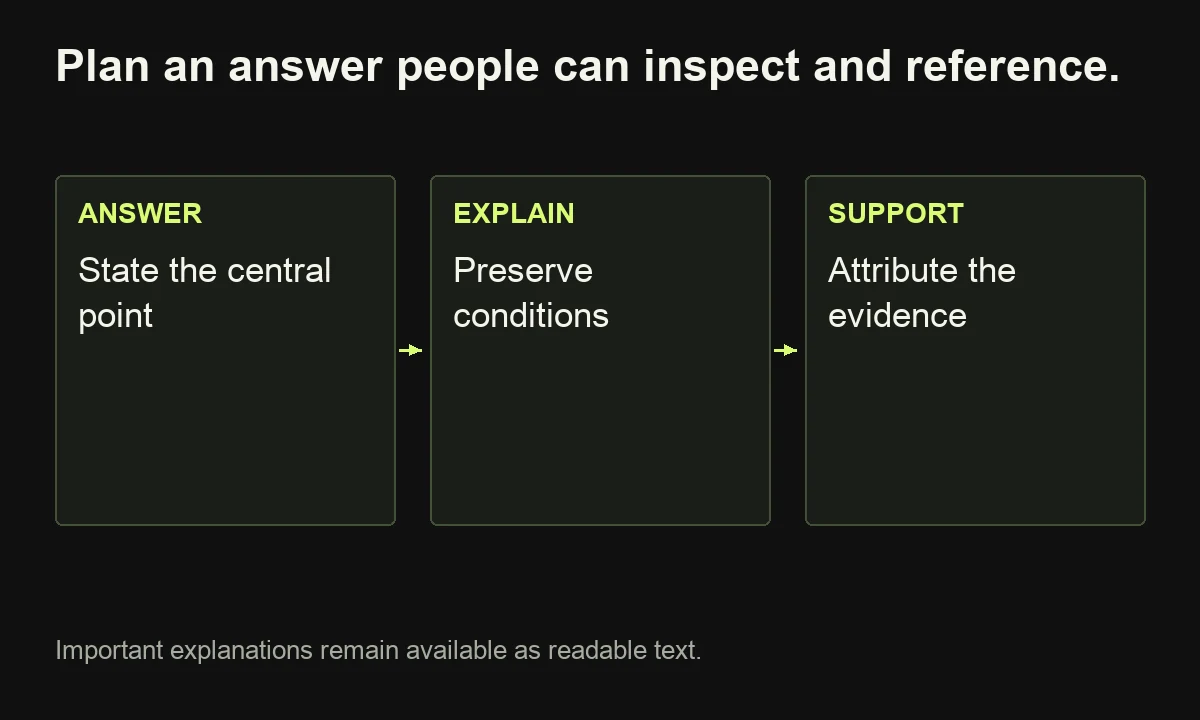
Plan a clear answer, supporting explanation and attributable evidence. Use the main query naturally where it describes the page, then cover related questions because they matter to the reader. Avoid instructions that demand a fixed number of keyword repetitions or promise that formatting will earn an AI citation.
For answer engines, specify the central question and a concise opening response. Keep conditions that change the answer beside the recommendation. A short answer that becomes misleading when quoted is a poor answer.
For generative discovery, identify which claims require sources and what original contribution another publisher could responsibly reference. Keep definitions and examples understandable outside the surrounding sales copy.
Google's guidance for AI features says established SEO practices still apply to AI Overviews and AI Mode, with no special AI markup required. That supports a useful brief grounded in content quality and technical eligibility, rather than a separate list of supposed AI tricks.
Specify descriptive links, accurate metadata and meaningful visuals. Ensure essential explanations remain available as text. An infographic can support the answer without becoming the only place it exists.
For more detail on the finished article, use the high-ranking blog writing guide. The brief should direct that work without pretending to guarantee its search performance.
Check readiness before handing the brief to a writer
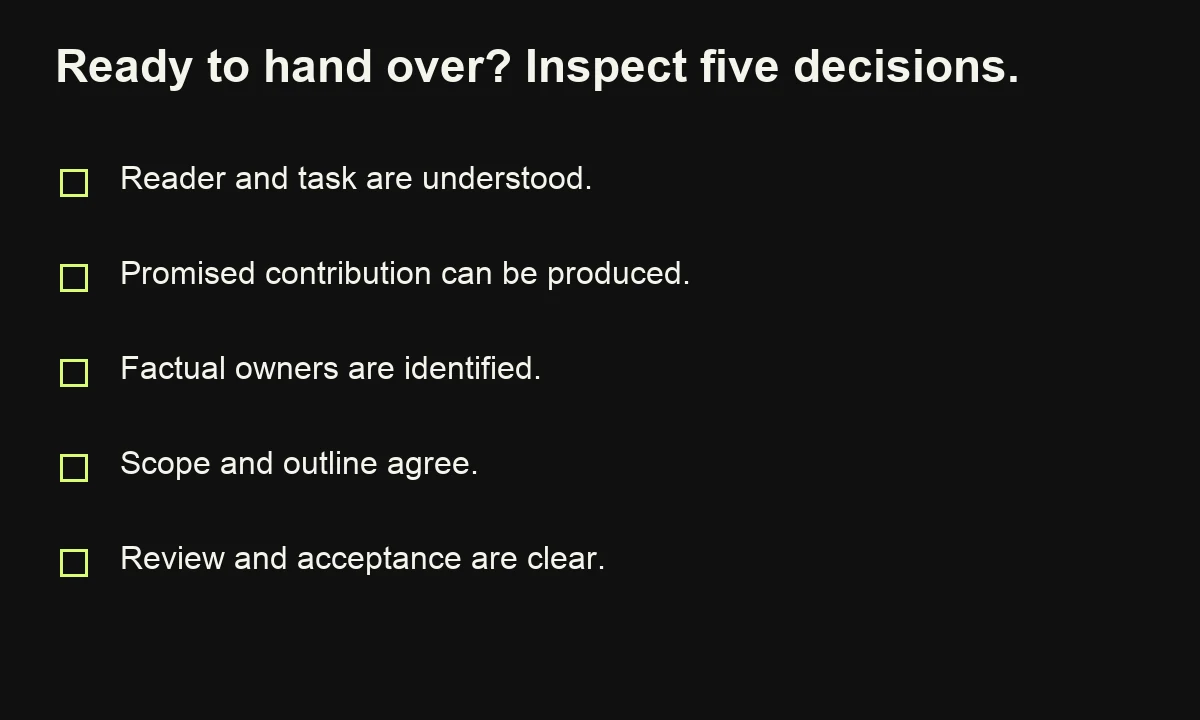
A brief is ready when the writer can explain the reader's task, the article's useful contribution and the evidence needed to support it. They should also know which questions remain open and who can resolve them. Approval means agreement on the assignment, not advance approval of every future sentence.
Run this handoff check:
- Ask the writer to summarize the intended reader and outcome.
- Confirm that the promised example or template can be produced.
- Identify the owner of each important factual decision.
- Check that the outline supports the agreed task and exclusions.
- Confirm which draft version will receive review and from whom.
AI can organize supplied notes or identify missing fields. Give it the approved evidence and ask it to flag gaps; inspect its suggestions before adding them to the brief. It should not invent company capabilities, customer experiences or keyword data to make the assignment look complete.
After publication, compare the finished asset with the original reader task. Record useful questions and weak explanations for future briefs. A recurring misunderstanding may reveal a briefing problem earlier than a traffic report does.
If your team has topics but struggles to turn them into clear assignments, tell me where the briefing process gets stuck. I can help connect buyer research, content direction and writing.
Quick questions
Is a brief the same as an outline?
No. An outline orders the content. A brief also establishes audience, purpose, evidence, boundaries and responsibilities.
Does every article need a long brief?
No. Use the detail needed to resolve the important decisions. Familiar subjects may need less explanation; technical or sensitive claims may require more.