
AI summary
A useful content gap analysis ends with a defensible editorial decision. Combine buyer evidence, existing answers and search research, then select improvements the team can support with accurate information. A competitor keyword alone does not justify another page.
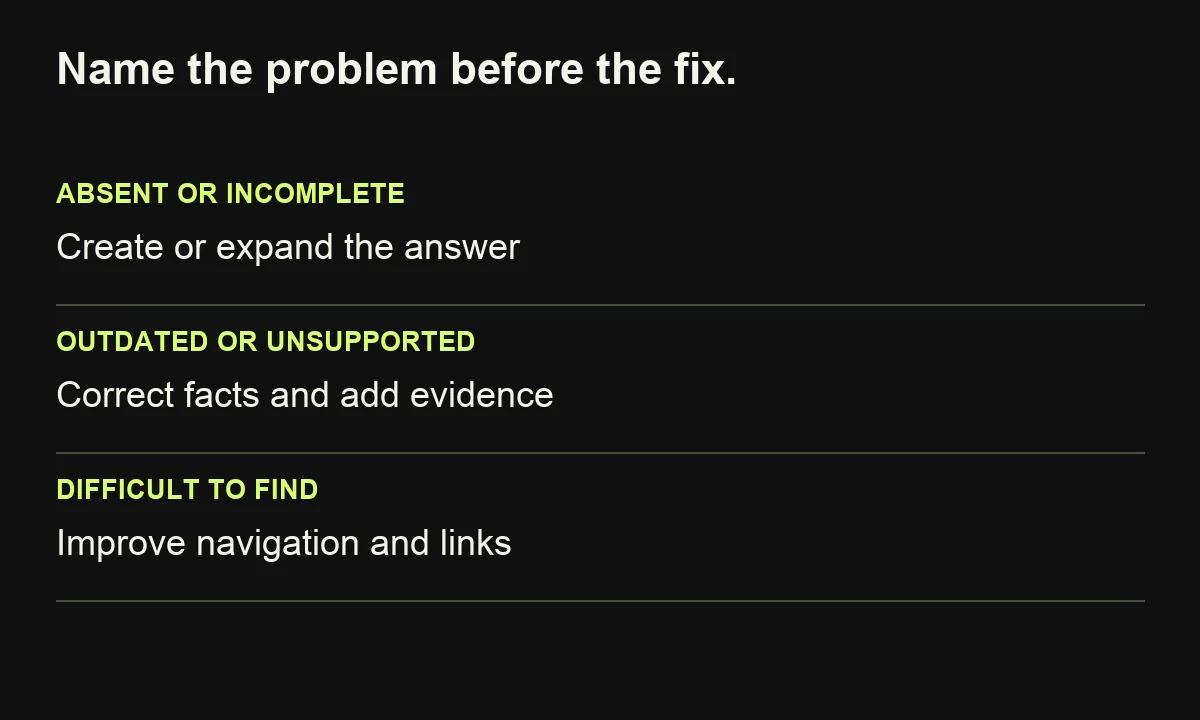
- Inspect the actual answer: Read relevant pages before calling a topic missing. Identify whether information is absent, incomplete, unsupported, outdated or difficult to find. Different problems require different changes, including updates and better navigation.
- Make the worksheet actionable: Record the buyer decision, evidence, current passage, missing information, proof required and owner. Keep unverified keyword metrics unverified. Prioritize relevance and the ability to produce a credible improvement over a large production queue.
- Close with acceptance criteria: Give the reviewer specific questions the finished page must answer. Verify the released result and examine business and search observations carefully, without treating every movement as proof that content caused revenue.
A content gap analysis identifies important questions your intended buyers cannot answer well with your current content. Compare buyer evidence, existing pages and relevant search results, then choose whether to update, create, connect or defer. A competitor's keyword is a possible research lead, not an automatic instruction to publish.
Google's helpful-content guidance encourages original value and content created for an intended audience. That supports a practical editorial standard: identify the missing understanding before deciding that a missing URL is the problem.
Start with one product, service or buyer group. Define the decision under review, such as choosing an implementation approach. A focused scope makes it possible to inspect the actual content instead of assigning superficial scores to hundreds of pages.
Collect questions before collecting competitor keywords
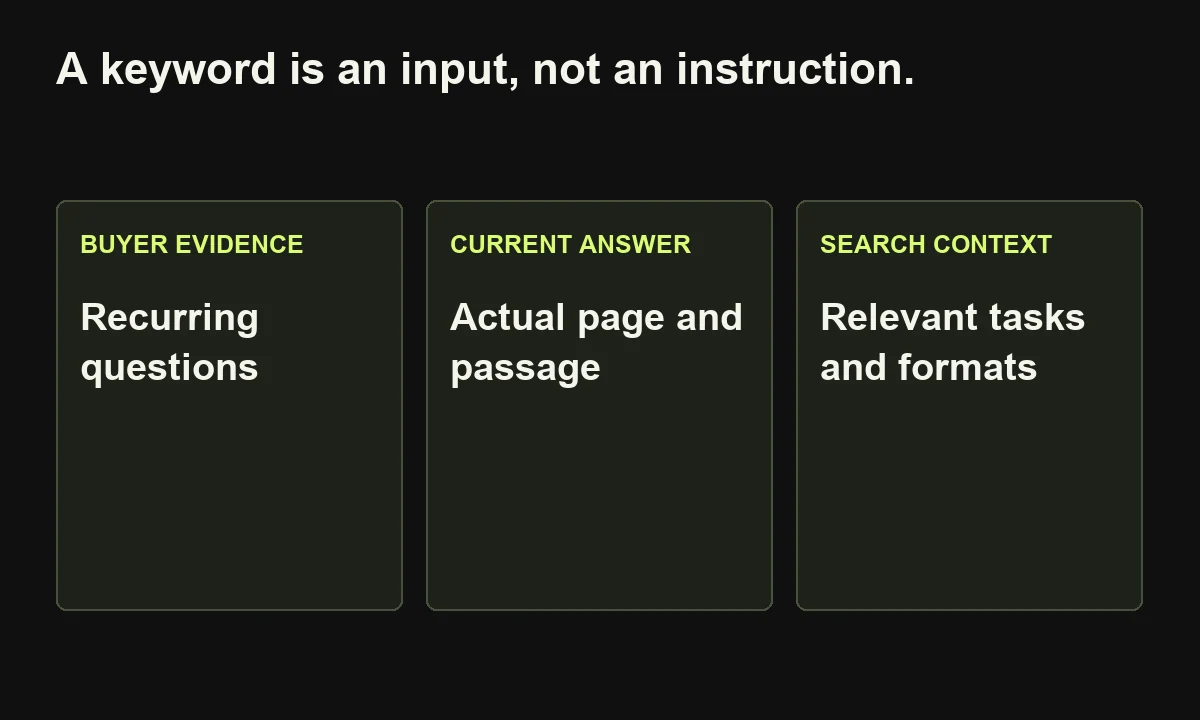
Gather recurring questions from authorized sales notes, support themes, product demonstrations and subject specialists. Remove personal and confidential details from the working material. Record the source, date and relevant context so another editor can understand why the question matters.
Then inspect search results for the underlying task. Read the pages rather than relying only on titles. Note whether results offer a definition, comparison, tool, product page or detailed implementation guide. The right format depends on what the reader needs to accomplish.
Competitor keyword tools can expand this research. Ahrefs' content-gap guide demonstrates a competitor-led keyword workflow. Use that view as an input alongside buyer evidence, rather than treating every competitor advantage as a commercial priority.
Record volume and organic difficulty only when current data is available for a specified market. Advertising competition is a different measure. If metrics are unavailable, leave the fields unverified and make a qualitative decision openly. An empty metric is more useful than a precise-looking number with no defensible source or relevant geography behind it.
Inspect the answer you already have
Search your own library before adding a new topic. Read the relevant pages and identify where the answer actually appears. A URL containing the target phrase may still provide a weak answer; a differently titled page may already satisfy the task.
Classify the problem in plain language. Is the answer absent, incomplete, unsupported, outdated or difficult to find? These conditions imply different changes. A buried implementation checklist might need a better introduction and internal link rather than a second article.
For each candidate, capture the current URL, the relevant passage and what remains unresolved. Add the next decision the buyer needs to make. This prevents a broad heading such as “integrations” from concealing several distinct concerns about compatibility, ownership and migration.
Do not delete or consolidate pages merely because their topics overlap. Compare actual purpose, useful evidence, incoming links and reader needs. A consolidation proposal should name what moves, what remains and how visitors will reach the surviving answer. That is a separate implementation decision requiring its own review.
Use a worksheet that ends in an editorial decision
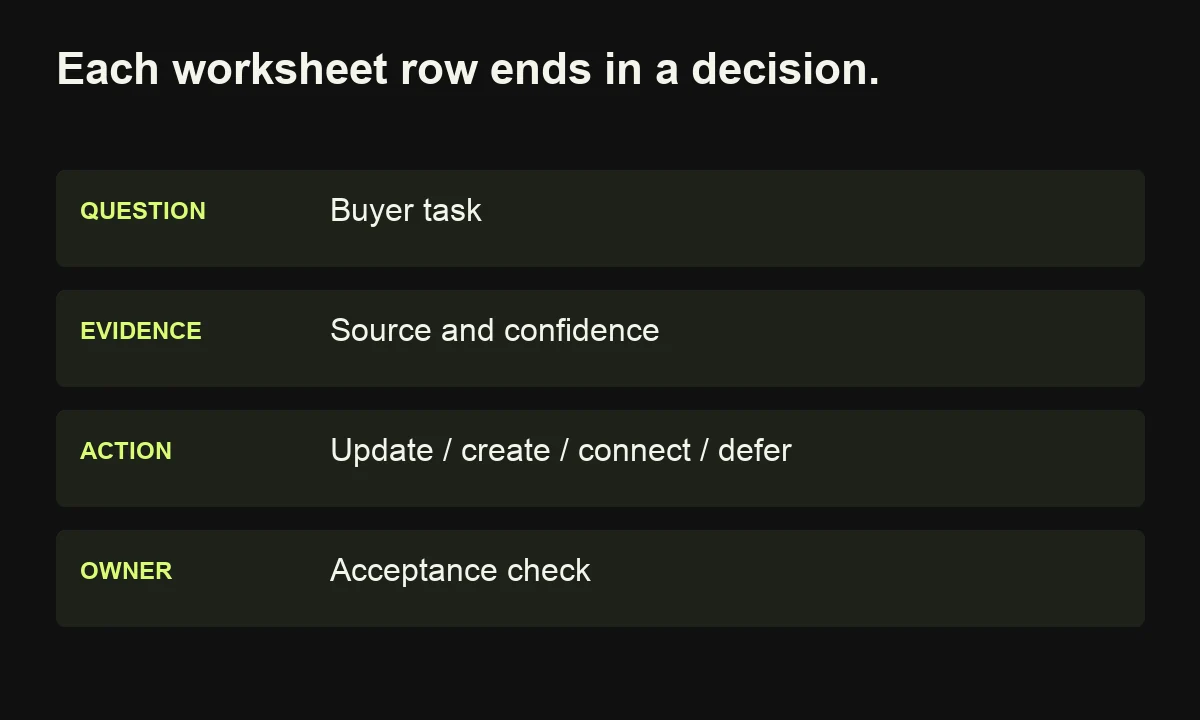
Create one row per underlying question. Keep wording close to the buyer's language, while removing identifying details. The row should be readable without reopening a call recording or remembering a meeting.
| Field | What to record |
|---|---|
| Buyer decision | What the reader needs to choose or do |
| Evidence | Source, date and confidence |
| Current answer | Existing URL and relevant passage |
| Missing information | The specific unresolved issue |
| Proof required | Expert, document, calculation or example |
| Editorial action | Update, create, connect or defer |
| Owner and review | Responsible person and acceptance check |
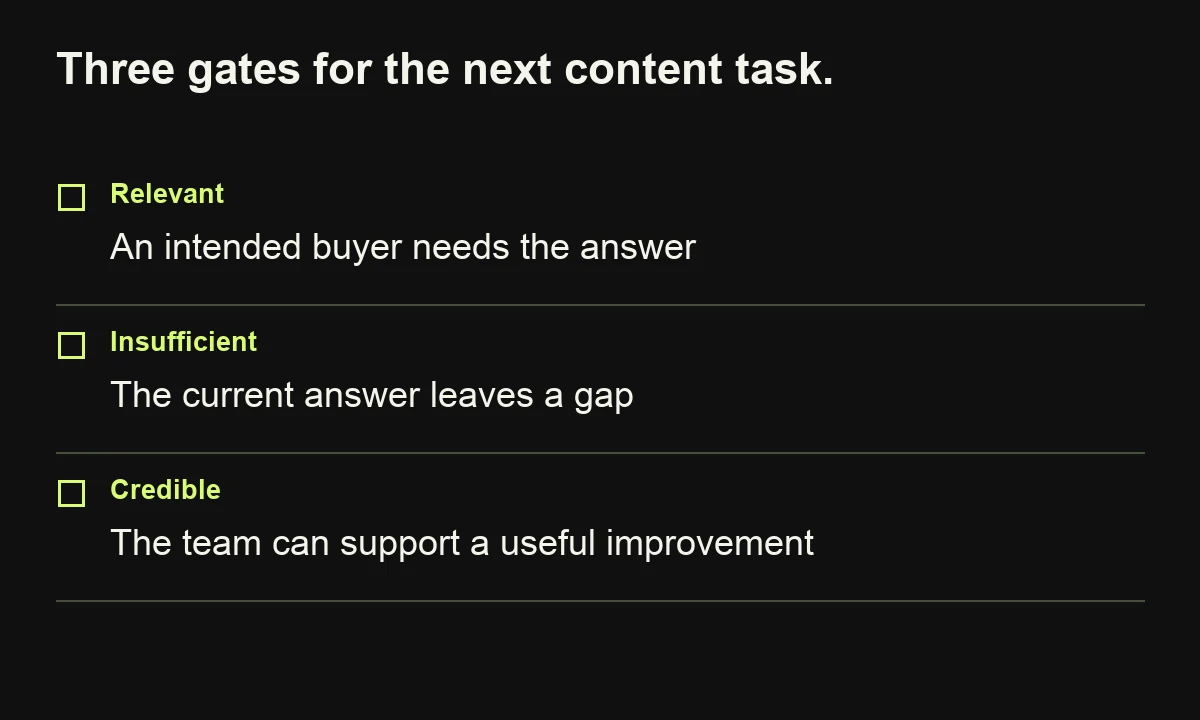
Avoid a complicated weighted score until the team understands the inputs. A numerical total can conceal weak evidence just as easily as it can organize good evidence. Start with three gates: the question matters to an intended buyer, the existing answer is insufficient and the team can provide a credible improvement.
If a candidate fails a gate, record why. “Defer until engineering confirms compatibility” is an actionable decision. A vague backlog entry saying “write integration guide” leaves the next writer to rediscover the problem.
Work through a migration question
Consider a fictional reporting-software company, Meridian. Its team has recorded four recent evaluation questions about preserving historical reports during migration. This is an illustrative dataset, not a claim about a real company's prospects or results.
The website has a general integration page. It says migration is supported but does not explain available import formats, responsibilities or what happens to unsupported fields. A keyword export suggests a broad “data migration” topic, but that phrase alone does not define the missing answer.
The worksheet row identifies the buyer decision: whether the organization can move its existing reports without losing necessary information. The evidence owner is the sales lead; the factual reviewer is the implementation specialist.
The editorial action is to expand the existing migration guide with supported inputs, responsibility boundaries and a sample field-mapping example. If no guide exists, create a focused one and link it from the integration page. Do not publish compatibility promises before the specialist verifies them.
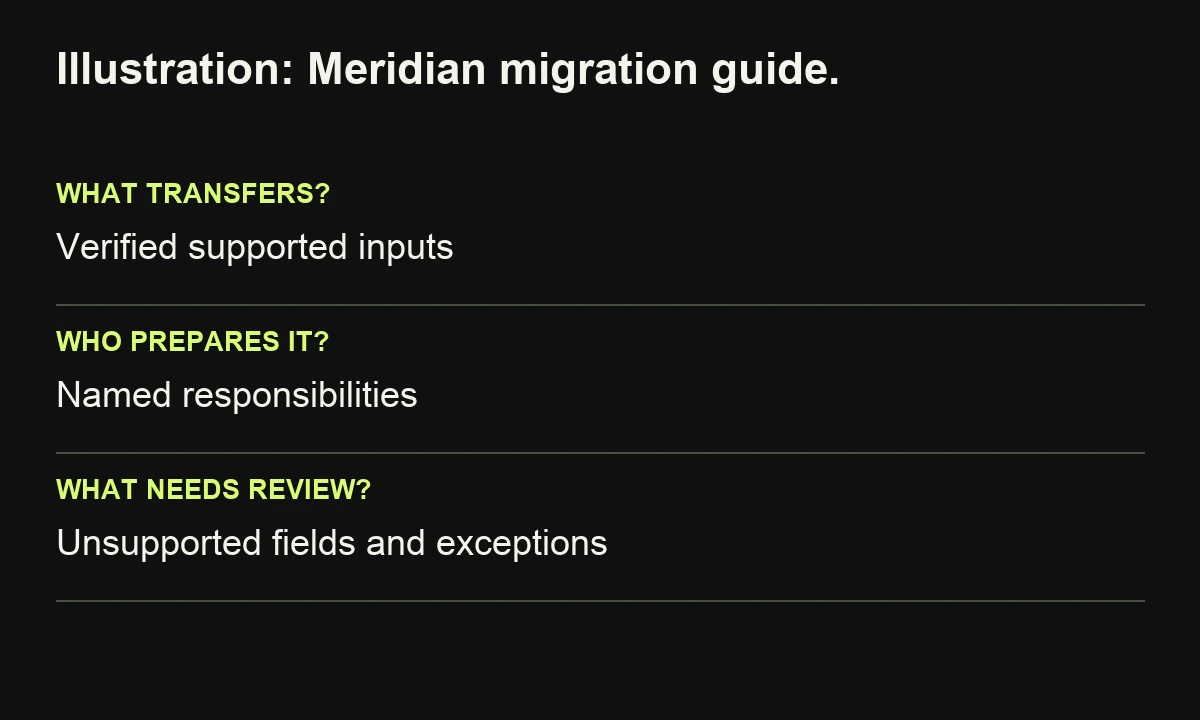
Acceptance means a reviewer can answer three questions from the finished page: what transfers, who prepares it and what requires investigation. That standard is more useful than a requirement to mention a keyword repeatedly. It also gives the writer a clear stopping point and gives the product team a specific factual review task.
Prioritize a small batch and verify the release
Select a manageable set of rows with meaningful buyer relevance and available evidence. Group related questions that belong in one answer. Keep separate topics apart when the audience, task or required proof differs.
Write a short brief for each action: reader, decision, current problem, proposed change, sources and acceptance check. Include the internal destinations the reader needs next. The SEO content brief template provides a fuller structure when a row becomes a substantial article.
Before publication, compare the draft with the worksheet. Has it answered the missing question, or drifted into a general introduction? Check product facts with the named reviewer and label any hypothetical calculation or example.
After release, verify the actual page, links, images and mobile layout. Record the publication date and change scope. For an updated page, preserve a usable baseline so later analysis can distinguish the edit from unrelated changes.
Review both business and search observations over appropriate periods. Ask whether sales can use the answer, whether repeated clarification requests change and whether relevant queries reach the page. None of those observations alone proves that the content caused revenue. Together, they can help decide which gaps deserve attention next and which assumptions need further investigation.
Common questions about content gap analysis
Is a gap always a missing keyword?
No. A page may rank for a phrase while failing to answer an important buyer question. A useful analysis also checks missing evidence, unclear responsibility, outdated information and weak navigation. The appropriate action may be an update or a link.
Can AI perform the analysis?
AI can help cluster supplied questions, identify possible duplication and draft candidate briefs. Verify its suggested gaps against the source material and actual pages. A generated assertion that “buyers want this” needs evidence before entering the publication queue.
How often should we repeat it?
Revisit the relevant scope when the offer, audience or recurring questions change. A periodic review can catch missed issues, but repeating a full-site audit without a new decision can consume time without improving the content.
Finish with a short action register, not a large unqualified topic list. Each selected row should have a question, evidence, editorial decision, owner and acceptance condition. That makes the analysis useful to the people producing and reviewing the work.
If your backlog is large but its priorities are unclear, share the offer and the questions buyers keep asking. Those inputs are a stronger starting point than another undifferentiated keyword export.